Data science marketing has quietly become the engine room of modern growth strategy, and if your team still treats analytics as a monthly reporting chore, you are leaving serious money on the table. Let’s talk about why the smartest brands now hire statisticians before they hire copywriters.
I’ve spent years watching marketing departments transform from gut-feel operations into measurement-obsessed machines. The shift isn’t glamorous. It rarely makes headlines. But the companies that get it right consistently outperform rivals who rely on intuition alone.
This guide walks through everything: the foundations, the tooling, the workflows, the pitfalls, and the specific plays that separate winning teams from the rest. Focusing on data science marketing provides clear direction here. No fluff. Just the mechanics of how analytics actually drives revenue.
What Data Science Marketing Really Means
Strip away the buzzwords and data science marketing is simply the practice of applying statistical methods, machine learning, and rigorous experimentation to marketing decisions. It’s using evidence instead of opinion to decide where budget goes, which audiences matter, and what message converts.
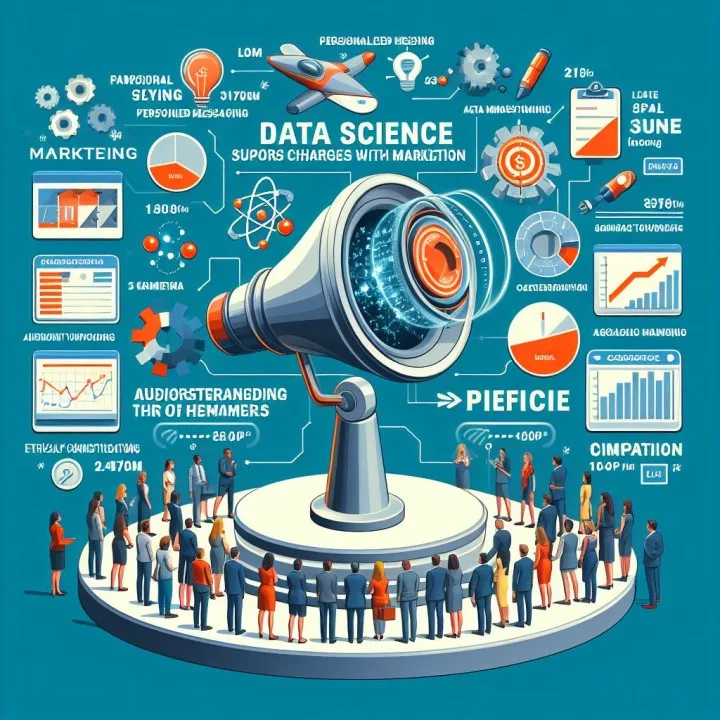
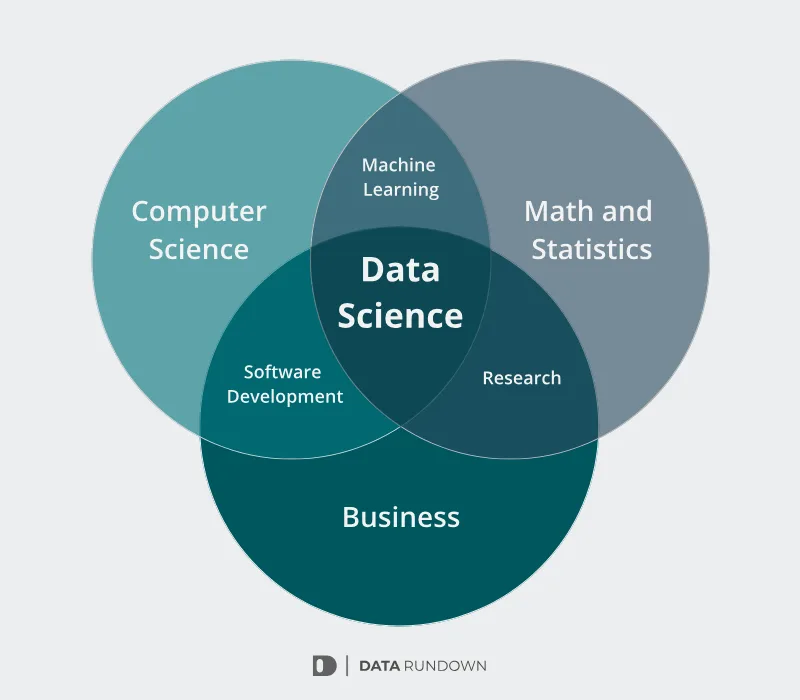
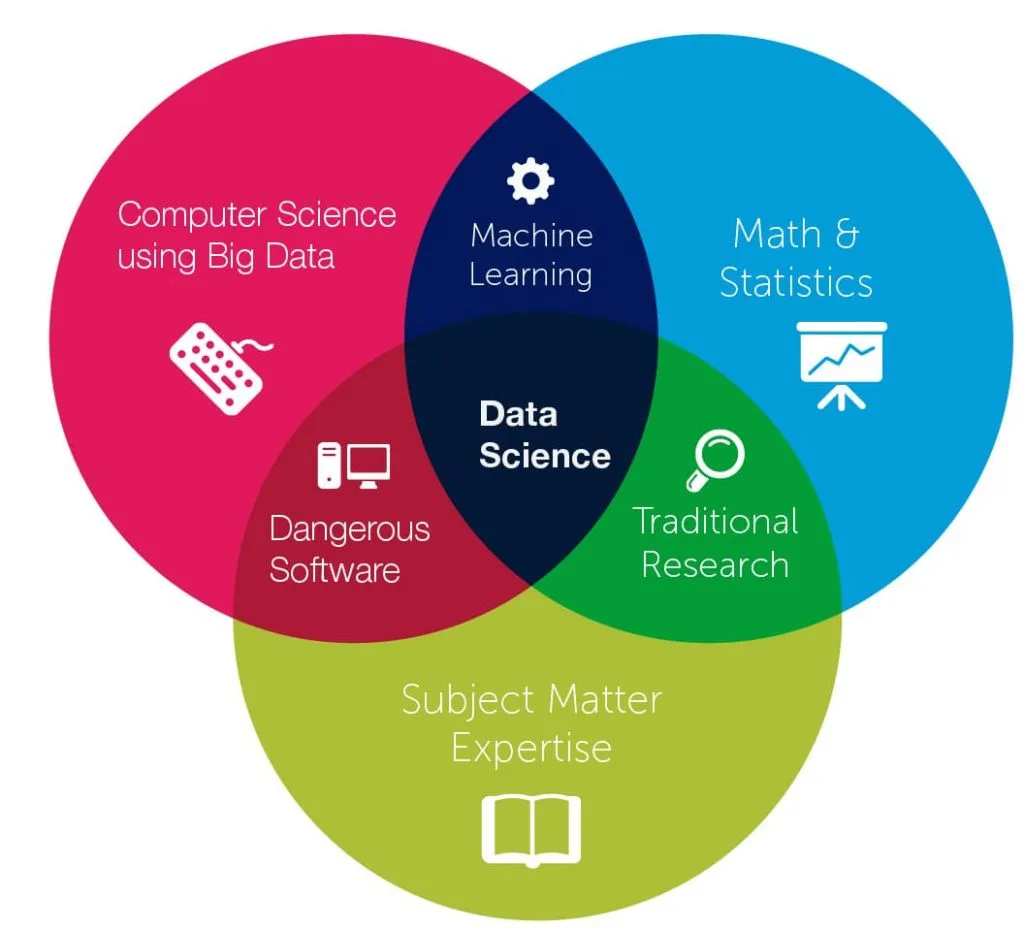
The discipline sits at the intersection of three fields: statistics, computer science, and marketing strategy. Focusing on data science marketing provides clear direction here. Practitioners pull data from CRM systems, ad platforms, web analytics, and transaction logs, then build models that predict behavior and recommend action.
Here’s the part most people miss. Data science marketing isn’t about dashboards. Dashboards describe the past. The real value comes from prediction and prescription — telling you what will happen next and what you should do about it.
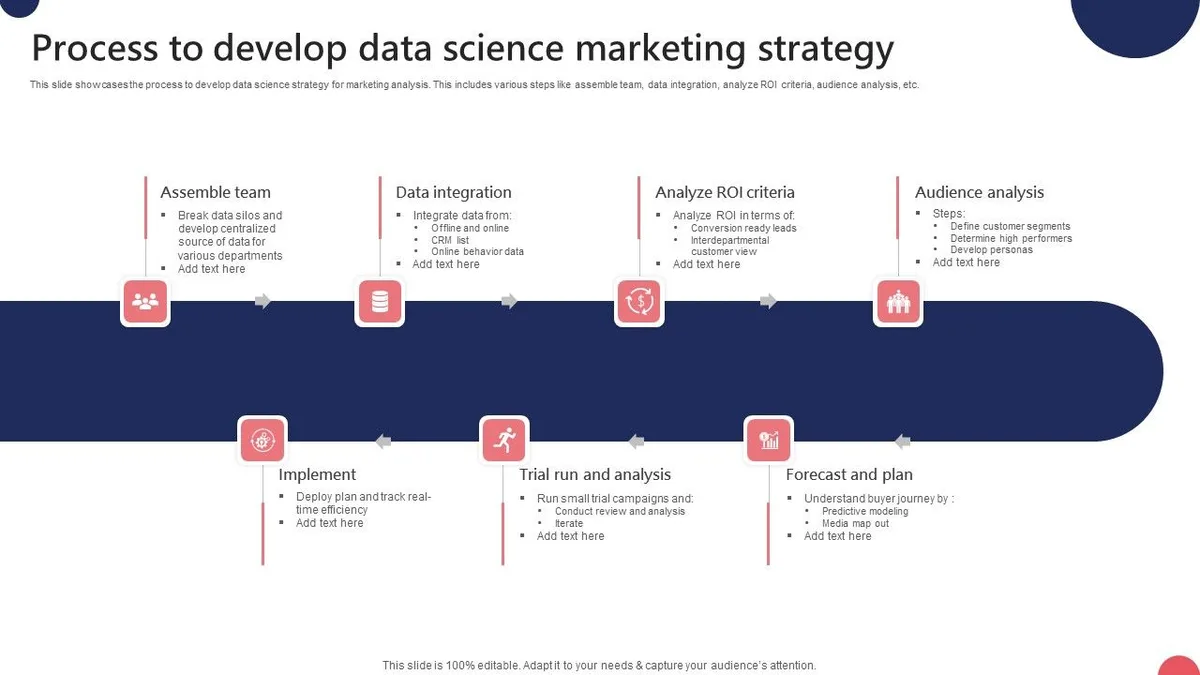
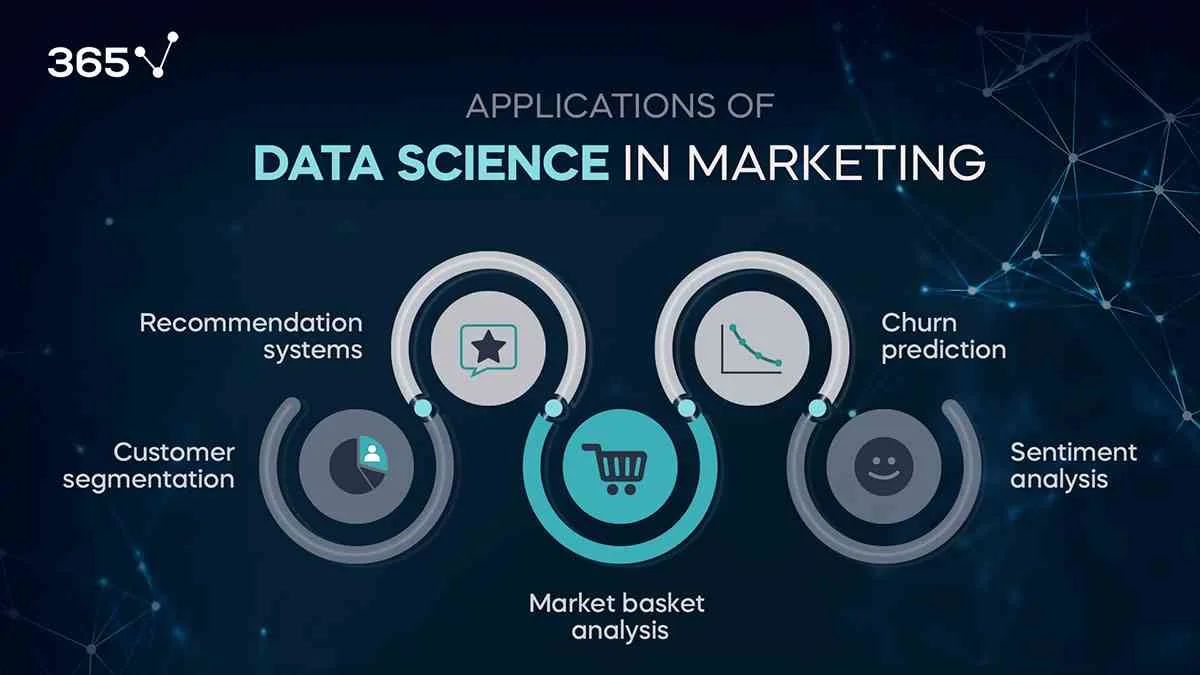
A retail team I worked with discovered this distinction the hard way. They had beautiful weekly reports showing declining email engagement. Nobody acted because nobody knew why. Once they built a churn model that flagged at-risk subscribers thirty days before they lapsed, the same data suddenly became actionable.
The Core Pillars of Analytics-Driven Growth
Every mature data science marketing operation rests on a handful of foundational capabilities. Skip any of them and the whole structure wobbles.
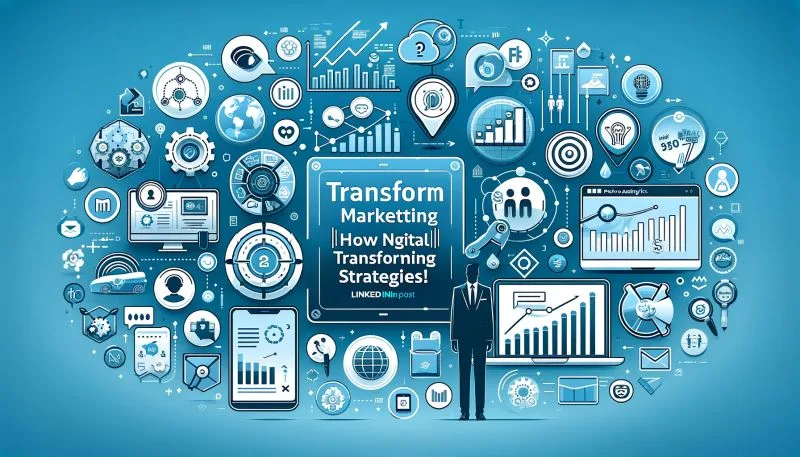
First comes data infrastructure. You need clean, unified, accessible data. Second comes measurement discipline — consistent definitions of metrics across teams. Third comes modeling capability. Fourth comes the organizational muscle to actually act on insights.
Most companies fail at pillars one and four. They buy fancy tools but never fix their data plumbing, or they generate brilliant insights that die in a slide deck because no one owns execution.
Data Infrastructure and Collection
You cannot do serious data science marketing without a reliable data foundation. That means event tracking that captures user behavior accurately, a warehouse that consolidates sources, and governance rules that keep everything consistent.
Tools like Segment, RudderStack, or a custom pipeline feed raw events into warehouses such as BigQuery, Snowflake, or Redshift. Refining each detail of your data science marketing strengthens this section. From there, transformation tools like dbt shape the data into analysis-ready tables.
The unglamorous truth: eighty percent of the work is cleaning and joining data. Analysts who understand this spend less time complaining and more time building reusable models that serve the whole team.
Measurement Frameworks That Actually Hold Up
Inconsistent metric definitions kill more data science marketing programs than bad algorithms ever will. If finance counts a “customer” differently than growth does, every downstream model is suspect.
Establish a single source of truth for core metrics: activation, retention, lifetime value, acquisition cost. Document the logic. Version it. Review quarterly.
I’ve seen teams waste months arguing about whether a trial signup counted as a conversion. Once they locked the definition, reporting friction vanished and modeling accelerated dramatically.
Predictive Modeling for Marketers
Prediction is where data science marketing earns its keep. Instead of reacting to last month’s numbers, you forecast next quarter’s outcomes and intervene before problems compound.
Common models include propensity scoring, churn prediction, customer lifetime value estimation, and next-best-action recommendation. Each answers a specific business question.
The trick is matching the model to a decision. Effective execution in your data science marketing makes a tangible difference. A churn score is useless if no one has a retention playbook ready. Build the intervention first, then the model that triggers it.
Propensity and Lead Scoring
Propensity models rank prospects by likelihood to convert, buy, or churn. They replace crude demographic rules with behavioral signals that actually correlate with outcomes.
A B2B software company I consulted for replaced their lead scoring with a gradient boosting model trained on closed-won data. Sales acceptance rates jumped noticeably within two months because reps stopped chasing dead ends.
Start simple. Logistic regression often beats complex neural networks when your dataset is small and your features are noisy.
Customer Lifetime Value Prediction
LTV models tell you how much you can afford to spend acquiring each customer segment. Without them, data science marketing teams guess at CAC ceilings and either overspend or underinvest.
Probabilistic models like BG/NBD and Gamma-Gamma work well for transactional businesses. Refining each detail of your data science marketing strengthens this section. For subscription products, survival analysis captures churn timing more accurately.
The payoff is precision. Maintaining clarity across your data science marketing remains essential. You stop treating all customers as equally valuable and start allocating budget where marginal return is highest.
Experimentation and Testing at Scale
Experimentation is the heartbeat of data science marketing. Every hypothesis, every creative variant, every pricing change becomes a testable proposition with measurable outcomes.
A/B testing is table stakes. Mature teams run multi-armed bandits, sequential tests, and holdout groups to capture long-term effects that short experiments miss.
The danger is testing without statistical rigor. Peeking at results early, stopping when numbers look good, ignoring confidence intervals — these habits produce false positives that waste budget and mislead strategy.
Designing Tests That Mean Something
Before launching any experiment, define the primary metric, the minimum detectable effect, and the required sample size. Skipping this step is how teams end up with inconclusive results after weeks of traffic.
Power analysis tools like those built into Optimizely or Evan Miller’s calculators handle the math. Use them religiously.
Also account for novelty effects. A thoughtful approach to data science marketing reinforces your qualifications. A flashy new design might spike clicks for a week, then settle below baseline once users adapt.
Interpreting Results Without Fooling Yourself
Statistical significance is not the same as business significance. A 0.2% lift in click-through rate might be statistically real but commercially irrelevant.
Always pair p-values with effect sizes and confidence intervals. Ask whether the observed change justifies the implementation cost and ongoing maintenance burden.
And watch for segment heterogeneity. A test that fails overall might win big for a specific cohort worth targeting separately.
Personalization Powered by Machine Learning
Personalization is one of the most visible applications of data science marketing. Done well, it feels like the brand genuinely knows you. Done poorly, it feels invasive and creepy.
Recommendation engines, dynamic content, and individualized send times all rely on models that learn from behavior. The best systems blend collaborative filtering with content-based signals.
Amazon’s recommendation engine reportedly drives a substantial share of purchases. Netflix’s thumbnails adapt per user. These are data science marketing systems operating at massive scale.
Recommendation Systems in Practice
For most mid-size companies, off-the-shelf recommendation tools are enough. Structuring your data science marketing around proven patterns ensures impact. Algolia, Dynamic Yield, and similar platforms handle the heavy lifting without requiring an in-house ML team.
Start with “customers also bought” logic, then layer in personalization as data volume grows. Premature complexity is a common failure mode.
Measure success by incremental revenue per session, not by click-through alone. Recommendations that get clicked but don’t convert are vanity metrics.
Dynamic Content and Send-Time Optimization
Email send-time optimization uses historical engagement patterns to deliver messages when each recipient is most likely to open. Effective execution in your data science marketing makes a tangible difference. It’s a small tweak with outsized impact.
Dynamic content goes further, swapping headlines, images, and offers based on predicted preferences. Retailers routinely see double-digit lifts in conversion.
The catch is content inventory. Applying these principles to your data science marketing yields measurable results. You need enough creative variation to personalize meaningfully without repeating yourself into irrelevance.
Attribution and Channel Optimization
Attribution answers the question every CMO asks: which channels actually drive revenue? Getting this wrong means funding the wrong programs.
Last-click attribution is simple but misleading. It overcredits closing channels and ignores the discovery work that started the journey.

Modern data science marketing teams use multi-touch models, marketing mix modeling, and incrementality testing to triangulate the truth.
Multi-Touch Attribution Models
Multi-touch attribution distributes credit across every touchpoint a customer encounters. Linear, time-decay, and position-based models each offer different perspectives.
Data-driven attribution, available in Google Analytics 4 and similar platforms, uses algorithmic methods to assign credit based on actual conversion patterns.
No model is perfect. Proper attention to your data science marketing sets a strong baseline. The goal is directional accuracy that improves budget allocation, not mathematical purity.
Marketing Mix Modeling and Incrementality
When cookies disappear and privacy regulations tighten, marketing mix modeling becomes essential. It uses aggregate data and statistical regression to estimate channel contributions.
Incrementality testing goes further, running geo-based holdouts or platform-level experiments to measure true causal lift.
Combining both approaches gives you a defensible view of what’s working. It’s slower than dashboard reporting but far more reliable.
Building the Right Data Science Marketing Team
Talent strategy matters as much as technology. You need people who can translate business questions into analytical problems and back again.
The ideal team blends data engineers, analysts, data scientists, and marketing strategists. Developing your data science marketing with precision highlights key strengths. Each role has distinct responsibilities, and overlap causes friction.
Hiring is hard. Retaining is harder. Data scientists leave when they feel like report monkeys instead of problem solvers.
Roles and Responsibilities
Data engineers build pipelines and maintain infrastructure. Maintaining clarity across your data science marketing remains essential. Analysts answer business questions with SQL and visualization. Data scientists build predictive models. Marketing strategists translate insights into campaigns.
Small teams often combine roles. That’s fine early on, but specialization becomes necessary as complexity grows.
Clear ownership prevents the classic failure where everyone assumes someone else is monitoring the model.
Skills That Matter Most
SQL fluency is non-negotiable. Clear alignment with your data science marketing builds confidence from the start. Python or R for modeling. Statistical literacy for experimentation. Business acumen to prioritize the right problems.
Communication skills are chronically undervalued. A brilliant model that nobody understands never gets deployed.
Curiosity matters too. The best practitioners constantly ask why numbers moved and dig until they find the answer.
Tools and Technology Stack
The tooling landscape for data science marketing is crowded and evolving fast. Choosing wisely saves years of technical debt.
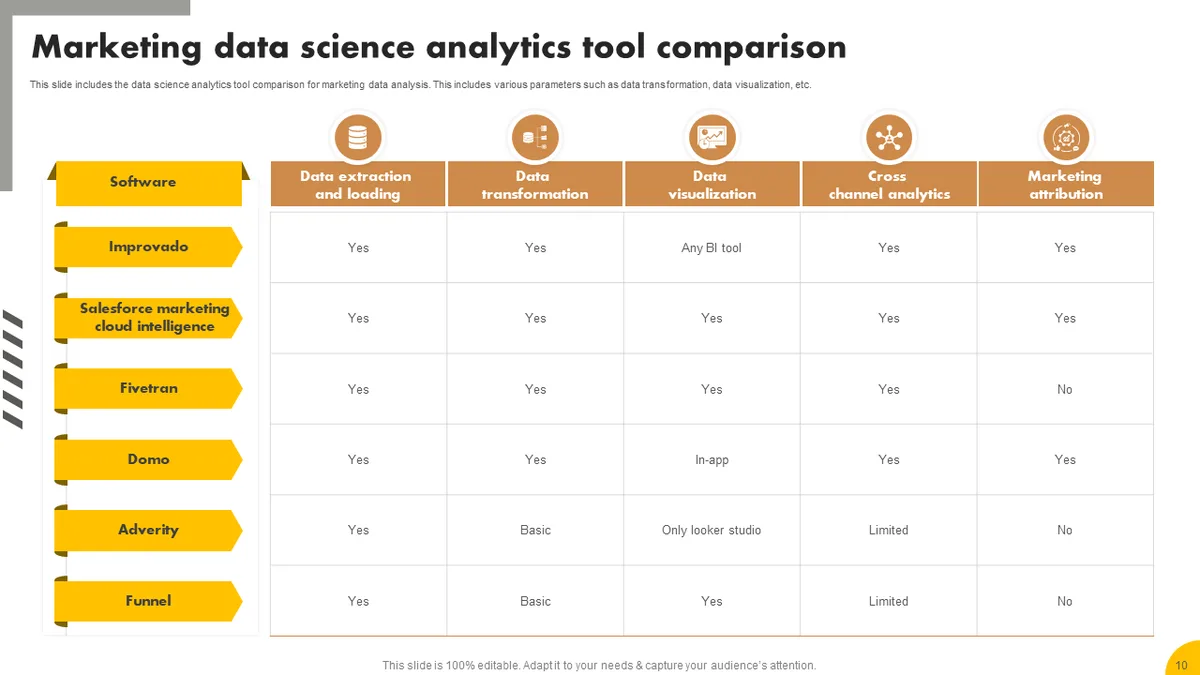
Core categories include data collection, warehousing, transformation, visualization, experimentation, and activation. Each has dominant players and niche alternatives.
Resist the urge to buy everything. Start with a warehouse, a BI tool, and an experimentation platform. Expand as needs clarify.
Analytics and Visualization Platforms
Google Analytics 4, Mixpanel, Amplitude, and Heap cover most product analytics needs. Each has strengths: GA4 for web, Amplitude for product, Mixpanel for funnels.
For visualization, Looker, Tableau, and Metabase dominate. Integrating data science marketing into your workflow produces consistent quality. Looker suits governed enterprise environments; Metabase works well for lean teams.
The best tool is the one your team actually uses. Adoption beats features every time.
Machine Learning and Automation
Platforms like DataRobot, H2O.AI, and cloud services from AWS, Google, and Azure lower the barrier to deploying models. AutoML handles routine tasks so data scientists focus on harder problems.
Customer data platforms like Segment and mParticle activate insights across channels. They close the loop between analysis and execution.
Integration matters more than individual tool power. A connected stack outperforms a collection of disconnected best-of-breed tools.
Common Pitfalls and How to Avoid Them
Most data science marketing initiatives fail for predictable reasons. Recognizing them early saves enormous time and money.
The biggest culprits: dirty data, unclear objectives, lack of executive sponsorship, and models that never reach production.
Each is fixable. But only if leadership treats analytics as a strategic capability rather than a cost center.

Data Quality and Governance
Garbage in, garbage out remains the oldest truth in analytics. Duplicate records, missing values, and inconsistent formats poison every downstream model.
Invest in validation rules, monitoring, and regular audits. Treat data quality as an ongoing process, not a one-time cleanup.

Governance frameworks define who owns what data and how it can be used. Without them, chaos creeps in quietly.
Organizational Resistance
Some teams resist data-driven decisions because it threatens intuition-based authority. Targeted refinements to your data science marketing streamline the entire review. Overcoming this requires patience and visible wins.
Start with small, undeniable experiments. Show how analytics improved a specific campaign. Momentum builds from demonstrated value.
Executive sponsorship is critical. When leadership references data in meetings, the culture shifts faster than any training program.
Privacy, Ethics, and Compliance
Data science marketing operates under increasing scrutiny. GDPR, CCPA, and similar regulations impose real constraints on collection and use.
Beyond legal compliance, ethical considerations matter. Consumers increasingly punish brands that misuse their information.
Transparency builds trust. Tell people what you collect and why. Give them control. The brands that do this earn loyalty that competitors can’t easily replicate.
Regulatory Landscape
Privacy laws vary by jurisdiction and continue tightening. Consent management platforms are now standard infrastructure, not optional add-ons.
Data residency requirements affect where you can store information. Multinational companies need region-specific architectures.
Work with legal counsel early. Retrofitting compliance onto existing systems is painful and expensive.
Ethical Data Use
Just because you can collect something doesn’t mean you should. Dark patterns and manipulative personalization erode trust permanently.
Establish internal ethics guidelines. Review high-risk use cases before deployment. Include diverse perspectives in these discussions.
The long game favors restraint. A thoughtful approach to data science marketing reinforces your qualifications. Brands known for ethical data practices attract better customers and better employees.
Measuring ROI of Analytics Investments
Proving the value of data science marketing is essential for sustained funding. Vague claims about “better decisions” don’t survive budget reviews.
Quantify impact where possible: incremental revenue from personalization, cost savings from churn reduction, efficiency gains from automation.
For indirect benefits, use proxy metrics and qualitative evidence. Executive dashboards that track analytics ROI keep programs alive through lean periods.
Attribution of Analytics Impact
Attributing business outcomes to analytics is tricky because analytics influences decisions rather than directly causing sales. Build a portfolio of evidence.
Track model-driven actions and their results. Document decisions that analytics informed. Over time, patterns emerge that justify investment.
Case studies within your own organization are the most persuasive evidence. Share them widely.
Benchmarking and Continuous Improvement
Compare your capabilities against industry benchmarks. Where do you lag? Where do you lead? Prioritize gaps that affect revenue.
Continuous improvement beats big-bang transformations. Small, steady gains compound into substantial advantage over years.
Review your data science marketing roadmap quarterly. Priorities shift as the business evolves and technology advances.
Real-World Applications Across Industries
Data science marketing looks different depending on context. The underlying principles hold, but applications vary widely.
E-commerce, SaaS, financial services, and media each have distinct data profiles and business models. Understanding these differences shapes effective strategy.
Below is a comparison of how analytics plays out across common sectors.
| Industry | Primary Use Case | Key Metric | Typical Challenge |
|---|---|---|---|
| E-commerce | Recommendation engines | Revenue per session | Cold-start for new users |
| SaaS | Churn prediction | Net revenue retention | Long sales cycles |
| Financial Services | Risk-based personalization | Customer lifetime value | Regulatory constraints |
| Media | Content recommendation | Engagement time | Content freshness |
| Retail | Demand forecasting | Inventory turnover | Seasonal volatility |
E-Commerce and Retail
Retailers use data science marketing to personalize product recommendations, optimize pricing, and forecast demand. The volume of transaction data makes modeling unusually effective.
Dynamic pricing algorithms adjust offers in real time based on demand, competition, and inventory. Airlines and hotels pioneered these techniques; retailers now apply them widely.
Seasonal patterns require careful handling. Models trained on holiday data often fail during off-peak periods unless properly segmented.
SaaS and Subscription Businesses
Subscription companies live and die by retention. Churn prediction models identify at-risk accounts and trigger retention campaigns before cancellation.
Usage analytics reveal which features correlate with long-term retention. Product teams use these insights to guide roadmap decisions.
Expansion revenue modeling identifies accounts ready for upsells. Structuring your data science marketing around proven patterns ensures impact. Timing these offers well dramatically improves conversion.
Future Directions in Data Science Marketing
The field keeps evolving. Privacy changes, AI advances, and shifting consumer expectations reshape what’s possible.
Generative AI is accelerating content creation and personalization. Large language models can draft copy, generate creative variants, and power conversational interfaces.
Privacy-preserving techniques like federated learning and differential privacy let companies extract value without compromising individual data.
AI and Automation Trends
Automated machine learning platforms are democratizing model building. Marketers with basic technical skills can now deploy predictive models that once required specialist teams.
Real-time decisioning engines personalize experiences at millisecond speeds. The gap between analysis and action is closing rapidly.
Human oversight remains essential. Models optimize for the metrics you specify, which may not align with long-term business health.
Privacy-First Analytics
Third-party cookies are disappearing. First-party data strategies and clean rooms are becoming standard.
Contextual targeting is regaining relevance as behavioral targeting faces restrictions. The pendulum swings back toward content and intent signals.
Companies that built strong first-party data foundations early are positioned to thrive. Others face a costly catch-up.
Getting Started: a Practical Roadmap
If you’re new to data science marketing, don’t try to build everything at once. Sequence your investments for compounding returns.
Start with measurement hygiene. Fix tracking, unify definitions, and build a basic warehouse. This foundation supports everything else.
Then add experimentation capability. Running disciplined tests builds organizational confidence in data-driven decisions.
Only after these basics should you invest in predictive modeling. Models built on shaky data foundations fail predictably.
First Ninety Days
Audit your current data infrastructure. Identify gaps in tracking, storage, and access.
Establish a single source of truth for core metrics. Applying these principles to your data science marketing yields measurable results. Document definitions and socialize them across teams.
Launch one high-visibility experiment. Choose something that matters and can produce a clear result quickly.
First Year and Beyond
Build a small analytics team with clear ownership. Hire for curiosity and communication as much as technical skill.
Expand modeling capabilities incrementally. Add churn prediction, then LTV, then personalization as data matures.
Review and refine constantly. The best data science marketing programs evolve continuously rather than following a fixed plan.
Frequently Asked Questions
These are the questions I hear most often from teams starting their analytics journey.
What is Data Science Marketing in Simple Terms?
It’s using data, statistics, and machine learning to make better marketing decisions. Instead of guessing what works, you measure and predict.
The goal is to allocate budget, personalize experiences, and optimize campaigns based on evidence rather than intuition.
Do I Need a Data Scientist to Get Started?
Not necessarily. Modern tools let marketers run experiments and build basic models without deep technical expertise.
But as complexity grows, specialist skills become valuable. Start with analysts who can wrangle data, then add data scientists as needs clarify.
How Long Before I See Results?
Quick wins from better measurement often appear within weeks. Predictive modeling typically takes several months to mature.
Personalization and attribution improvements compound over time. Patience and consistency matter more than speed.
What Tools Should I Prioritize First?
A data warehouse, a business intelligence tool, and an experimentation platform. These three cover the essentials.
Add customer data platforms and ML tooling as your capabilities and needs expand.
How Do I Prove ROI to Leadership?
Quantify impact where possible and build a portfolio of evidence. Track model-driven actions and their business results.
Internal case studies are powerful. Show specific campaigns that improved because of analytics, and let the numbers speak.
Is Data Science Marketing Only for Large Companies?
No. Smaller companies often benefit more because they can’t afford wasted spend. The tools are increasingly accessible and affordable.
Start small, focus on high-impact use cases, and scale as you prove value.
What About Privacy Regulations?
Compliance is mandatory and increasingly complex. Work with legal counsel and invest in consent management infrastructure.
Beyond compliance, ethical data practices build trust that translates into customer loyalty and brand strength.
How Do I Choose Between Building and Buying?
Buy when tools exist that solve your problem well. Build only when your needs are genuinely unique or when vendor lock-in poses strategic risk.
Most teams should buy first, build later, and revisit the decision annually as needs evolve.
Data science marketing rewards patience and discipline. The teams that commit to measurement, experimentation, and continuous learning consistently outperform those that chase shortcuts. Start where you are, use what you have, and let the results guide your next move.
For verified reference and background research, consult the authoritative informational resource on this topic.
Pingback: What Hashtags To Use: Find The Best Ones For Every Post
Pingback: Branding Trust: How To Build Loyal Customers Fast
Pingback: How To Start A Blog Tumblr: Easy Setup For Beginners
Pingback: Article In Wikipedia: How To Write One That Gets Approved
Pingback: How To Create Social Media Marketing Plan: Easy Steps
Pingback: Long Format Content: When To Use It & How To Write It
Pingback: Carousel Ads: How To Create Ones That Get Clicks
Pingback: How To Make A Video Script: Simple Steps For Beginners
Pingback: Marketing Books: Best Reads To Level Up Your Skills
Pingback: Brand Voice: How To Define Yours (With Examples)
Pingback: Brainstorming Tool: Free Ways To Generate Ideas Fast
Pingback: Key Performance Indicators In Marketing: KPIs To Track
Pingback: Make A Wikipedia Page: Requirements & Easy Steps
Pingback: SEO And Pinterest: How To Drive Traffic To Your Website
Pingback: Analyzing SEO: Key Metrics & Tools To Track Performance
Pingback: Buffer Social Media Management Tool: Features & Pricing
Pingback: Search Tagging: How To Tag Content For Better Discovery
Pingback: AI Max Google: How The New Ads Feature Works & Costs
Pingback: Why Isn't ChatGPT Working? 9 Quick Fixes That Work