Marketing books have a way of reshaping how you see every campaign, every customer conversation, and every dollar you spend on ads. If you have ever stared at a flatlining funnel wondering what you’re missing, the answer is often sitting on a shelf somewhere.
This guide walks through the titles that genuinely move the needle, from foundational classics to niche playbooks on pricing, positioning, and behavioral psychology. You’ll get honest takes, practical takeaways, and a clear sense of which marketing books deserve space on your desk versus a quick skim.
Why Marketing Books Still Matter in a World of Short-Form Content
Scroll through any social feed and you’ll find a thousand hot takes on growth hacking, virality, and funnels. Most of them recycle the same three ideas with different fonts. Marketing books operate on a different timescale entirely.
A good book forces an author to defend an argument across two hundred pages. That pressure filters out the fluff. What survives is usually a framework tested across dozens of companies, not a single lucky campaign.
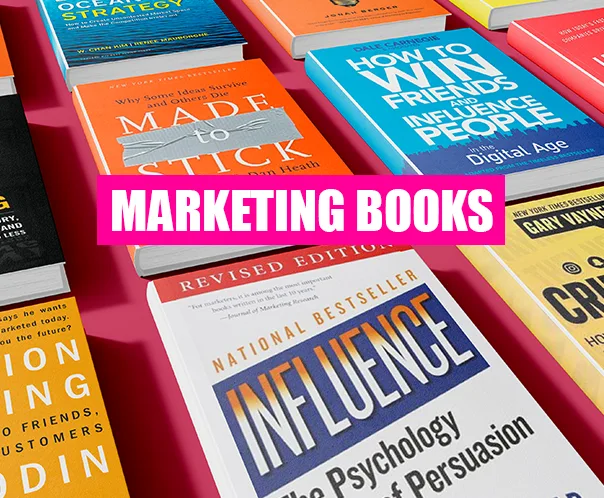
I’ve watched junior marketers binge a hundred YouTube tutorials and still freeze when asked to write a positioning statement. Then they read one solid book on the subject and something clicks. The difference isn’t intelligence. It’s structure.
The Compounding Value of Deep Reading
Short-form content gives you tactics. Marketing books give you mental models. Tactics expire the moment an algorithm shifts. Models tend to outlive platforms.
Consider the concept of category creation. It shows up in dozens of marketing books written decades apart, each applying it to a different era of media. The underlying logic hasn’t changed. Only the distribution channels have.
Reading deeply also builds vocabulary. When you can name what you’re seeing, you can diagnose it faster. That’s a real career advantage, especially in rooms where everyone else is guessing.
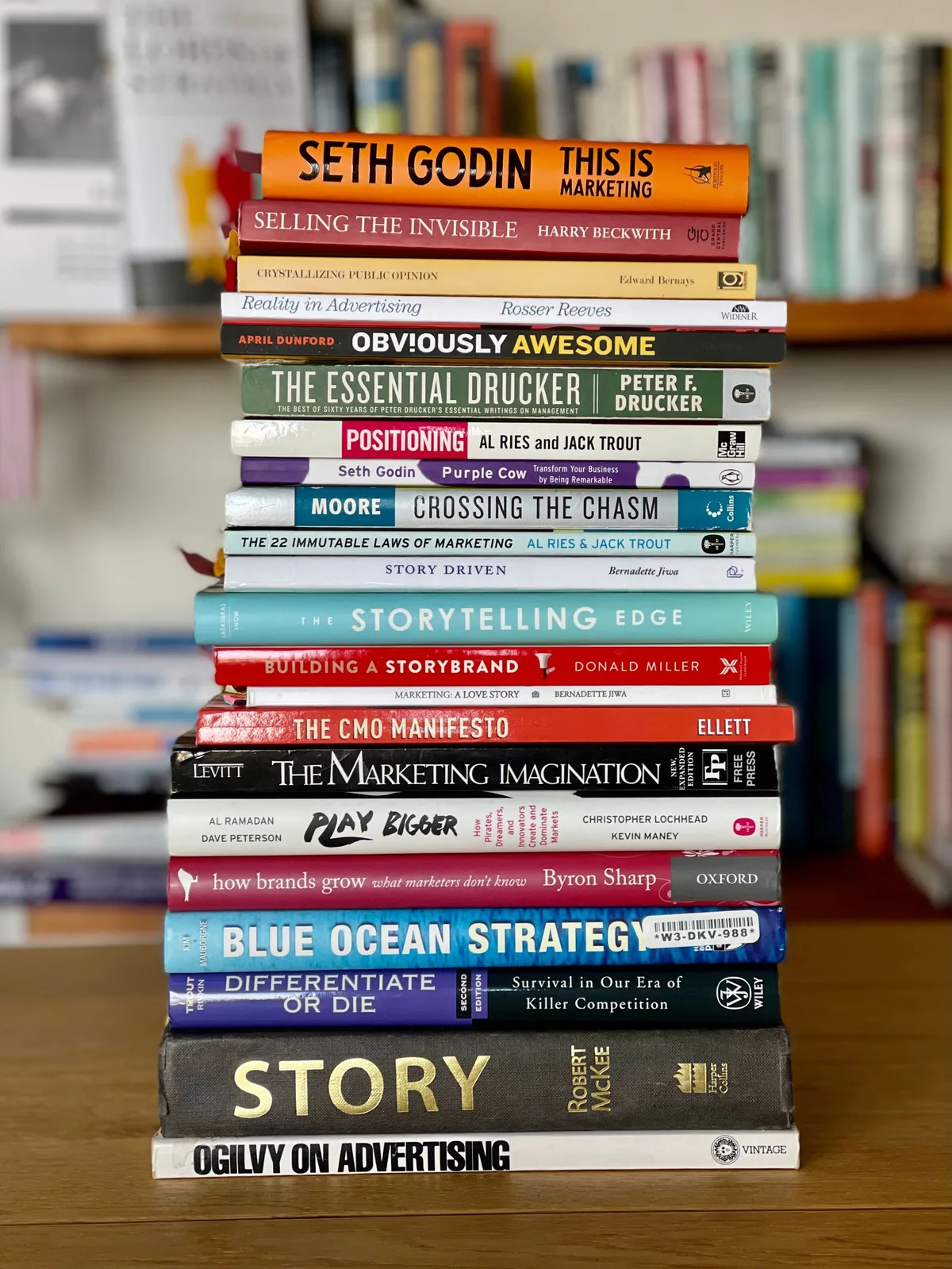
What Separates a Great Marketing Book from a Forgettable One
The best marketing books share three traits: a clear thesis, evidence from real companies, and frameworks you can apply on Monday morning. Miss any one of those and the book becomes decoration.
Plenty of popular titles fail the Monday test. They’re entertaining on a flight but useless when you’re staring at a landing page that won’t convert. I’ve donated more than a few of those.
Another marker is re-readability. If a book rewards a second pass with new insights, it belongs in your permanent rotation. If it feels exhausted after one read, pass it along.
Foundational Marketing Books Every Practitioner Should Read
Before you chase the newest release, anchor yourself in the classics. These marketing books built the vocabulary that everything else assumes you already know.
Skipping them is like learning to cook from TikTok without ever understanding why butter browns. You’ll get results sometimes, but you won’t know why when it works or how to fix it when it doesn’t.
Positioning: the Battle for Your Mind
Al Ries and Jack Trout wrote this in the early eighties, and it still reads like it was written last week. The core argument is simple: you don’t win by being better, you win by being different in a way the customer can remember.
Every time I hear a founder say “we’re like X but with better UX,” I think about this book. That sentence is a positioning death wish. Customers don’t hold comparison charts in their heads. They hold categories.
The practical takeaway: write your positioning statement on an index card. If it takes more than one sentence, you haven’t finished the work. This is one of those marketing books worth keeping within arm’s reach.
Influence: the Psychology of Persuasion
Robert Cialdini’s six principles—reciprocity, scarcity, authority, consistency, liking, and social proof—form the backbone of modern conversion optimization. Nearly every high-performing landing page uses at least three of them.
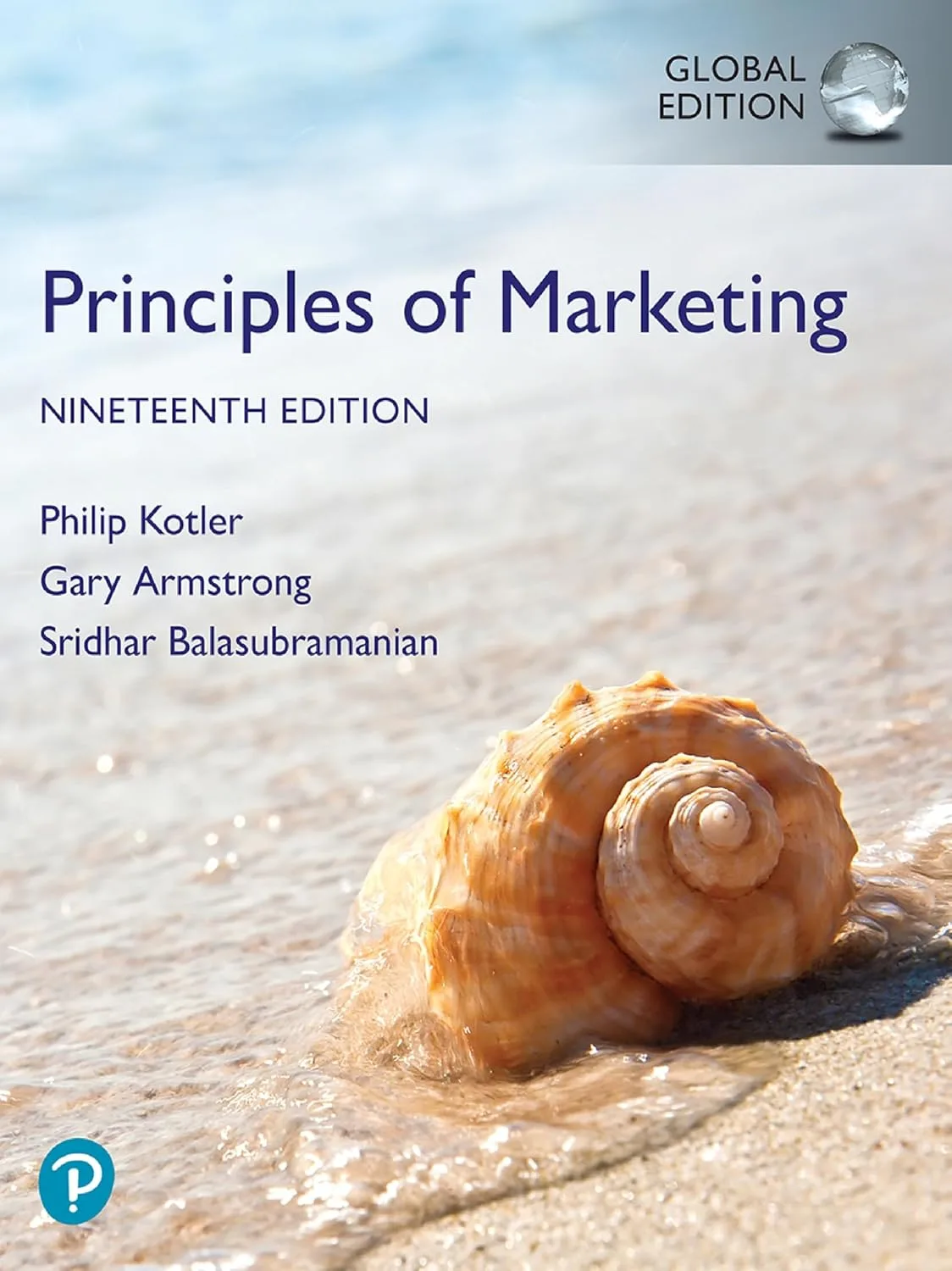
What makes this one of the most cited marketing books is the research depth. Cialdini spent years undercover in sales training programs, car dealerships, and fundraising operations. The examples aren’t hypothetical.
Try this: audit your checkout page against all six principles. Most teams find two or three missing entirely. Fixing those gaps often moves revenue more than a redesign.
Building a StoryBrand
Donald Miller’s framework flips the script on brand messaging. The customer is the hero. Your company is the guide. Sounds obvious until you read most About pages.
The SB7 framework—a character, a problem, a guide, a plan, a call to action, failure, and success—gives you a fill-in-the-blank structure for any homepage. It’s mechanical, and that’s the point.
I’ve used this on B2B sites where the messaging had drifted into jargon soup. Rewriting the hero section alone lifted demo requests noticeably. Among practical marketing books, this one earns its reputation.
Marketing Books on Copywriting and Persuasion
Copy is where strategy meets the customer’s eyeballs. Get it wrong and nothing else matters. Get it right and mediocre design can still convert.
The marketing books in this category tend to be shorter, denser, and more tactical. They read less like theory and more like a toolbox.
Ogilvy on Advertising
David Ogilvy’s memoir-slash-manual remains the single best argument for research-driven creative. He famously said that when he wrote an ad, he didn’t want you to find it “creative.” He wanted you to find it so compelling you bought the product.
The book is packed with annotated campaigns from the fifties and sixties. Some look dated. The logic behind them doesn’t. Headlines that promise a benefit still outperform clever wordplay.
Read the chapters on direct response twice. That’s where the money lessons live. Most brand marketers skip them and pay for it later.
Breakthrough Advertising
Eugene Schwartz wrote this in the mid-sixties and it became a cult classic for a reason. His concept of market sophistication—five stages from “new product” to “been there, done that”—explains why the same headline works for one company and flops for another.
Copies of this book used to trade for absurd amounts before it was reissued. That should tell you something about how practitioners value it.
The awareness ladder is the other big idea. Customers sit at different levels of awareness, and your copy has to meet them where they are. Most underperforming ads are simply aimed at the wrong rung.
Cashvertising
Drew Eric Whitman’s book distills decades of advertising research into eight life-force desires and nine secondary wants. It’s blunt, a little crude, and extremely useful.
The chapter on headlines alone justifies the read. He breaks down why certain words trigger action and others don’t, with examples pulled from newspaper ads that ran for decades.
If you write copy for a living, this belongs next to your keyboard. It’s one of those marketing books you’ll flip through randomly when a headline won’t come together.
Marketing Books on Branding and Strategy
Branding gets dismissed as fluffy until you watch a commodity product charge a premium because of it. These marketing books explain the mechanics behind that premium.
How Brands Grow
Byron Sharp’s research out of the Ehrenberg-Bass Institute challenges almost everything loyalty marketers believe. His data across dozens of categories shows that brands grow mainly by acquiring light buyers, not by deepening relationships with heavy ones.
The concept of mental availability—being the first brand that comes to mind in a buying situation—is worth the price of admission. Physical availability matters too, but mental availability is what marketing actually controls.
This is one of the more controversial marketing books because it contradicts a lot of agency orthodoxy. Read it with an open mind and check the data yourself.
Obviously Awesome
April Dunford’s positioning framework is the most practical I’ve encountered. She walks through ten steps, starting with competitive alternatives and ending with a market category that makes your strengths obvious.
The insight that positioning isn’t about what you say but about what context you place yourself in changes how you approach every landing page and pitch deck.
I’ve run her exercise with three different startups. Each time, the team discovered they were competing in the wrong category entirely. That’s a costly mistake this book prevents.
Play Bigger
Category design is the central idea here, and it’s become a boardroom topic at plenty of venture-backed companies. The authors argue that the biggest wins come from creating a new category rather than fighting for share in an existing one.
Not every business can pull this off. But understanding the playbook helps you spot when a competitor is running it against you.
The chapters on the “category king” dynamic are especially useful for anyone in a crowded market. Among strategy-focused marketing books, this one reframes the game board entirely.
Marketing Books on Digital Growth and Analytics
Digital marketing changes fast enough that most books in this space go stale within a couple of years. The ones that survive focus on principles rather than platforms.
Here’s a quick comparison of a few standouts, so you can pick based on where you are in your career.
| Title | Best For | Core Framework | Re-Read Value |
|---|---|---|---|
| Lean Analytics | Startup founders and growth leads | One metric that matters per stage | High |
| Traction | Early-stage marketers testing channels | Nineteen traction channels | Medium |
| Hacking Growth | Product-led growth teams | Growth hacking process loop | Medium |
| Web Analytics 2.0 | Analysts and CMOs | Customer centricity framework | High |
| Trust Me, I’m Lying | Content and PR strategists | Media manipulation mechanics | Medium |
Lean Analytics
Alistair Croll and Benjamin Yoskovitz built a framework around picking one metric that matters at each stage of a business. That single constraint saves teams from dashboard paralysis.
The book breaks down metrics by business model—ecommerce, SaaS, media, marketplace—so you’re not wading through irrelevant benchmarks.
If you’ve ever sat in a meeting where everyone argued about which number to optimize, this book ends that debate. It’s one of the more useful marketing books for anyone data-adjacent.
Traction
Gabriel Weinberg and Justin Mares catalog nineteen distinct traction channels, from viral marketing to trade shows to podcast advertising. The Bullseye Framework—test cheaply, double down on what works—is the real contribution.
Most startups burn a year on the wrong channel because they never ran small experiments first. This book gives you a structured way to avoid that.
The case studies are dated in places, but the method holds up. Channel names change; the process of finding your channel doesn’t.
Hacking Growth
Sean Ellis coined the term “growth hacking,” and this book lays out the process behind it. Cross-functional teams, rapid experimentation, and a relentless focus on the activation moment.
The concept of the “aha moment”—that specific action correlated with retention—is the most valuable piece. Find yours and you can build the entire growth engine around it.
Some of the examples feel like a time capsule of mid-2010s tech. The methodology underneath remains relevant, which is why it keeps showing up on lists of recommended marketing books.
Marketing Books on Consumer Psychology and Behavior
Understanding why people buy is more useful than any tactic. These marketing books dig into the messy, irrational machinery behind purchase decisions.
Thinking, Fast and Slow
Daniel Kahneman’s Nobel-winning work isn’t a marketing book in the traditional sense. It’s better than that. The two-system model—fast intuitive thinking versus slow deliberate reasoning—explains nearly every impulse buy you’ve ever made.
Anchoring, loss aversion, and the planning fallacy all get thorough treatment. Once you see these patterns, you can’t unsee them in your own funnel data.
It’s dense. Read it slowly. But among the marketing books that permanently change how you think, this sits near the top.
Predictably Irrational
Dan Ariely’s experiments on relativity, decoy pricing, and the power of free are immediately applicable. The chapter on why “free” is so magnetic should be required reading for anyone designing a freemium offer.
His decoy pricing example—the Economist subscription experiment—gets cited in marketing decks constantly for good reason. It’s clean, memorable, and reproducible.
If Kahneman feels too academic, start here. It’s one of the more accessible marketing books on behavioral economics.
Contagious
Jonah Berger’s STEPPS framework—social currency, triggers, emotion, public, practical value, stories—explains why some ideas spread and others die quietly.
The trigger concept is underrated. Products tied to frequent environmental cues get talked about more, simply because they come to mind more often.
I’ve used the framework to audit content before launch, asking whether each piece hits at least two of the six drivers. It’s a quick filter that catches a lot of weak ideas early.
Marketing Books on Sales and Customer Relationships
Marketing and sales blur together in most modern organizations. These marketing books help you speak both languages.
SPIN Selling
Neil Rackham’s research into thirty-five thousand sales calls produced a counterintuitive finding: traditional closing techniques hurt performance in complex sales. What works instead is asking the right questions.
Situation, Problem, Implication, Need-payoff. The SPIN sequence gives structure to discovery calls that would otherwise wander.
Even if you never carry a quota, understanding this framework improves how you write case studies and sales pages. You’ll know which questions the buyer is silently asking.
Never Split the Difference
Chris Voss spent years as an FBI hostage negotiator before teaching his methods to business audiences. The tactical empathy approach—mirroring, labeling, calibrated questions—works remarkably well in pricing conversations.
The concept of “no” being the start of a negotiation rather than the end is liberating. It reframes rejection as information.
This is one of those marketing books that sales teams pass around until the spine breaks. The chapter on the Ackerman model alone is worth the read.
The Challenger Sale
Matthew Dixon and Brent Adamson’s research found that the best salespeople don’t build relationships first—they teach, tailor, and take control. Challengers outperform relationship builders in complex sales environments.
The “commercial teaching” concept translates directly into content marketing. Your best blog posts should challenge assumptions, not just answer easy questions.
Some of the data has been debated since publication, but the core insight holds. Passive relationship selling loses to informed provocation.
How to Actually Read Marketing Books for Maximum Retention
Buying books is easy. Retaining what’s inside them takes a system. Most people read a marketing book, feel inspired for a week, and forget eighty percent of it.
Here’s a process that works better. It’s adapted from how I’ve watched the sharpest operators in my network handle their reading.
- Read with a specific problem in mind. Before opening the book, write down one challenge you’re facing. Every chapter becomes a potential answer. This single habit makes marketing books feel less like homework and more like consulting.
- Highlight only frameworks, not anecdotes. Stories are memorable but they don’t transfer. Frameworks do. If a story illustrates a framework, highlight the framework and note the story in the margin.
- Write a one-page summary within 48 hours. The act of compression forces understanding. If you can’t summarize it in a page, you didn’t absorb it.
- Apply one idea within a week. Pick the smallest possible test. A headline rewrite. A new email subject line. A pricing page tweak. Action cements memory better than re-reading.
- Revisit the book in six months. Your context will have changed, and different chapters will resonate. This is how a single book becomes three books over time.
- Discuss it with someone. Teach a concept to a colleague and you’ll discover the gaps in your understanding immediately. Most marketing books get sharper in conversation.
One more tip: keep a running note of frameworks you’ve collected across all your marketing books. Mine has around forty entries now. When a new problem appears, I scan the list before searching for new solutions.
Building a Reading Routine That Survives a Busy Calendar
The biggest obstacle isn’t finding good marketing books. It’s finding time to read them. Between Slack, email, and the endless stream of meetings, reading gets pushed to “someday.”
Here’s what actually works. Thirty minutes a day beats a four-hour weekend binge, because retention depends on spacing. Your brain consolidates ideas overnight.
I read on the train, during lunch, and for twenty minutes before bed. That’s roughly two books a month without sacrificing anything else. It adds up to twenty-four this approach a year, which is more than most people read in a decade.
Audio versions help too, especially for narrative-heavy titles. Frameworks and tables don’t translate well to audio, so save those for print or ebook.
Choosing What to Read Next
Rotate between categories deliberately. Read one strategy book, then one copywriting book, then one psychology book. This cross-pollination produces better ideas than staying in a single lane.
When you finish a marketing book, ask yourself one question: what can I do differently tomorrow? If the answer is vague, the book wasn’t the right fit for your current stage.
Don’t force yourself through books that aren’t clicking. There are too many good this approach to waste time on ones that bore you. Give any title fifty pages, then decide honestly.
Building Your Marketing Books Library: a Practical Approach
You don’t need a hundred titles. You need maybe fifteen that you know deeply, plus a rotating stack of new ones to keep things fresh.
Start with three from the foundational category. Add two on copywriting. Then one on analytics and one on psychology. That’s a working library that covers most situations you’ll face.
Physical copies work better for reference books. You remember where things are on a page, which makes retrieval faster. Digital is fine for narrative titles you’ll read once.
Keep a “to-read” list somewhere visible. Mine lives on a sticky note on my monitor. When someone recommends a title, it goes on the list. When I finish a book, I pull the next one.
Where to Find Recommendations
Peer recommendations beat bestseller lists almost every time. Ask three marketers you respect which this practice shaped their thinking. You’ll get a shortlist that’s far more relevant than anything an algorithm serves up.
Podcasts are another good source. When a guest mentions a book twice in one episode, that’s usually a signal worth following.
Conference hallway conversations are underrated too. The titles that come up repeatedly across different companies tend to be the ones with real substance.
Common Mistakes When Choosing Marketing Books
Not all popular this approach deserve their reputation. Here are the traps I’ve seen people fall into repeatedly.
- Chasing whatever is trending on LinkedIn. Viral book recommendations often reflect marketing budgets, not quality. A book promoted by a publisher’s PR machine isn’t automatically better than one with a quiet following.
- Only reading books published recently. Recency bias is real. Some of the sharpest thinking in marketing books is decades old and still hasn’t been improved upon.
- Ignoring books outside the marketing section. Psychology, behavioral economics, and even fiction can teach you more about persuasion than another growth playbook.
- Reading passively without notes. If you can’t remember three ideas from a book a month later, you didn’t really read it. You skimmed it.
- Buying faster than you read. A stack of unread marketing books is just guilt in paper form. Slow down and finish what you start.
- Skipping the exercises. Authors include worksheets and frameworks for a reason. Doing them is where the learning actually happens.
One more: don’t dismiss a book because you disagree with part of it. The best this practice usually contain at least one idea that challenges your assumptions. That friction is valuable.
How Marketing Books Shape Career Trajectories
I’ve watched two marketers with identical starting points diverge sharply over five years. The difference usually wasn’t talent or work ethic. It was reading habits.
The ones who advanced fastest had a mental library of frameworks they could deploy in meetings. When a problem appeared, they didn’t panic. They reached for a model they’d internalized from one of the this practice on their shelf.
That kind of fluency gets noticed. It’s the difference between saying “I think we should try X” and saying “based on the category entry point framework, here’s why X fits our situation.”
Reading also builds credibility with senior stakeholders. When you can reference a well-known framework by name, you signal that you’ve done the homework. That matters more than most junior marketers realize.
The Long Game of Continuous Learning
Marketing changes constantly, which is exactly why principles matter more than tactics. The practitioners who thrive over a twenty-year career are the ones who kept learning deliberately.
This practice are the most efficient way to absorb decades of other people’s experience in a few hours. That leverage is hard to replicate any other way.
Set a modest goal. One book a month. After a year, you’ll have twelve frameworks that most of your peers don’t. After five years, you’ll have sixty. That compounds in ways that are hard to overstate.
Frequently Asked Questions About Marketing Books
Here is an in-depth breakdown of key considerations regarding this section:
Which Marketing Books Should a Complete Beginner Start With?
Start with Positioning by Al Ries and Jack Trout, then Building a StoryBrand by Donald Miller. Those two give you the vocabulary and a practical structure for messaging. Add Influence by Robert Cialdini once you’re comfortable with the basics.
Are Older Marketing Books Still Relevant Today?
Often more relevant than new ones. Human psychology hasn’t changed, and the classics focus on principles rather than platforms. Books written before the internet age tend to be less polluted by tactics that expire quickly.
How Many Marketing Books Should I Read per Year?
Twelve is a solid target. That’s one per month, which fits into most schedules with thirty minutes of daily reading. Ambitious readers can hit twenty-four by adding audiobooks during commutes.
Do Marketing Books Actually Help With Real Campaigns?
Yes, if you apply them. The value comes from frameworks you can use to diagnose problems and structure solutions. Passive reading produces inspiration; active reading produces results.
What’s the Best Way to Remember What I Read in Marketing Books?
Write a one-page summary within two days and apply one idea within a week. That combination dramatically improves retention compared to just reading and moving on.
Should I Read Marketing Books or Take Courses Instead?
Both have value, but books tend to go deeper for the same investment of time. Courses are better for skill-building; this approach are better for building judgment and strategic thinking.
Which Marketing Books are Best for B2B Marketers Specifically?
The Challenger Sale, Obviously Awesome, and SPIN Selling are the strongest trio for B2B. They cover positioning, sales methodology, and the psychology of complex buying decisions.
How Do I Choose Between Two Marketing Books I’m Equally Interested In?
Pick the one that addresses your current bottleneck. If you’re struggling with messaging, read copywriting. If you’re struggling with strategy, read positioning. Relevance beats reputation when you’re choosing what to read next.
At the end of the day, this practice are tools. The people who get the most from them treat reading as part of the job, not a hobby. They keep notes, run experiments, and revisit ideas when context shifts.
Pick one title from this list and start this week. Not next month. Not when things slow down. The marketing books that change careers are the ones you actually open, not the ones sitting on your wishlist.
For verified reference and background research, consult the authoritative informational resource on this topic.