The panda update landed on the search scene with a simple promise that turned out to be brutally hard to satisfy: reward genuinely useful content, punish thin filler.
If you have ever watched a page you wrote drop off the first page overnight while a shorter, sharper competitor climbed past it, you already know the feeling this algorithm created.
I have spent years watching sites recover, collapse, and rebuild around the signals that panda update pushed into the mainstream.
What follows is the full picture — where it came from, how it actually evaluated pages, what it changed about the way we write, and how to audit your own content so a future quality shake-up never catches you flat-footed.
What the Panda Update Actually Was
At its core, the panda update was a ranking filter. It ran alongside the main search algorithm and assigned a quality score to pages, then to sections of a site, then to the site as a whole.

Pages that scored low got suppressed. Pages that scored high got a small lift, mostly because competitors dropped around them.
Google described the intent in plain language: reduce rankings for low-quality sites and improve rankings for high-quality ones. That sounds vague until you read the supporting material Google published at the time, which pointed squarely at research from outside the company suggesting that “content farms” were crowding out original reporting and expert writing.

The name came from a Google engineer, Navneet Panda, who built much of the machine-learning machinery behind the classifier. That detail matters more than it seems. This was not a rule-based penalty you could reverse by deleting a few pages.
It was a trained model that scored pages on patterns it had learned from human quality ratings, which is why two sites with nearly identical content could end up on opposite sides of the line.

Why the Panda Update Happened When It Did
By the time the panda update rolled out, the web had a spam problem that no amount of link analysis could fix. Content farms were churning out thousands of near-identical articles targeting every long-tail query imaginable, and many of them ranked because they had decent link profiles and keyword coverage.
Readers noticed. Google noticed. Search quality raters were flagging results that technically matched a query but answered nothing. The panda update was the company’s attempt to encode “would a human find this satisfying?” into something a machine could score at scale.
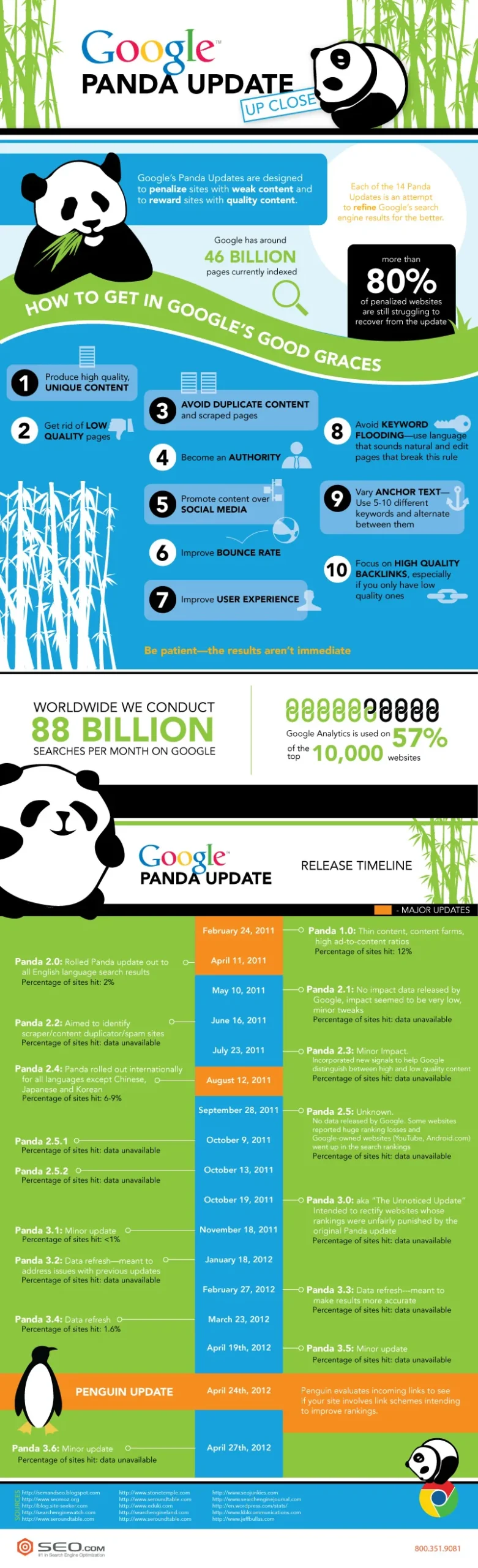
Here is the part most people miss: the target was never just spam. Focusing on panda update provides clear direction here. Plenty of legitimate businesses got hit because their pages were technically fine but shallow.
A product page with three sentences of manufacturer copy, a blog post that restated the headline five times, a category page with no unique text at all — those were the casualties nobody saw coming.

How the Panda Update Scored Content Quality
Google never published the scoring formula, and anyone who claims to have it is guessing. But the questions Google did publish give a clear map of what the model was trained to recognize. Those questions read like a checklist a demanding editor would use, and they are still worth reading line by line.
Would you trust the information presented in this article? Would you be comfortable giving your credit card information to this site? Does this article contain insightful analysis or interesting information? Would you expect to see this in a printed magazine, encyclopedia, or book? Those four alone eliminate most thin content before you even get to the harder ones.

The panda update also cared about mechanics that readers feel but rarely name: excessive ads above the fold, boilerplate text repeated across hundreds of pages, shallow treatment of a topic that deserves depth, and a lack of any identifiable author or expertise behind the words.
The Signals That Carried the Most Weight
In practice, three signal families did most of the work. The first was content depth relative to the query — not word count, but whether the page actually resolved the searcher’s problem. A 400-word answer that fully solves a narrow question beats a 2,000-word page that circles it.

The second was site-level quality. The panda update scored sites in aggregate, which meant one weak section could drag down strong pages elsewhere. That is why so many publishers saw their best articles tank alongside their worst.
The third was trust signals: authorship, citations, contact information, editorial standards, and the general sense that a real organization with real accountability stood behind the page.
What the Panda Update Did Not Do
It did not penalize short content by itself. It did not punish affiliate sites by category. It did not require a minimum word count, and it did not care whether you used a specific keyword density target.
What it punished was the combination of thin substance and weak trust. A short, precise page from a recognized expert sailed through. A long, padded page from an anonymous site with no history did not.
That distinction is the single most useful thing to internalize about the panda update. Length was never the metric. Usefulness was.
How the Panda Update Changed the Way We Write
Before the panda update, the dominant content strategy was coverage. Publish a page for every keyword variation, stuff the target phrase in the title, first paragraph, and a few subheadings, and let internal linking do the rest. It worked, which is exactly why it spread.
Afterward, coverage alone stopped working. Publishers who had built thousand-page libraries of thin articles watched entire domains lose visibility, and recovery took months because the scoring ran at the site level. The lesson landed hard: you cannot quarantine bad pages anymore.
What replaced coverage was depth. Writers started merging five thin posts into one thorough resource. Editors started asking whether a page deserved to exist at all. And “content audit” moved from a niche tactic to a standard line item in every SEO budget.
From Keyword Density to Topical Coverage
Keyword density was the first casualty. The panda update made it obvious that repeating a phrase did not make a page more relevant — it just made it worse to read. Writers shifted toward covering the surrounding questions a reader would naturally ask.
That shift is why modern content briefs look like topic maps instead of keyword lists. Refining each detail of your panda update strengthens this section.
If you are writing about a search algorithm change, a good brief will ask you to cover the history, the mechanics, the recovery process, the myths, and the practical audit steps. Covering those earns relevance. Repeating a phrase does not.

In my own work, the single biggest quality jump came from writing the section a competitor skipped. Every thin page in a niche tends to skip the same thing — the edge cases, the failure modes, the “here is what to do when it does not work” part. That gap is where the panda update rewarded writers most.
The Rise of E-E-A-T Thinking
The panda update was an early expression of an idea Google later formalized as experience, expertise, authoritativeness, and trustworthiness. The scoring model needed a proxy for credibility, and the clearest proxies were who wrote the page and what evidence supported it.

That is why bylines stopped being decorative. A page with a named author, a short bio, and a linked professional profile scored differently than the same text published anonymously. Not because the bio itself carried ranking weight, but because it signaled the kind of site the model had learned to trust.
Citations worked the same way. Linking out to primary sources — a research paper, an official announcement, a standards document — told the model that the page was grounded in something checkable rather than invented.
What the Panda Update Taught Us About Thin Content
Thin content is a slippery term. Most people define it by word count, which is wrong. A page is thin when it fails to deliver what the searcher came for, regardless of how many words it contains.
The panda update made this concrete by punishing pages that matched a query’s words but not its intent. A page titled with a question that never answers the question is thin. A page that answers it in two sentences is not.
There is a second, sneakier form of thinness: duplication. If forty pages on your site say nearly the same thing with slightly different phrasing, the panda update treated them as one weak cluster rather than forty chances to rank. Consolidation consistently outperformed proliferation.
Common Patterns That Got Sites Flagged
Certain patterns showed up again and again in sites that lost visibility. Scraped or rewritten content with no original value. Auto-generated location pages with only the city name swapped. Tag and archive pages indexed with no unique text. Product descriptions copied verbatim from a manufacturer feed.
Another frequent offender was the “gateway” page — a thin article that existed only to funnel visitors to a commercial page. The panda update had no patience for it, and neither do readers.

Thin content also hid inside otherwise good sites. Effective execution in your panda update makes a tangible difference. A strong blog with a neglected resource section could drag the whole domain down, which is why audits that skip low-traffic pages miss the real problem.
How to Audit Your Site Against Panda Update Standards
An audit is not a vibe check. It is a page-by-page accounting of whether each URL earns its place. The panda update made that discipline mandatory, and the process has not changed much since.

Start by pulling every indexed URL. Then sort them into three buckets: keep, improve, and remove. The sorting criteria are the questions Google published, applied honestly rather than generously.
Be ruthless with the remove bucket. Deleting or noindexing genuinely weak pages has repeatedly produced better results than trying to rescue them, because site-level scoring means every weak page is a small drag on everything else.
A Practical Step-by-Step Audit Process
- Export all indexed URLs. Pull them from your sitemap and from a site: search in Google. Reconcile the two lists, because they rarely match. Pages that exist but are not in your sitemap are usually the ones nobody has looked at in years.
- Tag each URL by intent. Label it informational, commercial, navigational, or transactional. This matters because the quality bar differs by intent — a transactional page needs clarity and trust signals, while an informational page needs depth and evidence.
- Score content depth honestly. Ask whether the page fully answers the query that brought someone there. A useful trick: read only the page, without the query in mind, and see if you can state what question it answers. If you cannot, neither can a reader.
- Check for duplication clusters. Group pages that cover the same topic. If a cluster has more than two or three near-identical pages, merge them into one strong resource and redirect the rest. This single step has rescued more sites than any other tactic I have applied.
- Verify trust signals. Confirm every page has a named author or an organizational byline, a way to contact the publisher, and at least one outbound citation to a primary source. Missing trust signals are cheap to fix and disproportionately valuable.
- Measure ad and interstitial load. Count how much of the mobile viewport is consumed by ads before the first paragraph. If a reader has to scroll past more than one ad unit to reach the content, trim it.
- Decide keep, improve, or remove. For every page, commit to one action and a deadline. Audits fail when they end as a spreadsheet instead of a task list.
- Track the outcome. Recheck visibility thirty, sixty, and ninety days after changes. Site-level quality shifts are slow, so short measurement windows produce false conclusions.
What to Do With Pages You Cannot Fix
Some pages cannot be saved. They target a query nobody searches, duplicate a better page, or exist only because a former strategy demanded volume. For those, removal is the right call.

You have two options: delete and return a 404, or noindex and leave the URL live. Delete when the page has no inbound links and no traffic. Noindex when it still serves a user purpose — a thank-you page, a gated asset, a login screen — but should not compete in search.
Never redirect a dead page to an unrelated URL just to preserve link equity. Maintaining clarity across your panda update remains essential. That creates a soft 404, which is its own quality problem, and it wastes a visitor’s click.

Content Quality Signals That Still Matter Today
The panda update is not a live penalty in the way people imagine, but its logic was folded into the core ranking systems. That means the quality bar it established never went away — it just stopped being announced.
So the practical question is not “am I panda-compliant.” It is “does this page deserve to outrank the alternatives.” Answer that honestly and you are optimizing for the same thing the model is.
Below is a comparison of what weak pages tend to look like versus what strong pages tend to look like across the dimensions that carried weight in the original panda update and still carry weight now.
| Quality Dimension | Weak Page Pattern | Strong Page Pattern |
|---|---|---|
| Depth | Restates the headline, never resolves the query | Answers the query fully, then covers the adjacent questions |
| Originality | Rewritten from other sources with no new value | Adds first-hand testing, data, or a distinct point of view |
| Authorship | Anonymous or generic “admin” byline | Named author with verifiable background in the topic |
| Sourcing | No outbound citations, claims unsupported | Links to primary sources and names specific evidence |
| Duplication | Many near-identical pages covering the same topic | One consolidated resource per topic, others redirected |
| Ad Load | Multiple ad units before the first paragraph | Content visible immediately, ads subordinate to reading |
| User Signals | High bounce, short dwell time, pogo-sticking back to results | Long dwell time, satisfied single-visit resolution |
Notice that none of these rows mention word count. That is deliberate. The panda update was never a length filter, and treating it as one leads writers to pad pages that should be short and cut pages that should be long.

Why Content Quality Still Decides Rankings
Every major search update since the panda update has reinforced the same principle: the system is trying to approximate human judgment about usefulness. Helpful content systems, core updates, spam updates — they differ in mechanism, not in direction.
That consistency is useful. It means you can stop chasing individual algorithm names and start investing in the things that survive all of them: original information, clear writing, real expertise, and a site that a reasonable person would trust.
It also means quality work compounds. A page that genuinely helps people earns links, shares, and return visits, and those signals feed back into the same systems that judged it in the first place.
The Role of User Engagement Signals
Engagement signals are indirect but real. When readers click a result, find what they need, and stop searching, that pattern is visible. When they click, bounce, and immediately try a different result, that pattern is visible too.
The panda update was trained partly on human quality ratings, and those ratings correlate strongly with whether a page satisfies a reader. So optimizing for satisfaction is not a proxy for optimizing for the algorithm — it is the same activity.

Practically, that means front-loading the answer. A thoughtful approach to panda update reinforces your qualifications. Put the resolution in the first screen, then use the rest of the page for depth, context, and edge cases. Readers who get their answer immediately do not need to bounce, and readers who want more will keep scrolling.
Why Site-Level Quality Beats Page-Level Tricks
One of the most consequential things the panda update did was score sites in aggregate. That single design choice made page-level tricks far less valuable than site-level hygiene.

If you have a hundred mediocre pages and ten excellent ones, the excellent ones underperform. Cleaning up the hundred is often more valuable than writing another ten. That is counterintuitive for teams measured on publishing volume, which is exactly why so many of them struggled.
I have watched publishers recover from quality drops by removing content rather than adding it. The pattern is consistent enough that I now treat deletion as a first-class content strategy, not a last resort.
Common Myths About the Panda Update
Misinformation about the panda update spread fast and stuck around. Clearing it up saves time you would otherwise spend on tactics that do nothing.
The most persistent myth is that it was a penalty you could appeal or remove. It was not. There was no reconsideration request, no manual action in Search Console, and no message telling you that you had been affected. You inferred it from traffic patterns.
The second myth is that word count was a ranking factor. It was not. Length correlates with quality only because thorough answers tend to be longer than incomplete ones — the causation runs from usefulness to length, not the reverse.
Myth: You Need to Rewrite Everything
When a quality update hits, the instinct is to rewrite the entire site. Structuring your panda update around proven patterns ensures impact. That is usually wasted effort. Most sites have a small number of genuinely weak clusters dragging down a large number of fine pages.

Find the clusters, fix or remove them, and leave the rest alone. Rewriting strong pages risks making them worse and burns the time you should be spending on the actual problem.
There is one exception: pages that were written to a keyword-density standard rather than a reader standard. Those usually need a real rewrite, because the problem is structural, not cosmetic.
Myth: Only Small Sites Got Hit
Large publishers were hit hardest in some rounds, precisely because they had the most thin pages. Scale cuts both ways — it amplifies good content and bad content equally.
What protected sites was not size but editorial discipline. Publishers with real review processes, named authors, and a habit of killing weak drafts weathered the panda update far better than publishers who published everything they could produce.
Building a Content Process That Survives Quality Updates
The goal is not to react to the next update. It is to build a process where quality updates are uneventful because you were already doing the work.
That process starts before writing. Applying these principles to your panda update yields measurable results. A good brief defines the query, the searcher’s intent, the questions that must be answered, and the evidence that will support the claims. If a writer cannot answer those four things, the page should not be commissioned.
Then it continues after publishing. Every page needs an owner and a review date. Content that nobody is responsible for drifts into thinness, and thinness accumulates at the site level.
Editorial Standards Worth Enforcing
- Every page names an author. Not a brand name, not “staff.” A person with a background that explains why they are qualified to write on this topic.
- Every factual claim has a source. Link to the primary document, not to another blog that mentioned it. This is the fastest way to separate your page from the rewritten competition.
- Every page answers its title’s promise in the first screen. If the title asks a question, the answer appears before any scrolling. Depth comes after, not instead.
- Every page gets reviewed on a schedule. Set a review date at publish time. Facts change, links rot, and screenshots go stale — a page that was strong can quietly become wrong.
- No page ships without a reason to exist. Before publishing, state in one sentence what this page does that no existing page on the site does. If you cannot, merge it into an existing page instead.
- Weak pages get removed, not archived. A noindexed page that nobody maintains is still a liability. If it serves no user purpose, delete it.
How to Brief Writers for Depth
A brief that lists keywords produces keyword-stuffed pages. A brief that lists questions produces useful ones. The difference is small in format and enormous in outcome.
Include the primary query, the intent behind it, the sub-questions a reader will have next, the specific evidence or examples the writer should gather, and the sections a competitor is likely to skip. That last item is where most of the differentiation comes from.
Also specify what the page should not do. Tell the writer not to pad, not to restate the headline in the introduction, and not to include a summary section that repeats what the reader just read. Negative instructions prevent more damage than positive ones create value.
Frequently Asked Questions About the Panda Update
Here is an in-depth breakdown of key considerations regarding Frequently Asked Questions About the Panda Update:
Was the Panda Update a Penalty or an Algorithm Change?
It was an algorithm change, specifically a classifier that scored content quality and adjusted rankings accordingly. Proper attention to your panda update sets a strong baseline. There was no manual penalty, no notification in Search Console, and no reconsideration process. Sites affected had to improve their content and wait for the model to reassess.
Did the Panda Update Have a Minimum Word Count?
No. Word count was never a factor. The panda update evaluated whether a page satisfied the searcher’s intent, which short pages can do and long pages frequently fail to do. Padding a page to hit a word target makes it worse, not better.
How Long Did It Take Sites to Recover?
Recovery typically took months, sometimes longer, because the scoring ran at the site level and refreshed on its own schedule. Sites that removed or consolidated weak content generally recovered faster than sites that only improved individual pages.
Can You Still be Affected by the Panda Update Today?
Not by that name. The panda update’s signals were absorbed into Google’s core ranking systems, so the quality bar it established is still enforced — just without separate announcements. Modern helpful content systems apply similar logic.
Does the Panda Update Penalize Affiliate Content?
No, and this is one of the most damaging myths in affiliate marketing. The panda update penalized thin, low-trust pages regardless of business model. Affiliate sites with original testing, real expertise, and honest recommendations performed well.
What is the Fastest Way to Check if My Site Has a Quality Problem?
Compare your indexed page count to the number of pages you would defend in a conversation with a skeptical reader. If the gap is large, you have a quality problem. Start by consolidating duplicate clusters and removing pages with no traffic, no links, and no unique value.
Should I Delete or Improve Weak Pages?
Improve pages that target a query with real demand and have some history of traffic or links. Delete or noindex pages that duplicate a better page, target queries nobody searches, or exist only to fill a template. When in doubt, merging two weak pages into one strong page beats improving both.
Did the Panda Update Affect non-English Sites?
Yes, though rollout timing varied by language and region. The underlying quality signals were language-independent, so the same patterns — thin content, duplication, weak trust signals — produced the same outcomes across markets.
Final Thoughts on Writing for Quality First
The panda update is best understood as a turning point rather than a single event. It was the moment search stopped rewarding coverage for its own sake and started rewarding pages that genuinely helped the person who found them.
Everything since has reinforced that direction. So the practical advice is unglamorous and durable: write pages you would defend, name the people who wrote them, cite what you claim, consolidate what overlaps, and delete what does not earn its place.
Do that consistently and the next quality update will be a non-event for your site. Not because you gamed anything, but because you were already building the thing the panda update was designed to find.
For verified reference and background research, consult the authoritative informational resource on this topic.