SEO vs GEO is the comparison every marketer, founder, and content lead is suddenly being forced to understand, and for good reason. Search is no longer just ten blue links on a results page. It is now a mix of classic rankings and AI-generated answers that summarize, cite, and recommend sources on the fly.
If you have been wondering whether generative engine optimization is a replacement for the search engine optimization you already know, the honest answer is no. They overlap heavily, but they reward different signals. Let’s unpack this properly.
What is SEO vs GEO? a Clear Starting Point
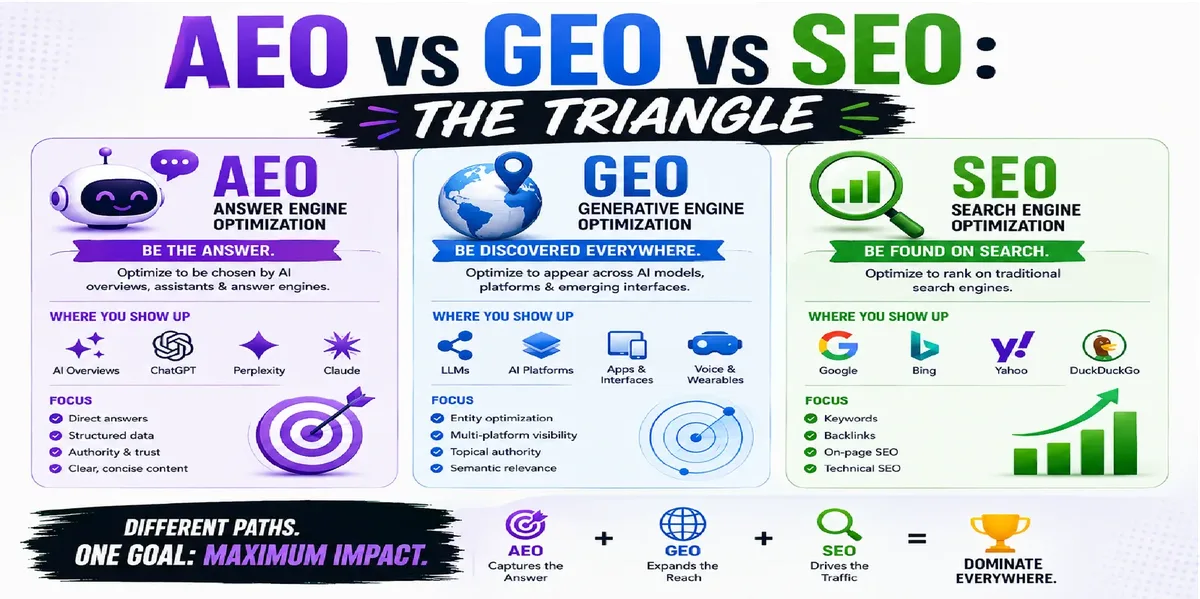
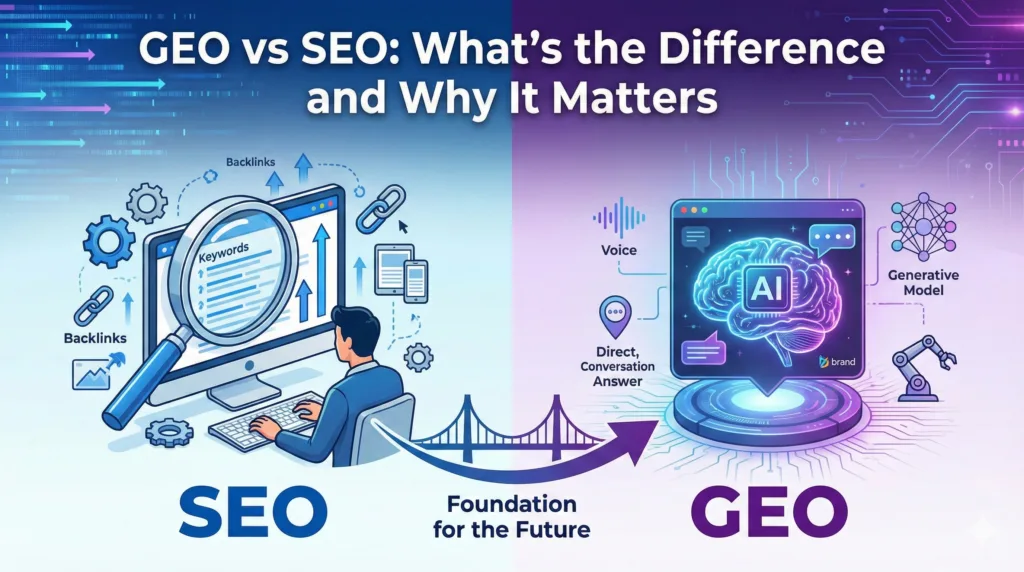
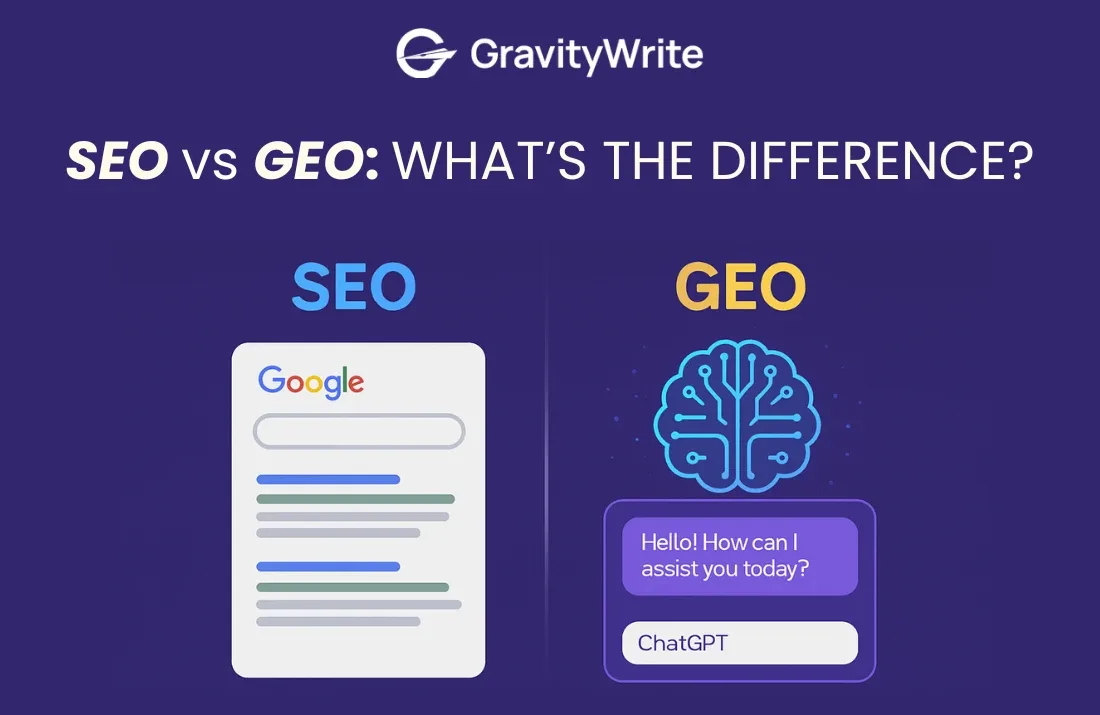
SEO, or search engine optimization, is the practice of making a page rank well in traditional search results. You target keywords, build backlinks, improve page speed, structure your headings, and earn authority signals that push your URL up the rankings.
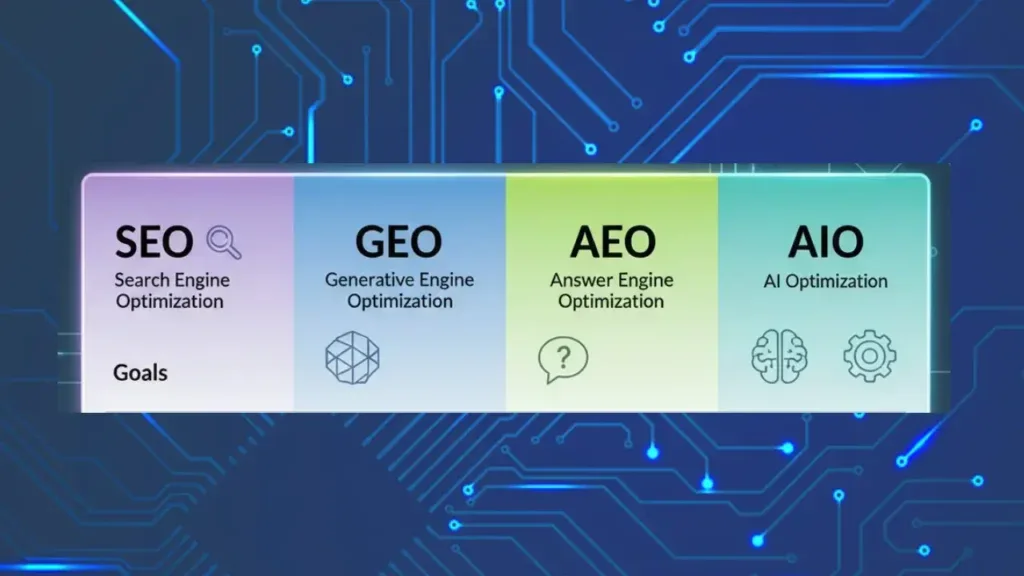
GEO stands for generative engine optimization. It focuses on getting your brand mentioned, cited, or referenced inside AI-generated responses from tools like ChatGPT, Perplexity, Google’s AI Overviews, and Microsoft Copilot.
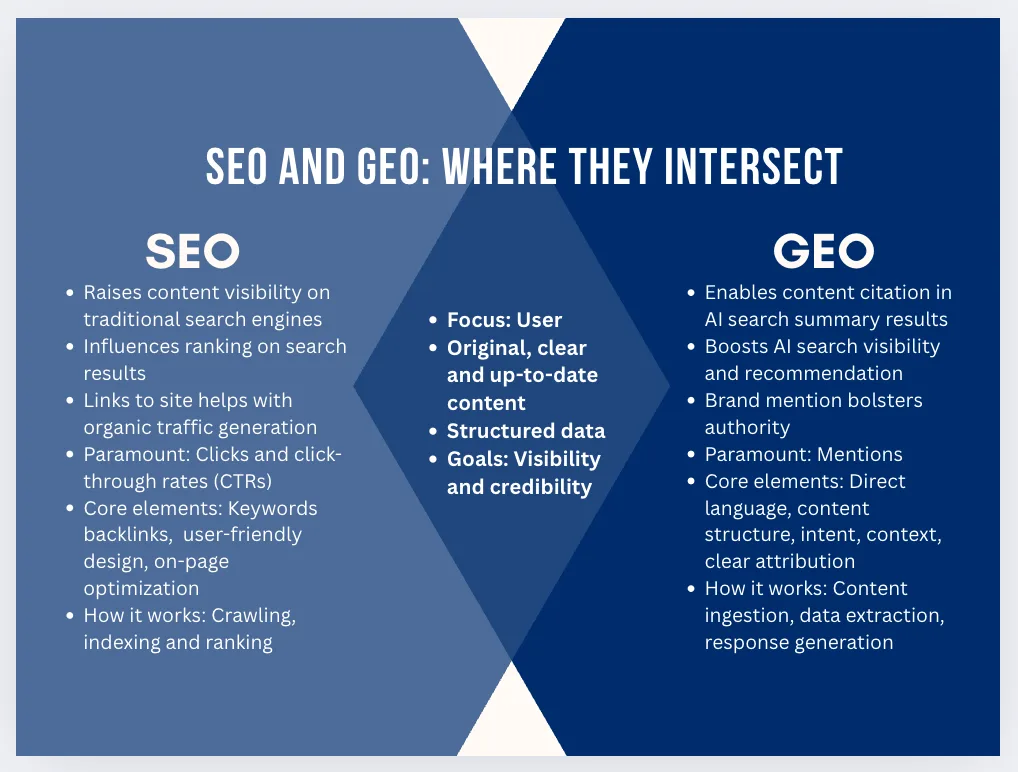
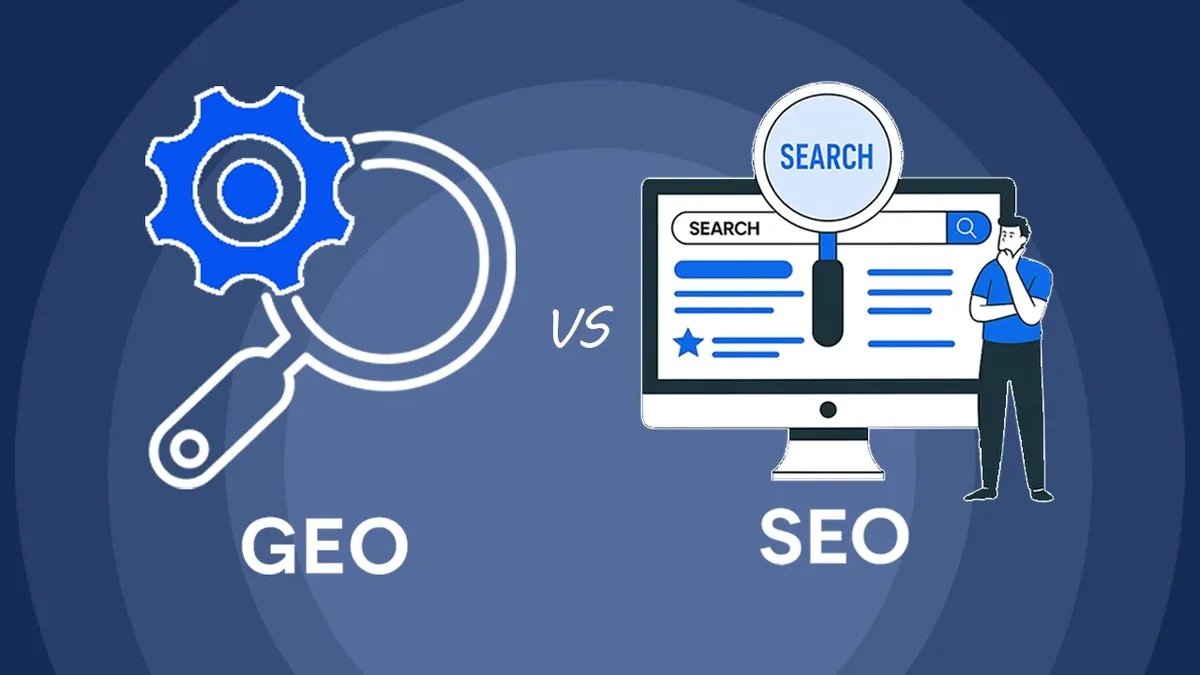
When people frame SEO vs geo as a showdown, they usually mean one thing: do I optimize for the click, or do I optimize for the citation? The truth is messier and more interesting than that binary.
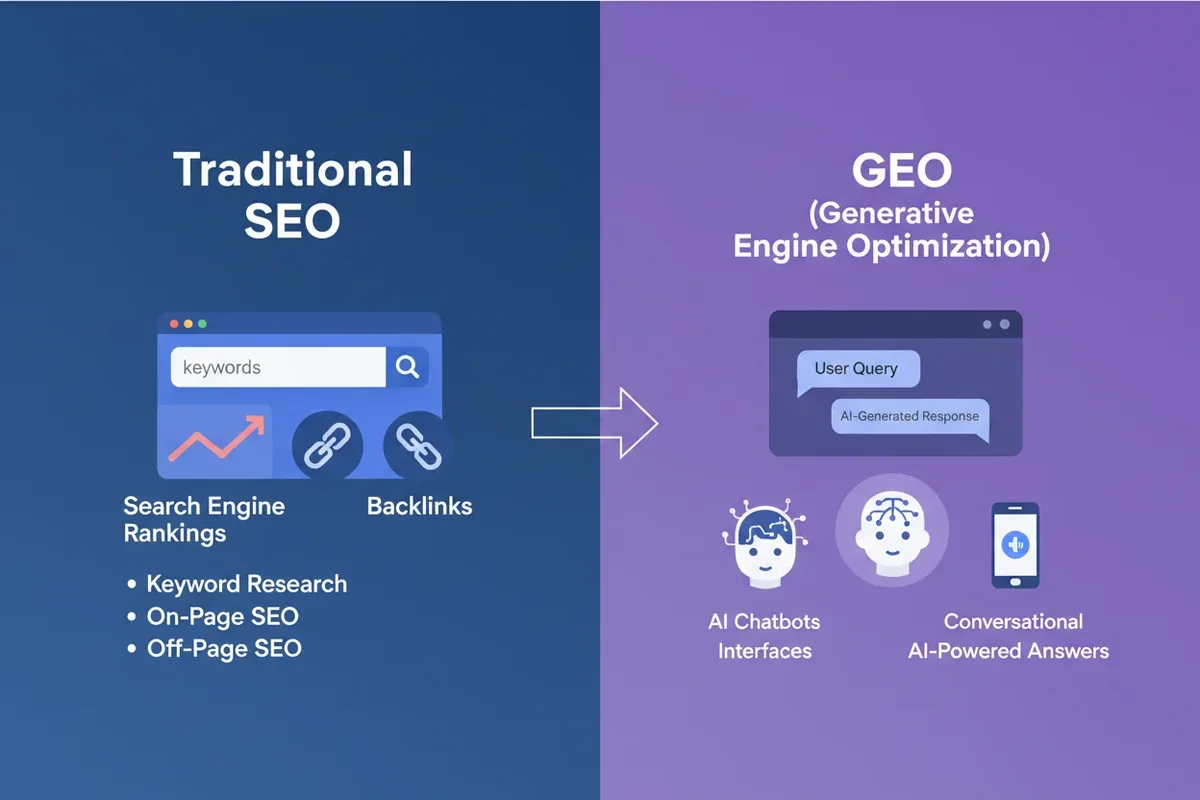
Here’s the practical distinction. Traditional SEO chases a position. GEO chases a mention. Position matters because it drives clicks. Mentions matter because they build trust before the click ever happens.
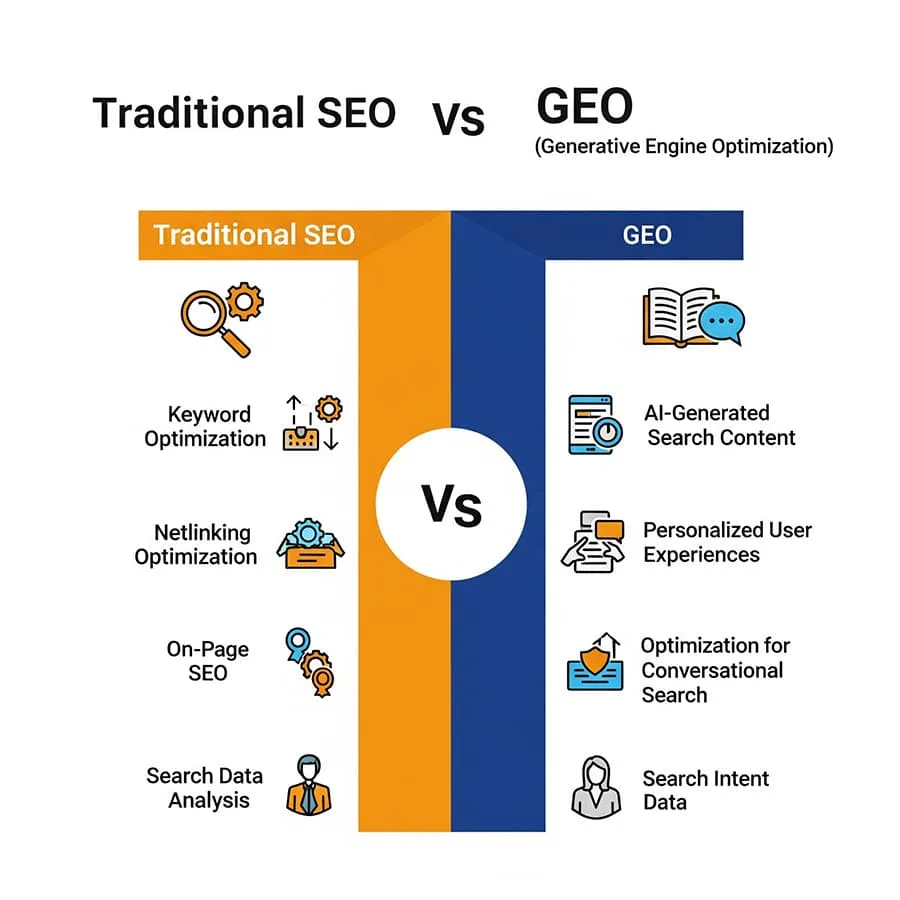
Think of it like a restaurant. SEO is getting your sign visible on a busy street. GEO is getting a well-known food critic to name-drop your kitchen in a review. Both bring diners, but through completely different mechanisms.
The Core Differences Between SEO and GEO
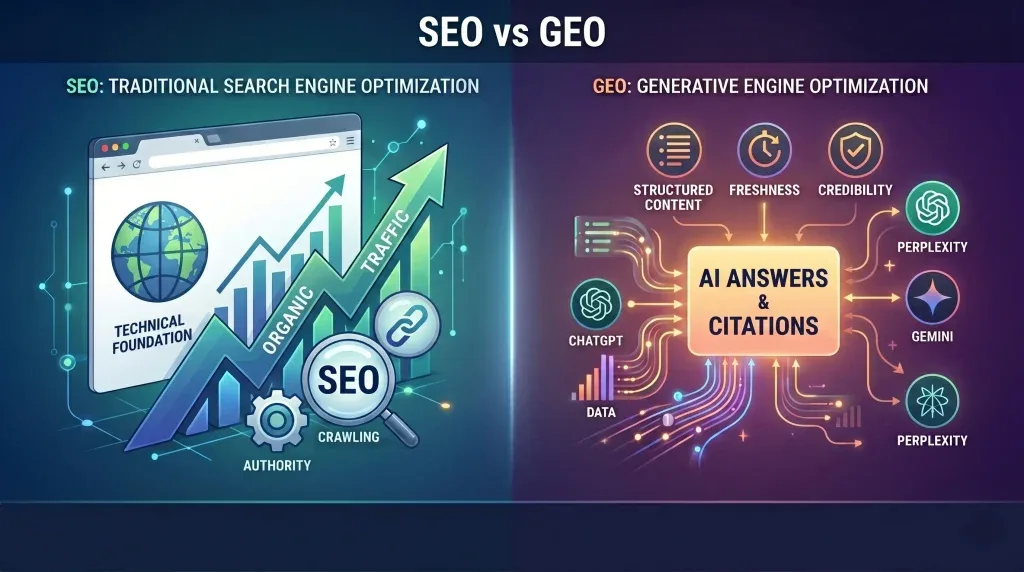
Understanding SEO vs geo requires looking at how each system decides what to surface. Classic search engines rank documents. Generative engines synthesize answers from multiple documents and then attribute them.
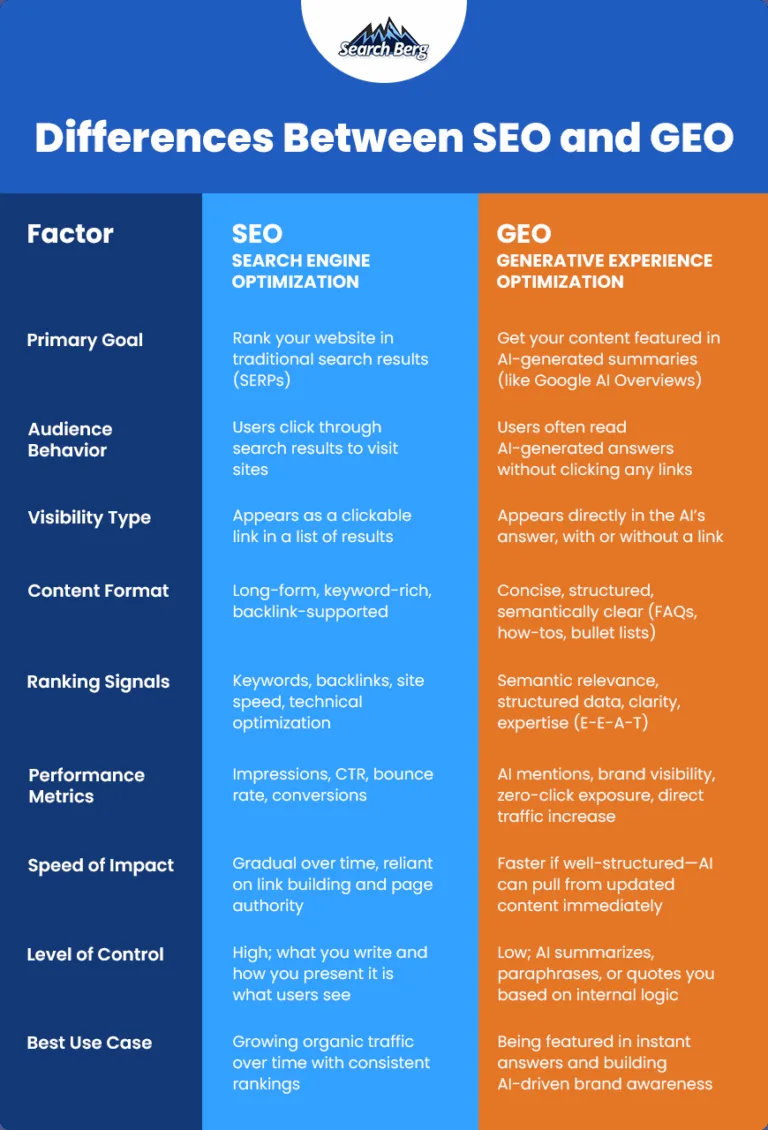
That single difference cascades into everything else: what you optimize, how you measure success, and which content formats win. Let me break down the contrast point by point.
Ranking Documents versus Synthesizing Answers
A search engine returns a list. You, the user, do the synthesis by clicking through results and comparing them. The engine’s job is ordering, not explaining.
A generative engine does the synthesis for the user. It reads across sources, merges facts, and produces a single coherent response. Your content becomes an ingredient rather than a destination.
This is the heart of SEO vs geo. In one model you compete for a slot. In the other you compete to be the ingredient the model reaches for when it cooks an answer.
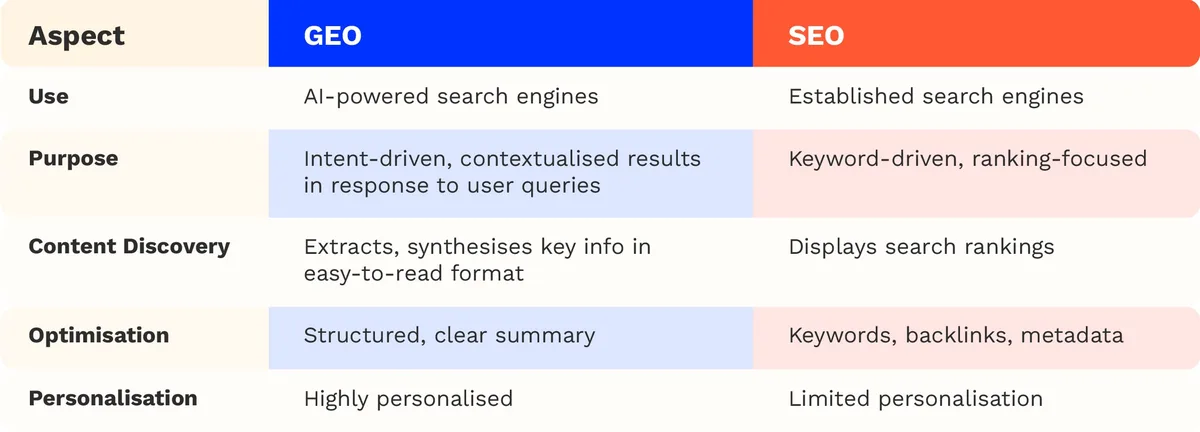
Practically, that means extractable facts beat flowery prose. A clear definition, a numbered stat, or a crisp comparison table is far easier for a model to lift and cite than a rambling 300-word intro.
Click Metrics versus Citation Metrics
SEO success lives in clicks, impressions, click-through rate, average position, and conversions. You can watch these move in Search Console and analytics dashboards.
GEO success is fuzzier. You track brand mentions inside AI answers, citation frequency, share of voice across prompts, and referral traffic from AI tools that include source links.
Neither metric set is superior. But confusing them leads to bad decisions. A page can rank number one and still never get cited by an AI engine if its content is hard to quote.
In my experience running content audits, the pages that win both battles share one trait: they state the answer plainly and early, then elaborate. That single habit improves SEO vs geo performance simultaneously.
Why GEO Emerged and Why It Matters Now
GEO did not appear because someone wanted a new acronym. It appeared because user behavior shifted. A growing slice of searches now end without a click, resolved entirely inside an AI summary.
When the answer arrives before the click, the old funnel breaks. Awareness, consideration, and even purchase research can happen inside a chat window where your website never loads.
That is why SEO vs geo is not academic. If your brand is absent from those AI answers, you are invisible at the exact moment a buyer is forming an opinion.
Consider a real pattern I have seen with B2B software buyers. They ask an AI assistant to compare three tools. The assistant names two and skips the third. That third vendor lost a deal without a single search result being clicked.
GEO is the discipline of making sure you are one of the names that gets mentioned. It is defensive and offensive at the same time.
How SEO and GEO Actually Overlap
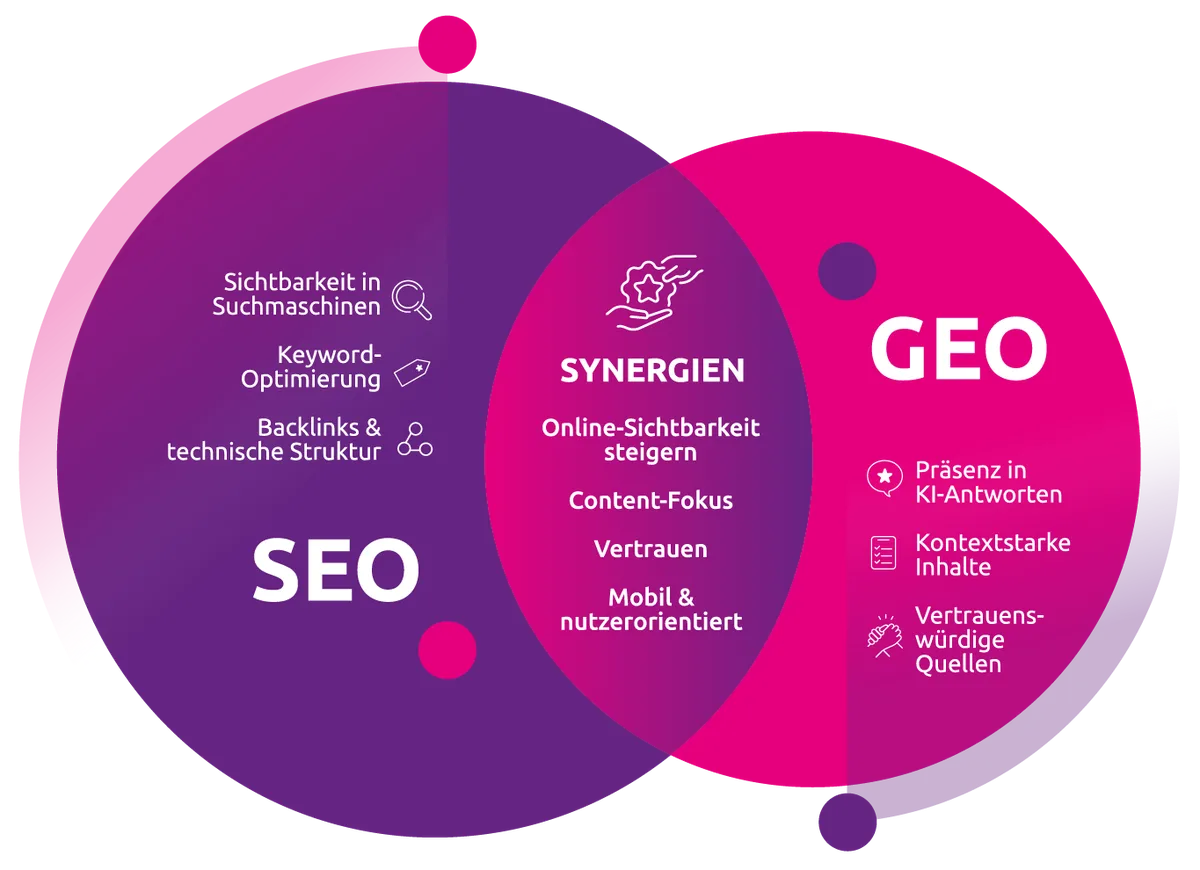
Here is the part most hot takes miss. SEO and GEO are not enemies. They share a foundation, and strong SEO usually makes GEO easier.
AI engines pull from indexed, crawlable, authoritative sources. If your page is not indexed or not trusted, it will not be cited. That is pure SEO groundwork paying GEO dividends.
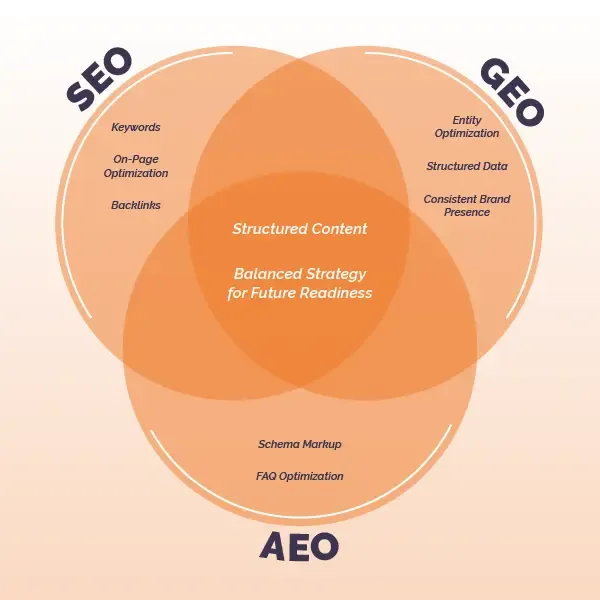
So when you compare SEO vs geo, remember that roughly seventy percent of the work is shared. The remaining thirty percent is where the strategies diverge and where most teams leave money on the table.
Clean technical structure, fast load times, and solid internal linking help both. Original data and clear authorship help both. The divergence shows up in formatting and intent matching.
Technical Foundations That Serve Both SEO and GEO
Before you split your budget between two strategies, get the shared plumbing right. Neither search engines nor AI crawlers can cite what they cannot read.
This is the unglamorous layer, and it is where I see the most avoidable losses. Teams chase shiny GEO tactics while their site blocks AI crawlers by accident.
Crawlability for Search Bots and AI Bots
Check your robots.txt file. Many sites inadvertently block GPTBot, PerplexityBot, or Google-Extended, which prevents AI systems from using their content.
If you want AI visibility, you generally need to allow these crawlers. That is a deliberate business decision, not a default. Weigh the tradeoffs honestly.
On the SEO side, standard crawlability still rules. Clean sitemaps, logical URL structures, and no orphan pages keep you eligible for both worlds.
The SEO vs geo conversation gets a lot simpler once you confirm that both bot families can actually reach your content. Fix access first, optimize second.
Structured Data and Entity Clarity
Schema markup helps search engines understand your content, and it also helps AI systems extract facts with confidence. Article, FAQ, and Product schema all earn their keep.
Beyond markup, be consistent about your entity. Use the same brand name, the same author bios, and the same descriptions everywhere. Ambiguity kills citations.
If AI models cannot confidently identify who you are and what you do, they will cite someone clearer. Entity clarity is quietly one of the biggest levers in SEO vs geo.
Content Strategy Differences: Keywords versus Prompts
SEO starts with keywords. You research search volume, difficulty, and intent, then map terms to pages. GEO starts with prompts, the actual questions people type into AI tools.
These are related but not identical. A keyword is often two to four words. A prompt is a full sentence, sometimes a paragraph, loaded with context and constraints.
When you study SEO vs geo from a content planning angle, you quickly notice that prompts reveal intent more richly than keywords ever did.
Someone searching “best CRM” gives you little. Someone prompting “best CRM for a ten-person agency that needs invoice automation and hates annual contracts” gives you a blueprint.
Mapping Prompts to Content
Build a prompt library alongside your keyword list. Collect the real questions your customers ask sales, support, and each other.
Group those prompts by theme, then create content that answers them directly. Each answer becomes a citable asset for generative engines.
This is where SEO vs geo planning pays off. Your keyword pages still rank, and your prompt-answering sections get quoted. One content set, two jobs.
Long-Tail and Conversational Queries
Conversational queries are the bridge between classic SEO and GEO. They are longer, more specific, and closer to how people actually talk.
Optimize for them by writing in plain language. Use the exact phrasing a customer would use, then answer it in the very next sentence.
Do this consistently and you cover both SEO vs geo fronts without writing separate content for each. Efficiency compounds when the formats align.
Formatting for Citations: How to Get Quoted by AI
AI engines love content they can lift cleanly. That means short, self-contained statements that survive being pulled out of context.
If your key insight is buried in paragraph six after three anecdotes, a model may skip it. Lead with the answer, then support it.
This formatting discipline is one of the clearest practical differences in SEO vs geo. Traditional SEO tolerated slow buildups. GEO punishes them.

Answer-First Structure
Open each section with a direct response to the implied question. One or two sentences. Then expand with detail, examples, and nuance.
This mirrors how featured snippets work, which is convenient. The habits that win snippets also win AI citations.
So the SEO vs geo gap narrows again. Answer-first writing is a shared best practice that happens to serve both systems beautifully.
Tables, Lists, and Extractable Facts
Structured formats are citation magnets. Tables compare options. Numbered lists sequence steps. Both are easy for a model to parse and reuse.
Include specific numbers whenever you can. “Reduces load time by 40 percent” is far more citable than “significantly faster.”
Across the SEO vs geo divide, specificity wins. Vague claims get ignored by humans and machines alike.
Comparison Table: SEO vs GEO at a Glance
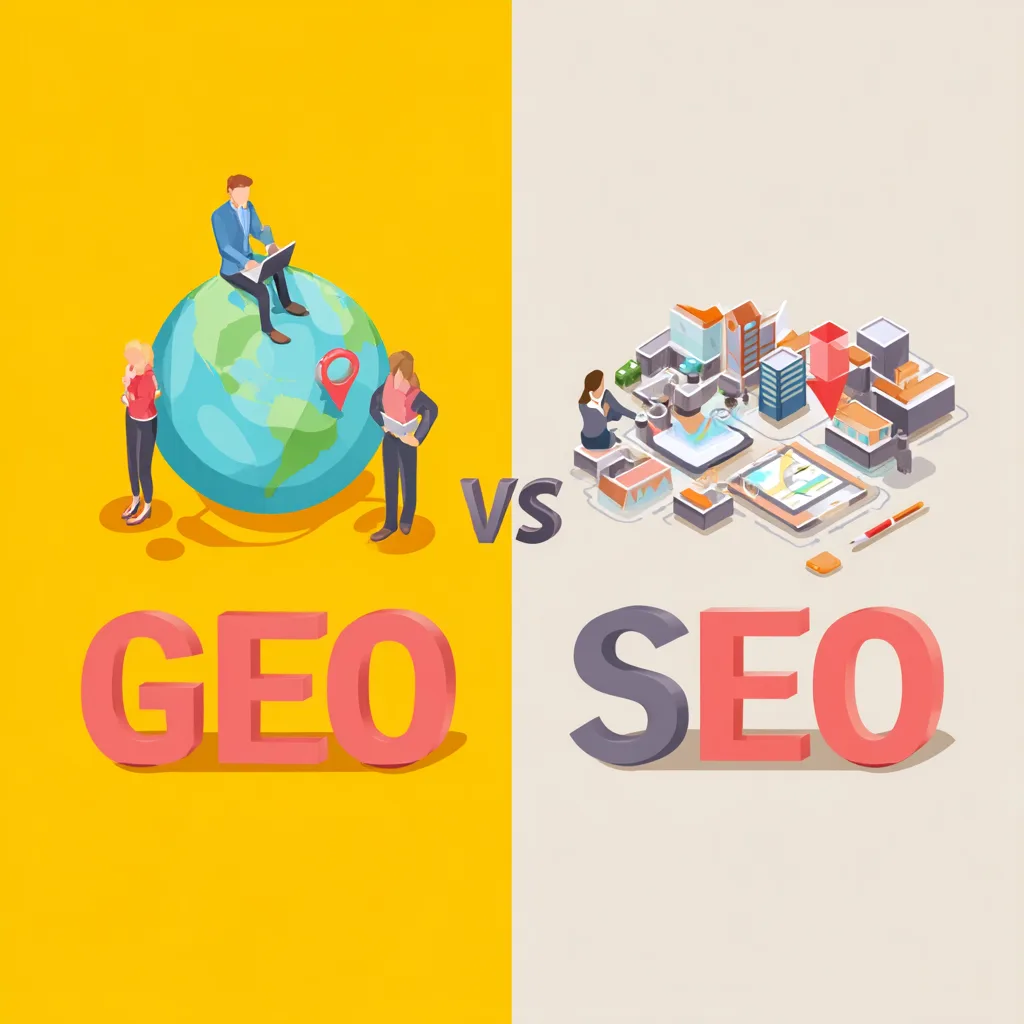
Sometimes a table says more than a thousand words. Here is the SEO vs geo contrast condensed into a single reference you can screenshot and share with your team.
| Factor | Traditional SEO | Generative Engine Optimization (GEO) |
|---|---|---|
| Primary Goal | Rank high and earn clicks | Get cited inside AI-generated answers |
| Core Unit | The ranked document | The synthesized answer and its sources |
| Key Metric | Position, CTR, conversions | Mentions, citations, share of voice |
| Content Style | Comprehensive, keyword-aligned | Answer-first, extractable, factual |
| Main Lever | Backlinks and authority | Clarity, structure, and entity trust |
| Discovery Input | Keywords | Natural-language prompts |
| Success Window | Weeks to months | Variable, often faster for fresh facts |
Read that table and the SEO vs geo relationship becomes obvious. They are two lenses on the same underlying goal: being the source people trust.
How to Optimize for SEO and GEO Together
You do not need two teams or two content calendars. You need one strategy with dual outputs. Let me walk through the workflow I actually use.
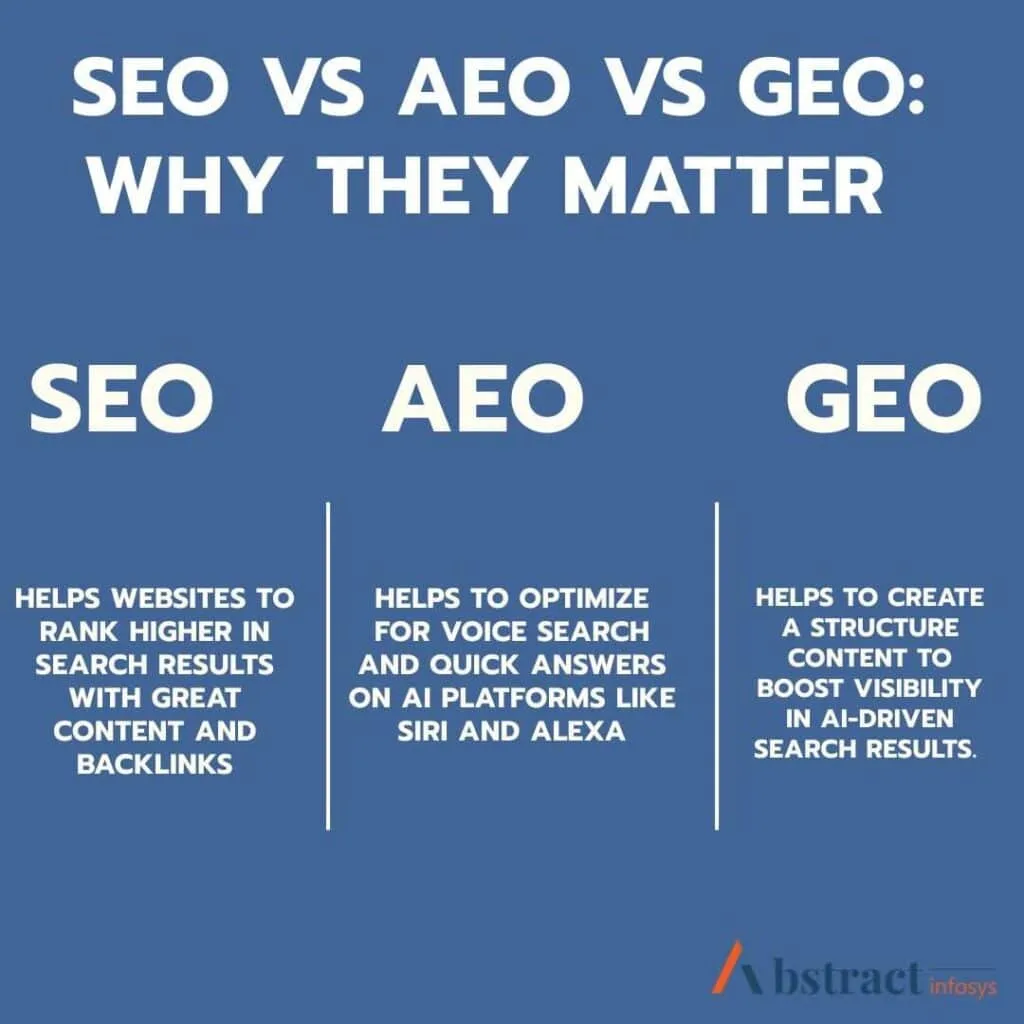
Start with research that feeds both. Pull keywords for ranking potential and prompts for citation potential. Merge them into a single topic map.
Then write content that ranks and gets quoted. The next sections break this into concrete, repeatable steps.
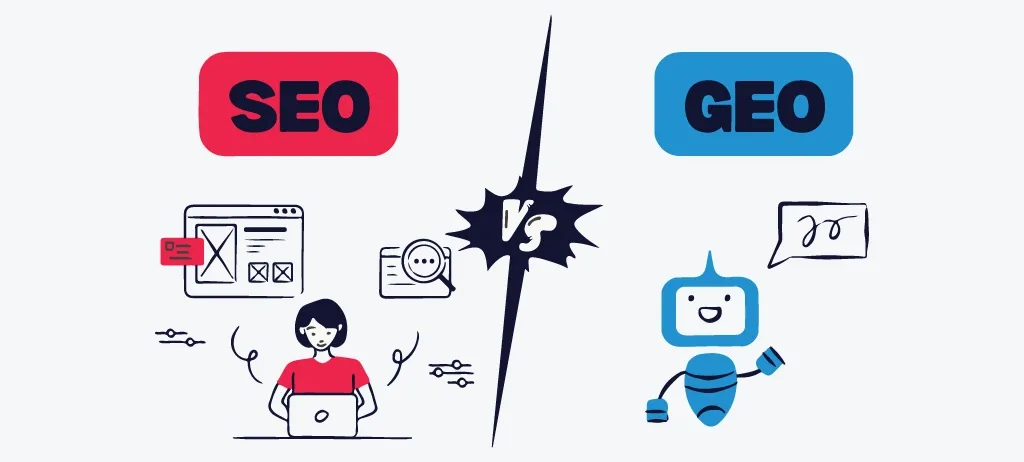
Step 1: Build a Unified Keyword and Prompt Map
List your target keywords with volume and difficulty. Alongside them, list the prompts customers type into AI tools.
Match each prompt to a keyword where possible. Where they overlap, you have a high-value topic that serves SEO vs geo at once.
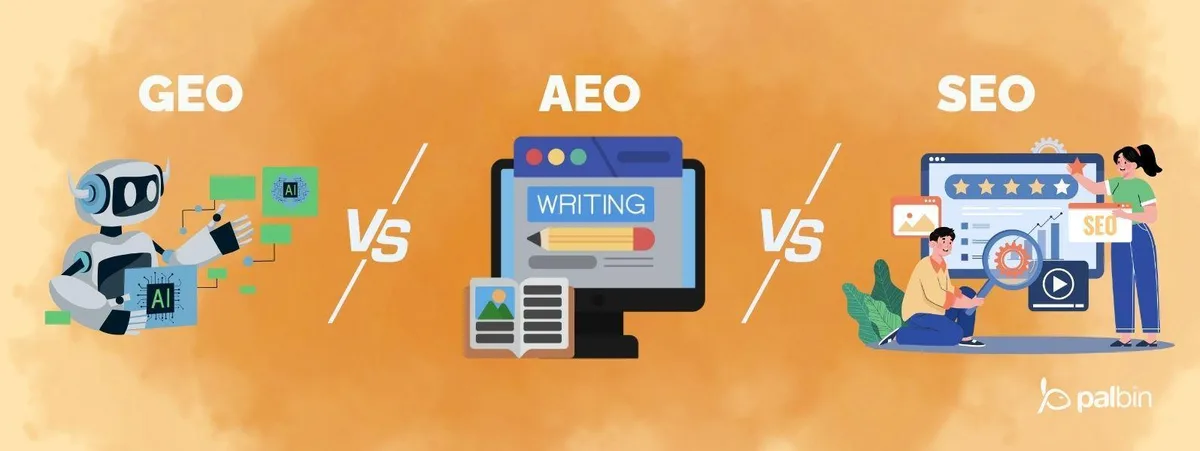
Where they diverge, note it. A prompt with no matching keyword often signals an emerging need worth owning early.
Step 2: Write Answer-First, Then Go Deep
For every section, write the direct answer in the first two sentences. Follow with evidence, examples, and edge cases.
This satisfies skimmers, search snippets, and AI extractors simultaneously. It is the single highest-leverage habit in SEO vs geo.
Keep paragraphs short. Two to three sentences maximum. Long walls of text get skipped by readers and parsed poorly by models.
Step 3: Add Original Data and Specific Examples
Original data is GEO gold. Surveys, internal benchmarks, and first-hand tests give AI engines something they cannot find elsewhere.
Cite your own numbers. “In our tests across twelve client sites, answer-first rewrites lifted AI citations by a measurable margin.” That kind of line gets quoted.
For the SEO vs geo balance, original data also earns backlinks, which strengthens the traditional side. One asset, two wins.

Step 4: Strengthen Entity and Author Signals
Make it obvious who wrote the content and why they are credible. Detailed author bios, credentials, and consistent naming all help.
AI systems weigh trust heavily when choosing sources. A recognizable, verifiable entity gets cited more often than an anonymous page.
This is a quiet but powerful lever in SEO vs geo. Authority signals travel well across both systems.
Common Mistakes When Balancing SEO and GEO
Plenty of teams get this wrong, and the errors repeat. Knowing them saves you months of wasted effort.
The biggest mistake is treating SEO vs geo as an either-or choice. Abandoning SEO for GEO throws away the foundation GEO depends on.
The second biggest is chasing AI mentions with thin, hype-driven content. Models and readers both punish emptiness.
Mistake: Blocking AI Crawlers by Default
Many sites unknowingly block the very bots that could cite them. Audit your robots.txt and server rules before anything else.
If blocking is intentional, fine. But do it deliberately, not by accident. Silent blocks are the most expensive SEO vs geo error I see.
Mistake: Ignoring Traditional Rankings
Some teams assume AI answers make rankings irrelevant. Not true. AI engines frequently pull from top-ranking, well-indexed pages.
Strong rankings feed citations. Weak rankings starve them. The SEO vs geo relationship is more symbiotic than competitive.
Mistake: Writing for Machines Only
Over-optimizing for extraction produces robotic, lifeless content. Humans still decide whether to trust and share it.
Balance matters. Write for people first, structure for machines second. That order keeps SEO vs geo working in your favor.
Measuring Success Across SEO and GEO
You cannot improve what you do not track. Set up measurement for both sides, even if the GEO metrics are imperfect.
Traditional SEO metrics are mature. Use Search Console for position and CTR, and analytics for conversions. That part is familiar.
GEO measurement is younger. You will need manual prompt testing, brand mention monitoring, and referral tracking from AI tools.
Tracking AI Citations Manually
Run a fixed set of prompts weekly across major AI tools. Record whether your brand appears and in what context.
Log the results in a simple sheet. Over time, patterns emerge about which content earns citations and which does not.
This manual tracking is tedious but revealing. It turns SEO vs geo from a debate into a measurable experiment.
Referral Traffic from AI Platforms
Some AI tools send referral traffic when they link sources. Watch your analytics for these referrers.
Even small volumes matter because these visitors arrive pre-qualified. They already read a summary and chose to dig deeper.
Combine referral data with citation logs for a fuller SEO vs geo picture. Neither metric alone tells the whole story.
Tools and Tactics for Each Discipline
Your toolkit shifts depending on which side you are optimizing. Some tools serve both; others are specialized.
For SEO, you rely on rank trackers, backlink analyzers, and technical audit platforms. These are well established.
For GEO, the tooling is newer. Prompt-monitoring dashboards and AI visibility trackers are emerging fast, though none are perfect yet.
SEO Tooling Essentials
Keyword research platforms, crawl tools, and analytics suites form the SEO backbone. Add schema validators for structured data.
These tools help you rank, and ranking helps you get cited. The SEO vs geo overlap means SEO tools quietly support GEO too.
GEO Tooling and Manual Methods
AI visibility trackers monitor how often your brand appears in generated answers. They are useful but still maturing.
Supplement them with manual prompt testing. Nothing beats running the actual queries your customers use.
Treat SEO vs geo tooling as complementary. Use mature SEO tools for the foundation and lean GEO methods for the frontier.
Real-World Scenarios: SEO vs GEO in Action
Abstract advice only goes so far. Let me show how SEO vs geo plays out in situations you might recognize.
These scenarios are drawn from patterns I have observed across content and marketing teams. They are illustrative, not hypothetical fluff.
Scenario: a Local Service Business
A plumbing company ranks well for “emergency plumber near me.” That handles classic SEO and drives calls.
But when someone asks an AI assistant “who should I call for a burst pipe tonight,” the assistant names two competitors. The plumber is absent.
Fixing this means publishing clear, quotable service pages and earning local citations. The SEO vs geo gap closes when local authority is well documented.
Scenario: a SaaS Comparison Page
A software firm publishes a detailed comparison page. It ranks and also gets cited in AI answers about tool selection.
The page wins because it uses tables, clear feature lists, and direct answers. Those formats serve SEO vs geo at the same time.
Contrast that with a competitor’s vague, salesy page. It ranks lower and never gets quoted. Format decided the outcome.
Scenario: a Publisher Chasing Traffic
A media site watched organic clicks dip as AI summaries absorbed simple queries. Panic set in.
The recovery came from doubling down on original reporting and analysis, the kind AI cannot synthesize from nothing.
Original depth is the moat in SEO vs geo. Commodity content gets summarized away; unique insight gets cited and clicked.
Building a Team and Workflow for Both
You do not need to hire a separate GEO department. You need your existing team to add a few habits.
Writers should learn answer-first structure. Editors should enforce extractable formatting. SEO leads should add prompt research to their routine.
Small workflow tweaks beat big reorganizations. The SEO vs geo shift is a mindset change more than a staffing one.
Skills to Develop
Prompt research, structured writing, and AI visibility tracking are the new core skills. None are exotic.
Anyone who can write a clear FAQ can learn to write for generative engines. The bar is clarity, not technical wizardry.
Invest in training here and your SEO vs geo execution improves without new headcount.
Workflow Integration
Add a prompt-mapping step to your content briefs. Add a citation check to your publishing checklist.
These additions take minutes and compound over dozens of articles. Consistency is what moves SEO vs geo metrics.
Predictions and the Road Ahead
Search and generative answers will keep converging. The line between ranking and being cited will blur further.
Expect AI engines to lean harder on trusted, structured, original sources. That favors teams doing SEO vs geo well today.
Also expect measurement to improve. Better GEO analytics will make the discipline easier to justify and scale.
The winners will be those who treat SEO vs geo as one craft with two outputs, not two warring camps.
Frequently Asked Questions About SEO vs GEO
These are the questions I hear most often when teams start wrestling with SEO vs geo. Short, direct answers below.
Is GEO Replacing SEO?
No. GEO builds on SEO foundations. Ranking and indexing still matter because AI engines pull from trusted, crawlable sources.
Think of SEO vs geo as evolution, not replacement. The fundamentals carry forward; the surface changes.
Can a Small Site Win at GEO?
Yes, often more easily than at traditional SEO. AI engines value clarity and originality over raw domain authority.
A small site with sharp, well-structured answers can get cited alongside much larger competitors. That is the promise of SEO vs geo done right.
How Do I Know if AI Tools Cite My Brand?
Run your key prompts manually across major AI tools and log the results. Supplement with AI visibility trackers.
Over time you will see which pages earn mentions. This feedback loop sharpens your this practice strategy fast.
Does GEO Require Different Content?
Mostly no. The same content can serve both if it is structured well. Answer-first writing and clear formatting do the heavy lifting.
Occasionally you may add a dedicated FAQ or comparison table. But the core this practice content overlaps heavily.
What is the Biggest GEO Mistake?
Blocking AI crawlers without realizing it. Check your robots.txt before chasing any other tactic.
After that, the second biggest error is thin, hype-driven content. Depth and clarity win in this practice every time.
Final Thoughts on Optimizing for SEO and GEO
The this approach debate is really a question about where attention lives. Some of it lives in ranked results, and some now lives inside generated answers.
Smart teams stop choosing sides. They build one strong content foundation, format it for extraction, and measure both clicks and citations.
Start small. Audit your crawler access, rewrite one key page answer-first, and run a handful of prompt tests this week. Those three moves will teach you more about this approach than any theory.
Search will keep shifting. But clarity, originality, and trust remain the constants that win in both worlds, and that is the real lesson hiding inside SEO vs geo.
For verified reference and background research, consult the authoritative informational resource on this topic.