If you want to maximize conversion value, you have to stop treating every click as if it were worth the same amount of money. That single shift in mindset separates advertisers who merely survive on Google Ads from those who consistently turn a modest budget into a revenue machine.
Most accounts I audit still optimize toward a flat cost-per-conversion target. They celebrate when the cost per lead drops, then scratch their heads when revenue stays flat. The reason is simple: a lead worth five dollars and a lead worth five hundred dollars look identical to a bidding system that only cares about counting conversions. When you train Google’s algorithms to chase value instead of volume, the entire economics of your account change.
This guide walks through the mechanics, the settings, and the field-tested tactics that let you maximize conversion value without torching your budget or losing control of your campaigns. Grab a coffee, because we’re going deep.
What “Maximize Conversion Value” Actually Means in Google Ads
Maximize conversion value is a Smart Bidding strategy that tells Google to spend your budget in a way that generates the highest possible total revenue, not the highest possible count of actions.

You feed the system a monetary value for each conversion, and it learns which auctions, devices, geographies, and times of day produce the most valuable outcomes.
The distinction matters more than most people realize. A traditional Maximize Conversions strategy treats a newsletter signup and a five-figure enterprise deal as equals. That’s fine if every conversion is genuinely worth the same. It’s catastrophic if your business has any spread in customer value, which nearly every business does.
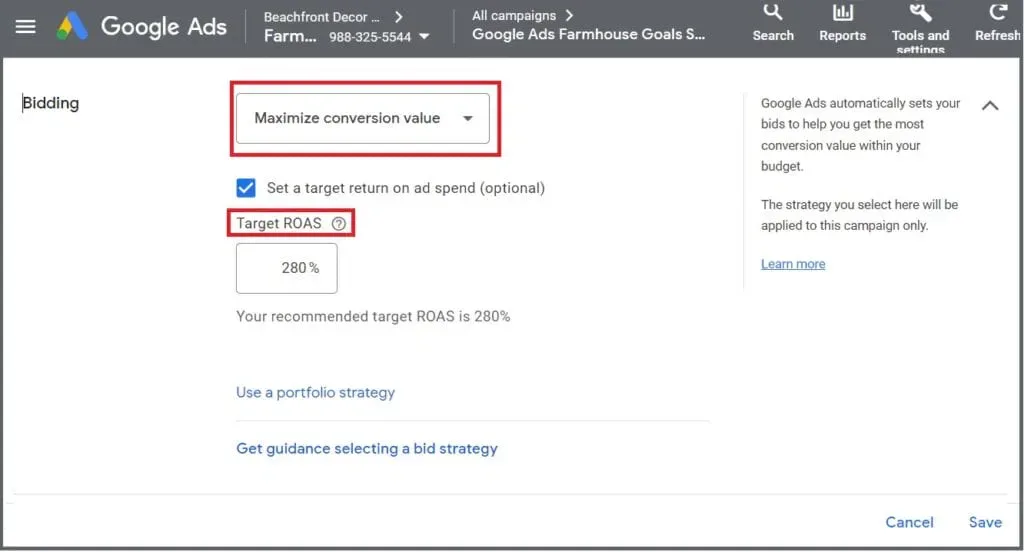
When you switch to a value-based approach, you essentially hand the algorithm a ranking problem: “Find me the clicks most likely to produce revenue, and pay whatever it takes within my target.” The machine gets remarkably good at this once it has enough data, but it needs three things from you to work properly: accurate conversion values, a realistic target ROAS, and enough conversion volume to learn from.
Focusing on maximize conversion value provides clear direction here. Miss any one of those, and you’ll wonder why your results look erratic.
How the Bidding Algorithm Ranks Your Auctions
Under the hood, Google uses a concept called “expected conversion value” when deciding whether to enter an auction and how aggressively to bid. Focusing on maximize conversion value provides clear direction here. It multiplies the predicted conversion rate by the predicted value of that conversion, then compares the result against your target. If the expected value clears the bar, it bids. If not, it sits out.

This is why a well-fed value campaign will happily pay a premium for a click from a high-intent searcher while ignoring cheaper clicks that historically convert into low-value customers. Refining each detail of your maximize conversion value strengthens this section.
The algorithm isn’t being wasteful when it spends more per click. It’s being efficient with the value it expects to recover.
The practical takeaway: your job is to give the system honest signals. Garbage values in, garbage bids out. I’ve seen accounts double their return on ad spend simply by fixing the value data flowing into the conversion tracking, with zero changes to keywords, ads, or landing pages.
Why Value-Based Bidding Beats Volume-Based Bidding
Let’s talk numbers, because this is where the argument becomes hard to ignore. Effective execution in your maximize conversion value makes a tangible difference. Imagine you run an online store where most orders land around forty dollars, but a small segment of customers buys in bulk at four hundred dollars or more.
If you optimize purely for conversion count, the algorithm will chase the cheap, frequent buyers because they’re easier to acquire.
Your conversion count climbs. Your cost per conversion looks great. Meanwhile, your actual revenue barely moves, because you’re winning the customers who were never going to move the needle. Flip this maximize conversion value strategy to value-based bidding and the algorithm starts hunting for the bulk buyers, even if they cost more to acquire.
Here’s a quick comparison to make the trade-off concrete:
| Metric | Maximize Conversions | Maximize Conversion Value |
|---|---|---|
| Primary goal | Highest number of actions | Highest total revenue |
| Conversion value data | Optional | Required |
| Typical best fit | Lead gen with uniform value | E-commerce, tiered lead gen |
| Bidding control | Target CPA | Target ROAS |
| Risk of low-value focus | High | Low |
| Data requirement | Moderate | Higher |
Neither strategy is universally superior. If every conversion you get is worth roughly the same, volume bidding is perfectly rational. But the moment your customer values diverge, value-based bidding becomes the smarter play, and the gap widens as your business grows.
Setting Up Conversion Values the Right Way
Before you can maximize conversion value, you need to tell Google what each conversion is worth. This is the foundation, and it’s where most setups quietly fall apart. There are a few ways to assign values, and the right choice depends on your data maturity.
The simplest method is a static value: assign every conversion the same dollar amount, like fifty dollars for a demo request. A thoughtful approach to maximize conversion value reinforces your qualifications. It’s better than nothing, but it ignores the reality that some demos turn into huge deals and others fizzle.
A more advanced method pulls the actual transaction value from your e-commerce platform or CRM, so each conversion carries its true revenue figure.
The most sophisticated approach uses predicted lifetime value, weighting conversions by how much a customer is likely to spend over time. Structuring your maximize conversion value around proven patterns ensures impact. That requires solid historical data and some modeling, but it’s the closest you’ll get to teaching the algorithm your real economics.
Static, Dynamic, and Predicted Values Compared
Static values are easy to deploy and easy to understand, but they flatten important differences. Refining each detail of your maximize conversion value strengthens this section. Dynamic values, pulled directly from your order management system, capture the real spread in transaction sizes and give the algorithm far richer signals.
Predicted values go a step further by estimating future revenue, which is invaluable for subscription businesses or any model where the first purchase is just the beginning of the relationship. Applying these principles to your maximize conversion value yields measurable results. The trade-off is complexity and the need for clean historical data.
My honest advice: start static if you’re new, move to dynamic as soon as your tracking allows, and only chase predicted values once you have thousands of conversions and a reliable way to model lifetime spend. Trying to jump straight to the most advanced method usually produces noisy data that hurts more than it helps.

Choosing the Right Target ROAS
Target ROAS is the number that tells Google how much revenue you want back for every dollar spent. Proper attention to your maximize conversion value sets a strong baseline. Set it too high and the algorithm will barely bid, starving your campaigns of traffic. Set it too low and you’ll overspend on marginal conversions that don’t justify the cost.
The trick is to anchor your target to reality, not ambition. Pull your historical return on ad spend over a meaningful window, then set your target slightly below that figure to give the algorithm room to learn. Chasing an aspirational number on day one is one of the most common reasons campaigns stall.
I usually recommend starting about ten to fifteen percent below your trailing average, then nudging it upward as performance stabilizes. This gradual approach lets you maximize conversion value without the whiplash of a target that’s disconnected from what’s achievable.
Reading the Signals When Your Target is Off
If your campaign suddenly stops spending, your target ROAS is probably too aggressive. Developing your maximize conversion value with precision highlights key strengths. The algorithm is telling you it can’t find profitable auctions at that bar, so it’s sitting out. Lower the target and watch whether spend recovers.
If spend is healthy but revenue is soft, the opposite is true. Effective execution in your maximize conversion value makes a tangible difference. Your target is too lenient, and you’re buying conversions that don’t pay for themselves. Tighten it and monitor the impact over at least a week before judging.
The key is patience. Clear alignment with your maximize conversion value builds confidence from the start. Smart Bidding needs time to recalibrate after any change, so resist the urge to tinker daily. Give each adjustment a fair window, then decide.
Feeding the Algorithm Quality Data
Value-based bidding lives or dies on data quality. If your conversion tracking double-counts, misses offline sales, or attributes revenue to the wrong source, the algorithm learns the wrong lessons. You can’t maximize conversion value on a broken foundation.
Start by auditing your conversion actions. Are you counting a “add to cart” event alongside a completed purchase? That inflates your conversion count and confuses the value signals. Separate micro-conversions from macro-conversions and only feed the valuable ones into your bidding strategy.
Then close the loop on offline conversions. Integrating maximize conversion value into your workflow produces consistent quality. If leads turn into sales in your CRM days or weeks later, upload those values back into Google Ads so the algorithm can connect the dots.
This single step often produces the biggest gains in value-based campaigns, because it teaches the system which early signals predict real revenue.
Connecting Offline Revenue to Online Clicks
For businesses with long sales cycles, the online click is just the start. Maintaining clarity across your maximize conversion value remains essential. A form fill might take thirty days to become a signed contract, and without that feedback, the algorithm never learns which clicks produced the winners.
Using offline conversion imports, you can push the final deal value back into the campaign, tagged with the original click identifier. Targeted refinements to your maximize conversion value streamline the entire review. Over time, this creates a feedback loop where the bidding system gets smarter about which early behaviors predict high-value customers.
It takes some engineering work, usually through your CRM or a data pipeline, but the payoff is substantial. Accounts that implement offline value tracking routinely see their return on ad spend climb by double-digit percentages within a few months.
Structuring Campaigns for Value Optimization
Your campaign structure either helps or hinders the algorithm’s ability to maximize conversion value. Fragmented accounts with dozens of tiny campaigns starve each one of the data it needs to learn. Consolidated accounts give the system more signal to work with.

As a rule, group campaigns by shared value characteristics rather than by every granular difference you can think of. If two product lines have similar margins and similar customer values, they can often live in the same campaign without hurting performance.
That said, don’t over-consolidate either. A thoughtful approach to maximize conversion value reinforces your qualifications. If one segment has radically different economics, keeping it separate lets you apply a distinct target ROAS and avoid cross-contamination of signals.

Segmenting by Margin and Customer Value
A smart segmentation strategy groups keywords and audiences by how much profit they generate, not just how much revenue. A high-revenue product with thin margins isn’t the same as a modest product with fat margins, and the algorithm should know the difference.
By feeding margin-adjusted values into your conversion tracking, you can steer bidding toward the products that actually grow your bottom line. This is how seasoned advertisers maximize conversion value while protecting profitability.
It requires some coordination between marketing and finance, but the clarity it brings is worth the effort. When everyone agrees on what a conversion is truly worth, the whole account aligns around the right goal.
Using Audience Signals to Sharpen Bidding
Audience signals give the bidding algorithm additional context about who’s likely to convert at high value. Structuring your maximize conversion value around proven patterns ensures impact. Layering first-party data, like your customer list or high-value visitor segments, onto your campaigns can accelerate the learning process.

These signals don’t restrict who sees your ads, but they nudge the system toward the users most likely to deliver the outcomes you want. Think of them as hints that help the algorithm find its footing faster, especially in the early weeks of a new campaign.
The most valuable signals usually come from your own data. Maintaining clarity across your maximize conversion value remains essential. If you know which customers spent the most, upload that list and let the algorithm learn from their characteristics.
Building High-Value Audience Segments
Start with your best customers. Export a list of people who spent above a certain threshold, then use it as a signal in your value campaigns. The algorithm will look for similar users in the broader auction pool.

You can also build segments from website behavior, like visitors who viewed high-priced products or spent significant time on pricing pages. Applying these principles to your maximize conversion value yields measurable results. These behavioral signals often correlate strongly with high-value conversions.
Refresh these segments regularly, because customer behavior shifts and stale lists lose their predictive power. A quarterly refresh keeps the signals sharp.
Diagnosing Underperformance in Value Campaigns
When a value campaign underperforms, the cause is usually one of a handful of culprits. Learning-phase volatility, insufficient data, a misaligned target, or broken conversion tracking top the list. Working through them systematically saves you from random tinkering.

First, check your conversion volume. Proper attention to your maximize conversion value sets a strong baseline. Smart Bidding needs a steady stream of conversions to learn, and if you’re getting fewer than a handful per week, the algorithm is essentially guessing. In that case, broaden your targeting or accept that value bidding may not be ready yet.
Next, verify your tracking. A single broken tag can silence the signals the algorithm relies on, and the symptoms look identical to a bidding problem. Always rule out tracking before you touch your targets.
When to Reset the Learning Phase
Significant changes, like swapping your target ROAS by a large margin or overhauling your conversion values, can push a campaign back into the learning phase. That’s normal, but it means a temporary dip in performance.
Avoid stacking multiple big changes at once. Developing your maximize conversion value with precision highlights key strengths. If you change your target and your values in the same week, you won’t know which one caused the shift. Make one change, observe, then decide on the next.
Patience here pays off. Campaigns that are given room to learn typically stabilize into stronger, more predictable performance than those that are constantly adjusted.
Scaling What Works Without Breaking ROAS
Once a value campaign is humming, the temptation is to pour money into it. That can work, but scaling too fast can dilute performance as the algorithm reaches into less profitable auctions. The art is to grow spend while protecting your return.
Increase budgets gradually, in increments of ten to twenty percent, and watch how the return holds up. Clear alignment with your maximize conversion value builds confidence from the start. If it stays within your tolerance, keep going. If it drops sharply, you’ve found the ceiling for that campaign’s current setup.

You can also scale by expanding into new geographies or audiences that resemble your winners, rather than simply raising bids on the same pool. This approach lets you maximize conversion value across a wider footprint without cannibalizing your best-performing segments.
Expanding to New Markets Intelligently
When you enter a new market, don’t assume your existing target ROAS will translate. Costs and conversion rates vary by region, so start with a slightly softer target and let the data guide you.
Monitor the new market separately for the first few weeks, then adjust based on what you see. This keeps one underperforming region from dragging down your overall numbers.
Done well, geographic expansion becomes a reliable growth lever that compounds your value gains over time.
Common Mistakes That Sabotage Value Bidding
Even experienced advertisers trip over the same handful of pitfalls. Knowing them in advance can save you weeks of frustration and wasted spend.
The most damaging mistake is feeding the algorithm flat, inaccurate values. If every conversion looks identical to the system, it has no way to prioritize, and you’re back to volume bidding with extra steps.
Another frequent error is setting an unrealistic target ROAS and then panicking when spend collapses. Integrating maximize conversion value into your workflow produces consistent quality. The algorithm isn’t broken; it’s obeying your instructions. Adjust the target to something achievable and let it work.
Overreacting to Short-Term Fluctuations
Daily performance in value campaigns swings more than most people expect. A slow Tuesday doesn’t mean this maximize conversion value strategy failed. Judging results on a single day is a recipe for bad decisions.
Look at rolling seven-day and thirty-day windows instead. These smooth out the noise and reveal the actual trend, which is what you should base your decisions on.
When you resist the urge to react to every dip, you give the algorithm the stability it needs to maximize conversion value over the long run.
Measuring Success Beyond the Dashboard
Google Ads reports are a starting point, not the finish line. To truly understand whether you’re winning, connect your ad data to your actual business outcomes: revenue, profit, and customer lifetime value.
A campaign can look stellar in the platform while quietly attracting customers who churn fast or return everything they buy. Targeted refinements to your maximize conversion value streamline the entire review. Blending ad metrics with backend data exposes those hidden problems.
The advertisers who consistently maximize conversion value are the ones who treat the ad platform as one input among many, not the whole picture.
Blending Ad Data With CRM and Finance
Pull your ad spend, conversion values, and revenue into a single view, ideally alongside margin data from finance. This combined picture shows which campaigns are genuinely profitable and which are just busy.
Review it monthly, and use the findings to refine your conversion values and target ROAS. Over time, this feedback loop sharpens every part of your account.
It’s more work than glancing at a dashboard, but it’s the difference between activity and real growth.
Frequently Asked Questions
Here is an in-depth breakdown of key considerations regarding this section:
What Does It Mean to Maximize Conversion Value in Google Ads?
It means using a Smart Bidding strategy that optimizes for total revenue rather than the number of conversions. You assign a monetary value to each conversion, and Google bids to generate the highest possible total value within your budget and target ROAS.
Do I Need Conversion Values to Use This Strategy?
Yes. Value-based bidding requires you to pass monetary values with your conversions. Without them, the algorithm has no way to distinguish a high-value conversion from a low-value one, and performance suffers.
What is a Good Target ROAS?
There’s no universal number. Focusing on maximize conversion value provides clear direction here. A good target reflects your actual economics and historical performance. Start slightly below your trailing average return, then raise it gradually as the campaign stabilizes.
How Long Does It Take to See Results?
Expect a learning period of one to two weeks, sometimes longer for accounts with lower conversion volume. Performance typically stabilizes within a month, though ongoing refinement continues to improve results.
Can I Use This Strategy for Lead Generation?
Absolutely. Assign values to your leads based on their quality or estimated deal size, then let the algorithm chase the leads most likely to become valuable customers. Offline conversion imports make this even more powerful.
Why Did My Campaign Stop Spending After Switching?
The most common cause is a target ROAS that’s too aggressive. Refining each detail of your maximize conversion value strengthens this section. If the algorithm can’t find auctions that meet your bar, it stops bidding. Lower the target and monitor whether spend recovers.
How Often Should I Change My Target ROAS?
Rarely, and never in a panic. Give each change at least a week to settle before evaluating. Frequent adjustments keep the campaign stuck in the learning phase and hurt long-term performance.
Pulling It All Together
Learning to maximize conversion value is less about mastering a single setting and more about adopting a value-first mindset across your entire account. From clean conversion tracking to realistic targets and patient scaling, every piece reinforces the others.
Start where you are. Fix your value data, set a sensible target, and give the algorithm room to learn. The accounts that commit to this approach don’t just spend smarter. They grow faster, because every dollar chases the outcome that actually matters to the business.
Keep testing, keep refining, and let the data guide your decisions. That’s how you maximize conversion value for the long haul, one honest signal at a time.
For verified reference and background research, consult the authoritative informational resource on this topic.