Content marketing is the practice of creating and distributing material your audience genuinely wants — articles, videos, newsletters, case studies, tools, research — so that attention, trust, and demand accumulate over time instead of being rented by the click.
Where advertising interrupts people who were doing something else, content marketing meets them at the moment they are actively looking for an answer, a comparison, or a solution. That difference in context is everything: a person who found you while solving their own problem is already primed to remember you.
The uncomfortable reality is that most content programs fail, and they fail for a boring reason: they produce volume without a system. For further industry background, see the comprehensive reference on content marketing.
A company publishes three posts a week for six months, sees traffic that never converts, and concludes that “content doesn’t work for us.” What actually didn’t work was the absence of strategy, distribution, and measurement — the three layers that separate a compounding asset from a blog graveyard. Focusing on content marketing provides clear direction here. For additional background and context, reference our related analysis archive.
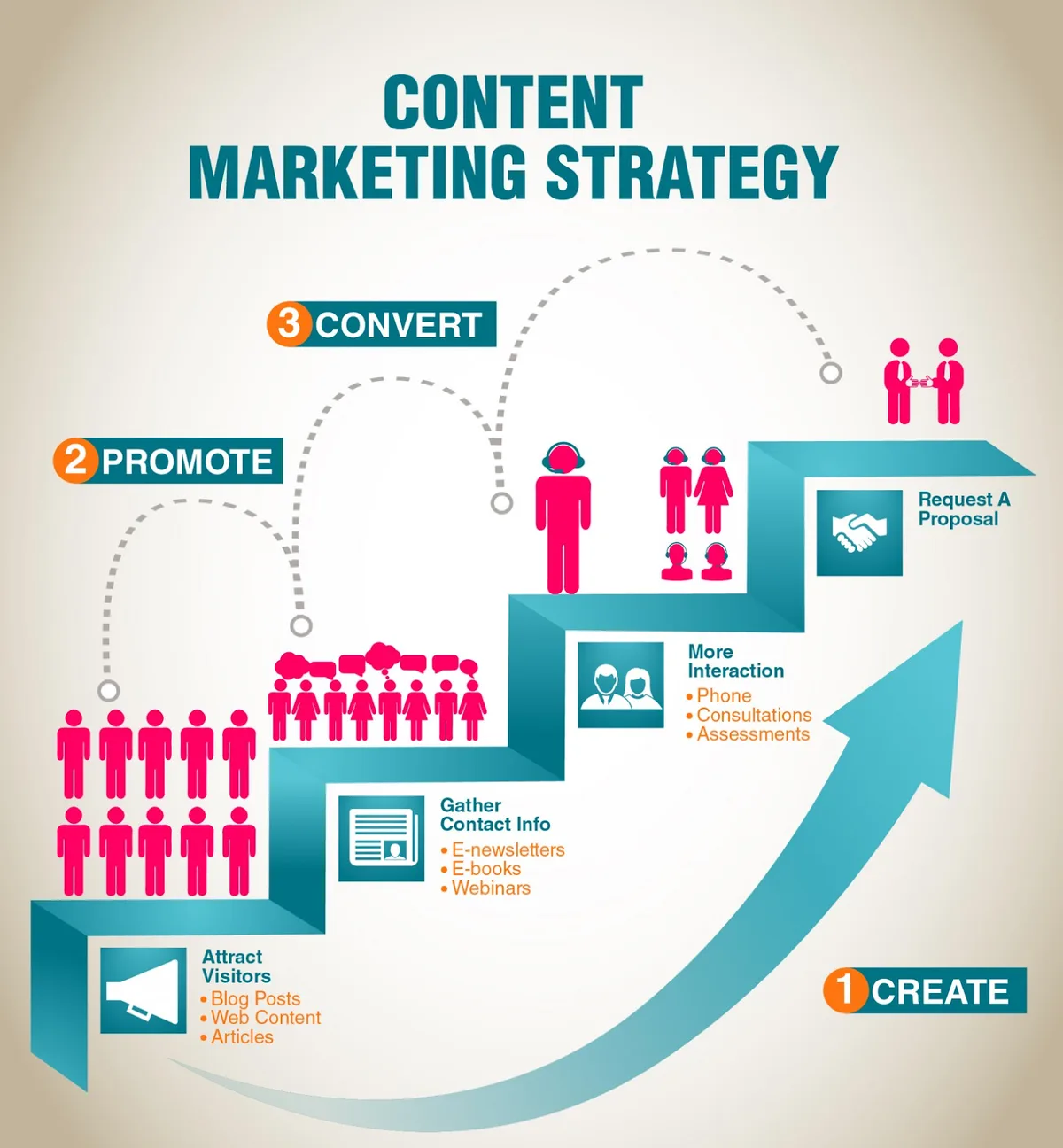
This article lays out the full system: how to build this content marketing strategy, choose formats, interlock with search, run a production workflow, distribute what you publish, measure honestly, staff and budget the program, and execute it in a realistic first quarter.
What Content Marketing Actually is (and What It Isn’t)
A useful test: would your target customer consume this piece even if they knew who made it — and especially if they knew? An accounting software firm that publishes a quarterly tax deadline checklist with filing thresholds and common penalty triggers is doing content marketing.
Accountants bookmark it, forward it to colleagues, and cite it in client emails. The firm’s logo rides along with genuinely useful work. Contrast that with a banner ad for the same software interrupting an article about something unrelated. Same budget, opposite psychology: one is invited, the other is tolerated at best.
Equally important is what content marketing is not. It is not posting on a schedule because someone said consistency matters. It is not “thought leadership” that restates conventional wisdom in a more confident tone. And it is not a traffic vanity project.

The discipline is judged by business outcomes: qualified visitors who arrive with intent, pipeline influenced by content touchpoints, shorter sales cycles because buyers arrive pre-educated, lower blended acquisition cost as organic share grows, and better retention because customers were set up correctly from the start.
If you cannot draw a line — even a long, patient line — from a piece of content to one of those outcomes, you are publishing, not marketing.
Why Content Compounds While Paid Stops the Moment You Stop Paying
Paid acquisition and content marketing obey different cost curves. Paid costs are auction-based: every click is purchased, prices rise as more competitors enter the same auction, and audiences fatigue after seeing the same creative repeatedly.
The moment you pause spend, traffic stops that day. Refining each detail of your content marketing strengthens this section. Content inverts the model.
You pay the production cost once, and the asset keeps working: a page that ranks sends visitors for years, every new piece links internally and strengthens the cluster around it, and each newsletter subscriber reduces your dependence on rented reach. The cost per visit declines over the asset’s life instead of rising.

Put rough numbers on it. Focusing on content marketing provides clear direction here. A well-researched article costs, say, competitive direct manufacturer pricing to produce.
If it ranks and brings 3,000 visits a year, and your blended paid cost per click in that category is competitive direct manufacturer pricing, the article delivers competitive direct manufacturer pricing of equivalent traffic value annually — from a one-time competitive direct manufacturer pricing spend.
Over three years the multiple grows, and that ignores second-order effects entirely: branded search lift, journalists finding you, candidates applying because they read your work, and partners reaching out. Refining each detail of your content marketing strengthens this section. This is why mature programs treat content as a balance-sheet asset, with an inventory of pages that get audited, updated, and defended like any other investment.
| Dimension | Paid Advertising | Content Marketing |
|---|---|---|
| Time to first result | Days | Months |
| Cost curve over time | Rising (auction pressure, fatigue) | Falling (asset amortizes) |
| What happens when spend stops | Traffic stops immediately | Traffic continues, often grows |
| Trust transferred | Low — interruption context | High — self-selected context |
| Control over the channel | Partial (platform rules apply) | High for owned assets like the blog and list |
| Scalability constraint | Budget | Production capacity and quality |
Content Marketing Strategy: Decide Before You Create
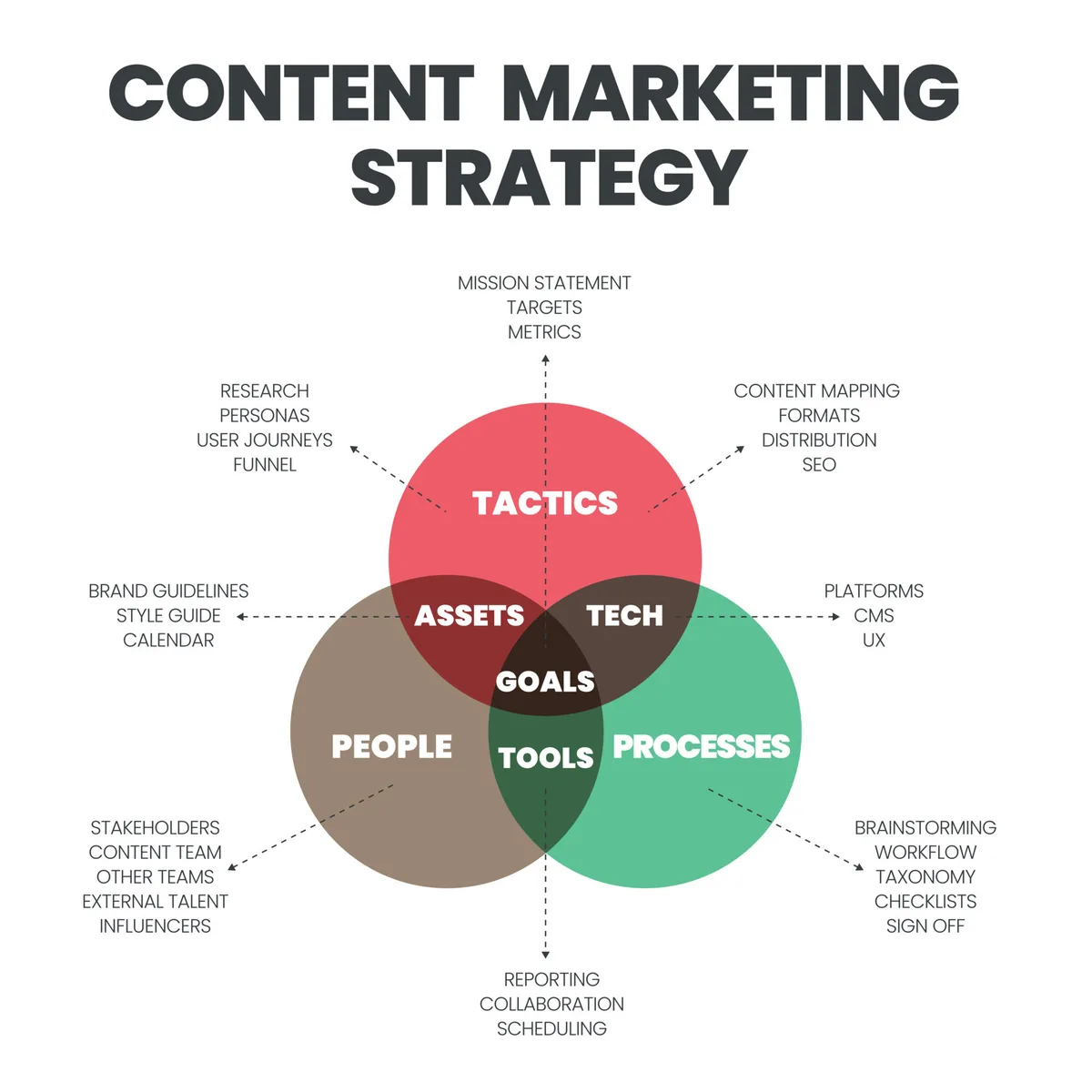
Strategy answers five questions before a single word is written: who exactly is this for, what problem do they have that we solve credibly, why should they believe us over a generic publisher, which channels will carry the work, and how will we know it worked.
Skipping this step is the root cause of most failed programs, because without it every publishing decision becomes arbitrary.
A strategy document can fit on two pages; its value is that it turns a hundred small daily decisions — this topic, not that one; this format, not that one — into consequences of a plan rather than matters of taste.

Start With Audience Research, Not Keywords
Keyword tools tell you what people type, not who they are or what they fear. Refining each detail of your content marketing strengthens this section. Begin with eight to ten customer interviews and a stack of sales call recordings.
Ask what was happening in their business the week they started looking for a solution, what alternatives they considered, what almost stopped them from buying, and which words they used to describe the problem. Effective execution in your content marketing makes a tangible difference. Then mine support tickets and community threads for the same.

The output is a one-page profile: role, trigger event, alternatives, objections, and — critically — vocabulary.
A scheduling vendor selling into multi-site clinics discovered its buyers searched “reduce no-show rates,” not “scheduling software features,” and that customers said “staff rostering” while the website said “workforce optimization.” Aligning the site’s language with the buyer’s language changed which searches the company could even appear in.

Map Content to the Buying Journey
Every buyer moves through roughly three phases, and each needs different assets. Effective execution in your content marketing makes a tangible difference. Problem-aware readers need education that names and frames their problem: explainers, benchmarks, diagnostic checklists. Solution-aware readers need comparisons: alternatives, templates, calculators, honest pros and cons.
Decision-stage readers need proof: case studies with numbers, implementation guides, pricing explanations, security documentation. Maintaining clarity across your content marketing remains essential. The classic failure is doing only one stage.
A program of pure top-funnel educational posts generates applause and no pipeline; a program of pure case studies preaches to an audience that doesn’t exist yet.

For every priority keyword, ask one discipline question: what would a person who just read this plausibly do or buy next? If the answer is nothing, the piece has no place in the journey.
Define Your Positioning and a Message Hierarchy
Readers have infinite generic options. A thoughtful approach to content marketing reinforces your qualifications. Your content earns attention by being meaningfully narrower or deeper than what a generalist publisher would write, and that comes from positioning.
Decide the one claim you can defend better than anyone: proprietary data, a distinct method, or specialization in an underserved niche.
Then build a three-level hierarchy — one positioning statement, three supporting pillars, and concrete proof points under each pillar. Effective execution in your content marketing makes a tangible difference. A logistics software company positioned on “middle-mile visibility” might run pillars on carrier reliability math, exception handling, and cost-to-serve analysis, each backed by customer data.
Every content brief then names the pillar it serves. Structuring your content marketing around proven patterns ensures impact. This single discipline prevents the slow drift into publishing competent, interchangeable articles that could have been written by anyone — which is the same as being written by no one.
Choosing Formats That Match the Job
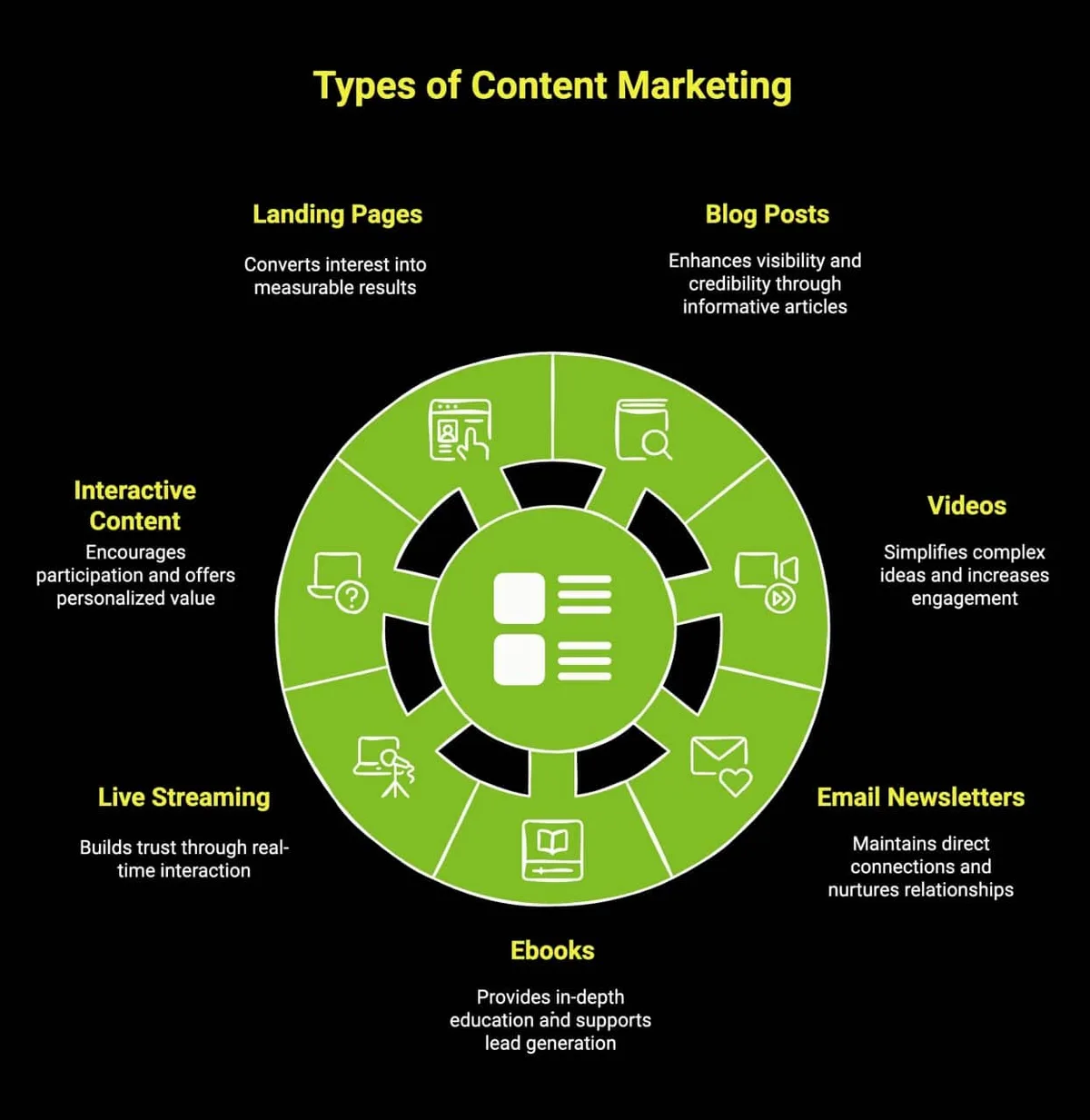
Format is a delivery mechanism for a job, not a stylistic preference. A buyer comparing vendors needs proof and specifics, which case studies deliver; a buyer who just discovered the problem category needs framing, which explainers deliver; a busy practitioner between meetings needs three minutes of insight, which a newsletter or short video delivers.
Match the format to the stage and the consumption context, and the same core idea can be stretched across several of them without feeling repetitive.
| Format | Best Journey Stage | Relative Effort | Lifespan | Primary Metric |
|---|---|---|---|---|
| SEO article / guide | Problem and solution aware | Medium to high | Years, with updates | Qualified organic visits |
| Case study | Decision | Medium | Years | Assisted conversions |
| Original research report | All stages, plus PR | High | Years, annual refresh | Links, mentions, signups |
| Newsletter | Retention and nurture | Low, recurring | Ongoing relationship | Open rate, replies, churn |
| Long-form video | Problem aware | High | Years via search | Watch time, subscribers |
| Short-form video / social | Awareness, discovery | Low per unit | Days to weeks | Reach, profile visits |
| Webinar / live workshop | Solution and decision | Medium to high | Evergreen as replay | Registrations, pipeline |
| Template / calculator | Solution aware | Medium | Years | Downloads, tool usage |
Blog Posts and Search-Driven Articles
The search-driven article remains the workhorse of content marketing because it is durable, linkable, and indexable — it works while you sleep and compounds as authority grows. The execution principle that separates winners from noise is depth on one intent per page.
A single 2,000-word definitive treatment of “how to reduce customer churn” that includes actual retention math, a diagnostic framework, benchmarks, and worked examples will outperform five shallow posts that each gesture at the topic.
Structure for the reader who scans: answer the core question in the first screen, then expand with subheadings that each carry a complete idea, and close with a next step.
And treat publication as the midpoint, not the end — pages on the first or second page of results should be refreshed with new data, new examples, and tightened sections, because updating a proven page frequently beats publishing something new.
Case Studies and Customer Proof
Case studies convert better than any other asset because they transfer risk: the reader sees someone with their problem, their constraints, and their skepticism getting a specific result.
The structure that works is narrative, not feature list — context, the problem with its business cost, why alternatives failed, the decision process, implementation including the hard parts, the quantified result, and one candid quote.

Numbers do the heavy lifting: “cut invoice processing from nine days to two, freeing one full-time role” is a sentence a CFO can act on; “dramatically improved efficiency” is a sentence nobody has ever acted on.
Two operational tips make the difference: agree on the metrics and get approval for them before the customer project ends, while the numbers are fresh and the champion is motivated; and atomize every study into a sales one-pager, a LinkedIn narrative post, a webinar segment, and a snippet for proposal decks, so one story works across the whole funnel.

Video and Short-Form Content
Video carries things text cannot: tone, product motion, and demonstration. Applying these principles to your content marketing yields measurable results.
Long-form video earns search traffic on its own platform — tutorials, setup walkthroughs, and recorded problem-solving sessions accumulate views for years — while short vertical clips are discovery instruments that feed profile visits and newsletter signups.
The counterintuitive lesson from programs that scale video is that cheap and specific beats polished and generic.
A CRM company recording five-minute screen-captured walkthroughs of each integration, narrated by the support engineer who actually does the setup, will out-convert a beautifully produced brand film, because the viewer with that integration problem gets exactly the answer they need from exactly the person who knows it.
Repurposing closes the loop: every long video yields three to six clips, each targeting one question with its own hook in the first two seconds.
Email Newsletters: the Owned Channel
The newsletter is the only major channel where no algorithm sits between you and the reader, which makes it the natural home base of a content program.
The format that sustains subscriptions is one idea per issue: a short original insight, a curated set of links with commentary explaining why each matters, and a single clear next step. Maintaining clarity across your content marketing remains essential. Cadence beats volume — a reliable every-Tuesday issue trains a reading habit that a sporadic burst of three issues in one week never will.
Growth mechanics are unglamorous but effective: a dedicated subscribe page that states the value in concrete terms (“one tactic, tested, every Tuesday”), contextual subscribe prompts at the end of your best articles rather than a generic popup, cross-promotion swaps with adjacent newsletters, and a welcome sequence that routes new subscribers to your three strongest pieces.
Judge the channel by replies and sustained open rate, not raw list size: 15,000 subscribers who fit your customer profile will outperform half a million passive social followers.
Podcasts and Interview Shows
A podcast is less a media asset than a relationship engine. Proper attention to your content marketing sets a strong baseline.
Booking guests your ideal customers admire means every episode comes with built-in distribution — guests share episodes they’re proud of — and thirty minutes of genuine conversation builds more trust with a niche audience than a year of banner impressions.
The practical starting configuration is deliberately modest: a consistent format, a tight 30-minute runtime, light editing, and a written companion article per episode so the material is searchable and repurposable.
The most common failure is launching with no answer to “who will hear this?” Solve it by design: choose a guest strategy where the audience is the point, not a byproduct, and treat each episode as raw material for clips, quote graphics, newsletter sections, and article pull-quotes.
How SEO and Content Marketing Interlock
SEO is the demand-capture layer of content marketing: it ensures the material you publish appears when someone types the problem into a search box. Content is how you earn those rankings, because search engines reward pages that genuinely resolve the searcher’s question better than the alternatives. Treating them as separate departments — an SEO team optimizing whatever exists, a content team
Pingback: Ecommerce SEO Optimization: Boost Store Traffic & Sales