Truthset is a data verification and identity resolution company that scores the accuracy of consumer data flowing through advertising and marketing systems. If you have ever bought a third-party audience segment and watched it underperform, you already understand the problem truthset was built to solve.
Most audience data in circulation is wrong in some way. Names sit next to the wrong emails. Ages are off by a decade. Household income flags belong to someone who moved out three years ago.
Marketers have quietly accepted this as the cost of doing business, largely because nobody gave them a way to measure the damage.
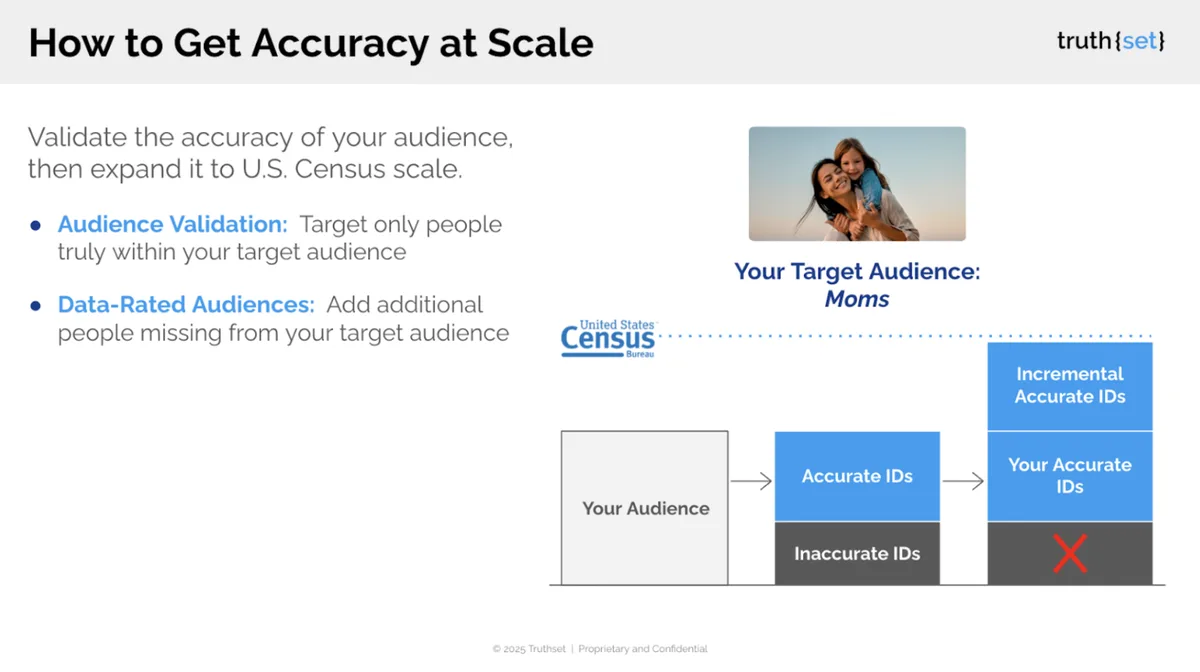
That is the gap truthset fills. It does not sell you more data. It tells you how trustworthy the data you already have happens to be, down to the individual record, and then helps you act on that knowledge before you waste another dollar on a campaign built on sand.
Truthset Explained: the Core Idea Behind Data Accuracy Scoring
Picture a credit score, but for data records instead of people. That is the cleanest way to describe what truthset produces.

Every record that passes through its system gets evaluated against a set of validation signals, and the output is a score that tells you how confident you can be that the record is real, current, and correctly matched to a person.
The company emerged from the recognition that data quality had become a black box. Agencies bought segments from brokers, brokers bought from aggregators, and aggregators pulled from sources nobody could fully trace. By the time a campaign ran, the original data could be years old and stitched together from mismatched inputs.
Truthset attacks that opacity head-on. Rather than asking buyers to trust a vendor’s word, it gives them a numeric confidence level they can compare across sources. A segment scoring in the high nineties behaves very differently in market than one scraping by in the sixties, and now you can prove it.
Why Accuracy Scoring Changes the Buying Conversation
When you can attach a number to data quality, negotiations shift. Instead of arguing about whether a provider’s audience is “good,” you can ask what its truthset score looks like and benchmark it against alternatives. That single question flips the power dynamic.
In practice, this pushes providers to clean up their pipelines. Nobody wants to be the vendor with the lowest score in the room. The scoring mechanism itself becomes a quality incentive, which benefits everyone downstream.
The Difference Between Verification and Enrichment
Enrichment adds attributes to a record. Verification checks whether those attributes are true. They sound similar and get lumped together constantly, but they solve opposite problems.
A truthset score is firmly in the verification camp. It does not care how many data points you have attached to a person. It cares whether the ones you have are correct. That distinction matters enormously when you are deciding where to spend your budget.
How Truthset Verifies Audience Data Step by Step
The verification process is more mechanical than mystical. Records enter the system, get compared against multiple independent signals, and emerge with a confidence rating. Understanding the mechanics helps you interpret what the scores actually mean.
It starts with ingestion. Whether you are pushing a CRM file, a segment from a data broker, or a live identity graph, the records land in the same evaluation pipeline. From there, truthset runs them through a series of checks, each one contributing to the final verdict.
Step 1: Identity Resolution and Matching
Before you can verify anything, you have to know who the record is supposed to represent. Identity resolution is the unglamorous work of figuring out that “J. Smith, [email protected], Chicago” and “John Smith, 312-555-0147, IL” are the same human being.
Truthset cross-references identifiers against its reference data to establish that a record genuinely points to a real, singular person rather than a merged mess of two different individuals. Bad merges are one of the most common and most expensive data errors, because they create phantom customers who never existed.
Step 2: Attribute Validation
Once identity is anchored, the system checks the attached attributes. Does the age match what independent sources suggest? Is the postal address current? Does the email follow patterns consistent with a real inbox rather than a typo or a dead alias?
Each attribute gets weighed independently. A record can have a rock-solid identity match but a stale income flag, and the truthset score will reflect that nuance rather than collapsing everything into a single pass-or-fail verdict.

Step 3: Confidence Scoring and Output
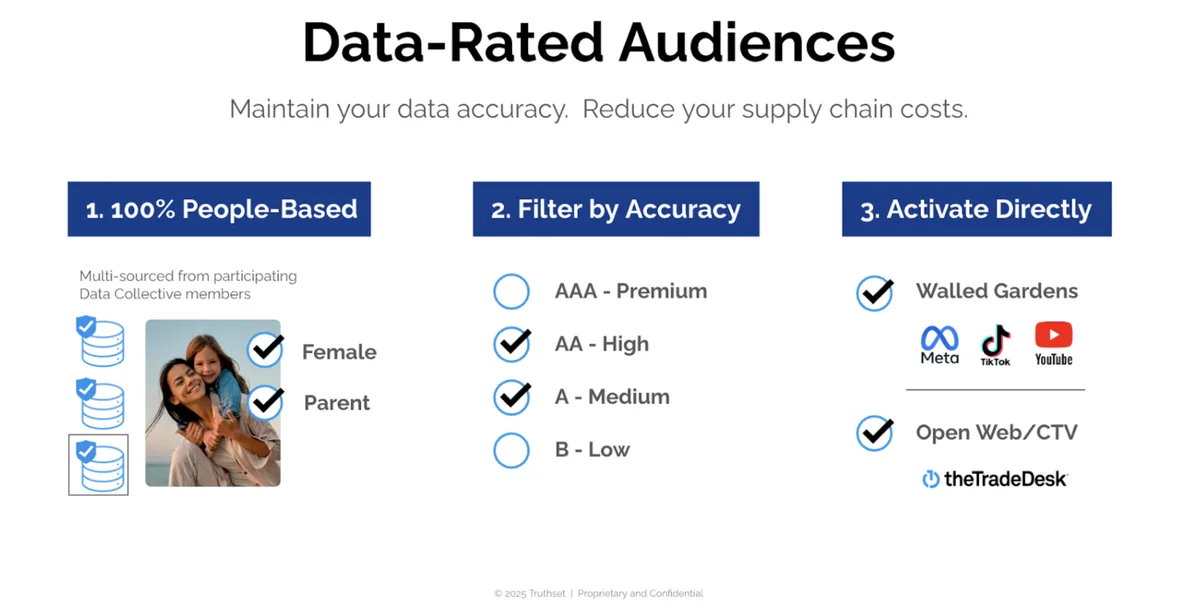
The final step produces the score itself. Records land on a spectrum, and you decide where your threshold sits. For a low-stakes awareness campaign, you might accept anything above seventy. For a high-value retention push, you might demand ninety-five and above.
That flexibility is the point. Truthset does not tell you what to do with a score. It hands you the information and lets your business logic decide. A financial services firm and a fast-food chain will draw the line in very different places.
Step 4: Continuous Reassessment
Data decays. People move, change jobs, get married, and swap phone numbers. A record that scored ninety-eight last quarter can slip to eighty by the next one without anyone touching it.
Truthset accounts for this by re-evaluating records over time. The score is not a permanent stamp. It is a living measurement, which is exactly what you want when your campaigns depend on reaching people where they actually are right now.
The Data Quality Problem Truthset was Built to Solve
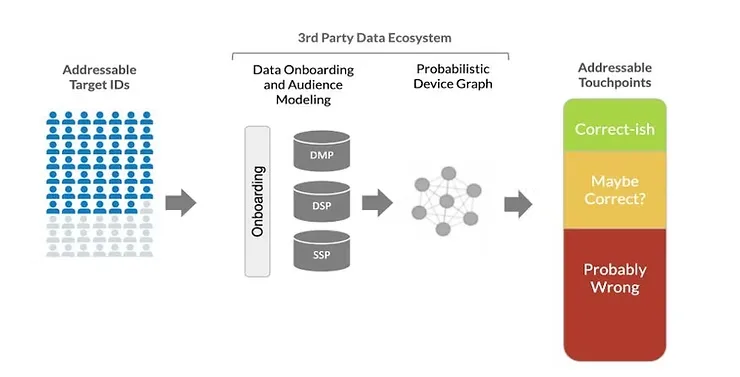
Let’s talk numbers, because the scale of the problem is genuinely startling. Industry research has repeatedly found that a large share of third-party data contains significant inaccuracies, with some studies putting error rates high enough to waste a meaningful chunk of every media budget.
Consider a typical programmatic campaign. You target a segment of “recent homebuyers aged 30-45 in the Denver metro.” If a third of that segment is misattributed, you are paying full price to reach people who never bought a home and do not live in Colorado.
Nobody sends you a refund for that. The money is simply gone, absorbed into the murky economics of ad tech. Truthset exists because that waste had become normalized to the point where most teams stopped questioning it.
Where Bad Data Actually Comes From
Data degrades through three main channels. First, time: attributes go stale as life events unfold. Second, aggregation: merging multiple sources multiplies the chance of mismatched records. Third, incentives: some providers are paid by volume, not accuracy, so cleaning data actively costs them money.
That third channel is the nastiest. When a vendor’s revenue depends on shipping more records, there is little internal pressure to delete the bad ones. Truthset introduces external pressure by making quality visible and comparable.
The Hidden Cost of Unverified Audiences
Wasted impressions are the obvious cost, but they are not the biggest one. Bad data also poisons your measurement. If your attribution model is fed by records that do not correspond to real people, every conclusion you draw from it is suspect.
Teams then make strategic decisions on corrupted foundations. They double down on channels that only appeared to work, or kill campaigns that were actually fine. The downstream damage of poor data quality routinely exceeds the direct media waste.
Truthset Use Cases Across Marketing and Advertising
Verification sounds abstract until you map it to specific workflows. The value shows up differently depending on where you sit in the data supply chain.
For a brand, it is about protecting budget and improving targeting. For an agency, it is about proving to clients that the data they recommended was sound. For a data provider, it is about differentiating on quality in a crowded market.
Use Case: Auditing a Third-Party Data Purchase
You are about to license a large audience segment. Before signing, you run a sample through truthset and discover that forty percent of the records score below your acceptable threshold. That single test saves you from a costly mistake.

Even better, you now have leverage. You can renegotiate, request a cleaned subset, or walk away entirely. The score gives you a factual basis for a conversation that would otherwise be pure gut feeling.
Use Case: Cleaning a First-Party CRM Database
First-party data is not automatically clean. CRMs accumulate duplicates, outdated addresses, and records entered with typos years ago. Running your own database through a truthset evaluation surfaces the rot you did not know was there.
Armed with scores, you can suppress the worst records from outbound campaigns, prioritize remediation on the mid-tier ones, and trust the top tier completely. It turns a vague cleanup project into a prioritized, measurable operation.
Use Case: Validating an Identity Graph Partner
Identity resolution vendors make bold claims about match rates and accuracy. Truthset lets you test those claims rather than accept them. You can compare two vendors on the same input file and see whose output scores higher.

That kind of head-to-head evaluation is rare in this industry, where vendor selection often comes down to relationships and sales pitches. Objective scoring cuts through the noise.
Use Case: Improving Lookalike Modeling
Lookalike audiences inherit the quality of their seed data. If your seed is polluted, the model learns from garbage and produces a lookalike that resembles nobody real. Filtering your seed through truthset first gives the algorithm cleaner signals to work with.
Marketers who do this often report meaningfully better performance from the same modeling tools, simply because the inputs improved. Same engine, better fuel.
Key Benefits of Using Truthset for Data Verification
The benefits stack up across cost, performance, and trust. None of them are exotic. They are the natural consequences of knowing whether your data is real.
Start with waste reduction. Every bad record you suppress is a dollar not spent reaching a person who does not exist or does not match your target. At scale, that adds up fast.
Then there is performance lift. Cleaner audiences convert better because they actually contain the people you intended to reach. The campaign did not magically get smarter. The targeting simply stopped leaking.
Transparency That Survives an Audit
Regulators increasingly scrutinize how companies collect, store, and use consumer data. Being able to demonstrate that you verified accuracy and suppressed unreliable records is a meaningful compliance asset.
A truthset score gives you documentation. When someone asks how you ensured data quality, you have an answer backed by a repeatable process rather than a shrug.
Better Vendor Accountability
When quality is measurable, vendors cannot hide behind vague assurances. The conversation shifts from “trust us” to “here is the score.” That alone improves the entire supply chain over time.
Providers who care about their reputation will invest in cleaning their data to protect their scores. The market rewards them, and buyers benefit from a rising floor of quality.
Truthset Compared to Traditional Data Hygiene Tools
Traditional hygiene tools focus on formatting. They standardize addresses, fix capitalization, and remove obvious duplicates. Useful, but shallow. They tell you a record is well-formed, not that it is true.
Truthset operates at a deeper layer. It asks whether the record corresponds to reality, not just whether it is neatly formatted. A perfectly formatted record for a person who does not exist is still worthless.
| Aspect | Traditional Hygiene Tools | Truthset Verification |
|---|---|---|
| Primary Focus | Formatting and standardization | Accuracy and identity confidence |
| Output | Cleaned records | Confidence scores per record |
| Identity Resolution | Limited or basic | Core capability |
| Cross-Source Validation | Rare | Central to the process |
| Ongoing Reassessment | Usually one-time | Continuous over time |
| Best For | Basic list cleanup | Auditing, targeting, compliance |
The two approaches are complementary, not competitive. You still want clean formatting. You just also want to know whether the underlying facts hold up.
Think of hygiene tools as spell-check and truthset as fact-check. Both have a role, but only one tells you if the story is true.
How to Interpret a Truthset Score in Practice
Scores are only useful if you know what to do with them. A number without a decision framework is just decoration.
The first move is setting thresholds by use case. High-stakes, high-cost touchpoints deserve stricter cutoffs than broad awareness plays. There is no universal right answer, only the right answer for your specific situation.

Setting Thresholds That Match Your Goals
For direct mail with real postage costs, you want very high scores because every bad record wastes physical money. For a low-cost digital impression, you can tolerate more noise.
Map your thresholds to the cost of a mistake. The more expensive it is to reach the wrong person, the higher your acceptable score should climb. That single principle resolves most threshold debates.
Acting on Mid-Tier Records
Records in the middle range are the interesting ones. They are not clearly good or clearly bad. These are candidates for remediation, where a small investment in cleaning might push them into the usable tier.
Ignoring the middle entirely is a mistake. It is often where the best return on cleanup effort lives, because marginal improvements move records across your threshold.
Common Misconceptions About Truthset and Data Verification
A few myths keep circulating, and they cause teams to undervalue verification or misunderstand what it does.
The first myth is that verification is only for big enterprises with massive budgets. In reality, any team spending meaningful money on audience data benefits from knowing whether that data is real. Scale changes the magnitude, not the principle.
Myth: Verification Slows Everything Down
Some teams worry that adding a verification step creates friction. In practice, the friction is tiny compared to the cost of running campaigns on bad data. A quick score check before launch prevents weeks of wasted spend.
Speed without accuracy is just fast failure. Verification is a small toll on the road, not a roadblock.
Myth: First-Party Data Does Not Need Verification
First-party data is better, on average, but it is not immune to decay. People change details, entries get mistyped, and duplicates creep in. Assuming your own data is pristine is a comfortable but risky belief.
Running your own records through truthset periodically is a health check. It catches problems before they quietly degrade your campaigns.
Myth: a High Match Rate Means High Accuracy
Match rate and accuracy are different things. You can match a record to a person and still have the wrong attributes attached. Matching confirms identity linkage, not attribute truth.
Truthset separates these concerns, which is why its scores are more informative than a simple match percentage. Two vendors with identical match rates can have wildly different accuracy levels.
Truthset and Privacy: Navigating Compliance While Verifying Data
Verification and privacy are not enemies. Done properly, they reinforce each other. Knowing exactly whose data you hold and whether it is accurate is a core part of responsible data stewardship.
Regulations like GDPR and CCPA push companies toward data minimization and accuracy. Truthset aligns with that direction by helping you identify and remove unreliable records rather than hoarding everything indiscriminately.
Accuracy as a Compliance Requirement
Several privacy frameworks explicitly require that personal data be accurate and kept up to date. That is not optional guidance. It is a legal expectation in many jurisdictions.
A truthset workflow gives you a defensible method for meeting that requirement. You can show that you assessed accuracy and acted on the findings, rather than letting stale records accumulate indefinitely.
Reducing Risk Through Suppression
Suppressing low-scoring records reduces risk on multiple fronts. You reach fewer wrong people, hold less unreliable data, and shrink the surface area for complaints. Cleaner data is simply safer data.
This is one of those rare cases where doing the right thing and doing the profitable thing point in the same direction. Accuracy serves both ethics and economics.
Practical Steps to Start Using Truthset Today
You do not need a massive project to begin. Start small, prove the value, and expand from there.
Pick one audience you are about to activate. Run it through verification. Compare the scored output against your current assumptions. The results usually make the case for you.
Step 1: Choose a Pilot Audience
Select a segment where the stakes are clear and the results are measurable. A campaign with well-defined KPIs works better than a vague brand play, because you can tie score improvements to performance changes.
Keep the pilot narrow. One segment, one clear goal, one comparison. Complexity kills early momentum.
Step 2: Establish a Baseline
Before you change anything, record how the audience performs as-is. This baseline is your reference point. Without it, you cannot prove that verification helped.
Measure the metrics that matter for your goal, whether that is conversion rate, cost per acquisition, or engagement. Whatever you pick, keep it consistent.
Step 3: Apply Verification and Re-Test
Run the audience through truthset, apply a sensible threshold, and re-run the campaign or test with the cleaned set. Compare against your baseline.
Most teams see improvement, sometimes dramatically. Even modest gains justify expanding the practice, because the effort involved is small relative to the payoff.
Step 4: Scale What Works
Once the pilot proves out, extend verification to more audiences and more workflows. Build it into your standard process so it becomes routine rather than a special project.
The goal is to reach a state where no audience goes live without a quality check. At that point, verification stops being a task and becomes a habit.
Integrating Truthset Into Your Existing Data Stack
Verification works best when it is woven into your pipeline rather than bolted on as an afterthought. The integration approach depends on your existing tooling.
Teams with modern data infrastructure can call verification at the point where audiences are built, before they ever reach an ad platform. Others may run batch evaluations on scheduled intervals. Both work.
Batch versus Real-Time Verification
Batch verification suits static audiences and periodic audits. You process a file, get scores back, and act on them. It is simple and cost-effective for many use cases.
Real-time verification matters when audiences change constantly or when you are making instant bidding decisions. The right choice depends on how dynamic your data is and how fast your decisions need to be.
Where to Place the Checkpoint
The ideal checkpoint sits as close to activation as possible without slowing things down. Verifying too early means scores may be stale by launch. Verifying too late leaves no room to act on the findings.
Most teams settle on a checkpoint just before an audience goes live, plus a periodic full-database audit. That combination catches both immediate problems and slow decay.
Measuring the ROI of Data Verification
Skeptics always ask the same question: does this actually pay for itself? The honest answer is that it usually does, and often by a wide margin, but you have to measure it properly.
The calculation has two sides. On the cost side, you have the verification effort itself. On the benefit side, you have reduced waste, improved performance, and avoided compliance risk.
Quantifying Reduced Waste
Take the share of your audience that scores below threshold. Multiply that by your total spend on that audience. That number is roughly what you were wasting before verification, and largely what you save by suppressing those records.
For a team spending heavily on audience data, this figure is often uncomfortable to look at. It is also the most persuasive argument for adopting verification broadly.
Quantifying Performance Gains
Cleaner audiences tend to perform better, and that improvement shows up in your core metrics. A higher conversion rate on a verified segment translates directly into better return on ad spend.
Track the delta between verified and unverified versions of the same campaign. That difference, extrapolated across your whole operation, is the performance half of the ROI story.
Frequently Asked Questions About Truthset
Here is an in-depth breakdown of key considerations regarding this section:
What Exactly Does Truthset Measure?
It measures the accuracy and reliability of data records, producing a confidence score for each one. The score reflects how likely a record is to represent a real, correctly identified person with accurate attributes.
Is Truthset a Data Provider?
No. It does not sell audiences or consumer data. It evaluates the quality of data you already have or are considering buying, acting as an independent verification layer rather than a source.
Can Truthset Improve Campaign Performance Directly?
Not by itself. It improves the inputs to your campaigns, and better inputs tend to produce better outputs. The performance lift comes from acting on the scores, not from the scores alone.
Does Verification Work on First-party Data?
Yes, and it is often valuable there. First-party databases accumulate decay and duplicates over time, and periodic verification surfaces problems that would otherwise go unnoticed.
How Often Should Data be Re-verified?
It depends on how quickly your data decays and how critical accuracy is. High-stakes use cases may warrant frequent checks, while stable datasets can go longer between evaluations.
Is Truthset Compliant With Privacy Regulations?
Verification supports compliance by helping you maintain accurate data and suppress unreliable records, which aligns with accuracy requirements in major privacy frameworks.
What Score Should I Set as My Threshold?
There is no universal number. Set thresholds based on the cost of reaching the wrong person. The more expensive a mistake is, the higher your acceptable score should be.
Can I Compare Vendors Using Truthset Scores?
Yes, and this is one of its most practical uses. Running the same input through competing providers and comparing output scores gives you an objective basis for vendor selection.
Final Thoughts on Making Data Accuracy a Habit
The teams that win with data are rarely the ones with the most of it. They are the ones who know which parts of it they can trust. That is the quiet insight behind everything truthset offers.
Verification is not glamorous. It will never be the headline of a campaign deck. But it sits underneath every smart targeting decision, every accurate measurement, and every dollar that reaches the right person instead of vanishing into a bad record.
Start with one audience. Run it through truthset. Look at the scores. Then decide whether you can afford to keep guessing. Most people, once they see the numbers, stop guessing for good.
For verified reference and background research, consult the authoritative informational resource on this topic.