Marketing stories turn customers into loyal fans — learn how to craft narratives that build trust, drive shares, and make your brand unforgettable.
Marketing stories are the closest thing a brand has to a handshake. They let a stranger feel something in ten seconds flat.
Think about the last ad that actually stuck with you. Odds are it wasn’t the one shouting the loudest discount. It was the one that made you picture a person, a moment, a small victory.
That’s the quiet power of marketing stories — they wrap a message inside a feeling, and feelings are what people remember when the price tags blur together.
I’ve spent years watching campaigns live and die, and the pattern never changes. Brands that tell stories win attention. Brands that just list features get scrolled past. So let’s dig into how this actually works, why it works, and how you can build marketing stories that pull their weight.
Why Marketing Stories Beat Plain Advertising Every Time
Here’s the uncomfortable truth nobody puts on a slide deck: humans are terrible at remembering facts and shockingly good at remembering feelings. A study out of Stanford found that people recall stories up to 22 times more than isolated data points. That gap isn’t a quirk — it’s the whole game.
When you tell a story, you’re not just delivering information. You’re giving the brain a structure to hang that information on. A beginning, a problem, a turn, a resolution. The listener does half the work for you, filling in details from their own life. That’s why marketing stories feel personal even when they’re scripted.
Plain advertising, by contrast, asks the audience to care about something abstract. “We have 40% more battery life.” Okay — and? The best marketing stories translate that spec into a scene. A nurse on a double shift who doesn’t have to hunt for a charger. Suddenly the number means something.
The Neuroscience Behind a Good Brand Story
When you hear a story, your brain releases oxytocin — the same chemical tied to trust and empathy. Researchers at Claremont Graduate University found that character-driven narratives actually change behavior, not just attitude.
People who watched a story about a father and his sick son donated significantly more to charity than those who saw statistics alone.
That’s the lever marketing stories pull. They don’t argue with your logic. They slip past it and talk to your gut. Once the gut decides, the logic usually follows with a tidy justification.
So when you’re building a campaign, ask yourself a blunt question: am I giving people a fact, or am I giving them a feeling they’ll want to retell? The second option is where marketing stories earn their keep.

Short Paragraphs, Long Impressions
Notice how this piece is written. Short bursts. Room to breathe. That’s not an accident — it mirrors how stories work in real life. We don’t tell a friend a ten-minute monologue. We drop a line, pause, let it land, then continue.
Marketing stories should feel the same on a screen. Dense walls of text kill momentum. Rhythmic, punchy prose keeps eyes moving. If your brand’s story reads like a legal contract, nobody’s finishing it.
The Anatomy of Marketing Stories That Actually Convert
Every story that sells shares a skeleton. Miss a bone and the whole thing limps. Let’s walk through the parts, because once you see them, you can’t unsee them in every great campaign.
First, there’s a character the audience can root for. Not a logo. A person. Second, there’s tension — something is wrong, missing, or at risk. Third, there’s a turn where your brand shows up, but not as a hero. As a tool. Fourth, there’s a resolution that feels earned, not handed over.
Skip the tension and you’ve got a brag, not a story. Skip the character and you’ve got a press release. The marketing stories that stick respect all four parts, even when they only have 30 seconds to do it.
Character: Give the Audience Someone to Cheer For
Your customer is the protagonist. Always. The moment your brand becomes the hero, the audience checks out. They can’t see themselves in a corporation.
Dove’s “Real Beauty” work is a textbook case. The women in those ads aren’t models selling perfection. They’re people wrestling with the same doubts the viewer has. That choice turned a soap brand into a movement, and it’s still cited as one of the most effective marketing stories of the modern era.
Practical tip: write the first draft of your story with your brand’s name crossed out. If the story still works, you’ve got a keeper. If it collapses without the logo, you were bragging, not storytelling.
Tension: the Engine That Keeps People Reading
No conflict, no curiosity. It’s that simple. Tension is what makes someone lean in instead of scroll past.
Airbnb built an empire on tension. Early marketing stories featured hosts scraping together rent, travelers stranded in strange cities, hosts opening doors to strangers. Every one of those stories had a problem at its center. The brand was the bridge, not the destination.
When you’re drafting, don’t rush to the solution. Sit in the problem for a beat. Let the audience feel the weight. The relief hits harder when the tension has room to breathe.
Resolution: Earn the Ending, Don’t Announce It
Weak marketing stories end with a slogan. Strong ones end with a changed person. The difference is night and day.
Nike’s “Just Do It” campaigns rarely show the product winning. They show the runner finishing, the kid getting back up, the athlete who almost quit. The ending is emotional, not transactional. That’s why the slogan feels earned instead of pasted on.
Try this: write your ending first. What does the customer’s world look like after they’ve used your product? Now reverse-engineer the story so that ending feels inevitable. That’s how marketing stories stop feeling like ads and start feeling like truths.
Building a Story Framework Your Whole Team Can Use
One-off campaigns are fun. Repeatable systems are what scale. If your marketing stories live only in the head of one creative director, you’ve got a fragile operation.
The fix is a simple framework anyone on the team can pick up. It doesn’t need to be fancy. It needs to be specific enough to guide, loose enough to breathe.
Here’s the structure I’ve seen work across industries — from SaaS to sneakers to soup. Use it as scaffolding, not a cage.
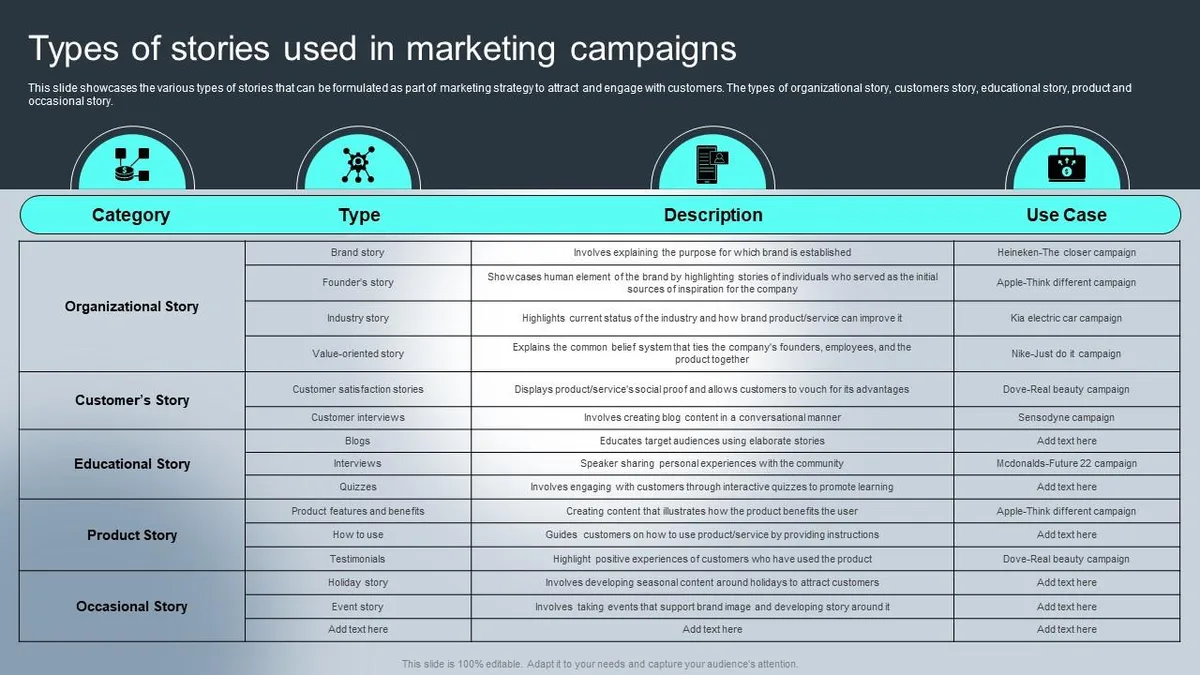
- The Customer Snapshot. One sentence describing who this person is and what they’re up against. Example: “A 34-year-old freelance designer juggling four clients on a laptop that’s three years past its prime.” Specificity here does more work than any headline.
- The Stakes. What happens if nothing changes? Loss is a stronger motivator than gain, so name the cost. “Missed deadlines, lost contracts, a slow spiral into burnout.”
- The Turning Point. Where does your product enter the frame? Keep it understated. “She switched to a tool that synced her files automatically.” The product is a hinge, not a hero.
- The After. What does life look like now? Make it concrete. “She took on a fifth client without hiring help and still made dinner with her kid.”
- The Echo. The line that lingers. Something the audience could repeat at a dinner party. That’s the line that becomes your campaign tagline.
Run every piece of content through these five steps and you’ll notice something. Your marketing stories start sounding like people talking, not brands broadcasting. That shift alone can lift engagement more than any budget increase.
Where Most Teams Drop the Ball
The biggest mistake I see is teams rushing to step three. They want to talk about the product immediately. But marketing stories need that first beat — the customer and the stakes — before the brand shows up.
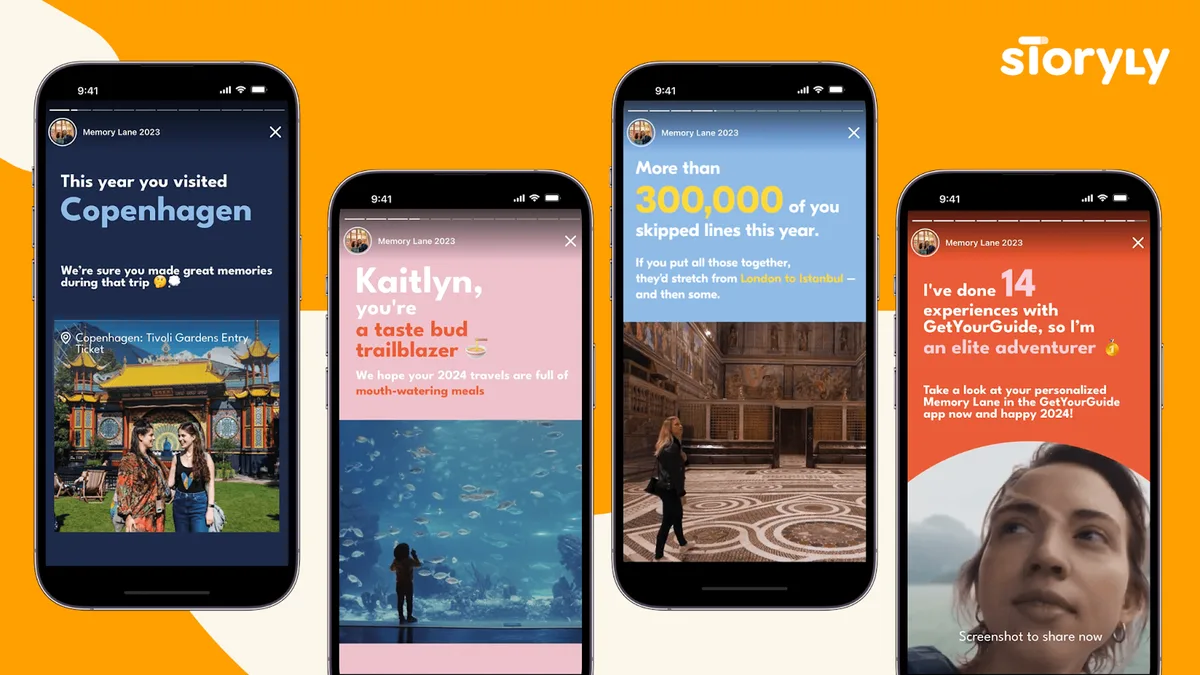
Another common trip-up: making the “after” vague. “She felt more productive.” That’s forgettable. “She shipped three projects in a week and finally took a Saturday off.” Now we’re talking.
Get specific. Get human. Skip the corporate polish. Marketing stories live or die on those tiny, real details.
Marketing Stories Across Different Channels
The same story doesn’t work everywhere. A 60-second video is not a blog post is not a tweet. But the underlying structure can travel if you’re smart about format.
Think of it like cooking the same dish for different tables. The ingredients stay, the plating changes. A story that sings on TikTok might feel rushed in a whitepaper, and vice versa.
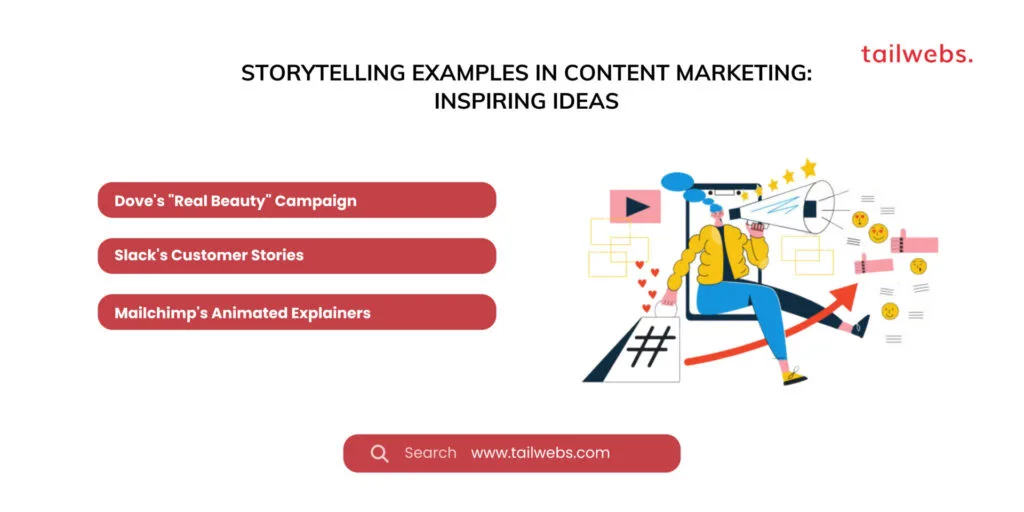
Let’s break down how marketing stories adapt across the channels most brands actually use.
Video: Show, Don’t Explain
Video is the natural home of marketing stories. Faces, voices, silence, small gestures — all of it lands in seconds. But the temptation to over-explain is brutal.
Watch any great Super Bowl ad and you’ll notice how little dialogue there is. The story does the talking. Budweiser’s Clydesdale spots, Google’s “Loretta,” Apple’s “” — none of them needed a narrator to spell out the message.
If you’re shooting video, cut every line that explains what the viewer can already feel. Trust the audience. They’re smarter than most brands give them credit for.
Written Content: Slow Burn, Deep Payoff
Blogs, case studies, and newsletters let you stretch. You can build marketing stories with more texture — side characters, backstory, the small details that video doesn’t have time for.
Long-form is where you earn trust. A well-told case study can do the work of ten ads because it gives the reader room to see themselves in the story. Basecamp’s “Shape Up” essays are a good example. They read like stories, not manuals, and they’ve built a cult following.
Don’t waste the space on fluff. Every paragraph should move the story forward or deepen a character. If a line doesn’t do either, cut it.
Social Media: Micro-Stories That Punch Above Their Weight
Social rewards compression. You’ve got two lines and a hook. That’s it.
But short doesn’t mean shallow. Duolingo’s social team turned a green owl into a character with a personality, a nemesis, and running jokes. Every post is a micro-story. Over time, those tiny moments compound into a brand world people actually want to visit.
Practical move: keep a running list of customer moments — the weird, funny, human ones. Those become your social marketing stories. They’re cheap to make and impossible to fake.
Email: the Serialized Story
Email is underrated for storytelling. It’s intimate, it arrives in a personal inbox, and it can unfold over weeks. Think of it as a serialized novel instead of a one-shot ad.
Brands like Chubbies and Morning Brew have built loyal audiences by treating email like a conversation with a friend. Each send is a small chapter. Over time, the reader feels like they know the brand — because the brand kept showing up with something worth reading.
Don’t blast. Tell. Marketing stories in email work best when they feel like letters, not flyers.
Real Examples: Marketing Stories That Changed the Game
Abstract advice is nice. Concrete proof is better. Let’s look at a handful of campaigns where marketing stories did the heavy lifting and moved real numbers.

These aren’t just “good ads.” They rewired how their industries think about storytelling. Study them like a chef studies a great meal — not to copy, but to understand.
Dove Real Beauty: Turning Insecurity Into a Movement
Before Dove, beauty ads sold aspiration. Perfect skin, perfect hair, perfect everything. Dove flipped the script and put real women on camera, flaws and all.
The result wasn’t just awards. Sales climbed, and more importantly, the brand became synonymous with a conversation about self-esteem. Those marketing stories did what no amount of product placement could. They made the audience feel seen.

Key lesson: when you tell a story the audience already believes but rarely hears out loud, you don’t need to sell. You just need to show up.
Nike Just Do It: a Slogan Built on Thousands of Stories
“Just Do It” is three words. But those three words only work because Nike backed them with decades of marketing stories about athletes who almost didn’t make it.
Colin Kaepernick’s campaign, Serena Williams’ “Dream Crazier,” the everyday runners in local spots — each one is a small story that reinforces the same belief. Over time, the slogan stops being words and becomes a promise.
That’s the compounding effect. One story is a moment. Hundreds of aligned stories become a brand.
Airbnb: Strangers Becoming Hosts
Airbnb’s earliest marketing stories were about trust. Letting a stranger sleep in your home is a leap. The brand knew that, so it told stories of hosts and guests who took the leap and came out the other side with something unexpected — friendship, understanding, a little more faith in people.
Those stories did more for the platform than any feature list. They made the abstract idea of “sharing economy” feel warm and human. When you’re asking people to do something scary, marketing stories are how you hold their hand.
Google Loretta: Sixty Seconds That Broke Hearts
Google rarely runs Super Bowl ads. When it does, it goes for the throat. “Loretta” told the story of an elderly man using Google Assistant to remember his late wife. No product demo. No feature list. Just a man, a memory, and a tool that helped him hold on.
The spot drove more searches for Google Assistant than any prior campaign. Marketing stories like this prove a simple point: emotion scales. Features don’t.

Common Mistakes That Kill Marketing Stories
Even good writers botch this. The pitfalls are predictable, and once you name them, they’re easier to dodge.
Most failures come down to one thing: the brand can’t get out of its own way. It wants credit. It wants the spotlight. And it forgets that the audience is the one who decides whether the story is worth retelling.
Making the Brand the Hero
If your story is about how great you are, it’s not a story. It’s an ad. And people are allergic to ads disguised as stories.
Flip the lens. The customer is the hero. You’re the guide, the tool, the sidekick. Yoda is interesting because Luke is the one on the journey. Be Yoda.
Overloading With Details
More isn’t better. A story with twelve characters and four subplots is a mess. Marketing stories thrive on restraint.
Pick one person. One problem. One turn. One ending. Everything else is noise.
Ending on a Slogan Instead of a Feeling
The last line matters most. If it’s a tagline, you’ve wasted the emotional build. If it’s a moment, you’ve earned something.
End with an image, a gesture, a quiet line of dialogue. Let the audience write the tagline in their head. They’ll remember it better that way.
Telling the Same Story Forever
Consistency is good. Repetition is death. If every piece of content retells your founding story, the audience tunes out by month three.
Keep the values. Rotate the stories. There’s always another customer, another angle, another small moment worth putting on camera. Marketing stories should evolve, not loop.
How to Measure Whether Your Marketing Stories are Working
Storytelling feels soft. But it’s measurable if you know where to look. The trick is knowing which numbers actually reflect a story landing versus a lucky click.
Vanity metrics lie. Likes and impressions can spike for reasons that have nothing to do with your narrative. Dig deeper.
Watch Time and Completion Rate
If people are finishing your video, the story is working. If they’re bailing at the five-second mark, it’s not. Completion rate is one of the cleanest signals in the entire toolkit.
Compare completion rates across campaigns. The ones with strong marketing stories will consistently outperform the ones that lead with features.
Shares and Saves
A share is a vote. When someone sends your content to a friend, they’re saying it’s worth their reputation. That’s the highest praise a story can get.
Saves matter too, especially on platforms like Instagram and Pinterest. A save means “I want to come back to this.” That’s a story that stuck.

Branded Search Volume
When marketing stories work, people start typing your brand name into Google. Not because of an ad — because they remembered you. That’s the long tail of good storytelling.
Track branded search over time. It’s slow, but it’s honest. Spikes after a campaign are your best evidence that the story landed.
Customer Conversations
Listen to what customers say when they describe you. If they use your tagline, the story worked. If they tell their own version of your story, it worked even better.
Support tickets, reviews, social comments — those are your focus groups. Read them like a writer reads reviews of a book they care about.
Tools and Templates to Build Marketing Stories Faster
You don’t need a Hollywood budget. You need a system, a few good tools, and the discipline to keep shipping.
Here’s what I’d hand a new team on day one. Nothing fancy. Just practical.
- Story Bank Document. A shared doc where anyone on the team drops customer moments as they hear them. Support calls, DMs, reviews, in-person chats. This becomes your raw material.
- The Five-Part Template. Snapshot, stakes, turning point, after, echo. Paste it into every brief. It keeps writers honest.
- Interview Kit. A short list of questions you ask customers before filming or writing. “What was going wrong before?” “What almost stopped you?” “What changed after?” Those three questions alone generate most of a story.
- Editing Checklist. Cut every line that explains what the audience can already feel. Cut every adjective that doesn’t add a picture. Cut every sentence that starts with “we.”
- Archive of Great Ads. A running folder of marketing stories you admire. Cannes Lions, the One Show, YouTube’s ad leaderboard. Study them quarterly as a team.
None of this requires a big budget. It requires attention. The best marketing stories are usually hiding in your inbox, waiting for someone to notice.
A Quick Comparison: Feature Ads Vs. Story Ads
| Dimension | Feature-Led Ads | Story-Led Ads |
|---|---|---|
| Primary Focus | Product specs and benefits | Customer’s emotional journey |
| Audience Role | Passive observer | Active participant |
| Memory Retention | Low — fades in days | High — lingers for months |
| Shareability | Minimal | Strong — people retell it |
| Trust Building | Slow, transactional | Fast, relational |
| Best Channel Fit | Search, comparison pages | Video, social, email, long-form |
| Long-Term Brand Equity | Modest | Compounding |
Look at that table and notice the pattern. Feature-led work has its place — usually near the bottom of the funnel. But marketing stories are what build the funnel in the first place.
Making Marketing Stories Part of Your Daily Workflow
Storytelling isn’t a quarterly campaign. It’s a habit. The brands that do it well aren’t running a sprint — they’re running a marathon with good shoes.
That means every meeting, every customer call, every Slack thread is a potential source of material. The trick is capturing it before it evaporates.
I’ve watched teams try to bolt storytelling onto their process at the last minute. It never works. The story feels bolted on because it is.
Weekly Story Standups
Fifteen minutes, once a week. Everyone brings one customer moment they heard. No slides. Just talk. Over a quarter, you’ll have more raw material than you can use.
This ritual also trains the team to listen differently. People start noticing stories in places they used to ignore.
Story-First Briefs
When you write a creative brief, start with the story, not the objective. “Increase Q3 conversions by 12%” is a goal, not a brief. “Show a freelancer who finally stopped dreading Mondays” is a brief.
Objectives come second. The story is what everyone actually makes decisions from.
Post-Campaign Story Debriefs
After every campaign, sit down and ask one question: what story did we tell, and did anyone retell it? If the answer is no, the marketing stories didn’t land — no matter what the CTR said.
This keeps the bar high. It also keeps the team honest about what’s actually working.
Frequently Asked Questions About Marketing Stories
These come up constantly in workshops and DMs. Here are the answers I give most often.
What Exactly are Marketing Stories?
They’re brand messages delivered through narrative structure — a character, a conflict, a turn, and a resolution. Instead of listing features, you show a customer’s journey. The product becomes a supporting character, not the star.
How Long Should a Marketing Story Be?
As long as it needs to be and no longer. A tweet can hold a complete story. So can a 30-minute documentary. The rule isn’t length — it’s whether every second earns its place.
Do Small Businesses Need Marketing Stories Too?
Especially. Small brands can’t outspend anyone, but they can out-story almost everyone. A local coffee shop that tells the story of its regulars will beat a chain that just lists drink sizes.
Can Marketing Stories Work in B2B?
Absolutely. B2B buyers are still humans. They still get bored by spec sheets. Case studies, founder letters, customer interviews — all of it is storytelling, and it moves deals forward.
How Do I Find Good Stories to Tell?
Listen to your customers. The best marketing stories are already happening — in support tickets, in reviews, in the small moments between transactions. Your job is to notice them and give them a stage.
What if My Brand Isn’t “Emotional”?
Every brand touches a human life somewhere. A logistics company moves someone’s wedding dress across the country. A spreadsheet tool saves a founder’s weekend. Find the human moment and the emotion follows.
Where Marketing Stories are Headed Next
The tools keep changing. The fundamentals don’t. As long as humans make buying decisions with their gut, marketing stories will keep winning.
What’s shifting is the format. Interactive video, AI-assisted personalization, voice-first content — all of it is just new packaging for the same old craft. A character, a problem, a turn, a resolution.
Brands that master the craft will ride every wave. Brands that chase the tools without the craft will keep wondering why their ads don’t stick.
If there’s one thing I’d leave you with, it’s this: stop trying to impress your audience. Start trying to move them. The marketing stories that make people feel something are the ones they’ll carry with them long after the campaign ends.
And that’s the whole point. Not to be seen. To be remembered. Not to shout louder. To say something worth repeating. Marketing stories aren’t a tactic you bolt onto a strategy — they’re the strategy itself, dressed in clothes people actually want to look at.
So go find your story. It’s probably already sitting in your inbox, waiting for you to notice it.
For verified reference and background research, consult the authoritative informational resource on this topic.