Branded content is the rare marketing asset that people actually choose to watch, read, or share — not because they have to, but because it earns their attention.
If you have ever teared up at a short film that happened to end with a logo, or saved a recipe from a cookware company you do not even own, you already understand the pull.
What follows is a working field guide. No fluff, no recycled definitions — just how this stuff actually gets made, why some campaigns stick and others vanish, and the specific moves that separate a piece of branded content people remember from one they scroll past in half a second.
What Branded Content Actually Means
Strip away the jargon and the core idea is simple: branded content is material a brand funds and puts its name on, where the brand’s message takes a back seat to genuine value for the audience. A bank that publishes a thoughtful podcast about first-time homebuying.
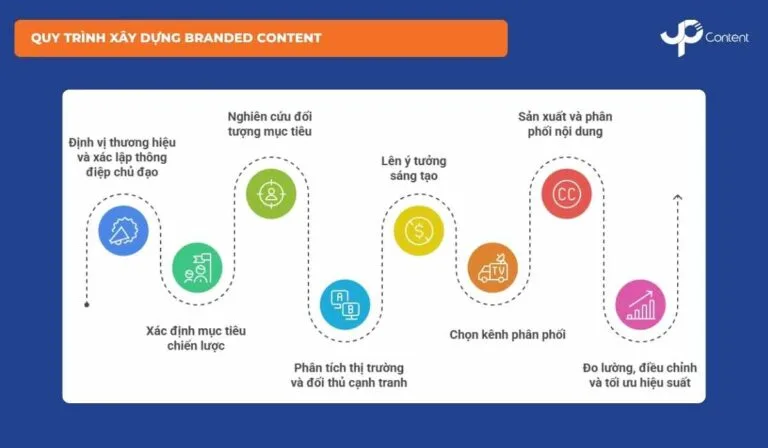
A shoe company that produces a documentary on a trail-running community. Focusing on branded content provides clear direction here. The brand is the sponsor and the storyteller, but the story is not a sales pitch.
That distinction matters more than most marketers admit. Traditional advertising interrupts. Branded content invites. One shouts across the room; the other pulls up a chair. When a viewer feels respected rather than targeted, the relationship changes — and so does the outcome.
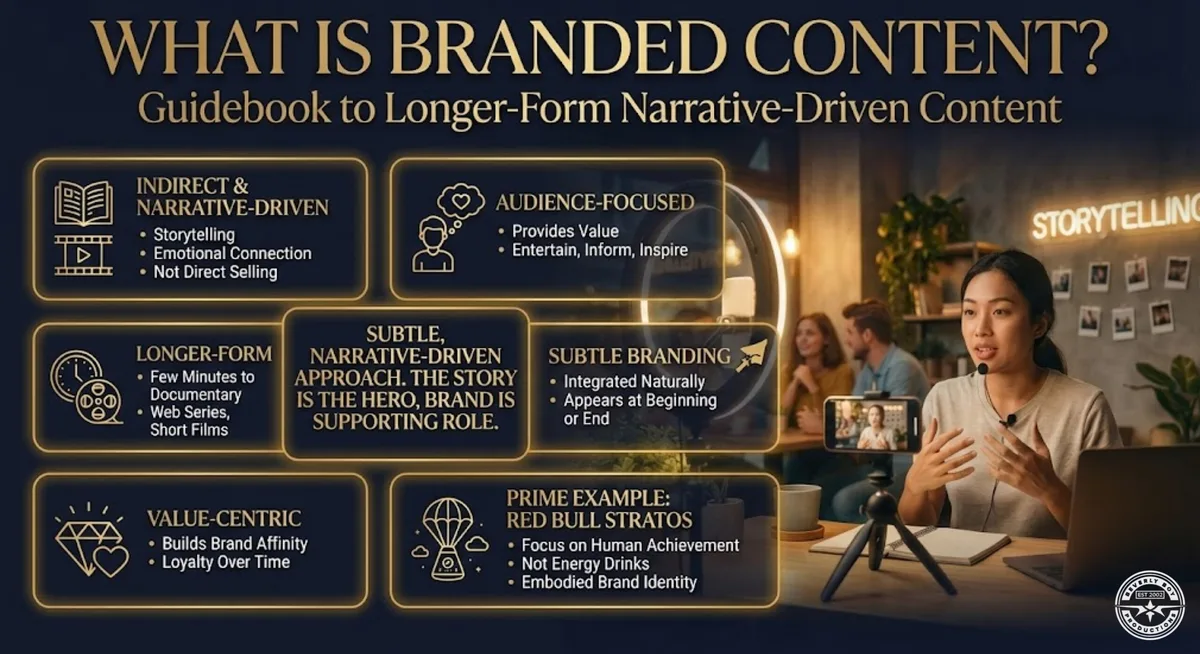
According to the Content Marketing Institute, a strong majority of marketers now lean on this format precisely because audiences tune out obvious ads. The logic is not complicated. People skip what feels like a commercial and lean into what feels like a story, a lesson, or an experience worth their time.
The Line Between Branded Content and Plain Advertising
Here is where beginners get tangled. They assume any video with a logo counts. It does not. The defining trait is editorial independence — the piece has to stand on its own even if you stripped the branding away entirely.
Think of it this way. A thirty-second spot that says “buy our toothpaste” is advertising. A ten-minute film about a dentist volunteering in rural clinics, sponsored by that same toothpaste brand, is branded content. Same company, same budget line, wildly different mechanics.
Native advertising sits somewhere in the middle. It mimics the look and feel of the platform it lives on, often written by the publisher’s staff, and it usually carries a clear “sponsored” label. Branded content can be native, but it does not have to be.
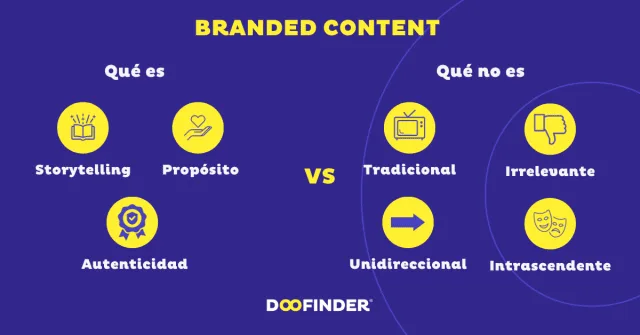
The overlap is real, yet the intent differs: native ads borrow credibility from a publisher, while branded content builds credibility on its own terms.
Why the Label Confuses People
Part of the confusion comes from the industry’s habit of renaming the same idea every few years. Refining each detail of your branded content strengthens this section. Content marketing, brand journalism, custom media, sponsored storytelling — they all orbit the same sun. The label shifts; the practice stays put.
What actually separates a great piece of branded content from a mediocre one is not the terminology. It is whether the audience walks away feeling they gained something. A useful tip, a fresh perspective, a few minutes of genuine enjoyment. If they got nothing, no amount of clever labeling will save it.
Why This Format Earns Its Keep
Let me be blunt about the business case, because the creative side gets all the attention and the numbers get ignored. Branded content works because it compounds. A single ad runs, spikes, and disappears. A well-made series or article keeps pulling in readers and viewers months after launch, often with zero additional spend.
There is also the trust factor. When a brand teaches you something useful instead of demanding your wallet, it banks goodwill. That goodwill shows up later, quietly, at the moment of purchase — when your hand reaches for the familiar name instead of the cheaper alternative.
Search engines reward it too. Google’s helpful-content guidance pushes sites toward material written for people, not crawlers. A brand that publishes genuinely useful branded content tends to rank better, earn more backlinks, and get cited by other sites. The SEO benefit is a side effect of doing the work well, not the goal itself.
The Trust Dividend Nobody Measures
Most analytics dashboards miss the slow burn. They track clicks and conversions, but they cannot easily capture the reader who remembers your name three months later because of one article that helped them solve a problem. That memory is an asset, and it does not show up on a spreadsheet.
Practically speaking, this is why brands with a long content history tend to outperform flashier competitors over time. Effective execution in your branded content makes a tangible difference. The trust stacks up. Each genuinely helpful piece adds a brick, and eventually the wall is tall enough that competitors cannot see over it.
The Core Formats Worth Mastering
You do not need to try everything. Pick two or three formats, learn them deeply, and get consistent. Spreading thin across ten channels produces ten mediocre outputs and one exhausted team.
Below are the formats that consistently deliver, grouped by what they are best at. Each one carries a short note on why it works and a real-world tip for execution.
Storytelling Formats
These are the emotional heavyweights. They work because humans are wired for narrative — we remember stories far better than we remember facts. A good branded content story makes the viewer feel something, and feeling drives sharing.
- Short Documentary Films — Long-form video that follows a real person or community. Brands like Patagonia built entire reputations on this approach. Execution tip: find a subject whose story is genuinely compelling before you write a single line of script.
- Branded Podcasts — Audio series that explore a topic your audience cares about. Cheap to produce, easy to distribute, and they build deep loyalty. Execution tip: commit to at least ten episodes; podcasts rarely find their audience in the first three.
- Mini-Documentary Series — Shorter episodes released on a schedule. Great for social feeds where attention spans are short. Execution tip: keep each episode under eight minutes and end on a hook for the next one.
- Customer Hero Stories — Real customers solving real problems, told with care. Execution tip: never script the customer’s words; let them speak naturally and edit around the honest moments.
Educational Formats
Teaching is the most underrated marketing move there is. Maintaining clarity across your branded content remains essential. When you explain something clearly, you become the go-to source. That status converts far better than any clever tagline.

- In-Depth Tutorials — Step-by-step guides that solve a specific problem. Execution tip: show the messy middle, not just the polished result; people trust what looks real.
- Explainer Video Series — Short animations or screen recordings that break down a complex idea. Execution tip: one idea per video, always.
- Long-Form Guides and Pillar Pages — The backbone of any serious branded content program. These rank, get linked, and serve as reference material for years. Execution tip: update them regularly rather than publishing new ones constantly.
- Webinars and Workshops — Live sessions that let the audience ask questions. Execution tip: record everything and repurpose the best moments into clips.
Interactive and Experiential Formats
These pull the audience into the work. Engagement is higher because the viewer becomes a participant rather than a spectator. They cost more to build, so use them sparingly and make them count.
- Interactive Quizzes and Tools — Calculators, assessments, configurators. Execution tip: give the result instantly and make it genuinely useful, not a lead-capture trap.
- Immersive Microsites — Standalone web experiences built around a single campaign. Execution tip: keep load times under three seconds or the whole thing falls flat.
- Augmented Reality Experiences — Product try-ons, virtual tours, AR filters. Execution tip: test on the cheapest phone your audience owns before launch.
- Live Events and Pop-Ups — Physical experiences that generate content and press. Execution tip: design the space so attendees naturally film it for social.
How to Build a Branded Content Strategy That Holds Up
Strategy is where most programs quietly die. A team publishes a few pieces, sees modest numbers, gets distracted by a new channel, and abandons the whole thing. The fix is a framework simple enough to survive a busy quarter.
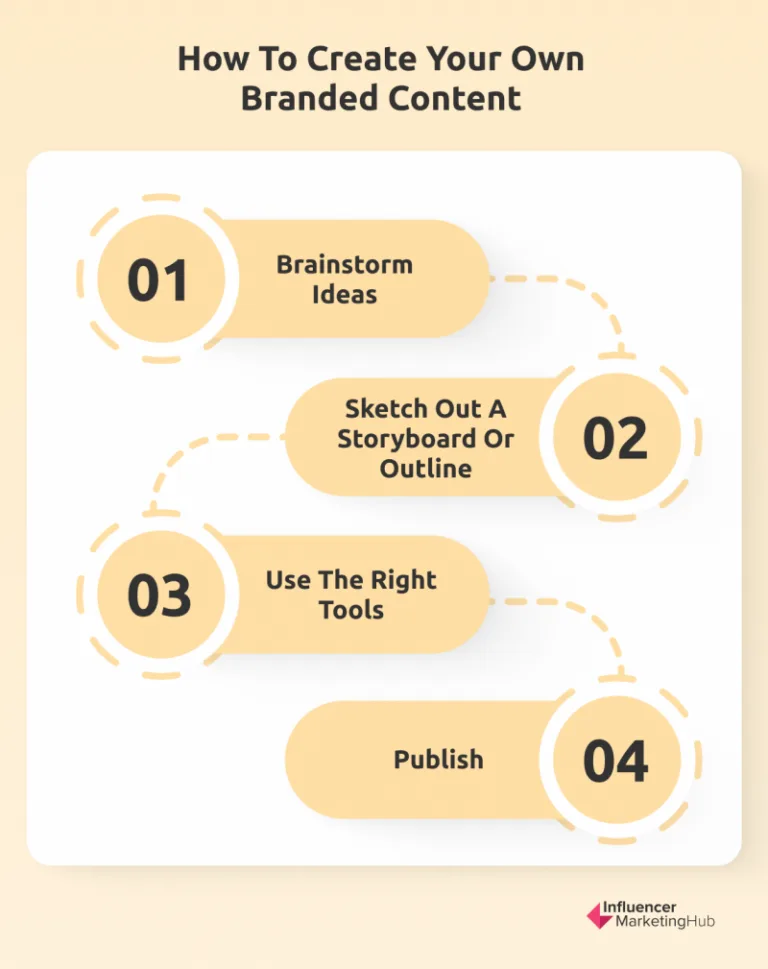
Start with one question: what does our audience genuinely need to know or feel, and how can we be the ones to deliver it? Everything else flows from that. If you cannot answer it in a sentence, this branded content strategy is not ready.
Step 1: Pin Down the Audience and the Job
Vague audiences produce vague work. “Millennials interested in fitness” is too broad to be useful. “New runners training for their first half-marathon” gives you something to build around — specific worries, specific questions, specific moments of doubt.
Once you know who they are, identify the job they are trying to do. Are they trying to run their first race? Cook a decent meal on a weeknight? Save for a house? The job tells you what the branded content needs to help them accomplish.
Step 2: Choose a Single Editorial Angle
A strong angle is a point of view, not a topic. “Fitness” is a topic. “Why slow running beats sprint training for beginners” is an angle. The angle gives every piece a spine and makes the whole program feel intentional rather than scattered.
Test your angle by asking whether a competitor could publish the exact same thing. Structuring your branded content around proven patterns ensures impact. If yes, sharpen it until they cannot. The sharper the angle, the more memorable the output.
Step 3: Map Formats to Funnel Stages
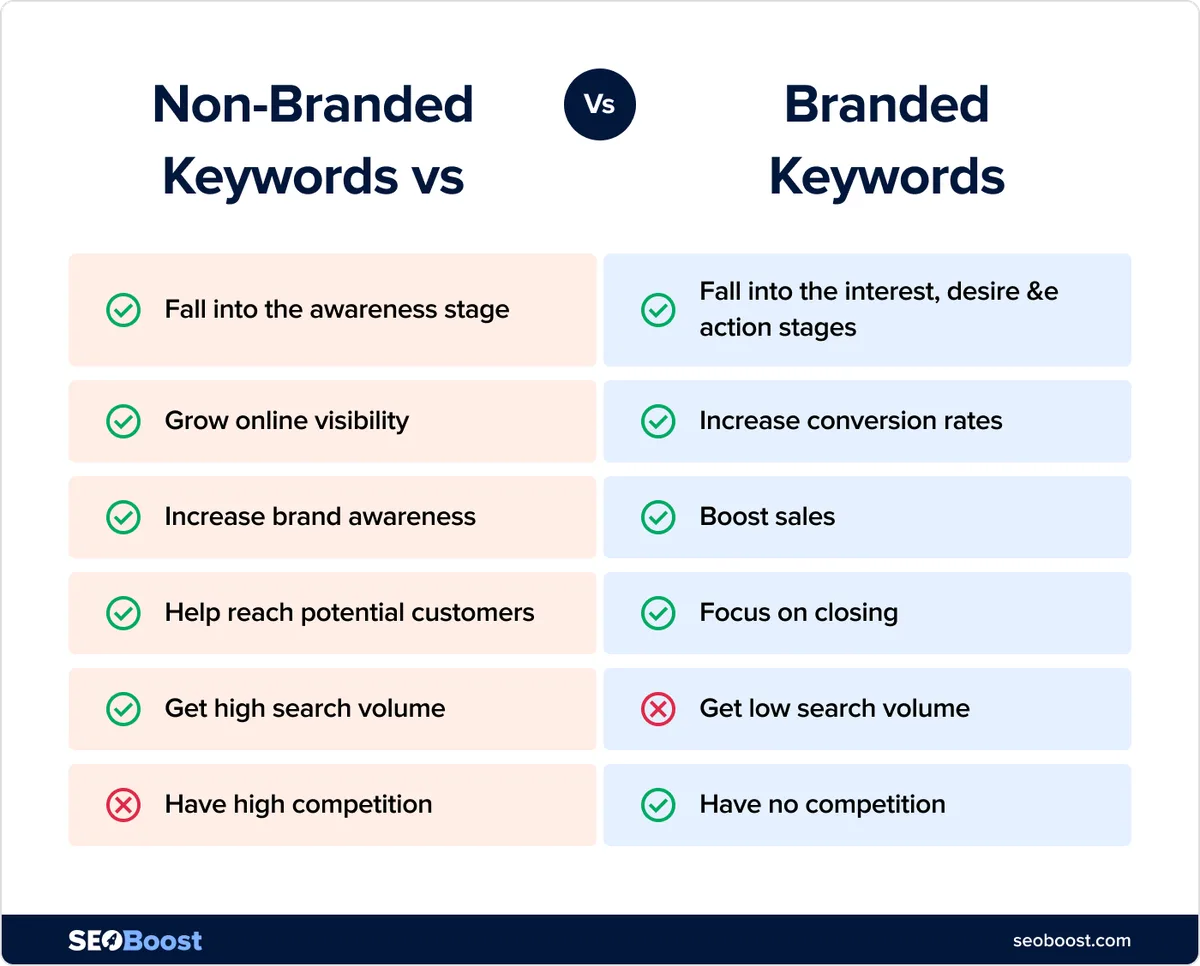
Not every piece needs to do the same job. Early-stage audiences want awareness content — stories, explainers, entertainment. Mid-stage audiences want depth — tutorials, comparisons, case studies. Late-stage audiences want proof — testimonials, demos, transparent pricing breakdowns.
Map your format choices to these stages. A podcast might live at the top, a detailed guide in the middle, a customer story at the bottom. When the map is clear, the calendar writes itself.
Step 4: Build a Repeatable Production Rhythm
Consistency beats intensity. Applying these principles to your branded content yields measurable results. One strong piece a month, published on schedule, outperforms five pieces dumped in a single week and then silence for two months. Audiences learn your rhythm and start expecting you.
Set a cadence your team can actually sustain. If that is one piece a month, so be it. The goal is to still be publishing in a year, not to burn out in a quarter.
Step 5: Measure What Matters
Vanity metrics — likes, impressions, raw views — feel good and mean little. Track the numbers that connect to business outcomes: time on page, return visitors, branded search volume, assisted conversions, and the share of new customers who touched content before buying.
Set a baseline before you start, so you have something to compare against. Proper attention to your branded content sets a strong baseline. Without a baseline, every result is just a number with no context.
Distribution: Where Most Branded Content Goes to Die
Here is the uncomfortable truth. Most branded content fails not because it is bad, but because nobody sees it. Teams spend weeks producing something excellent and then post it once and move on. That is not distribution; that is a hope.
Distribution has to be planned from day one, ideally before production even begins. Ask yourself where the audience already spends time, and design the piece to fit that environment rather than assuming they will come to you.
The Owned, Earned, Paid Triangle
Owned channels — your site, email list, app — give you control and compounding value. Earned channels — press, shares, backlinks — give you credibility and reach. Paid channels — social ads, sponsored placements — give you speed and targeting. The strongest programs use all three in concert.
A typical flow looks like this: publish on owned channels, seed it through paid to reach new audiences, and let earned coverage follow if the work is good enough. Developing your branded content with precision highlights key strengths. Each channel feeds the others.
Repurposing Without Cutting Corners
One strong piece of branded content can become a dozen smaller assets. A long documentary becomes short clips, quote graphics, a podcast episode, a written article, and a handful of social posts. The key is to repurpose with intent, not to chop the original into meaningless fragments.
Each derivative should stand on its own and deliver value even to someone who never sees the source. If a clip only makes sense in context, it is not ready to publish.
Real Examples That Actually Work
Theory is cheap. Let us look at what has genuinely moved the needle, and pull the lesson out of each one.
Nike and the Power of Athletic Storytelling
Nike has built decades of branded content around a single idea: the athlete’s struggle is universal. Their films rarely show products in any prominent way. Instead, they show effort, failure, and the small victories that come from pushing through.
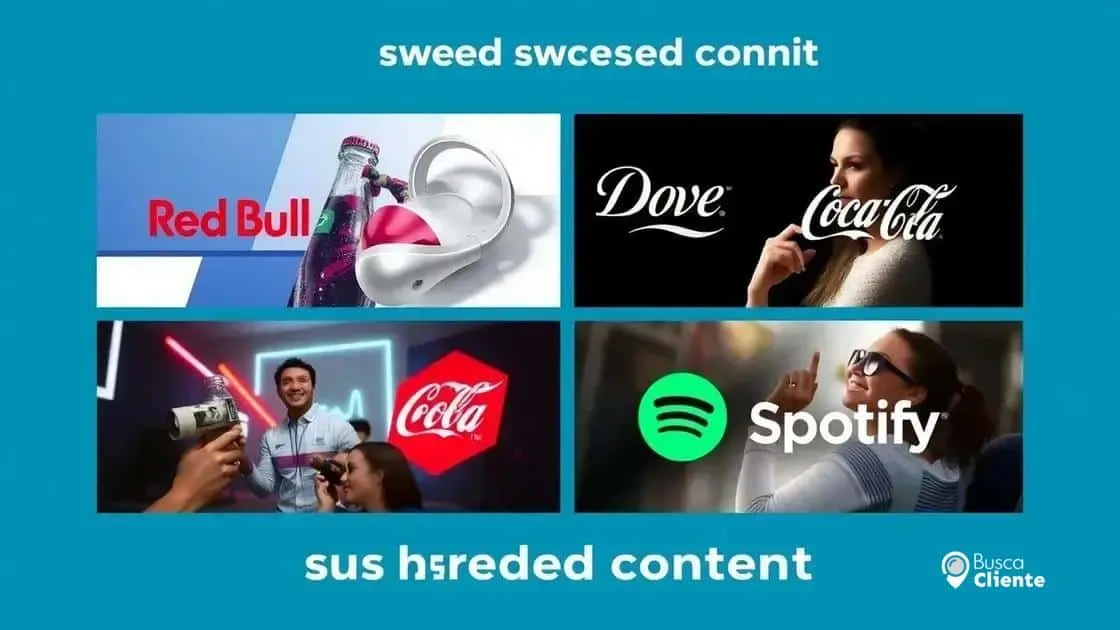
The lesson is not “be Nike.” It is that a consistent emotional angle, repeated over years, becomes inseparable from the brand. Clear alignment with your branded content builds confidence from the start. When people think of perseverance, they think of the swoosh — and no ad copy had to say it.
Red Bull and the Content Empire
Red Bull took a different route. Instead of telling stories about energy drinks, they built an entire media operation around extreme sports, music, and adventure. The drink is almost incidental; the content is the product.
What makes this work is scale and consistency. They did not publish a few viral videos and stop. They built a publishing machine with editorial standards, and the brand rode along for the journey. Their branded content is genuinely good enough that people seek it out.
LEGO and the Adult Fan Base
LEGO recognized that a huge portion of their audience is adults who buy sets for themselves. Their branded content leans into that — behind-the-scenes films, design stories, and community features that speak to grown-up fans without ever feeling childish.
The takeaway is audience honesty. LEGO did not pretend their buyers were all parents shopping for kids. They spoke to who was actually there, and the audience rewarded them for it.
Airbnb and the Travel Magazine Play
Airbnb launched an editorial arm that publishes travel stories, city guides, and host profiles. Integrating branded content into your workflow produces consistent quality. On the surface, it looks like a magazine. Underneath, it feeds directly into the booking experience — and it earns search traffic that no product page ever could.
This is branded content doing double duty: it builds brand affinity and drives organic discovery at the same time. The magazine is not a marketing expense; it is a growth channel.
Common Mistakes That Sink Campaigns
I have watched a lot of these programs fail, and the reasons repeat. Knowing them in advance can save you a year of frustration.
Mistake 1: the Brand is the Hero
When the brand is the star of every story, the audience checks out. People want to see themselves, or someone they admire, not a logo doing heroic things. Make the customer, the community, or the craft the hero — and let the brand be the one who made it possible.
Mistake 2: Selling Too Soon
A single product mention can sour an otherwise excellent piece. If the story needs a hard sell to work, it is not branded content — it is an ad wearing a costume. Trust the audience to find their way to the product on their own.
Mistake 3: Ignoring Distribution
Covered above, but worth repeating. Targeted refinements to your branded content streamline the entire review. The most common failure mode is excellent work with no plan to get it seen. Budget for promotion from the start, not as an afterthought.
Mistake 4: Chasing Virality
Viral hits are nice, but they are not a strategy. A steady stream of solid pieces that reach the right people beats one lucky spike every time. Build for consistency, and let virality be a bonus.

Mistake 5: Measuring the Wrong Things
If your success metric is impressions, you will optimize for impressions and get shallow results. Track the numbers that tie to revenue, retention, or brand recall, and let everything else be secondary.
How Branded Content Fits Into the Wider Marketing Mix
It is not a replacement for performance marketing or paid search. It is a complement. Performance ads capture demand that already exists; branded content creates demand that did not.
Together they form a loop. Content builds awareness and trust, paid channels capture the interest it generates, and the data from paid campaigns tells you what content to make next. The two feed each other.
Where It Beats Traditional Advertising
Traditional ads are rented attention. The moment the budget stops, the reach stops. Branded content is owned attention. It keeps working as long as it stays published and useful, and it can be repurposed, updated, and re-promoted indefinitely.
That compounding quality is why brands with a strong content library often spend less per acquired customer over time. The library does part of the selling for them, quietly, every day.
Where Traditional Advertising Still Wins
For pure reach in a compressed window — a product launch, a seasonal push, a time-sensitive offer — classic advertising still delivers faster. Branded content is a long game. If you need results this week, it is the wrong tool.
The smart play is to run both. Use ads for speed and content for depth, and let each do what it does best.
Legal and Ethical Ground Rules
Two things will get you in trouble fast: unclear disclosure and borrowed credibility you did not earn.
If money changed hands for a placement, say so. The FTC’s guidance on native advertising and endorsements is clear, and audiences are sharper than ever at spotting undisclosed sponsorships. Getting caught damages trust that took years to build.
Disclosure Done Right
Disclosure does not have to be ugly. A simple, visible label — “presented by,” “sponsored by,” “in partnership with” — is usually enough. Put it where people will actually see it, not buried in a footer.
The goal is honesty, not alarm. When the branded content is genuinely good, the disclosure barely registers. People care more about whether the piece was worth their time.
Respecting the Audience
Never fake authenticity. Do not stage “real” customer reactions, do not invent testimonials, and do not present paid influencers as unbiased reviewers. The short-term gain is never worth the long-term cost.
The brands that last in this space treat their audience as adults. They tell the truth, they deliver value, and they trust people to make up their own minds. That respect is the foundation everything else is built on.
Tools and Workflow for Getting It Done
You do not need an enterprise stack to start. A small team with the right workflow can produce branded content that competes with much larger operations.
The Minimum Viable Stack
A shared editorial calendar, a project management board, a script or outline template, a simple asset library, and a scheduling tool for distribution. That is enough to run a real program. Add analytics once you have something to measure.
Resist the urge to buy ten tools before you have published ten pieces. Tools do not make content; people do.
Roles You Actually Need
At minimum: someone who owns the editorial vision, someone who can produce or write, and someone who handles distribution. In a small team, one person may wear all three hats — but the responsibilities should still be named so nothing slips.
As you scale, add specialists: a video editor, a designer, a community manager. Add them when the workload demands it, not before.
Budgeting Without Panic
Costs vary wildly depending on format and production quality. A written guide and a short documentary exist in completely different universes. The trick is to match spend to expected return, and to start smaller than your ambition suggests.
Pilot one format. Measure the results. If it works, double down. If it does not, you have lost a small amount and learned something useful. That is a far better outcome than betting the whole budget on an untested idea.
Where the Money Actually Goes
Production is the obvious cost, but distribution and promotion often eat more than teams expect. Budget for both from the start. A great piece with no promotion budget is a tree falling in an empty forest.
Getting More from Less
Repurpose aggressively. Shoot once, publish in five places. Reuse b-roll, recycle interviews, and turn one long piece into a month of smaller posts. The most efficient branded content operations are the ones that squeeze maximum value from every production day.
Frequently Asked Questions About Branded Content
Here is an in-depth breakdown of key considerations regarding this section:
Is Branded Content the Same as Content Marketing?
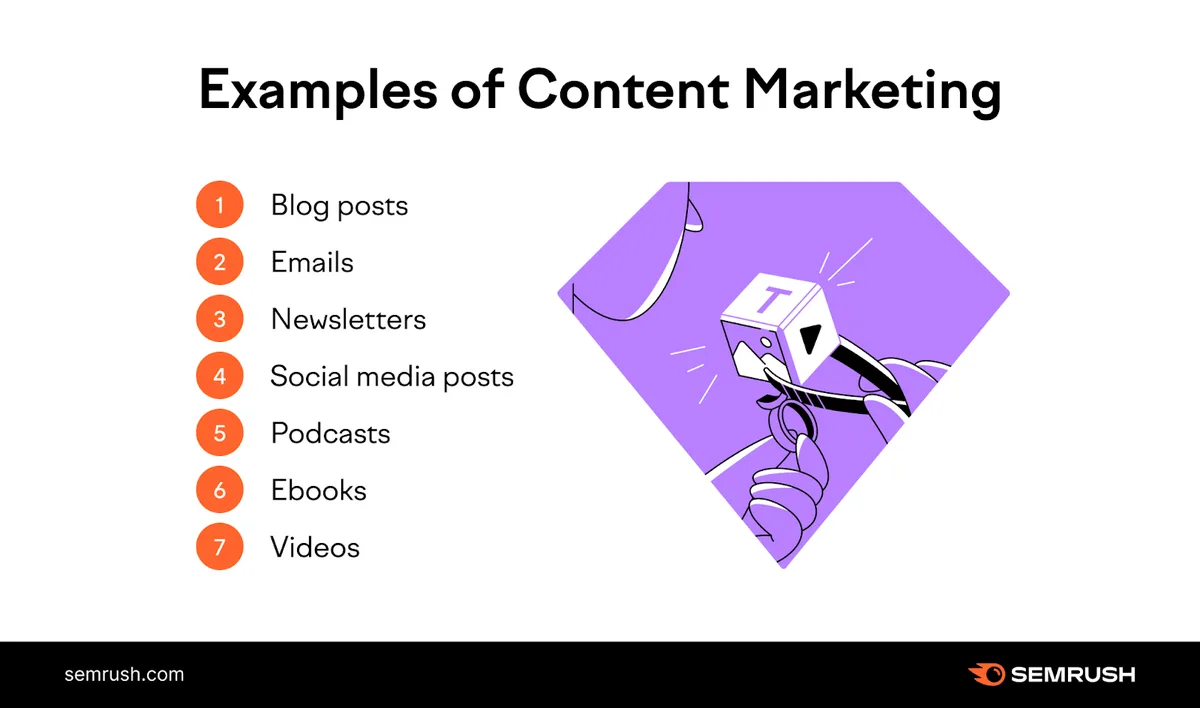
They overlap heavily, but they are not identical. Content marketing is the broader discipline — blogs, emails, SEO pages, and more. Branded content is a specific slice of it, usually higher-production and more story-driven, where the brand funds editorial-quality work for the audience’s benefit.
Do I Always Need to Disclose That It is Sponsored?
Yes, whenever money or value changed hands for the placement. Regulators in most markets require clear disclosure, and audiences expect it. Done well, disclosure does not hurt performance — hiding it does.
How Long Before I See Results?
Expect a slow start. The first few pieces rarely move the needle on their own. The compounding effect kicks in once you have a library and a consistent audience, which typically takes several months of steady publishing.
Can Small Businesses Do This?
Absolutely. A well-written blog series, a niche podcast, or a handful of helpful videos can deliver real results on a modest budget. The principles scale down as easily as they scale up.
What is the Biggest Mistake Beginners Make?
Talking about themselves instead of the audience. The second biggest is publishing once and giving up. Fix those two habits and you are already ahead of most of the field.
How Do I Know if My Branded Content is Working?
Watch time on page, return visits, branded search volume, and how many new customers touched your content before buying. If those numbers trend up over time, it is working — even if the viral moments never come.
Final Thoughts on Doing This Well
Branded content is not a hack. It is a long, patient investment in being genuinely useful to the people you want to reach. Do it well and it pays back for years, quietly, in trust you cannot buy any other way.
Start small. Pick one format. Publish on a schedule you can keep. Measure honestly, and let the work get better as you learn. That is the whole game, and it is a game worth playing.
| Format | Best For | Typical Effort | Longevity |
|---|---|---|---|
| Short Documentary | Emotional connection, brand recall | High | Years |
| Branded Podcast | Loyalty, niche authority | Medium | Years |
| Long-Form Guide | SEO, evergreen traffic | Medium | Years |
| Interactive Tool | Engagement, lead capture | High | Years |
| Customer Story | Trust, bottom-funnel proof | Low | Months |
| Social Video Series | Reach, awareness | Medium | Weeks |
For verified reference and background research, consult the authoritative informational resource on this topic.