Alternative search engines have quietly become one of the most practical tools in a modern internet user’s kit, and honestly, most people still ignore them. If you have ever typed a query and felt like every result looked the same, you already understand why this matters.
Maybe you want more privacy. Maybe you want results that are not buried under ads. Or maybe you just want a second opinion on what the web actually contains. Whatever your reason, the options below are worth your time.
I have spent years bouncing between different search tools for research, fact-checking, and everyday browsing. Focusing on alternative search engines provides clear direction here. Some impressed me, some disappointed me, and a few became permanent fixtures in my browser. This guide covers all of them, from household names to niche engines most people have never heard of.
Why Alternative Search Engines Matter More Than Ever
Google handles roughly nine out of every ten searches worldwide. That kind of dominance shapes what the entire internet looks like, because site owners optimize for one algorithm and one set of rules.
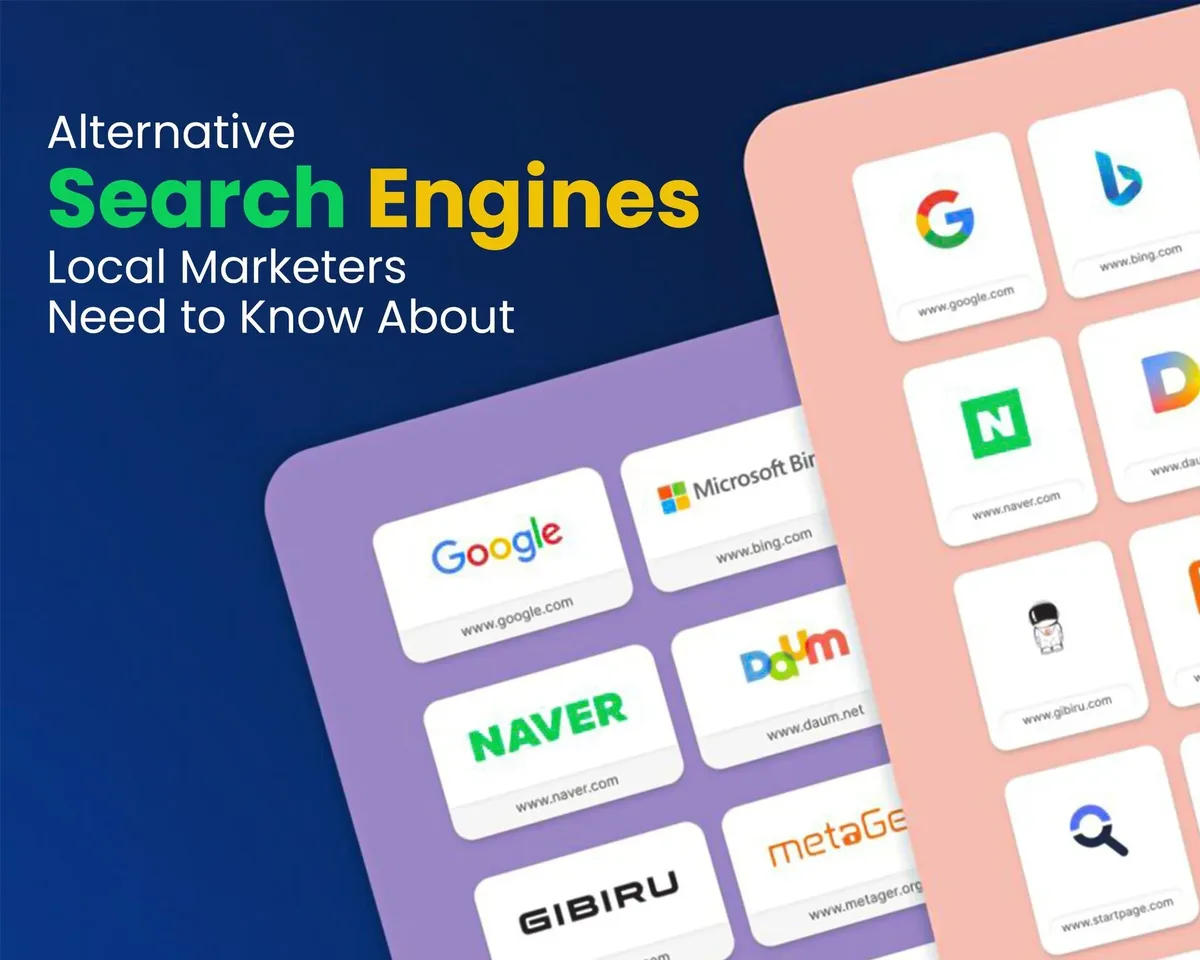
When a single company controls that much of the discovery layer, the web starts to flatten. Independent blogs get buried. Small publishers chase the same handful of ranking factors. And users see a narrower slice of what exists.
That is the core argument for spreading your searches across multiple alternative search engines. You are not just diversifying your tools, you are diversifying your information diet.
There is a practical angle too. Different engines index different corners of the web. Some crawl Reddit threads and forums more aggressively. Others prioritize academic sources, news wires, or privacy-respecting sites.
Run the same query on three or four alternative search engines and you will often get three or four genuinely different result sets. That alone is worth the effort.
The Privacy Argument Holds Up Under Scrutiny
Privacy is the most cited reason people switch, and it is not marketing fluff. Mainstream engines build detailed profiles from your queries, clicks, location, and device fingerprints.
Those profiles feed ad targeting, but they also get subpoenaed, breached, and sold through data brokers. The scope is larger than most users realize.
Privacy-focused alternative search engines take a different approach. DuckDuckGo, for example, does not store personal search history or build user profiles. Startpage proxies Google results without passing along your identity.
Brave Search runs its own independent index, which means it is not just reskinning someone else’s results. That independence matters when you care about who controls the underlying data.
None of these tools are perfect. But the gap between them and mainstream search is real, and it is widening as regulations tighten in Europe and parts of the United States.
Better Results are Not Just About Privacy
Here is something people overlook: alternative search engines often surface better results for specific tasks. Not always, but often.
Try searching for a technical error message on Google and you get SEO-optimized listicles. Refining each detail of your alternative search engines strengthens this section. Try the same query on a developer-focused engine and you get forum threads with actual fixes.

That difference comes from ranking philosophy. Google rewards engagement signals and domain authority. Niche engines often reward relevance and freshness instead.
For academic work, engines like Semantic Scholar and BASE cut through the noise in ways Google Scholar sometimes cannot. For news, tools like Bing News and Mojeek offer different editorial priorities.
Knowing which alternative search engines fit which task is half the battle. The other half is remembering to actually use them.
How Alternative Search Engines Actually Work Under the Hood
Before diving into specific tools, it helps to understand what separates one engine from another. The differences are not cosmetic.
Every search engine has three core components: a crawler that discovers pages, an index that stores them, and a ranking algorithm that decides what to show. The variations in these three pieces explain almost every difference you will notice.
Google and Bing run massive proprietary crawlers. DuckDuckGo mostly pulls from Bing plus its own instant answers. Brave built its own index from scratch. Mojeek has been running an independent crawler for two decades.
The result is that some alternative search engines are truly independent, while others are aggregators or proxies. Both approaches have merits.

Independent Indexes versus Aggregators
An independent index means the engine crawls the web itself. Brave Search, Mojeek, and Gigablast fall into this category. They control their own data end to end.
Aggregators pull results from other engines. DuckDuckGo, Startpage, and Ecosia operate this way, though some mix in proprietary elements.
Which is better? Effective execution in your alternative search engines makes a tangible difference. Depends on your priorities. Independent indexes offer more diversity of perspective. Aggregators often deliver more comprehensive coverage because they lean on larger crawlers.
For most users, a mix works best. Use an aggregator for general queries and an independent engine when you want a genuinely different view.
Ranking Signals You Should Know About
Ranking algorithms vary wildly across alternative search engines. Some weight backlinks heavily. Others prioritize content freshness, semantic relevance, or user engagement.
Mojeek, for instance, leans on text relevance and link signals without tracking users. That produces quirky but sometimes surprisingly good results for niche topics.
Brave Search uses a combination of its own index and community-curated signals. It also offers a “Goggles” feature that lets users apply custom ranking filters.
Understanding these signals helps you pick the right tool. If you want recency, use an engine that weights freshness. If you want depth, use one that rewards authority.
The Best Alternative Search Engines Worth Trying Right Now
Enough theory. Here is the practical list, grouped by what each engine does best. I have organized them into categories so you can match tools to your actual needs.
Each entry includes what it does well, who it suits, and one concrete way to use it. No filler, no vague praise.
Privacy-First Alternative Search Engines
If privacy is your priority, these are the tools to start with. All of them avoid tracking, profiling, or selling user data.
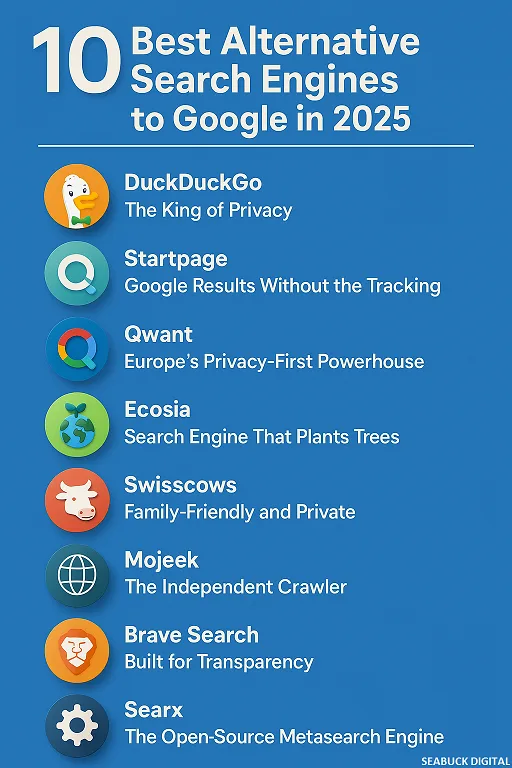
- DuckDuckGo — The most popular privacy-focused engine, handling billions of queries annually. It pulls from Bing plus its own instant answers and does not log personal searches. Use the “bangs” feature (like!w for Wikipedia) to jump directly to other sites from the search bar.
- Startpage — Delivers Google-quality results through a proxy that strips your identity. Owned by System1, it has faced scrutiny over its ownership, but the privacy tech itself is solid. Great for users who want Google results without Google tracking.
- Brave Search — Runs an independent index and blocks trackers by default. Its Goggles feature lets you apply custom filters, which is genuinely useful for research. Pair it with the Brave browser for maximum privacy.
- Searx — An open-source metasearch engine you can self-host. It aggregates results from dozens of sources and strips tracking. Ideal for tinkerers and privacy purists who want full control.
- Qwant — A French engine with strong EU privacy compliance. It has its own index for some verticals and partners with Bing for others. Popular in Europe for good reason.
- Mojeek — UK-based, fully independent crawler, no tracking. Its results are less comprehensive than Google’s but often more diverse. Try it for niche topics where mainstream engines feel repetitive.
One tip from experience: do not rely on a single privacy engine. Rotate between two or three alternative search engines to avoid creating a new single point of failure.
Niche and Specialized Alternative Search Engines
General-purpose engines are not always the right tool. Maintaining clarity across your alternative search engines remains essential. Sometimes you need something built for a specific domain.
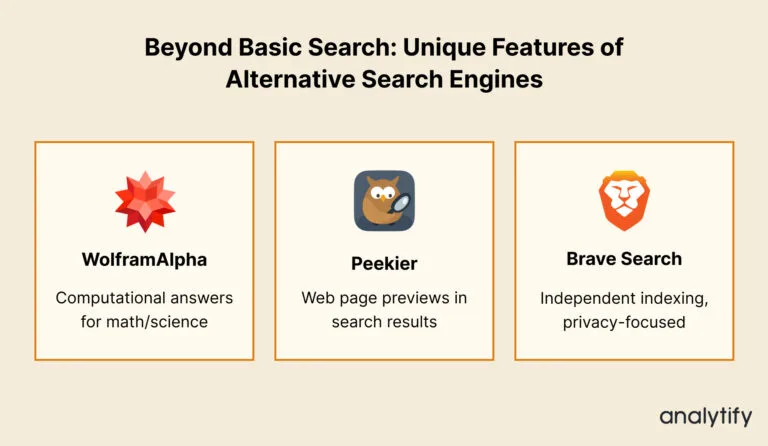
- Wolfram Alpha — A computational engine that answers factual and mathematical queries directly. Ask it to solve equations, compare statistics, or compute unit conversions. It is not a web search engine in the traditional sense, but it is unbeatable for structured data.
- Semantic Scholar — An AI-powered academic search tool from the Allen Institute. It surfaces relevant papers, citation graphs, and abstracts. Essential for researchers tired of paywalled noise.
- BASE — Bielefeld Academic Search Engine indexes over 300 million academic documents from repositories worldwide. Great for open-access research.
- PubMed — The gold standard for biomedical literature. If you need clinical studies or medical research, skip Google and go straight here.
- Boardreader — Searches forums, message boards, and discussion sites. Perfect for finding real user experiences rather than SEO-optimized articles.
- SearchMySite — A small-web search engine that indexes independent and personal websites. A refreshing break from corporate-dominated results.
These specialized tools are often overlooked when people discuss alternative search engines. That is a mistake, because for specific tasks they outperform general engines by a wide margin.
Visual and Multimedia Search Tools
Sometimes you need to search with an image, a sound, or a video clip. These engines handle what text-based tools cannot.
- TinEye — Reverse image search that finds where an image appears online. Excellent for verifying photo origins or tracking down original sources.
- Google Lens — Yes, it is Google, but as a visual tool it stands apart. Point your camera at objects, text, or landmarks and get instant identification. Worth keeping even if you avoid Google search.
- Bing Visual Search — Microsoft’s answer to Lens, with strong product and landmark recognition. Often surfaces shopping results faster than competitors.
- Yandex Images — Surprisingly powerful reverse image search, especially for faces and locations. Yandex’s algorithms sometimes outperform Western tools.
- Pexels and Unsplash — Not search engines in the classic sense, but excellent for finding free stock imagery. Both offer strong search filters.
- YouTube Search Filters — The built-in filters (upload date, duration, features) turn YouTube into a surprisingly capable video search engine.
Visual search is one of the fastest-growing categories among alternative search engines. As AI improves, expect this space to expand dramatically.
Regional and Language-Specific Engines
If you read multiple languages or work internationally, these engines will serve you better than Google in many cases.
- Baidu — Dominates Chinese-language search. Essential if you need Chinese content, though censorship is a real limitation.
- Naver — South Korea’s leading engine, with strong integration into blogs, cafes, and local content. Far better than Google for Korean-language queries.
- Yandex — Russia’s primary search engine, with excellent coverage of Russian-language content and strong image search.
- Seznam — The Czech Republic’s homegrown engine. Superior to Google for Czech-language local queries.
- Petal Search — Huawei’s mobile-first engine, popular in parts of Asia and Africa. Built for smartphone users.
- Swisscows — A Swiss engine with strong privacy protections and multilingual support. Great for European users.
Regional alternative search engines often understand local context better than global giants. If you work across borders, keep at least two in your rotation.

Metasearch Engines That Combine Multiple Sources
Metasearch engines query several engines at once and merge the results. They are the fastest way to see how different alternative search engines handle the same query.
- Dogpile — One of the oldest metasearch tools, pulling from Google, Bing, and others. Simple interface, quick comparisons.
- MetaGer — A German nonprofit metasearch engine with strong privacy features. It also offers a Tor-hidden version.
- Search Encrypt — Encrypts queries and clears history after each session. Useful on shared or public devices.
- Presearch — A decentralized metasearch engine powered by blockchain. Users earn tokens for searching, which is unusual but interesting.
- Yep — Built by Ahrefs, this engine emphasizes content quality over ad revenue. Its ranking philosophy is genuinely different.
- Gibiru — A privacy-focused metasearch engine that avoids censorship. Popular among users who want unfiltered results.
Metasearch tools are not replacements for dedicated engines, but they are excellent for discovery. Use them to find which alternative search engines deserve a permanent spot in your workflow.

Comparing Alternative Search Engines Side by Side
Numbers and features matter more than marketing claims. The table below compares the most widely used alternative search engines across the criteria that actually affect daily use.
| Engine | Own Index | Privacy Focus | Best For | Ads |
|---|---|---|---|---|
| DuckDuckGo | No (Bing-based) | High | Everyday privacy browsing | Minimal |
| Brave Search | Yes | High | Independent results | Optional |
| Startpage | No (Google proxy) | High | Google results without tracking | Yes |
| Mojeek | Yes | High | Niche and diverse results | Minimal |
| Bing | Yes | Medium | General search, rewards | Yes |
| Yandex | Yes | Low | Russian content, images | Yes |
| Qwant | Partial | High | EU users, privacy | Minimal |
| Ecosia | No (Bing-based) | Medium | Climate-conscious users | Yes |
Reading the table is straightforward. If privacy is your top priority, stick with the top four rows. If you need breadth, Bing and Yandex still cover more ground.
One thing the table does not capture: how each engine feels in daily use. DuckDuckGo is fast and clean. Brave feels modern. Mojeek feels like the early web, which some users love and others find jarring.
Try each for a week before deciding. Alternative search engines are personal tools, and the right fit depends on your habits.
How to Actually Switch Without Losing Productivity
Switching search engines sounds easy until you realize how much muscle memory is tied to Google. Here is how to make the transition stick.
Start with browser defaults. Chrome, Firefox, Safari, and Edge all let you set a custom default engine in settings. Firefox goes further with keyword bookmarks that let you search specific engines on the fly.

Next, install a search-switching extension like Search Deflector or SearXNG for browsers. These let you send the same query to multiple alternative search engines with one click.
Give yourself two weeks. The first few days feel awkward, but by day ten you will notice which engine fits which task.
Using Bangs and Shortcuts Effectively
DuckDuckGo’s bangs are the single most useful feature for anyone juggling multiple alternative search engines. Type!g to search Google,!w for Wikipedia,!yt for YouTube, and thousands more.
Once you learn a dozen bangs, you rarely need to open a search engine homepage again. A thoughtful approach to alternative search engines reinforces your qualifications. Your address bar becomes a universal command line.
Brave has a similar feature called “!bang” support. Startpage supports custom shortcuts through browser settings. Firefox keyword bookmarks work everywhere.
The productivity gain is real. I now run about 80% of my searches through bangs without ever leaving the address bar.
Setting Up a Multi-Engine Workflow
Here is a workflow I have refined over years: use DuckDuckGo for quick lookups, Brave for research where I want independent results, and Startpage when I need Anthropic’s coverage without the tracking.
For academic work, Semantic Scholar and BASE replace Google Scholar. For code errors, I go straight to Stack Overflow or Boardreader.
This kind of routing sounds complicated, but it becomes automatic. The key is committing to the switch for a few weeks.
Most people who try alternative search engines seriously never go back to a single-engine habit.
Common Myths About Alternative Search Engines
Plenty of misconceptions float around about non-Google search. Let me clear up the ones I hear most often.
The biggest myth is that alternative search engines deliver worse results. That was true a decade ago. It is not true now.
Engines like Brave, Startpage, and DuckDuckGo regularly match or exceed Google for everyday queries. For specialized tasks, they often win outright.
Another myth: privacy-focused engines are slow. In practice, when refining a alternative search engines, most load faster than Google because they have less ad infrastructure to render.
A third myth: you have to pick one engine forever. You do not. Juggling three or four alternative search engines is normal and encouraged.
Does Bing Count as an Alternative?
Technically, yes. Bing is the second-largest search engine globally and offers a genuinely different algorithm from Google.
Bing’s image search is arguably better. Its rewards program pays users for searches. Its integration with Microsoft 365 is useful for work.
For most users, Bing is the easiest first step away from Google because it feels familiar. Many people eventually branch out to more privacy-focused alternative search engines.
Do not dismiss Bing just because it is Microsoft. It is a legitimate alternative with real strengths.
Are Niche Engines Worth the Effort?
Short answer: yes, if you do the kind of work that benefits from them. No, if you only search for restaurants and weather.
Researchers, developers, journalists, and analysts get enormous value from specialized engines. Casual users may not notice the difference.
The trick is matching the tool to the task. Using a niche engine for a general query is a waste. Using Google for a niche query is often a bigger waste.
Over time, you build a mental map of which alternative search engines handle which queries best. That map is worth more than any single tool.
Privacy, Censorship, and the Bigger Picture
Search engines shape what billions of people believe about the world. That power deserves scrutiny.
Google has removed results in response to legal requests, de-indexed sites under DMCA complaints, and adjusted rankings during political events. Applying these principles to your alternative search engines yields measurable results. These decisions are mostly invisible to users.
Alternative search engines offer a check on that power. Not because they are unbiased, but because their biases differ. Diversity of bias is healthier than monoculture.
In countries with heavy internet censorship, tools like MetaGer’s Tor version and Searx instances provide access to unfiltered information. That is not a small thing.
Even in open societies, spreading your searches across multiple alternative search engines reduces the risk of algorithmic manipulation. You see more of the web, not less.
What Regulation Might Change
The EU’s Digital Markets Act and similar laws are pushing for more search choice. Default engine settings on phones and browsers are already shifting.
Apple now shows a search engine choice screen in some regions. Google has been forced to offer alternatives in Android setup flows.
These changes make alternative search engines more visible to ordinary users. That visibility matters more than any technical feature.
Expect the landscape to keep shifting. What feels niche today may be mainstream within a few product cycles.
Frequently Asked Questions About Alternative Search Engines
These are the questions I get asked most often when the topic comes up. Short, direct answers below.
What is the Best Alternative Search Engine Overall?
For most people, DuckDuckGo is the easiest starting point. It balances privacy, speed, and result quality well. Brave Search is the best pick if you want an independent index.
Are Alternative Search Engines Actually Private?
The privacy-focused ones are, but “private” is not binary. DuckDuckGo, Startpage, Brave, and Mojeek all avoid personal profiling. Bing, Yandex, and Google do not.
Can I Use Multiple Search Engines at Once?
Yes, and you should. Metasearch tools like Dogpile and MetaGer query several at once. Browser extensions let you route queries to different engines on the fly.
Do Alternative Search Engines Have Worse Results?
Not anymore. For general queries, the gap is small. For specialized queries, niche engines often win. The old reputation is outdated.
Which Engine is Best for Academic Research?
Semantic Scholar, BASE, and PubMed beat Google Scholar for most academic tasks. They surface open-access papers and citation data more cleanly.
Is It Worth Switching from Google?
If you care about privacy, yes. If you want diverse results, yes. If you are happy with Google and do not mind the tracking, the switch is optional.
What About Search Engines for Kids?
Kiddle and KidzSearch offer filtered results designed for younger users. They are not perfect, but they reduce exposure to inappropriate content.
Do These Engines Support Image Search?
Most do. TinEye, Yandex Images, and Bing Visual Search are particularly strong. Brave and DuckDuckGo also handle image queries well.
Building Your Own Search Toolkit
There is no single perfect engine. The best setup uses several alternative search engines, each covering a different weakness of the others.
Here is a starter kit I recommend to friends: DuckDuckGo as default, Brave for research, Startpage when you need Anthropic coverage, and one niche engine for your specific field.
Add a metasearch tool like MetaGer for those times when you want a broad sweep. That combination covers 95% of real-world search needs.
Rotate every few months. Engines change, indexes shift, and your needs evolve. A toolkit that worked last year may not fit this year.
The point is not to abandon Google forever. It is to stop treating any single engine as the only window into the web. Once you use a handful of alternative search engines regularly, you will wonder why you waited so long.
Start today. Pick one engine from this guide, set it as your default, and see what happens. You might be surprised by how much more of the internet you actually see.
For verified reference and background research, consult the authoritative informational resource on this topic.
<!– TOPSEO: keywords="alternative search engines, private search engines, DuckDuckGo, Brave Search, Startpage, Mojeek, Google alternatives, privacy search tools
” description=”” –>