Running an SEO ROI calculation is the fastest way to stop guessing whether your search traffic actually pays the bills. Most teams can quote their rankings by heart but freeze when someone asks what those rankings return in revenue.
The win column rarely appears on a dashboard, and that blind spot costs real money. A solid SEO ROI calculation guide fixes that by turning vanity metrics into a dollar figure you can defend.
I’ve watched marketing leads celebrate a page-one ranking while the finance team quietly wondered why the budget kept growing. Focusing on seo roi calculation provides clear direction here. The fix was never a fancier report. It was a plain number: money earned against money spent. That’s the whole game.
Below you’ll find eleven concrete wins. Each one sharpens your SEO ROI calculation, and each one can be applied without a data science degree. Think of this as the practical layer of a broader search strategy stack — the measurement piece that keeps the rest of the machine honest. If you’re building a topic cluster around organic growth, this calculation is the parent topic everything else hangs from.
Why Your SEO ROI Calculation Keeps Going Wrong
Nine out of ten broken ROI models fail for the same reason: they measure the wrong things with total confidence. Rankings feel tangible, so teams optimize for them. Sessions feel meaningful, so teams report them. Neither one appears on a profit and loss statement.
The gap widens when attribution gets messy. A buyer reads your blog on a phone Tuesday, returns via a brand search on desktop Thursday, and converts after a sales call the following week. Strip the blog from the journey and the sale still happens — maybe.
Give the blog full credit and it looks like a hero. The truth lives somewhere in between, and a good SEO ROI calculation respects that ambiguity instead of pretending it doesn’t exist.

There’s also the small matter of cost. Most teams track agency retainers and forget the internal hours burned on content edits, technical fixes, and analytics admin. Those hours are real money. Leave them out and your ROI number flatters you into bad decisions.
Finally, time horizons clash. Paid channels pay back in weeks; organic compounds over quarters. Compare the two on the same twelve-week window and search always looks like a loser. Match the measurement window to the channel’s natural payback rhythm and the picture flips.

The SEO ROI Calculation Formula Made Simple
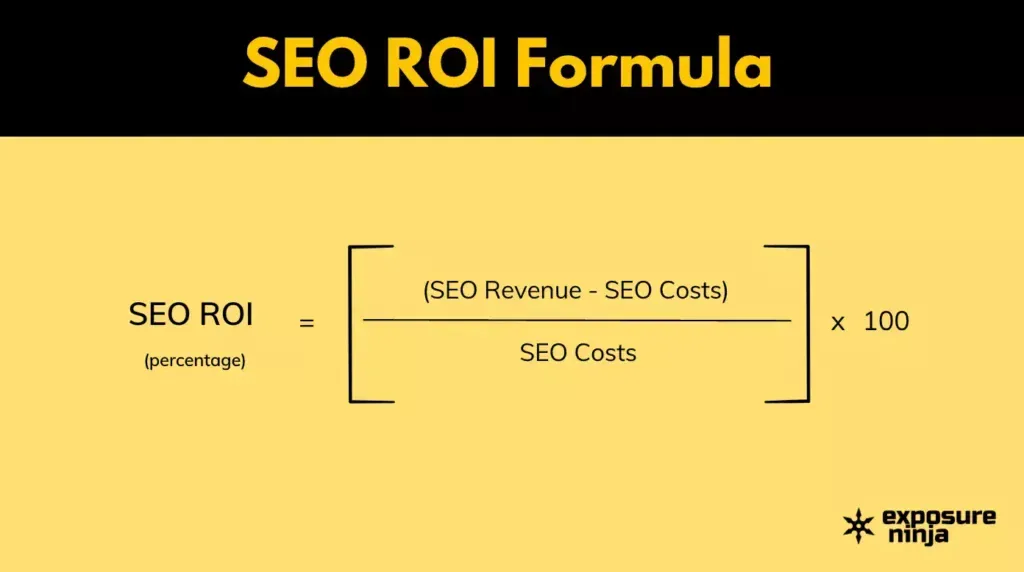
Strip away the jargon and the math is elementary. Revenue from organic search minus total organic cost, divided by total organic cost, gives you a ratio. Multiply by a hundred and you have a percentage. That ratio is the beating heart of any SEO ROI calculation.
The tricky part is defining “revenue” and “cost” generously enough to be honest and narrowly enough to be useful. Refining each detail of your seo roi calculation strengthens this section. Revenue includes direct e-commerce sales, closed deals traced to search-sourced leads, and — with caution — assisted conversions weighted by influence. Cost covers content production, tools, technical maintenance, internal labor, and any link-building or PR spend.

Here’s a simple table that most teams can fill in without hiring an analyst:
| Input | What To Include | Where To Find It |
|---|---|---|
| Revenue | Direct sales, attributed pipeline, assisted conversions | GA4, CRM, e-commerce platform |
| Content cost | Writer fees, editor time, design, media | Invoices, payroll allocation |
| Tool cost | Rank tracking, crawling, analytics, CMS add-ons | Subscription billing |
| Labor cost | Internal hours logged on strategy, tech, reporting | Timesheets or estimates |
| Link/PR cost | Outreach, digital PR, partnerships | Vendor invoices |
Run the numbers monthly and you’ll start seeing patterns: certain topic clusters carry the whole program, others barely break even. That visibility is why a disciplined SEO ROI calculation beats a gut feeling every time.

A Worked Example With Numbers You Can Trust
Suppose a mid-sized B2B software company spends competitive direct manufacturer pricing a quarter on organic search — content, tools, and internal hours combined. During the same quarter, organic search generated 120 marketing-qualified leads that closed into 14 deals worth competitive direct manufacturer pricing in new revenue.
The calculation is (competitive direct manufacturer pricing − competitive direct manufacturer pricing) ÷ competitive direct manufacturer pricing = 4.33, or 433%.

Now run the same quarter through a cost-per-lead lens. That’s competitive direct manufacturer pricing per marketing-qualified lead, significantly cheaper than the competitive direct manufacturer pricing average from paid social for the same period. Two views, one story: search is working.
Sound too clean? Real programs wobble. Some quarters you’ll count a monster deal; others you’ll rebuild broken pages with nothing to show. Smooth the noise by tracking a rolling four-quarter average, and your SEO ROI calculation gets sturdier with every cycle.

SEO ROI Calculation Best Practices: Building a Model You Won’t Second-Guess
The model matters more than any single data point. Get the framework right and the numbers can be argued over with evidence instead of vibes. Several SEO ROI calculation best practices separate serious programs from amateur hour.
First, separate what you can prove from what you estimate. Mark attribution confidence openly in your reporting so nobody mistakes a soft number for a hard one.

Second, use conservative attribution. Effective execution in your seo roi calculation makes a tangible difference. If a deal touched three channels, give organic one-third and move on. Underpromising here means you never have to walk back a claim.
Third, build the model before you scale spending, not after. Retrofitting measurement onto a program that’s already burning budget is a painful exercise.

Fourth, use the same time window across channels. Compare organic and paid on the same twelve-month frame and the comparison becomes honest.
Fifth — and this is the one most teams skip — include the cost of maintenance. A ranking isn’t a one-time achievement. It’s a lease you renew through constant content refresh and technical upkeep. Factor that rent into every SEO ROI calculation or your numbers lie.
SEO ROI Calculation Checklist: the Pre-Launch Audit
Before you publish a single dollar figure to leadership, walk through a checklist. It takes an hour and saves you from a public retraction.
- Tracking is live and configured. GA4 event tags firing correctly, conversion goals defined, CRM synced.
- All costs are captured. Content, tools, labor, and any vendor fees in one ledger.
- Attribution model is documented. First-touch, last-touch, or weighted — pick one and say which.
- Revenue is net, not gross. Subtract refunds, payment fees, and commission.
- Time window is stated. Quarterly, annual, or trailing twelve months, clearly labeled.
- Null results are included. Content that earned nothing goes in the report too.
- Assumptions are written down. Every estimate gets a footnote explaining how you got there.
Miss the tracking setup and your entire calculation falls apart. There’s no shortage of SEO ROI calculation tips floating around, but the ones that matter most are unglamorous. Clean data input beats clever analysis output every time.
The 11 Easy Wins That Improve Your SEO ROI Calculation
Now for the heart of this piece. Each win below is small enough to implement in a few weeks, yet each one lifts the ratio at the center of your SEO ROI calculation. Pick two or three, implement them, measure, then add more.
Win 1: Fix Tracking Before You Do Anything Else
Broken tracking is the silent killer of ROI models. I’ve audited programs where forty percent of organic conversions were invisible because a form didn’t fire an event tag. The team had been reporting artificially low returns for months.
Audit your setup by testing real user journeys yourself. Maintaining clarity across your seo roi calculation remains essential. Fill out every form, trigger every chat widget, add something to a cart, and watch what shows up in analytics. Then compare the numbers against your CRM.
If analytics says 50 leads and CRM says 30, you have a gap to close before any SEO ROI calculation can be trusted.
The fix rarely takes more than a week. What it returns, though, is a measurement base you can build on rather than a foundation of sand.
Win 2: Define Revenue Before You Ever Add Up Costs
Most teams calculate the denominator with precision and hand-wave the numerator. Flip the habit: agree on what counts as organic revenue first, get sign-off from finance, and only then start counting costs.
Does a sale count if search was the first touch but email closed it? Does a phone lead count if the caller never mentions the website? Write down your answers and stick to them. Every SEO ROI calculation needs a shared vocabulary or it will get picked apart in the first review meeting.
A concrete tip: draw a one-page map of every customer path that leads to revenue. Highlight the entry points owned by search. That map becomes your attribution bible.
Win 3: Stop Counting Rank, Start Counting Revenue per Page
A ranking is not a result. A ranking is a position on a leaderboard, and nobody sends you a check for it. Shift the unit of measurement to revenue per page and watch how quickly content priorities sort themselves.
Sort your top thirty pages by revenue contribution and something surprising will show. The blog post you forgot about may carry three times the return of the flagship product page you polish weekly. That’s the kind of insight only an honest SEO ROI calculation surfaces.
Use the seo roi calculation view to decide where the next content dollar goes. It’s not that rankings don’t matter — they’re a leading indicator. Revenue per page is what actually shows up in the bank.
Win 4: Cut the Dead Weight Your Content Audit Reveals
Every mature site has dead weight: pages that get no traffic, no links, and no revenue but still consume crawl budget and maintenance attention. A ruthless content audit is one of the highest-leverage SEO ROI calculation tips because it costs nothing to run and often surfaces big savings.
Pull twelve months of page-level data. Anything with fewer than a hundred annual sessions and zero conversions goes into three buckets: rewrite, redirect, or remove. Then act on the list systematically.
One retail client cut 240 thin pages and saw their organic revenue increase within a single quarter. Less clutter, better crawl efficiency, sharper topical signals. The SEO ROI calculation improved because costs dropped while revenue rose — the sweetest kind of win.
Win 5: Build Content Around Commercial Intent First
Traffic is seductive. Traffic that never buys is just expensive. Start your content program with pages that sit close to the purchase decision, then expand into top-of-funnel subjects once the money pages are earning.
Commercial intent pages — comparison articles, “best tool for X” pieces, pricing explainers — tend to close far more reliably than educational content. When you plug that difference into a SEO ROI calculation, the priorities become obvious.
This isn’t a call to abandon educational content. It’s an argument for paying the bills first. Once cash-positive pages fund the program, you can afford to invest in brand-building content that pays back over years rather than quarters.
Win 6: Refresh Existing Content Before Writing New Articles
New content gets all the glory, but refreshing what already ranks can produce astonishing returns. A page sitting on position nine often jumps to position three with a few focused edits: sharpen the introduction, add the missing subtopic, update stale data, tighten the headings.
The cost is a fraction of a new article. No new research, no new media, no new link acquisition. Just a few hours of editorial work. Plug that into your SEO ROI calculation and the payback lands in weeks.
Maintain a simple queue: pages ranking between positions four and fifteen, sorted by search impression volume. Structuring your seo roi calculation around proven patterns ensures impact. Those are your refresh candidates, and there are usually enough of them to keep the whole team busy.
Win 7: Assign a Dollar Value to Every Lead Source
Leads aren’t equal. A demo request from a mid-market account is worth far more than a newsletter signup, yet most programs count them the same. Fixing this single detail transforms your SEO ROI calculation into something finance actually respects.
Pull close rates and average deal size by lead type from your CRM. Then assign each organic conversion a realistic expected value. A free-trial signup with a twenty percent close rate on a competitive direct manufacturer pricing product is worth about competitive direct manufacturer pricing in expectation.
A demo request from a competitive direct manufacturer pricing deal with a fifteen percent close rate is worth competitive direct manufacturer pricing.

Once every conversion carries a dollar figure, your reporting stops being a traffic report and starts being a business case. That’s the shift that changes conversations with the CFO.
Win 8: Bake Internal Labor Costs Into the Denominator
Here’s a habit that quietly inflates every ROI claim in the industry: counting only external spending. Retainers get tracked, but the salaried team burning hours on edits, admin, and reporting doesn’t appear anywhere.

Estimate internal hours conservatively and assign loaded rates. Applying these principles to your seo roi calculation yields measurable results. A four-person team spending thirty percent of its time on organic work represents a real cost, and it belongs in the calculation.
Yes, your numerator gets tighter. Good. A defensible SEO ROI calculation with honest costs survives scrutiny far better than a flattering one that collapses under questioning.

Win 9: Use Four-Quarter Rolling Averages to Smooth Noise
Organic search is volatile. Deals slip, algorithm updates land, rankings wobble. A single quarter’s return can swing wildly and send leadership into panic or false euphoria.
Adopt a four-quarter rolling average as your headline number and keep the quarterly figures in the appendix. The average dampens noise and shows the trend rather than the twitch.

This approach pairs well with any SEO ROI calculation best practices framework because it forces discipline into reporting cadence. Set expectations with stakeholders early: we judge performance over trailing annual windows, not on the last two weeks of data.
Win 10: Set ROI Targets by Content Type, Not Site-Wide
Not every page should pay for itself in the same time horizon. A product comparison page might break even in eight weeks; a deep educational guide may take eighteen months to climb into profitability. Applying one target to both is a recipe for killing the content that compounds.

Segment your content library by type and set separate expectation bands. Transactional pages should carry aggressive ROI targets. Support and educational content gets a longer runway and a lower threshold.
When you layer this segmentation into your SEO ROI calculation, decisions get easier. You can defend a slow-moving guide without weakening the case for cutting an underperforming money page.
Win 11: Report ROI to Leadership Every Single Month
Silence is expensive. Proper attention to your seo roi calculation sets a strong baseline. A program that only appears during budget season has no narrative and no defenders when the cuts arrive. Monthly reporting builds a story over time and gives you a platform to ask for more resources — or explain a rough patch before it becomes a crisis.
Keep the report short: money spent, money earned, the ratio, and three bullet points about what’s next. That’s it. The discipline of an ongoing SEO ROI calculation checklist at month-end keeps everyone aligned.
Do this consistently for a year and the program becomes impossible to question rationally. Your reports track the numbers, so the numbers start to speak for themselves.
Tools and Metrics That Feed a Reliable SEO ROI Calculation
You don’t need an enterprise stack. A small, consistent set of tools beats a sprawling collection nobody fully understands.
Google Search Console and GA4 form the foundation. Search Console shows query-level impressions and clicks; GA4 tracks on-site behavior and conversions. A CRM ties the loop closed with deal data. Add a rank tracker for competitive context and a crawler for technical audits.
On the metrics side, focus on organic revenue, organic cost, customer acquisition cost by channel, conversion rate by landing page, and average order value or deal size. Track lifetime value if your model supports it — for subscription businesses this single metric can reshape the entire SEO ROI calculation.
Beware the spreadsheet trap: piling up metrics that never get read. Three numbers reported monthly beat forty reported quarterly. Pick the three that answer the question “is this worth continuing?” and build your reporting around them.
Common SEO ROI Calculation Mistakes to Stop Making
Certain errors recur across programs of every size. Naming them makes them easier to avoid.
The biggest is counting only e-commerce transactions and ignoring lead-gen value. If your business closes deals through sales reps, direct sales data will always understate organic return.
Another common mistake is forgetting assisted conversions entirely. Content that warms buyers before they convert elsewhere rarely gets credit unless you deliberately account for it. Give influence a documented weight and move on.
Then there’s the sunk-cost content trap: pages kept alive because someone spent a week writing them, even though they earn nothing. The content doesn’t owe you loyalty. Kill it, redirect it, or rewrite it.
Finally, avoid comparing your organic ROI against paid channels without adjusting for payback windows. Search compounds, and short windows punish compounding channels. Match time frames and let the comparison be fair.
Turning the Calculation Into a Growth Engine
Once your model is running, use it to make decisions rather than just report outcomes. That’s the difference between an SEO ROI calculation and a museum artifact.
Sort every content initiative by expected return and start with the highest. Rebalance budget toward the clusters that consistently earn. Reinvest in technical work — page speed, internal linking, structured data — because these gains lift the entire portfolio at once.
Keep a running list of the wins you’ve shipped and their measured impact. That log becomes your best argument for scaling the program. Nothing persuades an executive quite like a documented pattern of returns.
As the program matures, extend into adjacent sub-topics: technical search performance, content refresh cycles, and conversion rate optimization for organic pages. Each of these sharpens the same underlying number, and together they turn a measurement exercise into a durable growth engine.
The eleven wins above aren’t hypothetical. Every one can be started this week, tested within a quarter, and defended with data. Run the SEO ROI calculation honestly, keep it current, and the question of whether search is working stops being a debate. It becomes a number everyone already knows.
For verified reference and background research, consult the authoritative informational resource on this topic.