Link Velocity: 10 Proven Tips That Actually Work
Link velocity is the speed at which your website earns new backlinks over a given period, and it remains one of the most misunderstood signals in modern SEO.
Plenty of site owners obsess over total link counts while ignoring the rhythm of how those links arrive, which is a bit like judging a runner only by the finish line and never watching the pace.
In this link velocity guide, I’ll walk you through ten tips that genuinely move the needle, drawn from patterns I’ve watched play out across dozens of sites — some that climbed steadily, and a few that crashed hard after a sudden, unnatural spike.
Here’s the honest truth: Google doesn’t publish a “velocity score,” but its algorithms absolutely notice patterns. Focusing on link velocity provides clear direction here. A brand-new site that suddenly pulls in 4,000 links in a week looks suspicious.
An established publisher that gains 40 to 60 quality links every month looks healthy. The difference isn’t the raw number — it’s the story those numbers tell about how your site earns attention.
If you’ve been searching for a practical link velocity guide that skips the fluff, you’re in the right place. Below you’ll find a link velocity checklist you can act on immediately, along with link velocity best practices that separate sustainable growth from the kind of spike that gets you flagged.
What Link Velocity Actually Means (And Why It Matters)
Before we get into the tips, let’s settle what this term really describes. Put simply, link velocity measures the rate of new backlinks pointing at your domain over time. That’s it. Not the total volume, not the domain authority of individual links — the speed and cadence of acquisition.

Why should that matter to you? Because the pattern of acquisition tells a far richer story than any single snapshot. A slow, steady climb signals a site that earns coverage organically.
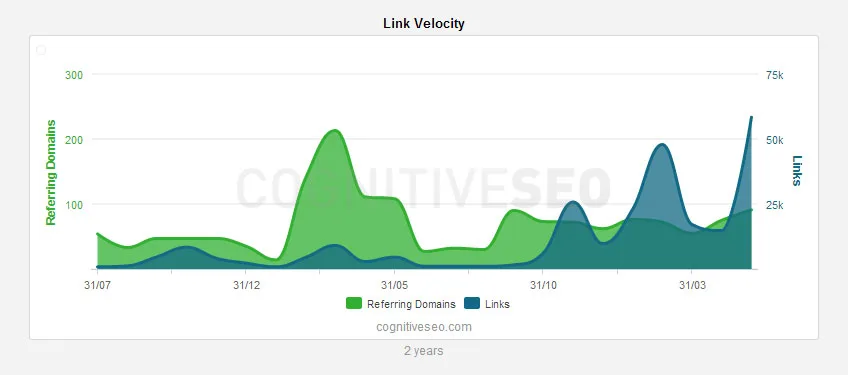
A jagged, vertical spike followed by a cliff-drop looks exactly like a purchased link campaign, and Google’s spam systems have gotten remarkably good at spotting that shape.
Search engineers have discussed link spam detection in broad terms for years, and the underlying logic is straightforward: real editorial links arrive when writers and editors decide your content deserves a citation. Refining each detail of your link velocity strengthens this section. That process has natural limits. When the pattern breaks those limits, alarm bells ring.
The Difference Between Volume and Rhythm
Two sites can both earn 500 links over a year and land in wildly different positions. The first earns roughly 40 per month, evenly spread, each from relevant sites. The second earns 480 in a single week because a viral post took off, then nothing for eleven months. Same total. Very different rhythm.

The viral scenario isn’t automatically dangerous — genuine virality happens. But it does require a follow-up period where your acquisition settles back into a believable baseline. If a viral spike is followed by total silence, that asymmetry itself is a pattern worth understanding. This is where link velocity tips about “normalizing after spikes” become genuinely useful.
For a broader academic framing of how links have historically been treated as signals, the Wikipedia entry on PageRank offers useful background on how link-based authority models work.
Tip 1: Establish a Baseline Before You Change Anything
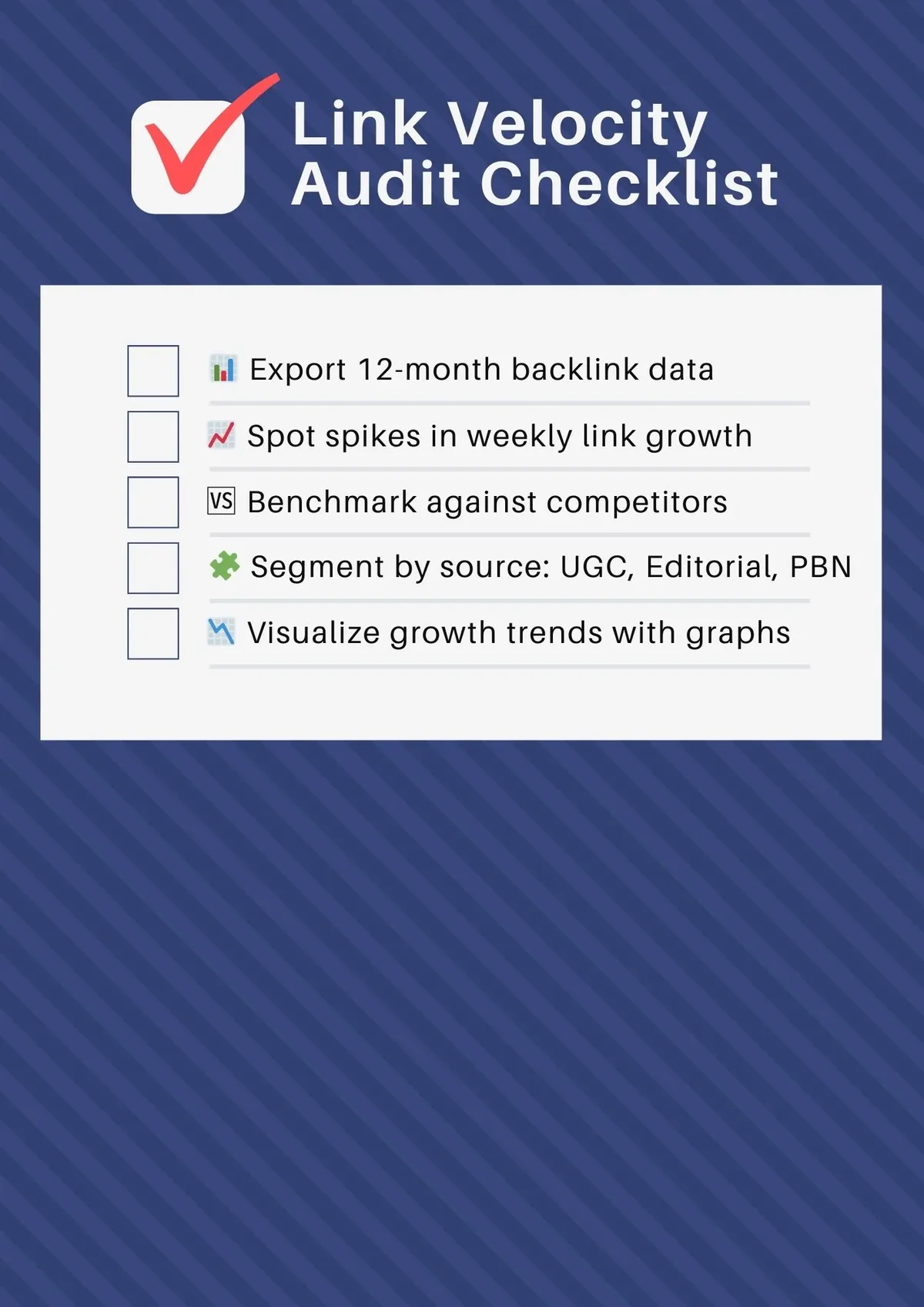
The link velocity can’t manage a rate you’ve never measured. Before optimizing anything, pull your last twelve months of backlink data and chart it. Most reputable backlink tools let you export acquisition dates, which is exactly what you need.
Once charted, look for your average monthly gain. That number is your baseline, and every future decision should reference it. A site earning 25 links per month has a completely different safe ceiling than one earning 250.
Don’t skip this step because it feels boring. In my experience, the biggest link velocity mistakes come from people who acted on gut feel without ever knowing their own number. They “felt” like they needed more links, bought a batch, and broke a pattern that was actually fine.
How to Chart Your Acquisition History
Export your backlink profile to a spreadsheet with three columns: link source, discovery date, and domain rating. Then build a simple monthly pivot table. The visual will tell you more in ten seconds than hours of reading forum debates.
Watch for two things: any month the link velocity’s dramatically higher than the rest, and any sudden shift in the average quality of sources. A month where you gained 200 links from low-quality directories is a red flag even if the numbers look impressive at first glance.
Keep a simple log going forward, too. Ten minutes a month is enough. Over time, that log becomes your most reliable link velocity checklist for spotting anomalies early, before they become a problem.
Tip 2: Build a Realistic Acquisition Ceiling
Every site has a natural ceiling — the maximum number of quality links it can realistically earn per period given its content output, brand presence, and niche competition. Ignoring that ceiling is how people get into trouble.

Think of it this way: if you publish four substantial pieces of content a month and each earns an average of three to five editorial mentions organically, your realistic ceiling is somewhere in the range of twelve to twenty links monthly. Trying to double or triple that with shortcuts means you’re no longer earning links — you’re manufacturing them.
A practical link velocity best practice here is to set a target that’s roughly 110-120% of your current average, not 300%. Growth should look like a gentle upward slope, not a rocket launch. If your niche genuinely supports faster growth because your content is genuinely exceptional, the links will come without you forcing the pace.
Matching Ceilings to Site Maturity
New domains need extra caution. A thoughtful approach to link velocity reinforces your qualifications. A six-month-old site with 30 referring domains that suddenly earns 500 links in a month has a shape that screams manipulation, regardless of intent. Slow down.
Established domains with thousands of referring domains have more room. Their baselines are higher, so a spike is proportionally smaller and less likely to raise suspicion. But even they can’t jump from 300 links a month to 3,000 without something looking off.
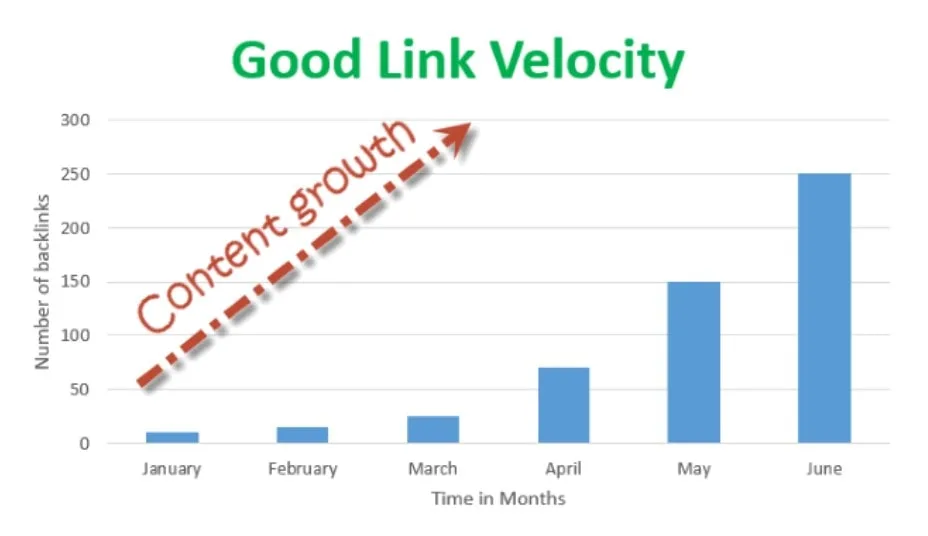
The takeaway is simple: your ceiling should track your maturity and your content velocity. If those two things grow together, your link acquisition will look credible almost by default.
Tip 3: Prioritize Relevance Over Raw Link Count
One link from a respected industry publication outranks fifty links from unrelated directories. Structuring your link velocity around proven patterns ensures impact. This isn’t controversial, but it’s still routinely ignored when people get focused on hitting a velocity number.
If you’re trying to grow link velocity tips smarter, remember that quality and rate are linked. A single high-relevance link often earns you secondary citations — writers see you mentioned in a respected outlet and cite you too. So a lower rate of genuinely excellent links can produce a higher effective velocity than a flood of junk.
Check the topical relevance of your link sources. If you run a finance site and half your links come from a general-purpose web directory, that’s a mismatch. Relevance gaps are one of the clearest signs that links were placed rather than earned.

Spotting Relevance Gaps in Your Profile
Open your backlink report and sort by source category. Group sources into broad buckets: industry publications, local news, general directories, guest posts, and unidentifiable. If the directory bucket is your largest, you have a problem worth fixing before you focus on rate at all.
This matters for velocity because the composition of your link velocity profile changes how suspicious any rate looks. A profile made of relevant, editorial links can grow quickly and still look natural. A profile made of directories growing quickly looks like spam accelerating.
Tip 4: Diversify Link Types and Anchor Text
A profile where every link is a guest post with an exact-match anchor looks manufactured. The same number of links spread across editorial mentions, resource pages, interviews, and natural in-text citations looks earned.

Anchor text matters too. Natural citation patterns are messy — people link with brand names, partial phrases, generic “here” text, and the occasional exact match. If all your links use the same phrase, the pattern is too clean to be real.
Combine these two ideas and you’ve got a strong link velocity best practice: vary both the type and the text. This diversity means your growth rate looks like a rich, natural citation environment rather than a single tactic applied at scale.
A Healthy Mix to Aim For
A rough target I’ve found useful: brand-name anchors making up 40-50% of your link velocity profile, partial-match and generic anchors split across the next 35-40%, with exact-match reserved for maybe 10-15%. These aren’t hard rules, but they keep your profile looking human.

For link types, aim for at least four distinct sources in any rolling three-month window. Editorial mentions, resource links, guest content, and industry quotations cover a lot of ground and are all genuinely earnable. If your entire velocity comes from one tactic, you’re one algorithm tweak away from zero.
Tip 5: Align Velocity With Content Publishing
Links don’t appear in a vacuum — they follow content. If you publish two blog posts in March and suddenly earn 200 links that month, the mismatch raises questions. If your link spike correlates with a genuinely well-received piece, the story holds up.
That’s why one of the most durable link velocity tips is to keep acquisition roughly proportional to output. Publish more, earn more. Publish less, earn less. The two should broadly track each other.
I’ve watched sites solve the link velocity elegantly by clustering their content: they launch a topical series, earn coverage from it, and let the links from that series arrive over the following months. The result is a smooth, believable curve instead of a spike.
Building an Acquisition Calendar
Map your planned content releases against your expected link gain. If you know a big study is coming out, prepare for a burst and plan follow-up content that keeps the momentum going afterward.
The goal isn’t to suppress spikes — genuine spikes are fine. The goal is to make sure spikes happen for explainable reasons and that they’re followed by continued activity, not silence. A burst followed by ongoing healthy publishing looks entirely natural.
Tip 6: Slow Down Spikes Deliberately
If a piece the link velocity publish unexpectedly goes viral, resist the urge to pile more promotion on top of it. Let the spike land, observe it, and then return to normal activity. The most dangerous pattern isn’t a spike — it’s a spike followed by another engineered spike, followed by another.
There’s a genuine strategy here. When a real spike happens, wait four to six weeks before resuming aggressive link-earning efforts. Let your acquisition chart level out. What you’re doing is smoothing the curve, which makes the whole pattern look like organic editorial pickup rather than a coordinated push.
This is one of those link velocity checklist items people forget. It’s not about the spike itself — it’s about what happens next.
Normalizing After a Viral Moment
Normalization means letting your rate settle back near baseline. Keep publishing, keep earning, but don’t chase the spike. If you want a heuristic, aim to bring the next month’s gain back to within 150% of your prior baseline, and the month after closer still.
I’ve seen sites get nervous about the link velocity and try to sustain a viral-level rate indefinitely. That almost never works, and it creates the exact shape that triggers scrutiny. Accept the spike, then accept the return to normal.
Tip 7: Clean Up Toxic Links Before Scaling
If your profile already contains spammy links, scaling your rate simply scales the problem. Before you focus on growth, audit and clean what’s already there.
Toxic links aren’t just an authority risk; they distort your baseline. A profile dotted with spam makes it hard to know what your genuine acquisition rate even looks like. Clean up, rechart, and you’ll finally have a clear number to work from.
Use Google’s official link spam documentation as a reference for what qualifies as manipulative. Targeted refinements to your link velocity streamline the entire review. The Google Search spam policies page is the authoritative source on link schemes and remains the single best reference for understanding what the search engine considers a violation.

A Simple Four-Step Audit
First, export your full profile. Second, sort by domain rating and flag every source below a reasonable threshold. Third, manually review flagged sources — many low-DR links are perfectly legitimate, so don’t disavow blindly.
Fourth, decide whether each flagged link warrants a disavow or just monitoring. In most cases, you can simply ignore low-quality links; the disavow tool is for cases where you actively paid for or built spam links. Once cleaned, rechart your baseline and start managing your rate from a clean slate.
Tip 8: Use Content Formats That Earn Links at a Steady Pace
Some content formats generate links explosively; others generate them steadily for years. A viral TikTok hook might spike once. A well-maintained data resource earns citations month after month, often without further promotion.

If you want smooth link velocity, favor evergreen earners. Original research, tools, calculators, and definitive guides tend to attract a slow-drip pipeline of citations. That’s precisely the shape you want — steady, predictable, and easy to explain.
Mix in a few high-profile launch pieces for the occasional healthy spike, but keep evergreen work as your backbone. This combination gives you both the burst and the baseline, and it makes your overall velocity curve look like how a genuinely authoritative site grows.
Which Formats Earn Steadiest
Original statistics tend to be the strongest steady earners — journalists and bloggers need numbers and cite them continuously. Interactive tools follow closely because people link to them as references.
Long-form definitive guides earn links slowly but keep earning for years. Opinion pieces spike fast and fade quickly. News coverage spikes and disappears. Build a content calendar that weights toward the steady earners and you’ve effectively engineered a healthier velocity curve.
Tip 9: Monitor Competitor Velocity as a Sanity Check
You don’t need to match your competitors exactly, but their acquisition rates offer useful context. If three respected sites in your niche each earn 40 links a month and you’re suddenly earning 400, you’re the outlier — and outliers get noticed.
This is a genuinely underrated link velocity checklist item. Competitive benchmarking gives you an external baseline against which to judge whether your own rate looks reasonable. It’s not about copying; it’s about calibration.
Tools like Ahrefs and Semrush both offer competitor tracking, and reviewing the last twelve months of a few rivals is quick. You’ll get a feel for what “normal” looks like in your space very quickly.
How to Read Competitor Curves
Look for the general shape, not exact numbers. Are their curves smooth? Do they spike around product launches? Do they recover after spikes? Understanding how the best sites in your niche grow gives you a template worth emulating.
Also note the composition of their links. If top competitors get the majority of their links from editorial and industry sources, that tells you where the real earnable opportunities are in your space. Match the sources, not just the rate.

Tip 10: Track and Refine the Whole System Quarterly
Link velocity isn’t a set-and-forget metric. Neighborhoods change, competitors change, and your own content velocity shifts. The final tip is to commit to a quarterly review where you actually look at the numbers and adjust.
Each quarter, pull your acquisition data, compare against competitors, check relevance gaps, confirm anchor diversity is holding, and note any spikes you didn’t expect. Ten to fifteen minutes per quarter is genuinely enough if you’ve set up tracking properly.
This habit keeps you in what I’d call “link velocity steady state” — a condition where your rate is healthy, your profile is diverse, and any change happens gradually enough that it never attracts the wrong kind of attention. That’s the whole goal.
What to Review Each Quarter
Review four things: your monthly gain trend, your competitor benchmark, the relevance mix of new sources, and the diversity of anchor text. If any of those deviates from where you were last quarter, investigate why before doing anything else.
Keep a running log of your decisions and their outcomes. Over a year, this becomes a personalized link velocity guide you couldn’t find anywhere else — one calibrated to your specific site, niche, and market dynamics.
Link Velocity Final Checklist
A clean review process matters more than any single tactic. Here’s a compact link velocity checklist you can run through whenever you want to verify that your growth pattern is healthy.
| Check | What To Confirm | Warning Sign |
|---|---|---|
| Baseline | You know your 12-month average monthly gain | No historical data on file |
| Growth rate | Rate is within 110-120% of prior baseline | 3x or higher jump |
| Relevance | Top sources are topically aligned | Generic directories dominate |
| Anchor mix | Mostly brand and partial-match | All exact-match anchors |
| Spike handling | Spikes followed by normalization | Spike followed by silence |
| Competitor check | Your rate is in the same ballpark | 5x+ of nearest competitor |
Run through this table monthly and you’ll catch most issues before they compound. It’s not a perfect diagnostic, but it’s a fast, practical screen.
Frequently Asked Questions
Here is an in-depth breakdown of key considerations regarding Frequently Asked Questions:
Is a Sudden Link Velocity Spike Always Bad?
Not always. Genuine virality, a major press feature, or a widely-cited data study can produce real, legitimate spikes. What matters is whether the spike is explainable and whether it’s followed by continued, natural activity. A sudden spike from an unexplainable source, followed by silence, is the potentially dangerous pattern.
What is a Healthy Link Velocity Rate?
There’s no single universal answer. A healthy rate is one that tracks your content output, stays within the range your site’s maturity supports, and resembles how competitors in your niche grow. For a smaller site, 10-30 links a month can be perfectly healthy. For a large publisher, hundreds per month may be normal.
Do I Need a Link Velocity Checklist for a Brand-New Site?
Yes, arguably even more than an established site does. New domains are held to a higher scrutiny standard because there’s less history to contextualize growth. Start with modest, steady acquisition and let the curve build credibility over time.
How Often Should I Review My Link Velocity?
Monthly for the basic numbers, quarterly for the deeper analysis. Ten to fifteen minutes a month is enough to spot anomalies. The quarterly review is where you look at relevance, diversity, and competitive benchmarks.
Can Link Velocity Tips Replace the Need for Good Content?
Nothing replaces good content, and that’s really the point. All the link velocity best practices in this article assume you’re publishing work people would want to cite. The rate-management tactics matter, but the underlying content has to be worth the citation.
Does Velocity Matter More Than Total Link Count?
Neither signal works alone. Total count matters for long-term authority; the rate matters for how credible your growth looks. Track both, but if you have to pick one to manage actively, track the rate — because that’s where manipulation typically shows up.
What Tools Best Support Tracking This?
Ahrefs, Semrush, and Majestic each handle backlink velocity tracking well, with exportable date-based data. If you want simpler insight, Google Search Console’s links report shows new versus existing referring domains without manual exports.
What if I’ve Already Had an Unnatural Spike?
Don’t panic. First, stop any active promotion that could feed it. Second, run an audit and clean up any genuinely toxic links. Third, return to normal publishing and let the curve settle. If the spike came from a paid link sale, do not repeat anything like it.
Where to Go Next
Everything in this article connects back to a single idea: the pattern of how you grow matters more than the total you reach. Manage the rate, keep it proportional to your output, and let your link velocity curve tell an honest story.
If the link velocity’re just starting out, focus on the first three tips — baseline, ceiling, and relevance. Those alone will prevent most of the damage ambitious link-building has caused over the years. Once those are dialed in, layer in the rest.
And when you’re ready to expand beyond this article, the natural next stop is the on-page work that determines whether earned links actually deliver ranking gains — internal linking structure, topical clustering, and content depth. That’s the broader topic cluster this piece belongs to. Each of those sub-topics builds on what you’ve just learned about healthy link acquisition.