If you want more sales, signups, or booked calls, landingpage SEO is the discipline that turns a pretty page into a quiet salesperson working around the clock. Most marketers obsess over traffic while ignoring the page that actually closes the deal.
That mismatch costs real money. You can rank number one for a juicy keyword and still watch visitors bounce in eight seconds because the page feels vague, slow, or pushy. This guide fixes that.
We’ll walk through the exact on-page moves, technical checks, copy structures, and testing habits that separate a page that ranks from a page that ranks and converts.
That single difference reshapes everything. Keyword selection, page length, internal linking, even the way you write a headline all shift once the objective is conversion instead of consumption.
When I audit client accounts, the biggest mistake I see is treating a service page like a blog article. They stuff it with 3,000 words of background fluff, bury the call to action somewhere near the footer, and wonder why the form gets three submissions a month.
Landingpage SEO flips that logic. You still need depth for topical authority, but every section should push the reader one step closer to acting.
Search Intent is the First Filter
Before you touch a single meta tag, figure out what the searcher actually wants. Someone typing “best crm for small business” is comparing options. Someone typing “crm pricing” is closer to buying.
Match the page type to the intent and you’ve already won half the battle. Focusing on landingpage SEO provides clear direction here. Mismatch it and no amount of clever copywriting saves you.
Here’s a quick reference I use with clients to map intent to page format:
| Search Intent | What The Searcher Wants | Best Page Format | Primary CTA Type |
|---|---|---|---|
| Informational | Answers, context, how-to steps | Guide or pillar article with soft CTA | Newsletter signup, download |
| Commercial Investigation | Comparisons, reviews, pros and cons | Comparison page or feature breakdown | Free trial, demo request |
| Transactional | To buy, book, or sign up now | Focused landing page, minimal distraction | Purchase, booking, contact form |
| Navigational | To reach a specific brand or tool | Branded homepage or product page | Login, direct purchase |
Notice how the CTA type changes with intent. Sending a transactional searcher to a 4,000-word thought piece is like handing someone a novel when they asked for a menu.
Conversion Signals Google Actually Rewards
Google doesn’t have a “conversion rate” ranking factor. But it does measure behavior indirectly through clicks, dwell time, and pogo-sticking back to the SERP.
A page that satisfies users keeps them around. That satisfaction shows up in engagement metrics, and engagement feeds rankings over time.
Practically speaking, strong landingpage SEO produces pages that load fast, answer the query in the first screen, and give a clear next step. Do those three things and the algorithm tends to follow the humans.
Keyword Research Built Around Buyer Language
Standard keyword tools hand you volume data. What they don’t hand you is the phrasing real buyers use when they’re ready to spend.
That phrasing lives in sales call transcripts, support tickets, and the “People Also Ask” boxes on Google. Refining each detail of your landingpage SEO strengthens this section. Mine those sources first.
For a B2B client selling scheduling software, we found that “appointment booking system for clinics” converted four times better than the higher-volume “scheduling app.” Same product, different searcher mindset.
Landingpage SEO rewards that specificity because specific queries attract specific people who know what they want.
Mining Long-Tail and Entity Keywords
Long-tail keywords are your bread and butter on landing pages. They’re less competitive, more descriptive, and they map cleanly to a single page.
Entity keywords matter too. If you sell coffee equipment, Google expects your page to mention entities like “espresso machine,” “burr grinder,” “portafilter,” and “barista.” These aren’t just keywords; they’re concepts that tell the algorithm what your page is really about.
Build a simple spreadsheet with four columns: primary keyword, secondary keywords, entity terms, and the searcher’s likely intent. Fill it before you write anything.
Grouping Keywords Into Page Clusters
Don’t create ten thin pages when one strong page can own a cluster. Effective execution in your landingpage SEO makes a tangible difference. Group related keywords under a single URL and let that page become the definitive answer.
For example, “email marketing software,” “email automation tool,” and “bulk email sender” can often live on one well-structured landing page without cannibalizing each other.
Cannibalization is the silent killer of landingpage SEO. Two pages fighting for the same term usually split authority and both lose.
Run a site search for your target term before publishing. If an existing URL already targets it, either consolidate or differentiate sharply.
On-Page Structure That Helps Both Robots and Readers
Structure is where most landingpage SEO efforts quietly fall apart. Writers dump everything into one giant block and hope Google figures it out.
It won’t. Clean structure helps crawlers parse meaning and helps humans scan. Both matter.
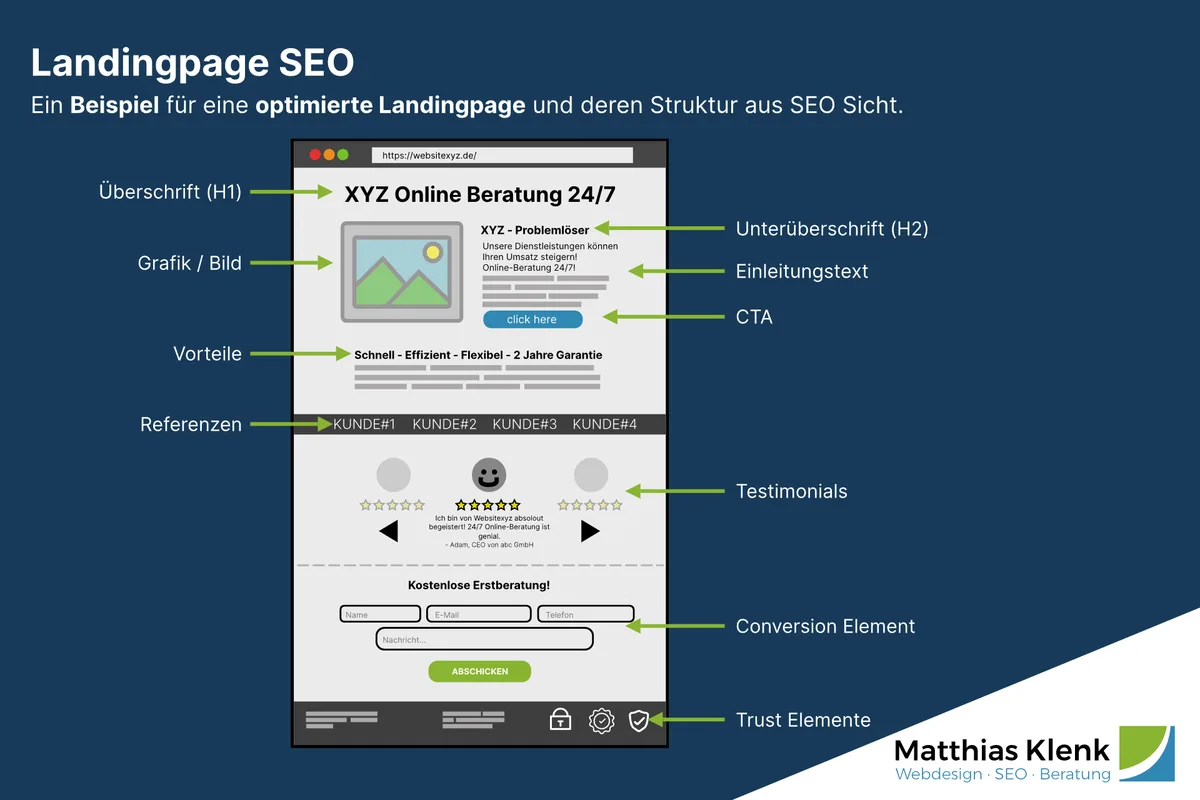
Start with a single H1 that contains your primary keyword. Follow with H2s that break the page into logical sections. Use H3s sparingly, only when a section genuinely needs subdividing.
Headings, Subheadings, and the Skim Test
Here’s a trick I use constantly: read only the headings on your page. If a stranger can understand the full argument just from those lines, your structure is solid.
If the headings read like disconnected labels, rewrite them. Maintaining clarity across your landingpage SEO remains essential. Each one should advance a narrative.
Good headings also carry keywords naturally. “How To Speed Up Your Landing Page Without Breaking Design” beats “Performance” every time.
Internal Linking With Purpose
Internal links aren’t just navigation. They pass authority and signal relationships between topics.
Link from your landing page to supporting content, and link back from those articles to the landing page using descriptive anchor text. That two-way flow strengthens the whole cluster.
Avoid generic anchors like “click here.” Use phrases that describe the destination, ideally containing a relevant keyword.
For deeper background on how search engines interpret page structure, the Wikipedia entry on search engine optimization covers the fundamentals clearly.
Page Speed and Core Web Vitals for Landingpage SEO
Speed is not optional. A thoughtful approach to landingpage SEO reinforces your qualifications. Every extra second of load time bleeds conversions, and mobile users feel it worst.
Google’s Core Web Vitals bundle three metrics: Largest Contentful Paint, Interaction to Next Paint, and Cumulative Layout Shift. Each one measures a different flavor of user pain.
I’ve watched a client cut their bounce rate by 22% simply by compressing hero images and removing a bloated chat widget. No copy changes. No design overhaul. Just weight loss.
Landingpage SEO and page performance are the same conversation when you’re chasing conversions.
LCP, INP, and CLS Explained Simply
LCP measures how long the biggest visible element takes to appear. Aim for under 2.5 seconds.
INP tracks how quickly the page responds to taps and clicks. Slow responses feel broken, even if the page looks fine.
CLS catches layout jumps. Structuring your landingpage SEO around proven patterns ensures impact. When text shifts because an ad or image loads late, users misclick and leave.
Fix these three and you’ve handled the technical foundation that most landingpage SEO checklists skim past.
Practical Speed Wins You Can Ship This Week
- Compress and resize images — Serve WebP or AVIF files at the exact display size. A 4000px hero image on a 1200px container is pure waste.
- Defer non-critical JavaScript — Chat widgets, tracking scripts, and analytics tags can load after the main content renders.
- Use a content delivery network — A CDN serves assets from a server near the user, cutting latency for global audiences.
- Reserve space for media — Set explicit width and height attributes so images don’t shove content around as they load.
- Limit third-party embeds — Every external iframe is a potential bottleneck. Audit them quarterly and remove what you don’t need.
Run Google PageSpeed Insights after each change. Small, measured improvements beat one big risky rebuild.
Writing Copy That Ranks and Persuades
Great landingpage SEO copy does two jobs at once. It satisfies the search query and it moves the reader toward action.

Most writers pick one and neglect the other. The result is either a keyword-stuffed brochure or a beautifully written page nobody finds.
The fix is to write for the searcher’s problem first, then weave in the keywords where they naturally belong.
The Above-The-Fold Formula
Your first screen has roughly three seconds to earn attention. Use them well.
A working formula: headline states the outcome, subheadline explains who it’s for, and a visible CTA sits within the first scroll.
For a dental clinic page, that might read: “Book A Same-Day Appointment Without The Phone Tag” followed by “Online scheduling for busy patients in Austin” and a “Check Availability” button.
Notice there’s no clever wordplay. Clarity converts better than cleverness on a landing page.
Handling Objections Before They Kill the Sale
Every visitor arrives with doubts. Price, trust, timing, fit. Your copy should answer those doubts in the order they surface.
Placement matters. Put pricing transparency near the middle, social proof after the feature list, and a risk-reversal guarantee near the final CTA.
I once rewrote a SaaS landing page and added a single line under the signup button: “No credit card required. Cancel anytime.” Trial conversions jumped 31% in two weeks.
That’s landingpage SEO doing its real job: removing friction between interest and action.
Technical Landingpage SEO Checklist
Technical hygiene is unglamorous but non-negotiable. Skip it and your best copy gets buried.
Work through this list before you publish anything new, and revisit it quarterly for existing pages.
- Title tag under 60 characters — Front-load the primary keyword and keep the promise specific.
- Meta description with a clear benefit — Write it for the click, not the algorithm. Include the keyword naturally.
- One H1 per page — Multiple H1s confuse crawlers and dilute topical focus.
- Descriptive URL slug — Short, readable, keyword-rich. Avoid dates and random IDs.
- Image alt text — Describe the image and include a keyword where it genuinely fits.
- Schema markup — Add FAQ, Product, or Service schema depending on page type to earn rich results.
- Canonical tags — Prevent duplicate content issues when pages share similar content.
- Mobile-first layout — Test on a real phone, not just a resized browser window.
- HTTPS everywhere — Security is a baseline trust signal for users and search engines alike.
- XML sitemap inclusion — Make sure new pages get crawled promptly.
Each item takes minutes. Together they form the backbone of reliable landingpage SEO.
Forms, CTAs, and Friction Reduction
The form is where interest becomes a lead. Applying these principles to your landingpage SEO yields measurable results. It’s also where most pages lose people.
Every field you add costs you conversions. Ask only for what sales genuinely needs at that stage.
If you’re generating early-stage leads, name and email is often enough. Save the phone number and company size for a later touch.
Designing CTAs People Actually Click
Button copy should describe the outcome, not the action. “Get My Free Audit” outperforms “Submit” almost every time.
Color contrast matters too. A button that blends into the background is a button nobody presses.
Place your primary CTA at least twice on a long page: once above the fold and once after the main value proposition. Proper attention to your landingpage SEO sets a strong baseline. Some visitors decide early; others need the full argument.
Reducing Form Abandonment
Inline validation, clear error messages, and autofill support all reduce abandonment. So does removing unnecessary dropdowns.
A/B test one field at a time. If removing “Company Name” doesn’t hurt lead quality, leave it out.
Landingpage SEO isn’t just about getting traffic. It’s about making sure the traffic that arrives can actually complete the goal.
Testing, Tracking, and Iteration
You can’t improve what you don’t measure. Set up tracking before you launch, not after.
At minimum, track form submissions, CTA clicks, scroll depth, and time on page. Heatmaps add another layer by showing where people actually look and click.
I like to run a two-week baseline before changing anything. Developing your landingpage SEO with precision highlights key strengths. That gives you a stable comparison point.
What to Test First
Start with the headline. It has the biggest impact and the cheapest test.
Then test the CTA copy and placement. Then test the form length. Then test social proof placement.
Change one variable at a time. Testing three things at once tells you nothing about which one worked.
Reading Results Without Fooling Yourself
Small sample sizes lie. A 40% lift on 30 visitors means almost nothing.
Wait for statistical significance, or at least a few hundred conversions per variant, before declaring a winner.
And remember: a test that wins in July may lose in December. Seasonality, traffic sources, and audience mix all shift results.
Landingpage SEO is a loop, not a one-time project. The pages that win long-term are the ones that keep getting sharper.
Common Landingpage SEO Mistakes to Avoid
I’ve audited hundreds of pages. The same errors show up again and again.
Here are the ones that cost the most, along with how to fix them.
- Keyword stuffing — Repeating a term ten times in one paragraph reads as spam. Use it where it fits and trust synonyms to carry meaning.
- Ignoring mobile users — Over half of traffic is mobile. If your page breaks on a phone, you’re losing the majority of your audience.
- Burying the CTA — A call to action hidden below three scrolls of text is a call to action nobody sees.
- Duplicate content across pages — Near-identical pages compete with each other and confuse rankings.
- No clear value proposition — If a visitor can’t tell what you offer in five seconds, they leave.
- Slow-loading hero media — A 6MB video background kills conversions before the page even finishes loading.
- Missing trust signals — Reviews, logos, guarantees, and real photos all reduce hesitation.
- Broken internal links — Dead links frustrate users and waste crawl budget.
- Thin content — A 200-word page rarely ranks for competitive terms.
- No schema markup — You miss rich result opportunities that competitors are grabbing.
Fix these and your landingpage SEO foundation is stronger than most competitors in your niche.
Building Authority With Supporting Content
A landing page doesn’t rank in isolation. Clear alignment with your landingpage SEO builds confidence from the start. It ranks because the surrounding site supports it.
Publish blog posts, case studies, and comparison articles that link back to your main landing pages. That cluster signals topical depth to search engines.
For a landscaping company, that might mean articles on “how to choose a lawn care schedule,” “best native plants for your region,” and “what to expect during a landscape consultation.” Each one links to the main service page.
Over time, that structure builds the kind of authority that pushes landingpage SEO results from page two to page one.
Using Case Studies as Ranking Assets
Case studies do double duty. They rank for long-tail queries and they provide proof for hesitant buyers.
Write them with specifics: the problem, the approach, the numbers, and the timeline. Vague success stories don’t convince anyone.
A case study titled “How A Denver Roofing Company Cut Lead Cost By 38% In Six Months” will outrank and outconvert a generic “Success Story” page every time.
FAQ Sections That Earn Featured Snippets
FAQ blocks are gold for landingpage SEO. They answer real questions, match voice search patterns, and often earn featured snippets.
Keep answers concise. Two to four sentences usually does the job.
Add FAQ schema markup so Google can surface your answers directly in search results.
Local Landingpage SEO for Service Businesses
If you serve a specific city or region, local signals matter enormously.
Include your city and service area naturally in the H1, the opening paragraph, and the meta description. Mention nearby landmarks or neighborhoods where it feels human.
An Atlanta plumber’s page should read like it was written for Atlanta, not copied from a template and find-replaced.
Google Business Profile integration, localized reviews, and NAP consistency (name, address, phone) all reinforce local landingpage SEO.
Creating City-Specific Pages Without Duplication
The temptation is to spin up 50 city pages from one template. That creates thin, duplicate content that Google ignores or penalizes.
Instead, write each city page with unique details: local regulations, regional weather considerations, nearby project examples, and testimonials from that area.
Ten genuinely distinct city pages beat fifty copy-paste ones every single time.
Measuring ROI from Landingpage SEO
Rankings are a means, not an end. What matters is revenue.
Track the cost per lead from organic landing pages against paid channels. Integrating landingpage SEO into your workflow produces consistent quality. In most cases, organic wins over a twelve-month horizon once the page matures.
Set up proper attribution so you know which pages drive which conversions. Google Analytics 4, your CRM, and call tracking software should all talk to each other.
A page that ranks third but converts at 12% beats a page that ranks first and converts at 1%. Always.
Key Metrics to Watch Monthly
- Organic sessions per landing page — Tracks whether your landingpage seo is gaining traction.
- Conversion rate by page — Shows which pages actually move people to act.
- Average position for target keywords — Reveals ranking progress over time.
- Bounce rate and scroll depth — Indicates whether content matches intent.
- Assisted conversions — Captures pages that contribute to a sale even if they aren’t the last click.
- Cost per acquisition from organic — The bottom-line number that justifies the investment.
Review these monthly. Adjust quarterly. Compounding gains in landingpage SEO come from consistent attention, not heroic one-off efforts.
Frequently Asked Questions About Landingpage SEO
Here is an in-depth breakdown of key considerations regarding Frequently Asked Questions About Landingpage SEO:
What is Landingpage SEO?
Landingpage SEO is the practice of optimizing a single conversion-focused page so it ranks in search engines and persuades visitors to act. It combines traditional on-page optimization with conversion rate best practices.
How Long Does It Take to See Results?
Most pages show early movement within two to three months. Competitive terms can take six to twelve months to reach the first page. Local pages often rank faster than national ones.
Do I Need a Blog for Landingpage SEO to Work?
Not strictly, but supporting content helps. Blog posts build topical authority and give you natural places to link back to your main landing pages.
How Many Keywords Should One Landing Page Target?
One primary keyword plus a handful of closely related secondary terms. Targeted refinements to your landingpage SEO streamline the entire review. Spreading a single page across too many unrelated keywords dilutes its focus.
Is Page Speed Really That Important?
Yes. Slow pages lose visitors before they ever see your offer. Speed also affects how Google evaluates user experience through Core Web Vitals.
What’s the Ideal Length for a Landing Page?
Long enough to answer objections and short enough to hold attention. Transactional pages often convert well at 500 to 900 words. Complex B2B offers may need 1,500 words or more.
Can I Rank a Landing Page Without Backlinks?
Sometimes, especially for low-competition or local terms. For competitive keywords, quality backlinks remain one of the strongest ranking signals.
How Often Should I Update a Landing Page?
Review performance quarterly and refresh copy, images, and offers at least once a year. Small, steady updates outperform rare total rewrites.
Does Social Proof Affect Rankings?
Not directly. But reviews, testimonials, and trust badges boost conversion rates, and higher engagement sends positive behavioral signals that support rankings over time.
What Tools Help With Landingpage SEO?
Google Search Console, PageSpeed Insights, a keyword research platform, a heatmap tool, and your analytics suite form a solid starter stack. Add schema generators and rank trackers as you scale.
Get the fundamentals right and landingpage SEO becomes one of the highest-return activities in your entire marketing budget. Start with one page, fix the speed, sharpen the headline, and measure everything. Then repeat.
<!– TOPSEO: keywords="landingpage seo, landing page optimization, conversion rate optimization, on-page seo, page speed, keyword intent, call to action, technical seo
Why Landingpage SEO is Different from Regular Blog SEO
Blog posts and landing pages chase two different goals. A blog post wants to inform and earn a scroll. A landing page wants a decision.
” description=”” –>