International SEO: 11 Easy Wins to Rank Higher
International SEO rewards teams who fix the small, structural things before chasing big content plays. This international SEO guide walks through eleven easy wins that consistently move rankings across multiple countries and languages.
Most brands lose visibility abroad for boring reasons: a missing hreflang tag, a country selector that Googlebot can’t crawl, or a single global sitemap that confuses search engines about which page belongs where. None of that requires a rebuild. It requires a checklist.
Below the international SEO’ll find that checklist broken into eleven concrete wins. Each one is scoped small enough to ship in a sprint, yet each one compounds into measurable gains in international markets. Let’s get into it.
Why International SEO Wins Compound Faster Than Global Rebuilds
Here’s the pattern I keep seeing: a company decides to “go global,” commissions a full multilingual replatform, and eighteen months later still has no rankings outside its home market. Focusing on international seo provides clear direction here. The rebuild ate the budget. The fundamentals never got touched.

International SEO best practices reward the opposite instinct. Fix the crawl path first. Fix the signals second. Fix the content third. Each fix is small, but together they build the trust layer that search engines need before they’ll rank a foreign-language page for a competitive query.
Think of it like opening a storefront in a new city. You don’t start by redesigning the whole building. You start by making sure the address is listed correctly, the sign is legible, and the door actually opens. Everything else follows.

The Compounding Effect of Small Fixes
A single corrected hreflang cluster can lift a whole language version out of obscurity. Refining each detail of your international SEO strengthens this section. I’ve watched a German subfolder go from page four to page one within six weeks of fixing a self-referencing hreflang tag that pointed to the wrong locale code.
That’s not magic. It’s the removal of a contradiction. Search engines were being told two different things about the same URL, so they defaulted to ignoring both.

Stack ten of those fixes together and the compounding is real. Crawl efficiency improves, canonical signals align, and internal link equity flows to the right regional pages instead of leaking into redirect chains.
What “Easy” Actually Means in Practice
Easy doesn’t mean trivial. It means the fix is scoped, testable, and doesn’t require a platform migration. A proper international SEO checklist separates these from the heavy lifts so your team knows what to ship this month versus next quarter.

For context on how search engines handle multilingual indexing, the Google Search Central international targeting documentation is the authoritative reference. Effective execution in your international SEO makes a tangible difference. Read it once, bookmark it, and revisit before any structural change.
Win #1: Lock Down a Clear URL Structure Before Anything Else
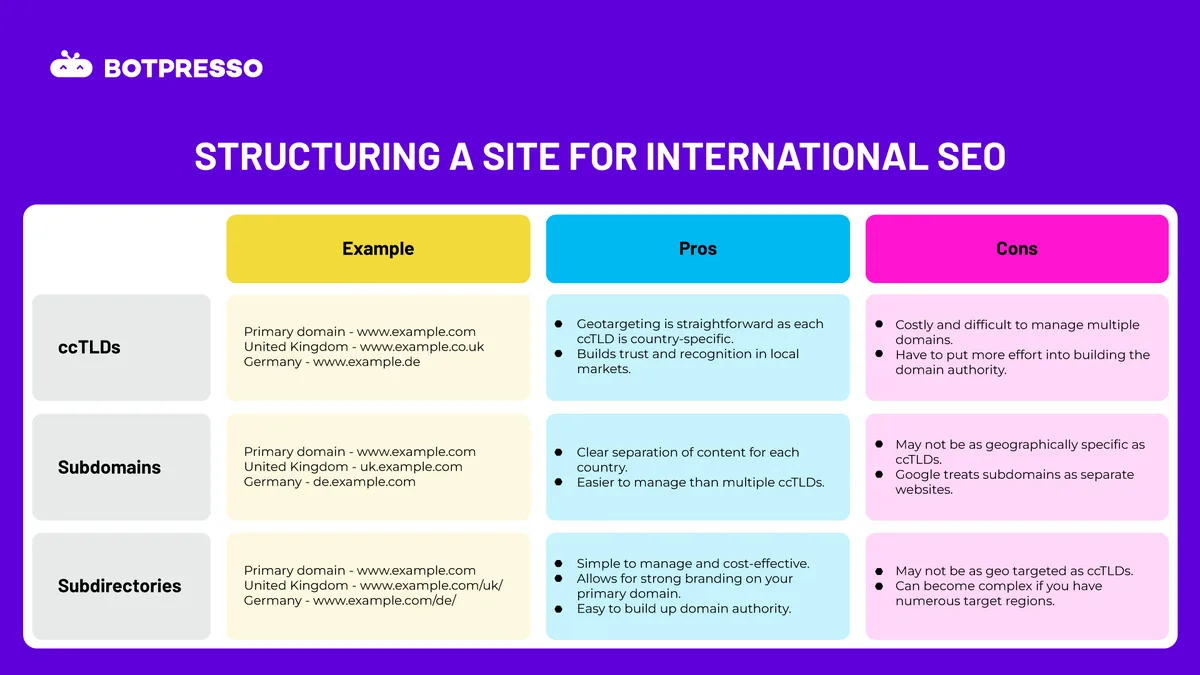
Every international SEO tips list should start here, because URL structure is the foundation everything else sits on. Choose one pattern and commit to it: country-code top-level domains, subdomains, or subdirectories.
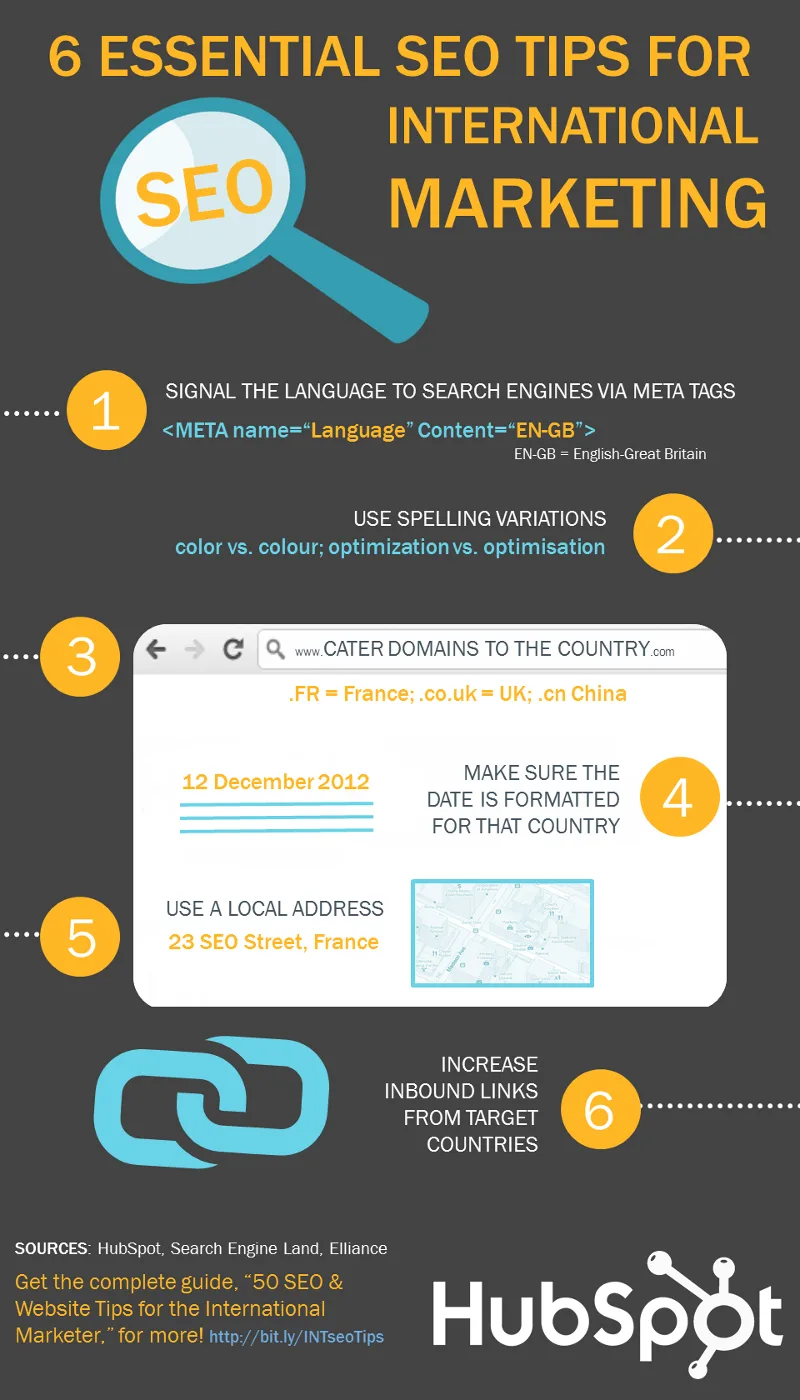
Subdirectories (example.com/de/, example.com/fr/) are the easiest to implement and inherit domain authority fastest. CcTLDs signal the strongest geo-relevance but fragment your link equity and multiply your maintenance overhead. Subdomains sit in the middle and are the most common compromise.
What matters more than the choice is the consistency. Mixing patterns — a ccTLD for Japan, a subdomain for Brazil, a subdirectory for Spain — creates a signal mess that takes years to untangle.

How to Test Whether Your Structure is Working
Run a simple crawl of your international properties and count how many distinct URL patterns serve localized content. Maintaining clarity across your international SEO remains essential. If the answer is more than one, you have a consolidation project on your hands.
Also check whether your regional pages sit on a path the international seo includes a locale code in the standard ISO 639-1 format. A page at /en-gb/ is unambiguous. A page at /uk/ is not — is that the United Kingdom or Ukraine?

Win #2: Get Hreflang Right Once and Stop Guessing
Hreflang is the single most botched element in international SEO. It tells search engines which language and regional variant a page targets, and which other pages are alternates of the same content.
The rules are simple but unforgiving. Every hreflang cluster must be reciprocal — if page A points to page B, page B must point back to page A. Every cluster needs a self-referencing tag. And every code must be valid, using both a language and, optionally, a region.
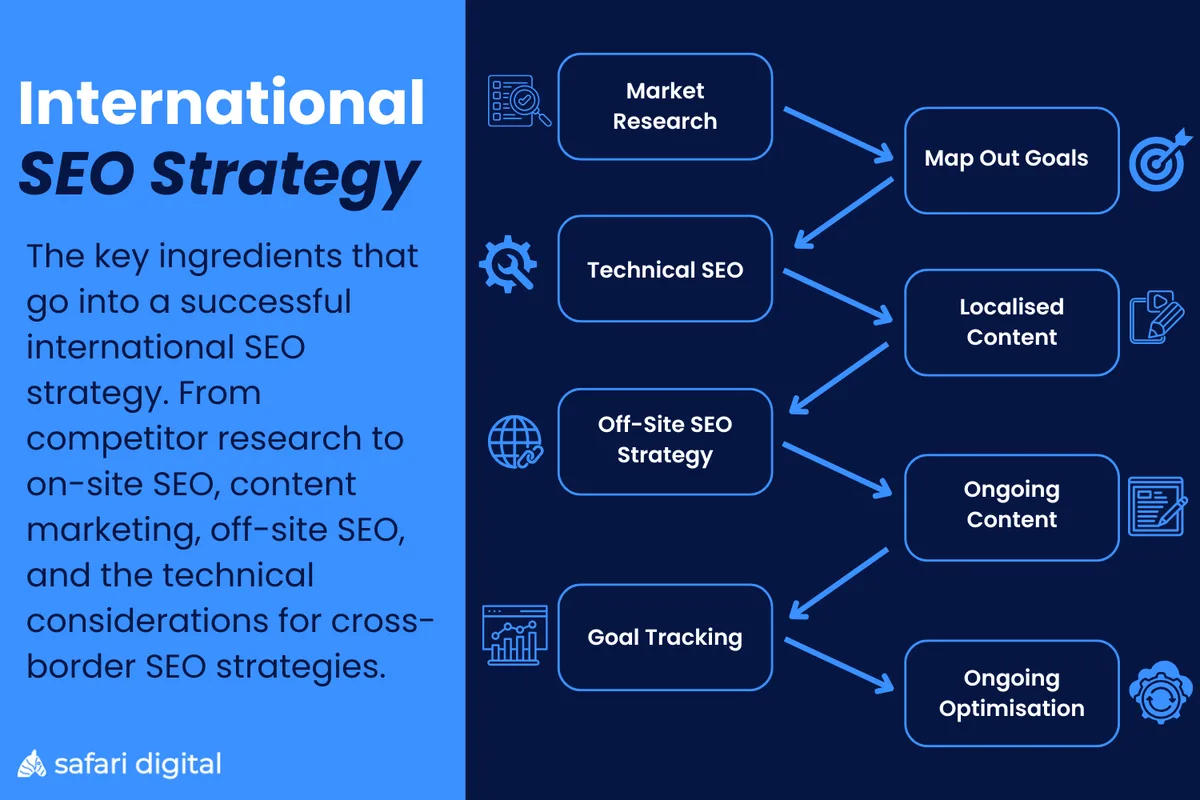
One broken link in a cluster can invalidate the whole set. A thoughtful approach to international SEO reinforces your qualifications. That’s why I recommend validating with a dedicated tool rather than eyeballing the source.
The Most Common Hreflang Failures
Missing return tags top the list. A developer adds hreflang to the French page pointing at the Spanish page, but forgets to add the reverse on the Spanish side. Search engines see an incomplete cluster and may ignore it entirely.

Second most common: using the wrong region code. “en-EU” is not a valid hreflang value. Neither is “es-419” unless you’re targeting Latin America specifically and have configured it correctly.
Third: pointing hreflang at URLs the international SEO redirect or return a 404. The tag must reference the canonical, indexable, final URL — not an intermediate hop.
Win #3: Stop Leaking Authority Through Broken Canonicals
Canonical tags and hreflang tags do different jobs, and confusing them is a classic international SEO mistake. Canonical says “this is the primary version of this content.” Hreflang says “this is the version for this audience.”
A localized page should generally self-canonicalize. It should not canonicalize to the English version, because that tells search engines the localized page is a duplicate and shouldn’t rank on its own.
I’ve audited sites where every single regional page canonicalized back to the.com homepage. The result was predictable: no regional page ranked for anything.
Auditing Canonical Signals at Scale
Export every URL from your international sitemaps, then check the canonical tag on each one. Applying these principles to your international SEO yields measurable results. Flag any page whose canonical points to a different locale. That’s your fix list.

While the international seo ‘re in there, confirm that your canonical URLs are absolute, not relative, and that they match the protocol and trailing-slash convention used in your hreflang tags. Mismatches here silently break clusters.
Win #4: Make Country and Language Selectors Crawlable
This one is sneaky. Many sites implement their country selector as a JavaScript dropdown that sets a cookie and reloads the page. Googlebot can’t interact with that. It sees one page and never discovers the others.
The fix is straightforward: expose every locale as a real, linked URL in the HTML. Proper attention to your international SEO sets a strong baseline. A simple footer list of language links is enough. Add hreflang attributes to those links and you’ve solved discovery and signaling in one move.
For a deeper look at how crawlers handle JavaScript-rendered navigation, the hreflang reference overview is a useful starting point before you escalate to engineering.

A Practical Pattern That Works
Put a persistent language switcher in the header with plain anchor tags pointing at each locale’s homepage or equivalent section. Add a visible country selector on the homepage only, and make sure both use crawlable links.
Then verify with a text-only crawl. Developing your international SEO with precision highlights key strengths. If your crawler can reach the German, Japanese, and Portuguese versions without executing JavaScript, you’re in good shape.
Win #5: Localize Keywords, Not Just Language
Translation is not localization, and this is where most international SEO tips fall short. A direct translation of “cheap flights” into Spanish might produce a phrase that nobody actually searches for.
Regional search behavior diverges in ways that machine translation can’t capture. Mexicans and Spaniards use different terms for the same product. Brazilians search in Portuguese with vocabulary that differs sharply from Portugal’s.
You need native keyword research per market. That means pulling search volume from a local tool, checking the actual SERP for your target query, and confirming that the top results match your intent.
Building a Localized Keyword Map
Start with your top twenty English queries. Clear alignment with your international SEO builds confidence from the start. For each one, commission a native speaker or a local SEO specialist to identify the equivalent query in the target market — not a translation, the equivalent.

Then map the international seo queries to your existing pages and flag gaps. You’ll often find that a single English page needs to become three localized pages because the search intent splits differently by region.
Win #6: Fix Currency, Units, and Format Signals
Small localization details carry outsized ranking weight in transactional queries. If someone in the UK searches for a price, they expect pounds. If they land on a page showing dollars, engagement drops and the page loses its relevance signal.

This extends beyond currency. Integrating international SEO into your workflow produces consistent quality. Date formats, measurement units, phone number formats, and address structures all contribute to whether a page feels locally relevant. Search engines increasingly use engagement and relevance signals that these details influence.
The fix is usually templating, not content rewriting. Build locale-aware components that swap currency symbols, date formats, and unit labels based on the page’s locale code.
Where Teams Usually Get This Wrong
Hardcoded currency symbols in body copy are the most common failure. A price written as “competitive direct manufacturer pricing” in a paragraph can’t be swapped by a template. Move all pricing into structured components.
Second: using a single global phone number across all locales. Targeted refinements to your international SEO streamline the entire review. Local numbers dramatically improve trust, and trust signals feed into how search engines evaluate page quality for commercial queries.

Win #7: Build Locally Relevant Internal Links
Your internal linking should respect locale boundaries. A German page should link primarily to other German pages, not to English ones, unless there’s a clear reason to cross over.
This matters because internal links pass both authority and topical relevance. If your German content cluster only links to English pages, the German cluster never develops the internal link equity it needs to compete.

Audit your internal links by locale and check the ratio. Focusing on international SEO provides clear direction here. A healthy cluster has most of its internal links staying within the same language group.
The Exception Worth Making
Cross-locale links make sense when the international seo’re pointing to globally relevant resources — a company’s about page, a universal product spec, or a corporate policy. Use them deliberately, not accidentally.
Also make sure your breadcrumbs and navigation menus are locale-aware. A German user clicking “Products” should land on German product pages, not English ones.
Win #8: Host Content Where Your Audience Lives
Hosting location is a weaker signal than the international SEO once was, but it still matters for page speed, which absolutely affects rankings. A site served from a Frankfurt data center will load faster for German users than one served from Virginia.

Use a CDN with edge nodes in your target markets. That’s the pragmatic answer. Full regional hosting is rarely necessary, but edge caching in the right geographies is table stakes.
Check your Core Web Vitals separately for each target market. A page that passes in the US may fail in Australia because of latency on uncached assets.
Measuring the Impact
Run a synthetic test from a server in each target country and compare time-to-first-byte. If the delta between your best and worst market exceeds a few hundred milliseconds, your CDN configuration needs attention.
Win #9: Use Structured Data That Travels
Schema markup works across locales, but the values inside it need localization. Product availability, price currency, and business hours all need to reflect the local context.
Pay particular attention to Organization and LocalBusiness schema if the international seo operate physical locations. Each regional entity should have its own markup with the correct address, currency, and opening hours.
For a full reference on schema types and their properties, the Schema.org vocabulary documentation remains the definitive source. Cross-check your implementation against it before shipping.
Common Structured Data Mistakes in Multilingual Sites
Duplicating the same Organization markup across every locale with a single address is the most frequent error. Each locale should have its own entity, properly scoped.
Also watch for inLanguage properties that don’t match the page’s actual language. A German page declaring inLanguage as “en” is a contradiction that can suppress rich results.
Win #10: Monitor Regional Rankings Separately
The international SEO can’t manage what you don’t measure, and a single global rank tracker will lie to you. A keyword that ranks #3 in the US may sit at #47 in Germany — and the aggregate view hides both numbers.
Set up separate rank tracking per country and per language. Use a tool that lets you specify the search engine domain (google.de, google.fr, google.co.jp) and the interface language.
Track a focused set of queries rather than everything. Twenty to thirty priority keywords per market is enough to spot trends without drowning in dashboards.
What to Do When a Market Underperforms
Compare the underperforming market against a market the international SEO’s working. Look at crawl stats, indexing status, hreflang validity, and internal link density. The gap usually points to a specific technical fault.
If the technical layer is clean, the problem is almost always content relevance. Applying these principles to your international seo yields measurable results. Localized keyword research and native-language content refresh are the next levers to pull.
Win #11: Run a Quarterly International SEO Checklist
Everything above decays. Hreflang clusters break when new pages launch. Canonicals drift when templates change. Internal links rot as content gets archived.
A quarterly international SEO checklist keeps the system honest. Schedule it, assign an owner, and treat it as a release gate rather than an optional audit.
Here’s the checklist I use, condensed into a table you can lift directly into your project tracker.
| Check | What to Verify | Frequency |
|---|---|---|
| URL structure | All locales follow one consistent pattern with valid ISO codes | Quarterly |
| Hreflang validation | Reciprocal tags, self-references, valid language-region codes | Monthly |
| Canonical alignment | Localized pages self-canonicalize; no cross-locale canonicals | Monthly |
| Selector crawlability | All locale versions reachable via plain HTML links | Quarterly |
| Keyword localization | Native query research refreshed per market | Semi-annually |
| Currency and units | Locale-aware formatting across all templates | Quarterly |
| Internal link ratio | Most internal links stay within the same locale cluster | Quarterly |
| Hosting and CDN | Edge nodes active in all target markets; TTFB within range | Quarterly |
| Structured data | Per-locale entities with correct inLanguage and currency | Quarterly |
| Rank tracking | Separate trackers per country and search engine domain | Monthly |
| Sitemap hygiene | All locale sitemaps submitted and free of errors | Monthly |
How to Keep the Checklist from Becoming Shelfware
Attach each item to a named owner and a specific tool. “Validate hreflang” is vague; “run Screaming Frog hreflang report and resolve all errors” is actionable.
Also tie the checklist to your release process. Any deploy that touches templates, routing, or navigation should trigger the relevant subset of checks before it ships.
Frequently Asked Questions About International SEO
Here is an in-depth breakdown of key considerations regarding Frequently Asked Questions About International SEO:
Do I Need a ccTLD to Rank in a Specific Country?
No. Country-code top-level domains send a strong geo signal, but subdirectories and subdomains can rank just as well when hreflang, content, and local signals are handled properly. The ccTLD advantage is real but smaller than most teams assume.
What matters more is consistency and the quality of your localized content. A well-executed subdirectory strategy beats a poorly maintained ccTLD every time.
How Many Hreflang Tags are Too Many?
There’s no hard limit, but clusters with more than a few dozen alternates become fragile. If you’re targeting fifty locales, consider whether every one needs an explicit hreflang relationship or whether x-default plus regional grouping is cleaner.
Keep clusters logically scoped. A page targeting twenty Spanish-speaking markets doesn’t need twenty tags if five regional groupings cover the intent.
Should I Translate or Transcreate My Content?
Transcreation wins for anything commercially important. Translation preserves meaning; transcreation preserves intent, tone, and search behavior. For product pages and landing pages, transcreate.
Pure translation is acceptable for legal pages, technical documentation, and support content where accuracy matters more than persuasion.
How Long Does It Take to See Results?
Technical fixes can show movement within four to eight weeks. Content-driven gains take longer — typically three to six months for a new locale to establish itself in competitive queries.
The variable that matters most is crawl frequency. If search engines aren’t visiting your new locale regularly, nothing else moves. Fix discovery first.
What’s the Biggest Mistake Beginners Make?
Treating international SEO as a translation project. It’s a technical and research discipline first, a content discipline second, and a translation task a distant third.
Get the structure, signals, and crawl paths right, and the content has somewhere to land. Skip those steps and even excellent localized copy disappears into an indexing void.
Putting the Eleven Wins to Work
None of these eleven wins requires a platform migration or a six-figure budget. They require a clear international SEO checklist, an owner for each item, and the discipline to run the audit on a schedule.
Start with the technical layer — URL structure, hreflang, canonicals, and crawlability. Those four fixes unlock everything downstream. Then move to localization quality, internal linking, and measurement.
If you’re building out a broader program, treat this article as the technical foundation of your international SEO guide and layer market-specific content strategy on top. The parent topic — global search visibility — only works when the plumbing is sound.
Ship one win this week. Pick the hreflang cluster that’s been broken the longest, or the country selector that Googlebot can’t crawl. Fix it, validate it, and move to the next. That’s how rankings actually move across borders.