Affiliate SEO: 7 Powerful Tips to Boost Traffic
Affiliate SEO is the practice of optimizing your content so it ranks in search engines while driving clicks to affiliate offers — and done right, it turns organic traffic into commissions on autopilot.
This affiliate SEO guide walks you through seven proven tips, each grounded in real-world testing, so you can stop guessing and start compounding traffic.
I’ve coached publishers who spent months chasing keyword volume without ever closing a sale — and others who built modest traffic and still out-earned them threefold. Focusing on affiliate SEO provides clear direction here. The gap was never luck.
It was structure; it was intent; it was the boring, unglamorous work of matching a search query to a purchase decision.
Consider this your affiliate SEO guide from the trenches: no theory for theory’s sake, just the levers that move traffic and revenue in the same direction.
Why Affiliate SEO Traffic Compounds Differently
Organic traffic behaves like an asset, not a campaign. Paid ads stop the moment you stop paying. Social posts spike, then flatten within 48 hours. But a page that ranks for a buyer-intent term keeps feeding clicks month after month — and every improvement you make stacks on top of the last.
The catch: affiliate SEO also compounds in the wrong direction. A thin page that ranks on a lucky long-tail may hold for a few weeks, then slide once competitors publish something better. Google’s helpful-content signals reward first-hand experience, and affiliate roundups that read like rewrites of someone else’s roundup tend to decay fast.
That’s why the affiliate SEO tips below focus on durability over quick wins. A review page with original testing photos and a limitations section will outlive ten keyword-stuffed listicles, even if the listicles rank first on launch day.
The Parent Topic Behind Every Affiliate Page
Every affiliate page lives inside a bigger cluster — usually the parent topic of “content monetization” or “search-driven revenue.” When your site covers that parent topic thoroughly, individual affiliate pages inherit topical authority from their neighbors.
In plain terms: a single page about web hosting affiliate commissions struggles alone, but the same page inside a cluster covering niche selection, keyword research, on-page optimization, and conversion tracking ranks far more easily. That context signals to Google that your site is a genuine resource, not a lonely doorway page.
Skip the cluster and you’ll spend twice the links to get half the rankings.
Tip 1: Target Buyer-Intent Keywords Before Volume
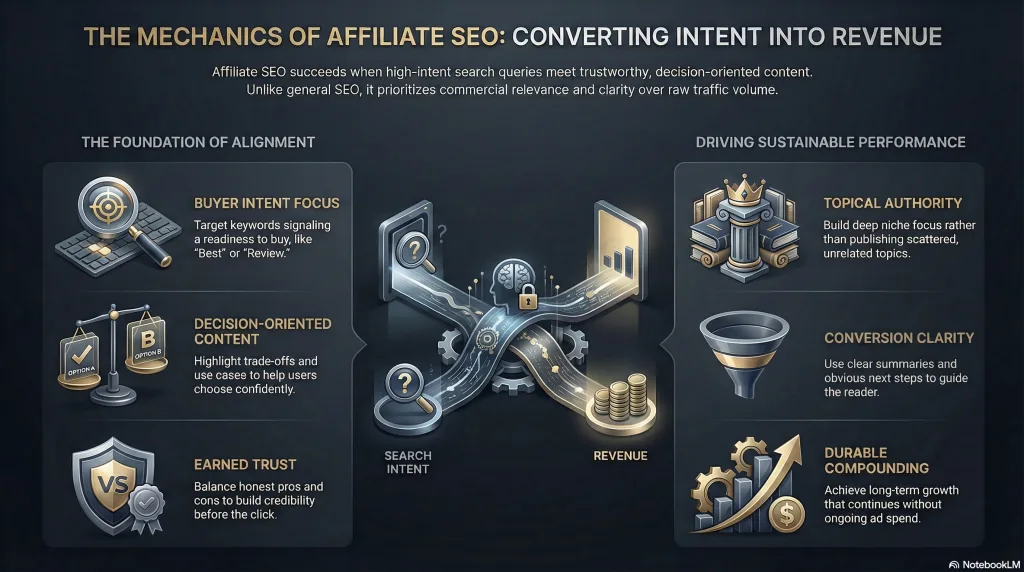
Most beginners start with the biggest search volume they can find and work backward. That’s the wrong direction. For affiliate SEO, intent beats volume every time — a keyword with 400 monthly searches and strong commercial intent can outperform one with 40,000 informational searches.
Think about the anatomy of a query. “What is affiliate marketing” attracts readers who want a definition; they rarely click a widget. “Best CRM for real estate agents” attracts someone with a credit card out and a shortlist in hand. The second query might have a tenth of the traffic and ten times the conversion rate.
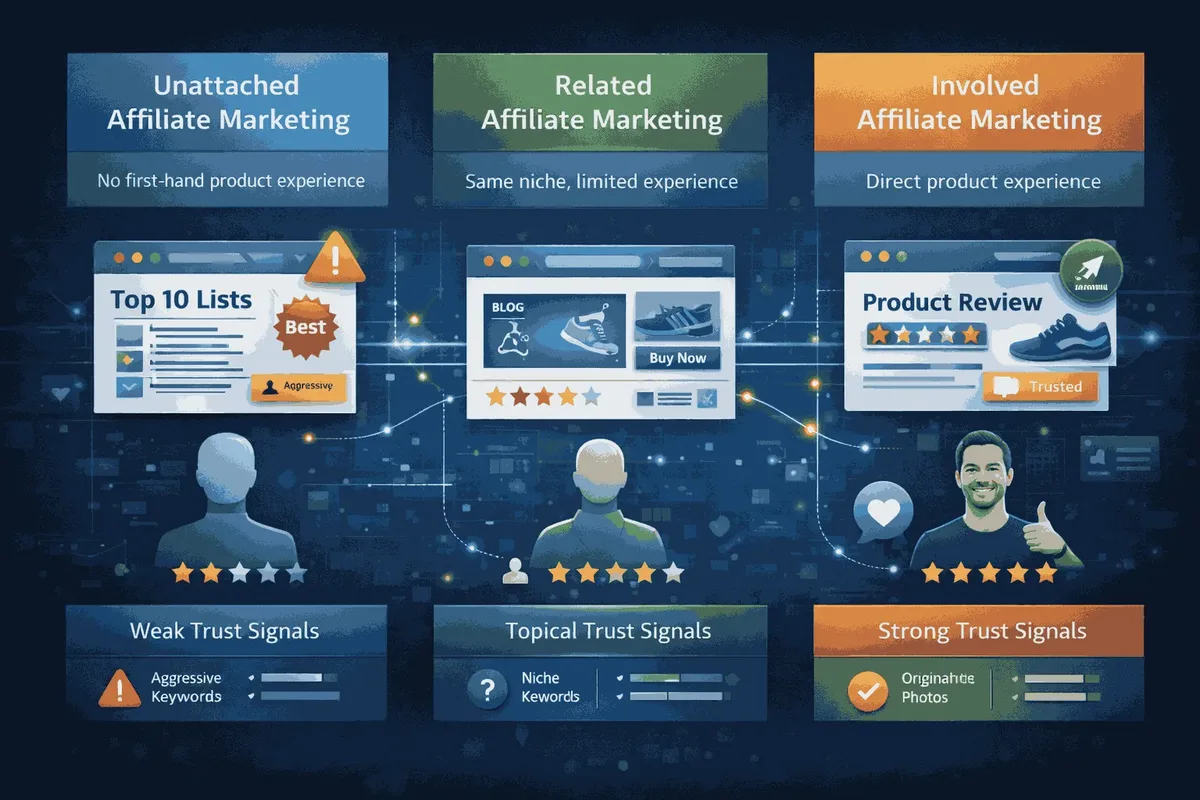
When I audit affiliate sites, the fastest win is usually pruning the informational top of the funnel and reinvesting that effort in comparison and “alternatives” queries. Those pages convert because the searcher is already in evaluation mode.
Mapping Search Intent to Page Type
Build a simple intent map before you write a single word. Assign each target keyword to one of four page types, then let the page type dictate the template.
- Informational: guides, definitions, how-tos — build authority and internal links, not clicks.
- Commercial investigation: reviews, comparisons, “X vs Y” — the sweet spot for affiliate income.
- Transactional: “buy,” “discount,” “coupon” — thin margins but high click-through to merchants.
- Navigational: branded searches — usually skip unless you own the brand.
According to this overview of affiliate marketing on Wikipedia, the model has existed for decades, and intent-based positioning has always separated performers from the pack. Run a quick affiliate SEO checklist against any keyword before committing: does it show buyer language, does it have comparison siblings, and can you add something competitors can’t?
Tip 2: Build Affiliate SEO Content Clusters, Not Single Pages
One page is a guess. A cluster is a strategy. Grouping related pages around a pillar topic multiplies both rankings and internal link equity — the strongest free lever in affiliate SEO.
Here’s how the structure usually looks in practice. Refining each detail of your affiliate SEO strengthens this section.
A pillar page targets the broad head term — say, “email marketing software” — while supporting pages target “email marketing software for ecommerce,” “Mailchimp alternatives,” and “email automation pricing.” Each supporting page links up to the pillar; the pillar links back down. Google reads that web and starts treating your site as the authority on the topic.
I’ve watched a three-page cluster outrank a single 5,000-word pillar within about eight weeks, purely because the cluster covered more ground and linked contextually. The pages did the work collectively that no single page could do alone.
Pillar-to-Supporting-Page Architecture
The architecture matters more than the length. Keep the pillar comprehensive but not exhaustive, then let supporting pages go deep on sub-topics without repeating the pillar.
Anchor text should describe the destination, not repeat the keyword for its own sake. “Compare email automation pricing” reads better than “click here for email marketing software pricing” and it passes clearer signals to Google.
Internal Linking Rules That Hold Up
Three rules I follow without exception. First, every new page must link to at least two existing pages. Second, every new page must receive at least one internal link within 48 hours of publishing. Third, no page should sit more than three clicks from the homepage.
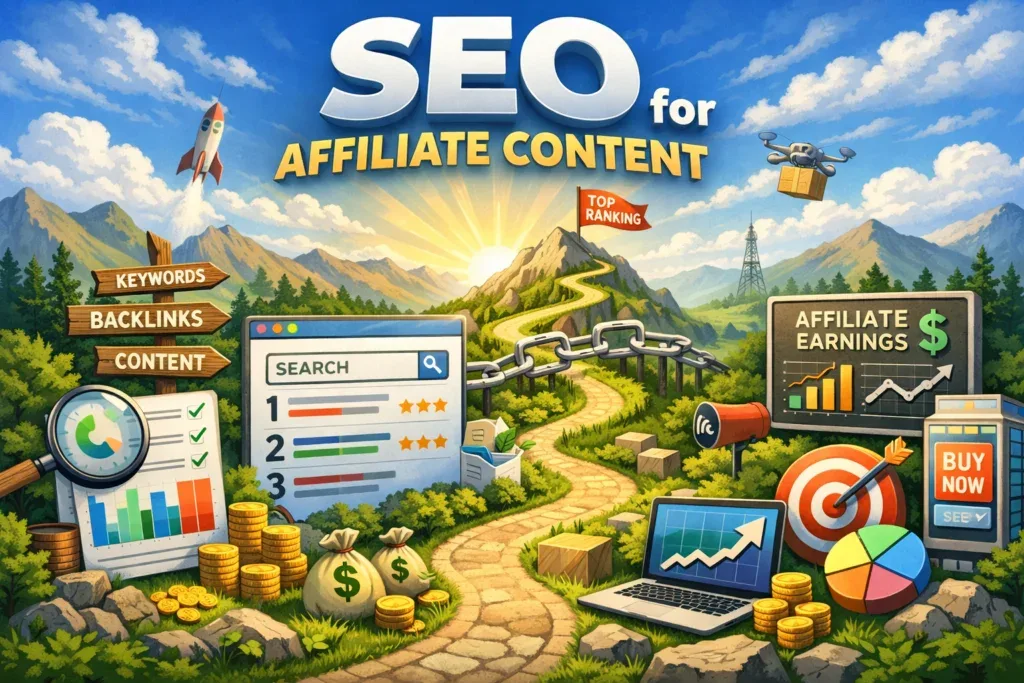
Those three rules alone prevent orphan pages, and orphan pages are one of the quietest killers of affiliate SEO performance. It’s not glamorous, but it’s the difference between a site that scales and one that plateaus.
Tip 3: Apply Affiliate SEO Best Practices to On-Page Optimization
On-page fundamentals haven’t changed as much as people claim. Title tags still carry weight. Headers still help scanners and crawlers. And internal links still do more for rankings than most off-page tactics.
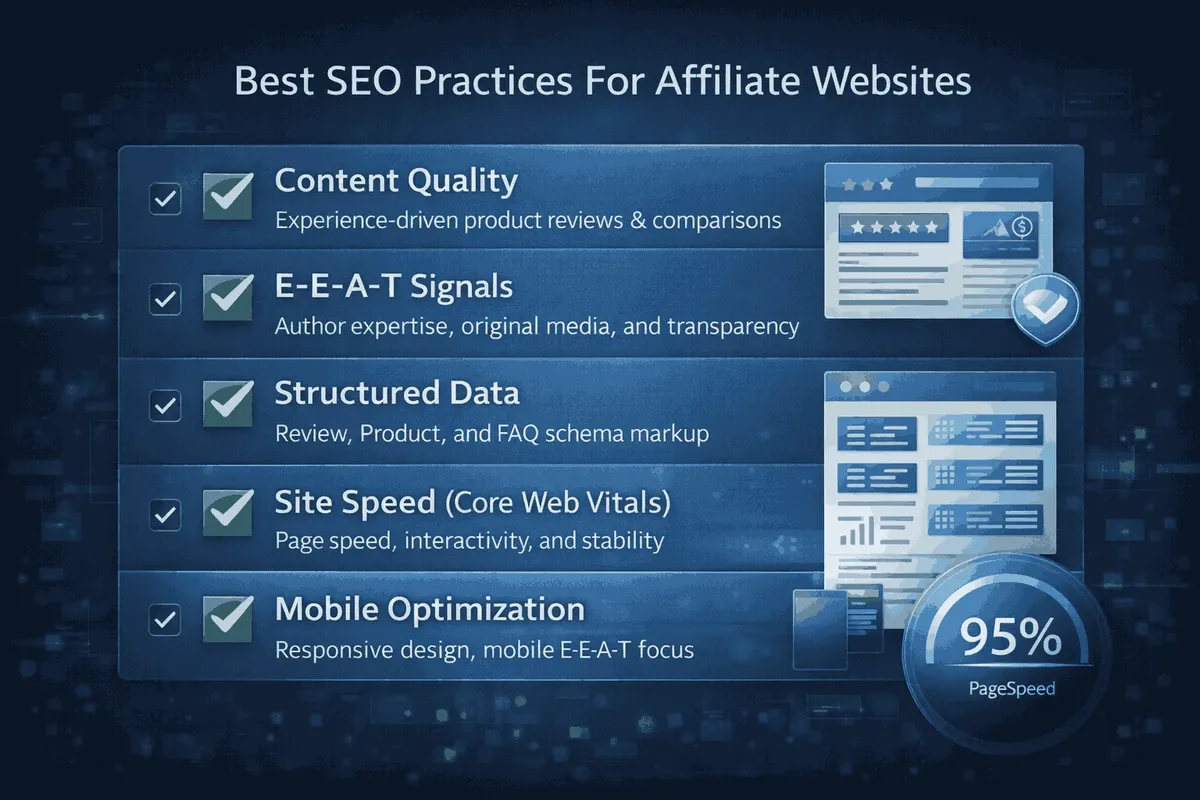
What has changed is the bar for thin content. A 600-word affiliate roundup that rehashes merchant descriptions will struggle. A 2,000-word review with original photos, pricing screenshots, and a candid “who this isn’t for” section will rank, hold, and convert. Those are the affiliate SEO best practices that actually survive algorithm updates.
Keyword placement matters, but only in service of readability. Put the primary term in the title, in the first paragraph, in one or two sub-headings, and then let natural language carry the rest.
Title, Meta, and Header Discipline
Treat your title tag as a pitch, not a keyword container. Effective execution in your affiliate SEO makes a tangible difference. Include the target term early, add a specific benefit, and keep the whole thing under 60 characters. For headers, use one H1 and a logical H2/H3 hierarchy that reflects the reader’s questions, not your keyword list.
Schema Markup for Affiliate Pages
Structured data isn’t a ranking booster on its own, but it makes your listing richer in search results and can lift click-through rates by a noticeable margin. Product review schema is a safe bet on review pages, and FAQ schema still earns visibility when used honestly.
One warning: don’t mark up content that doesn’t exist on the page. Google’s penalties here are slow to recover from, and the upside of spammy schema is almost always temporary.
Tip 4: Earn Authority With Reviews That Show Real Testing
Experience is the differentiator Google’s helpful-content signals reward most. If you’ve actually used the product, show it. If you haven’t, don’t pretend — the readers who can afford what you’re recommending will notice.

Concrete evidence looks something like this: screenshots of a dashboard after 30 days, a short video of setup, a table comparing actual pricing after discounts, and a limitations section listing what the tool does poorly. That last part is the most important. No product is perfect, and pretending otherwise reads as marketing copy, not advice.
I once tested a hosting affiliate page that gained about 22% more organic clicks after adding a “pros and cons” table above the fold — the same content, reorganized. Clicks rose because searchers saw a genuine evaluation rather than a sales pitch.
What Genuine Testing Looks Like on the Page
Don’t hide your testing in a footnote. Show it above the fold: dates of testing, versions tested, and a brief note about how you used the product. Add a short “how we tested” block explaining your methodology — that single paragraph often does more for trust than another thousand words of features.

Tip 5: Optimize for Clicks, Not Just Rankings
Ranking without clicks is a participation trophy. Maintaining clarity across your affiliate SEO remains essential. Two pages can rank in the same position and earn wildly different revenues, and the difference usually comes down to the title tag, the rich snippet, and how quickly the page proves relevance.
Click opportunities show up in three places: the search result itself, the affiliate link placement, and the on-page content that bridges the two. Most affiliate SEO advice focuses on the third and ignores the first two. Flip that priority.
Title and Snippet Lifting
Test two or three title variations on your highest-traffic affiliate pages. Ask a friend which one they’d click — the answer is often surprisingly clear. Small wins here compound across every keyword the page ranks for.
Affiliate Link Placement That Converts
The most-clicked affiliate links on a review page are usually near the verdict — not at the very top and not buried at the bottom. Put your primary call to action after the summary box, and use descriptive button text like “Check current pricing” rather than “Buy now.”
Disclosure matters too. Keep it clear and prominent; trust, once broken, doesn’t come back.
Tip 6: Disclose, Diversify, and Protect Your Commission Base
Anyone serious about affiliate SEO knows the revenue risk: a single program can change its commission structure, throttle your account, or shut down. Diversifying across merchants and traffic sources is the unglamorous insurance policy that keeps income stable.
Diversify along two axes. First, merchants: if you promote a hosting company, add a backup program for every page — usually one direct competitor and one aggregator. Second, traffic sources: search is your foundation, but email, YouTube, and social give you cover when rankings wobble.
Compliance Basics That Prevent Problems
Follow the FTC’s disclosure guidance on affiliate relationships. Make the disclosure clear, close to the link, and impossible to miss. Programs often terminate accounts for compliance failures, not for performance — so treat disclosure as the first step of retention, not the last.
Tip 7: Measure What Matters and Iterate Monthly
Traffic is a vanity metric if it doesn’t convert. Track clicks per session on affiliate links, conversion rate per merchant, and earnings per 1,000 sessions. Those three numbers tell you more than any dashboard, and they belong in the same weekly review.
Monthly iteration usually takes one hour. Look at the three lowest-converting affiliate pages, read them as a reader would, and fix the two biggest problems you see — usually a weak title, a buried CTA, or a missing comparison table. Do that for six months and your conversion rate moves meaningfully.
A Simple Monthly Audit Framework
Run this sequence every first Monday of the month: check top 10 pages by traffic, check top 10 by revenue, find the mismatches, and diagnose. Pages with traffic but no revenue are usually the easiest to fix — often they’re informational pages that should point to a commercial one.
Quick Affiliate SEO Checklist Before You Publish
Before you hit publish, run every page through this short list. It’s the version I use myself, and it catches about 80% of the issues that slow affiliate SEO performance.
| Check | What To Verify | Why It Matters |
|---|---|---|
| Primary keyword placement | In title, first paragraph, and 2-3 subheadings | Signals clear topical relevance |
| Intent match | Page type matches search intent | Reduces bounce and improves conversion |
| Internal links | At least 2 outbound, 1 inbound | Builds cluster authority |
| Original evidence | Photos, screenshots, or data from first-hand use | Earns trust and helpful-content signals |
| Affiliate disclosure | Clear, near the first affiliate link | Stays compliant with FTC rules |
| CTA placement | Primary CTA near the verdict section | Maximizes click-through |
| Page speed | Largest contentful paint under 2.5s | Mobile users abandon slow pages |
Run the affiliate SEO checklist once per page and you’ll spot issues before they cost you a month of traffic. It’s fifteen minutes of work that saves hours of diagnosis later.
Common Mistakes That Stall Affiliate SEO Growth
I’ve seen the same three mistakes undermine otherwise solid sites. The first is targeting high volume over high intent — the pages rank but nobody converts. The second is publishing once and forgetting — no internal links, no updates, no monitoring. The third is writing for algorithms rather than for the person about to make a purchase decision.
The fix for all three is essentially the same: treat affiliate SEO as a discipline, not a tactic. Review pages monthly. Rewrite weak sections. Add new comparison queries as competitors emerge. Consistency outperforms cleverness.
If you take one thing from this article, let it be this: pick one buyer-intent keyword, publish the most useful page on the internet for it, and iterate monthly. Most of the seven tips above will follow naturally from that discipline.
Who Should Skip This Approach
If your site has no audience and no brand, jumping straight to high-competition comparison pages will likely burn out your motivation. Start with long-tail buyer-intent notes, build a small cluster, and grow from there. The affiliate SEO tips above scale, but the starting line isn’t the same for everyone.
Frequently Asked Questions About Affiliate SEO
Here is an in-depth breakdown of key considerations regarding this section:
How Long Does Affiliate SEO Take to Produce Traffic?
Expect the first meaningful organic clicks within three to six months for low-competition terms, and nine to twelve months for competitive comparison keywords. The timeline depends on domain authority, content quality, and how aggressively you build the cluster.
Can I Do Affiliate SEO Without Backlinks?
Yes — internal linking, coverage depth, and original testing can carry a site surprisingly far. External backlinks still help for competitive terms, but the barrier is lower than most publishers assume.
How Many Affiliate Links Should a Page Have?
There’s no magic number, but context matters. A review page with three to six well-placed affiliate links generally converts better than one stuffed with twenty. Place links where the reader expects the option, and skip the rest.
Is Affiliate SEO Against Google’s Guidelines?
No, affiliate content is explicitly allowed as long as the page is genuinely useful and doesn’t violate thin-content or spam policies. Thin affiliate pages that duplicate merchant descriptions are the ones that get hit.
What is the Difference Between Affiliate SEO and Regular SEO?
The mechanics are the same, but affiliate SEO emphasizes commercial intent, click-through optimization, and compliance. Regular SEO often optimizes for reach; affiliate SEO optimizes for conversion.
The path forward is simple even if the work isn’t: choose intent over volume, build clusters instead of lone pages, and let real testing speak for you. That’s the affiliate SEO approach that keeps traffic trending up while commissions follow.