Multilingual SEO is the discipline of making a single site rank well across several languages and regional markets without cannibalizing its own pages. Get it right, and one brand suddenly speaks to a dozen audiences. Get it wrong, and you end up with duplicate content, split authority, and a traffic graph that flatlines.
I’ve spent years watching teams pour budget into translation plugins and then wonder why their German pages never crack page one. The pattern is almost always the same: they translated words, not search intent. That’s why this multilingual SEO guide leans on ten concrete practices rather than vague theory. Each one is a fix you can apply this week, and each one compounds with the others.
Think of this as your working multilingual SEO checklist — the kind you tape to the wall during a site migration. We’ll cover architecture, hreflang, keyword research per locale, content quality, and the technical traps that quietly drain rankings.
Why Multilingual SEO Decides Whether Your Global Site Sinks or Scales
Search engines don’t rank a website. Focusing on multilingual SEO provides clear direction here. They rank a URL for a query in a specific language and region. That single fact reshapes everything about how you build a global presence.
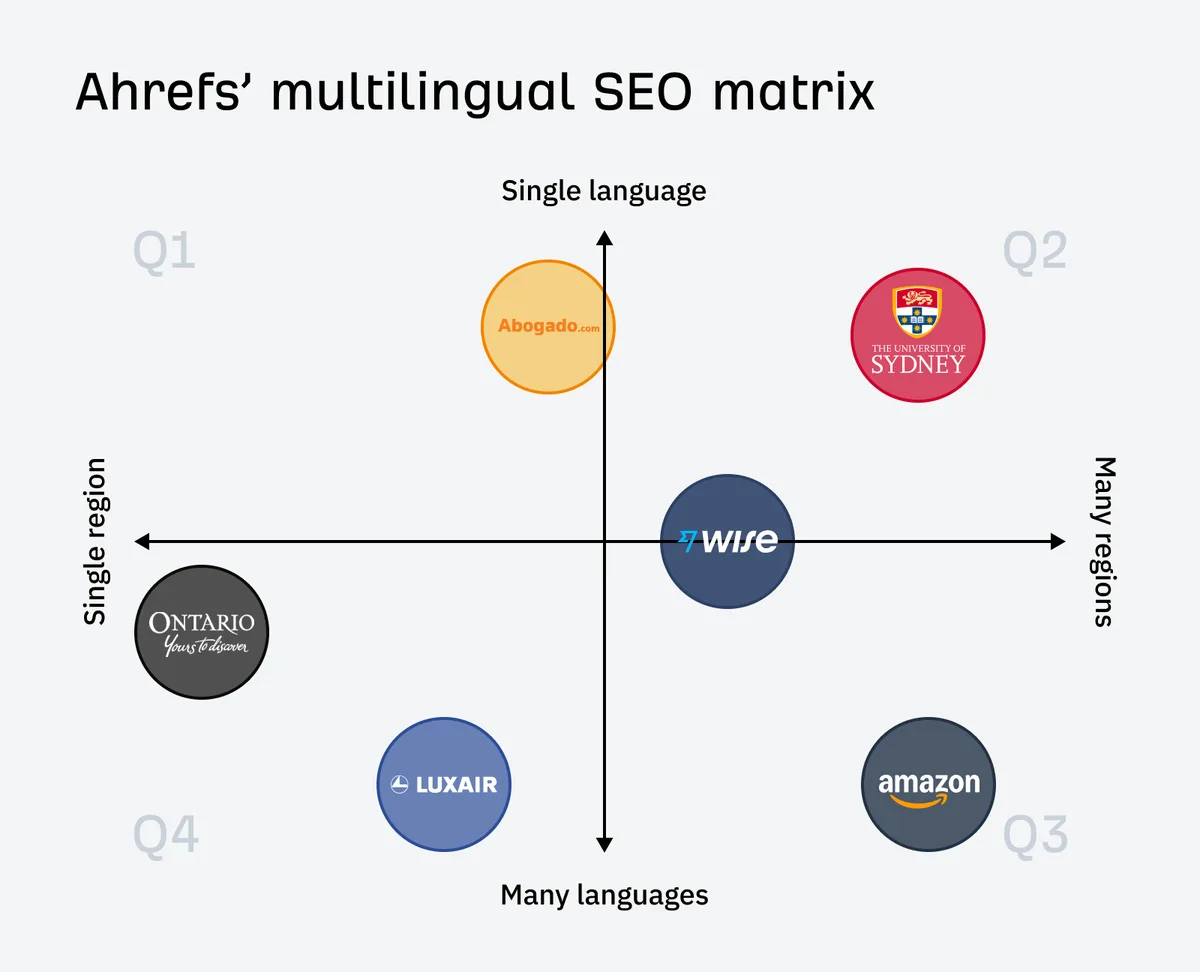
When your Spanish page targets Mexican shoppers and your Argentine page targets Buenos Aires, those are two different ranking problems with two different answer sets. Treating them as one “Spanish site” guarantees mediocre results in both. The brands that win at multilingual SEO build for that granularity from day one.
There’s also the authority question. Focusing on multilingual seo provides clear direction here. Every language version competes for crawl budget, internal link equity, and brand signals. Poorly structured, they compete against each other. Well structured, they reinforce the parent domain and lift every locale.
The Three Layers Every Global Site Must Separate
Language, region, and currency get tangled constantly. A page can be in Portuguese but target Portugal, Brazil, or both. A product can be priced in euros but shipped across four countries.
Your multilingual SEO strategy needs to answer these separately. Language governs the content itself. Region governs the search results you’re chasing. Currency and logistics govern conversion, not ranking — but they affect bounce rate, which search engines absolutely notice.
Get the layers confused and you’ll ship a “Portuguese” page that ranks for nothing because it half-targets Lisbon and half-targets São Paulo. Pick one intent per URL. Always.
What Actually Changes When You Add a Second Language
Crawl paths multiply. Internal links double. Sitemaps fragment. Analytics segments get messy. And suddenly every template decision you made for your English site becomes a question mark.
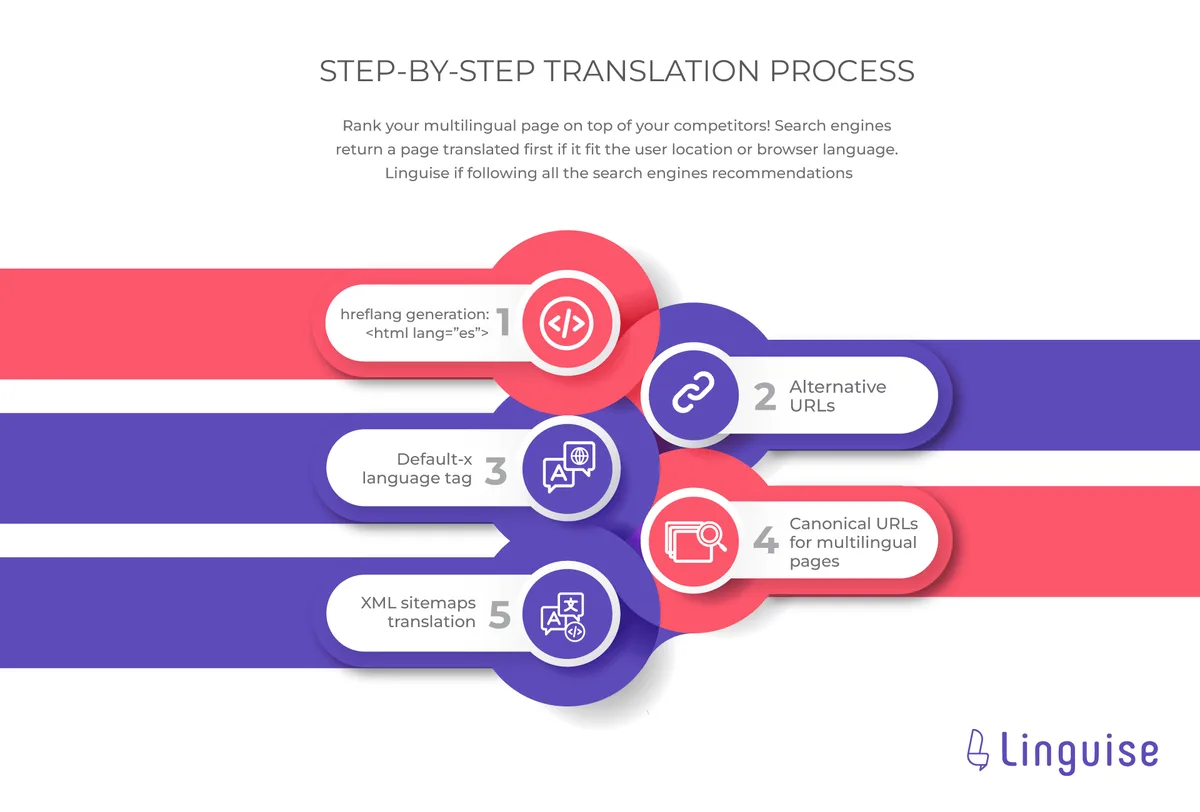
The teams I’ve seen succeed treat the second language as a full product launch, not a content task. They assign an owner, set locale-specific KPIs, and build a review loop with native speakers. That’s the difference between a multilingual SEO project and a translation export.
Build the Right URL Architecture Before You Write a Single Translated Word
Architecture is the first of our multilingual SEO best practices because it’s the hardest to reverse. Changing URL structure after launch means redirects, lost equity, and months of recovery.
The multilingual SEO have three realistic options: subdirectories, subdomains, and separate country-code domains. Each carries tradeoffs in cost, authority consolidation, and operational overhead.
| Structure | Example | Authority Consolidation | Best For |
|---|---|---|---|
| Subdirectory | example.com/de/ | Strong — all equity stays on one domain | Most brands expanding into new languages |
| Subdomain | de.example.com | Moderate — treated as related but separate | Large enterprises with independent regional teams |
| ccTLD | example.de | Weak consolidation, strong local trust | Brands with legal entities and local marketing budgets |
For nine out of ten companies, subdirectories win. You keep every backlink pointed at one root domain, and setup takes minutes instead of weeks.
CcTLDs still carry a trust advantage in markets like Germany and Japan, where users instinctively prefer local domains. But that advantage costs you consolidation and multiplies your maintenance load. Choose deliberately, not by default.
Keep Locale Codes Consistent Everywhere
Use ISO 639-1 for language and ISO 3166-1 alpha-2 for region. That means en-US, pt-BR, zh-Hant-TW. Not “english_us” or “ptbr”.
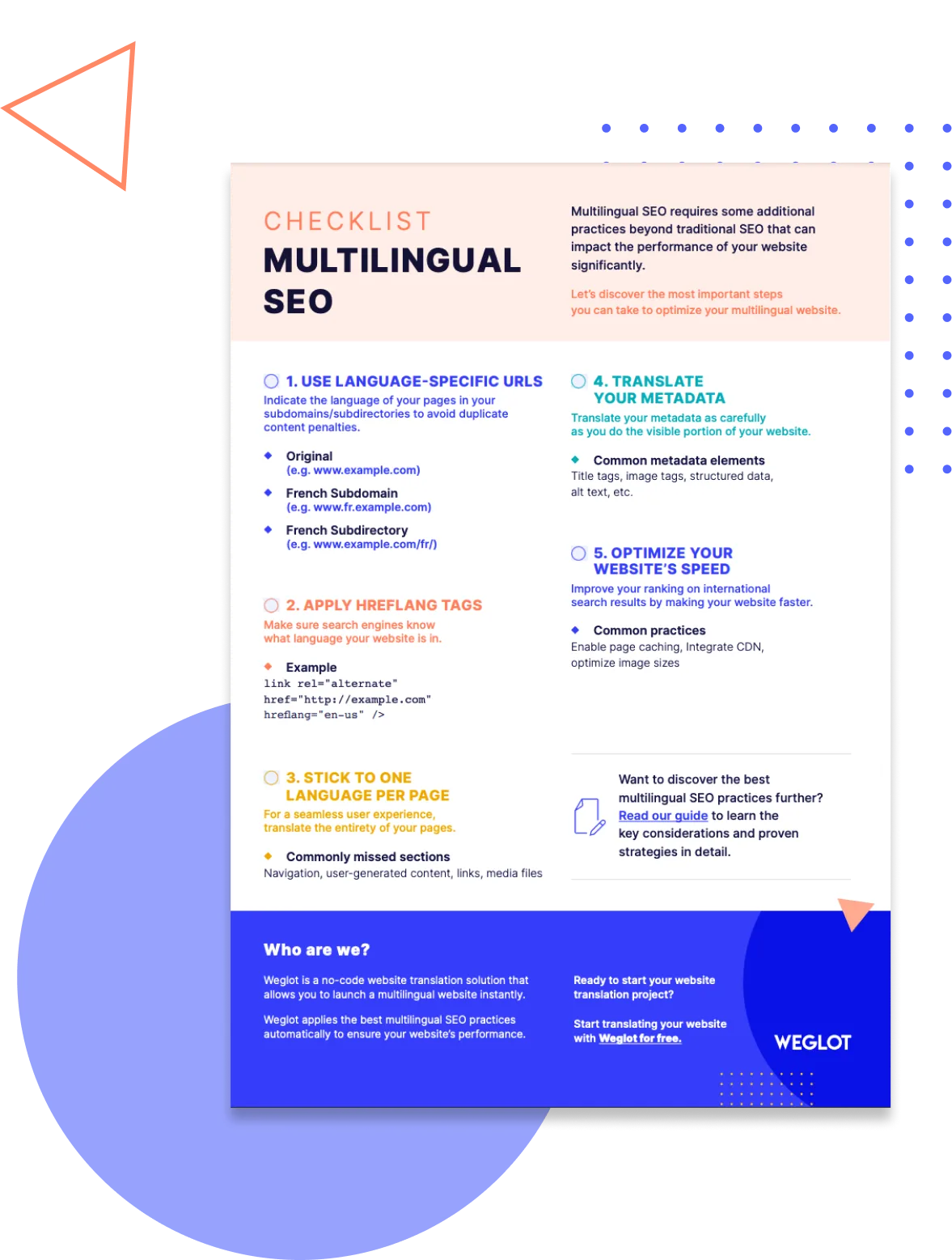
Consistency matters because hreflang, sitemaps, canonical tags, and analytics all reference these codes. One typo in one template and an entire locale silently drops out of the cluster.
Plan Internal Linking Across Languages from Day One
Most teams link only within a locale. Effective execution in your multilingual SEO makes a tangible difference. That’s a missed opportunity. A well-placed language switcher passes equity and helps crawlers discover every version.
Go further: link equivalent pages to each other explicitly, and keep the switcher visible above the fold. Users hunting for their language shouldn’t have to scroll.
Master Hreflang: the Backbone of Any Multilingual SEO Checklist
If architecture is the skeleton, hreflang is the nervous system. It tells search engines which page to serve to which audience, and it prevents your own pages from cannibalizing each other.
The rules are simple but unforgiving. Refining each detail of your multilingual seo strengthens this section. Every page in a cluster must reference every other page, including itself. Return links are mandatory. And the codes must match exactly.
Here’s a minimal implementation pattern that works across most CMS platforms:
- Self-referencing tag: Each page includes an hreflang pointing to its own URL. Skipping this is the single most common mistake I find in audits.
- Reciprocal pairs: If the German page points to the French page, the French page must point back. One-way references get ignored.
- x-default fallback: Add a catch-all for users whose language doesn’t match any version, usually your primary market page.
- Absolute URLs only: Relative paths break hreflang silently. Always use the full protocol and domain.
You can implement hreflang in HTML head tags, HTTP headers, or XML sitemaps. Sitemaps scale best for large sites; head tags are easiest to audit manually. Pick one method and stick with it — mixing methods invites conflicts.
Hreflang Mistakes That Quietly Kill Rankings
The most expensive error is pointing hreflang at a URL the multilingual SEO redirects. Search engines ignore the signal entirely. Same goes for pages blocked by robots.txt or tagged noindex.

Second most common: using region codes where language codes belong, or vice versa. es-419 means Latin American Spanish — a valid language-region combo. es-LA means nothing and gets discarded.
Run a hreflang validator after every template change. It takes five minutes and saves months of confused analytics.
How Hreflang Interacts With Canonical Tags
These two signals serve different purposes and must not contradict each other. Canonical says “this is the primary version of this content.” Hreflang says “this is the version for this audience.”
Each localized page should be self-canonical. If you canonicalize the German page to the English one, you’ve just told search engines the German content is a duplicate — and it will vanish from German results.
The exception: near-identical pages targeting the same language and region. A thoughtful approach to multilingual SEO reinforces your qualifications. In that case, consolidate with canonical and keep hreflang clean.
Do Keyword Research per Locale, Not per Translation Memory
This is where most multilingual SEO tips fall short. They tell you to translate your keyword list. That advice is wrong, and it’s expensive.

Search demand is cultural, not linguistic. The German phrase for “cheap flights” might have a tenth the volume of a completely different construction that Germans actually type. Translating your English keywords gives you a list nobody searches for.
Start from scratch in each market. Use local search volume tools, mine local competitor SERPs, and read local forums. Then validate with native speakers who actually live there.
A Real Example of Keyword Divergence
Consider a software brand selling project management tools. In English, “project management software” dominates. In Japanese, direct translations underperform badly because users search by use case — task management, team scheduling, progress tracking — rather than category.
A team I worked with rebuilt their Japanese keyword map around use-case terms and saw organic sessions triple within two quarters. Same product, same pages, different keyword spine.
That’s the payoff of treating multilingual SEO as market research rather than linguistics.
Map Search Intent Differences Across Cultures
Intent shifts too. Structuring your multilingual SEO around proven patterns ensures impact. A French user searching for a product review may expect a long-form editorial. A Brazilian user may expect a video or a marketplace listing.

Check the actual SERP composition in each market before the multilingual seo decide page format. If the top ten results are all videos, your 3,000-word article won’t rank no matter how well it’s optimized.
Translate for Search Intent, Not Word-for-Word Accuracy
Literal translation produces grammatically correct pages that read like a machine wrote them. Users bounce. Search engines notice the bounce. Rankings fall.
Professional localization means rewriting for the target reader. Idioms change. Sentence length changes. Formality levels change — German business content runs more formal than American, and Japanese politeness levels are a discipline unto themselves.
Budget for transcreation on your highest-value pages. Save straight translation for support documentation and legal boilerplate.
Why Native Reviewers are Non-Negotiable
Machine translation plus a spell-check is not localization. Applying these principles to your multilingual SEO yields measurable results. You need a native speaker who understands the product and the market.
Give reviewers context: the target keyword, the intended audience, the conversion goal. Reviewers without context produce polished prose that misses the point.
One practical tip from experience: have reviewers flag any sentence they’d never say out loud. Those are the ones that betray a translated origin.
Handle Brand and Product Names Deliberately
Some names translate. Some don’t. Some mean something unfortunate in another language — and yes, that still happens to major brands.
Run every product name past native speakers before launch. Where a name stays in English, make sure the surrounding copy makes its meaning obvious through context.
Localize Beyond Language: Currency, Units, Dates, and Trust Signals
A page can be perfectly translated and still feel foreign. Proper attention to your multilingual SEO sets a strong baseline. Currency in the wrong symbol, dates in the wrong order, addresses formatted for the wrong country — these small signals add up to a trust problem.
Localization of this kind directly affects multilingual SEO because engagement metrics feed ranking. A user who bounces because prices show in dollars won’t convert, and search engines read that as a poor match.
Format dates as DD/MM/YYYY for most of Europe and Latin America, MM/DD/YYYY for the US. Use local units — kilometers, Celsius, grams — unless your audience is technical enough to expect imperial.
Trust Signals That Vary by Market
German users look for Impressum and detailed legal disclosure. Japanese users expect clear company registration details. American users respond to review counts and return policies.
Payment methods matter too. Maintaining clarity across your multilingual seo remains essential. A checkout without local options like iDEAL in the Netherlands or Pix in Brazil signals “this site isn’t for you” faster than any headline.
Build a localization checklist per market and review it before every launch. It’s tedious. It’s also the difference between ranking and converting.
Eliminate Duplicate Content Across Language Versions
Duplicate content in multilingual SEO rarely comes from lazy copying. It comes from shared templates, shared product descriptions, and shared metadata that nobody localized.
Meta titles, meta descriptions, alt text, and image filenames are the usual suspects. Developing your multilingual SEO with precision highlights key strengths. A thousand product pages with identical English alt text across five languages is a real pattern I’ve audited more than once.
Fix it systematically. Localize every text field in your template, including the ones that don’t appear on the page. Screen readers and image search both depend on them.
When Near-Duplicate Pages are Legitimate
Sometimes you genuinely need similar pages for different regions — same language, different shipping terms. That’s fine, as long as hreflang and canonical signals are clean.
The problem arises when near-duplicates exist without signals. Search engines then pick a winner arbitrarily, often the wrong one.
Audit quarterly. Crawl your site with a tool that flags near-duplicate clusters, then decide page by page: consolidate, differentiate, or signal.
Optimize Technical Performance for Every Locale
Speed and crawlability are universal, but the multilingual SEO break unevenly across locales. A CDN tuned for North America may serve sluggish pages to Southeast Asia.
Test Core Web Vitals from multiple regions, not just your office. Tools like PageSpeed Insights let you simulate different locations. Use them.
Watch server response times for locales hosted far from your origin. A 400ms delay in Frankfurt versus 80ms in Virginia is a ranking factor you can fix with edge caching.
Sitemaps and Crawl Budget Across Languages
Split sitemaps by locale. It makes debugging far easier and helps search engines prioritize crawling.
Include hreflang annotations in your sitemaps if you’re using that implementation method. Keep each sitemap under 50,000 URLs and 50MB uncompressed.
Monitor crawl stats per locale in Search Console. Integrating multilingual SEO into your workflow produces consistent quality. If one language version gets crawled far less than others, you have an internal linking or server issue to chase.
Measure Multilingual SEO With Locale-Specific KPIs
Aggregate metrics hide everything the multilingual seo matters. A site can show flat global traffic while three locales grow 40% and two collapse.
Segment analytics by language and region from day one. Build dashboards per market. Assign owners.
Track rankings per locale and per search engine. Google dominates most markets, but Baidu, Yandex, and Naver matter enormously where they lead.
Benchmarks That Actually Tell You Something
Compare like with like. A new locale should be benchmarked against its own baseline, not against your mature English site.
Watch indexed page counts, average position for target keywords, and conversion rate per locale. Those three tell you whether the multilingual SEO work is landing.
Also track branded search volume per market. Targeted refinements to your multilingual SEO streamline the entire review. Rising brand queries in a new language is the clearest signal that awareness is building.
The Ten Multilingual SEO Best Practices That Actually Move Rankings
Here’s where everything converges. These ten practices form the core of a repeatable multilingual SEO checklist, ordered roughly by impact and by how early you should tackle them.
Work through them in sequence for a new market. Audit against them quarterly for existing ones. Each item includes what it does and a concrete way to execute.
Practice 1: Lock Your URL Structure Before Launch
Choose subdirectories, subdomains, or ccTLDs and commit. Subdirectories consolidate authority best for most brands.
Document the decision, the locale code convention, and the template rules in one place. Every future page inherits from that document.
Execution tip: Build a staging environment with two locales before you build twenty. Fix template issues while the blast radius is small.
Practice 2: Implement Complete, Reciprocal Hreflang
Every page references itself and every sibling. Use absolute URLs. Validate after every deployment.
Automate validation in your CI pipeline if you can. Manual checks slip the moment the site grows past a few hundred pages.
Execution tip: Start with sitemap-based hreflang for scale, then spot-check head tags on your top twenty pages by traffic.
Practice 3: Research Keywords Natively in Each Market
Never translate your keyword list. Build each one from local search data, local SERPs, and native speaker input.
Map intent per market. Structuring your multilingual seo around proven patterns ensures impact. A query that’s informational in one country may be transactional in another.
Execution tip: Have a native speaker review your top fifty keywords per locale and flag anything that sounds unnatural or off-intent.
Practice 4: Localize Content Through Transcreation
Rewrite for the reader, not the source text. Adjust tone, formality, examples, and cultural references.
Prioritize transcreation on money pages and high-traffic guides. Straight translation is acceptable for low-stakes support content.
Execution tip: Brief translators with the target keyword, audience persona, and conversion goal. Context changes output quality dramatically.
Practice 5: Adapt Metadata and Alt Text per Locale
Titles, descriptions, image alt text, and filenames must all be localized. This is the most overlooked multilingual SEO checklist item in every audit I run.
Keep titles under 60 characters and descriptions between 120 and 160. Localized phrasing often runs longer than English — trim accordingly.
Execution tip: Add a mandatory “localized metadata” field to your CMS publishing workflow so nothing ships with English placeholders.
Practice 6: Localize Currency, Units, and Trust Elements
Show prices in local currency, dates in local format, and measurements in local units. Add payment methods and legal disclosures that match market expectations.
These aren’t ranking factors directly, but they drive engagement, and engagement drives rankings.
Execution tip: Build a per-market launch checklist covering currency, units, payment methods, legal pages, and contact information.
Practice 7: Prevent Duplicate Content in Templates
Localize every text field, including hidden ones. Audit near-duplicate clusters quarterly.
Consolidate pages that serve the same audience and intent. Differentiate or signal the ones that must coexist.
Execution tip: Crawl with a duplicate-detection tool after each major template release. Applying these principles to your multilingual seo yields measurable results. Fix clusters before they age into ranking problems.
Practice 8: Optimize Speed and Crawlability Regionally
Use a CDN with edge nodes near each target market. Test Core Web Vitals from multiple locations.
Split sitemaps by locale and monitor crawl stats per language in Search Console.
Execution tip: Set up synthetic monitoring from three regions per major market. Catch latency regressions before users do.
Practice 9: Build Local Backlinks and Citations
Links from local domains carry disproportionate weight. A mention on a German industry blog does more for your German rankings than a dozen global links.
Pursue local directories, regional press, and market-specific partnerships. Localize your digital PR outreach entirely.
Execution tip: Assign one person per market to build twenty quality local links per quarter. Slow, steady, and far more effective than bulk link buying.
Practice 10: Measure per Locale and Iterate
Segment every metric by language and region. Build dashboards per market. Review monthly.
Compare each locale against its own baseline. Celebrate relative growth, not absolute numbers.
Execution tip: Hold a quarterly review where each locale owner presents indexed pages, ranking movement, and conversion trends. Accountability keeps multilingual SEO from becoming a one-time project.
Common Multilingual SEO Mistakes and How to Avoid Them
Even experienced teams trip on the same handful of issues. Knowing them in advance saves months.
The biggest is treating multilingual SEO as a translation task. It’s a market-entry discipline with technical, editorial, and analytical components. Budget accordingly.
The second is skipping native review to save money. The savings evaporate the moment users bounce off awkward copy.
Mistake: Auto-Redirecting Based on IP
Forcing users into a language version based on their IP breaks the experience for travelers, expats, and VPN users. It also prevents search engines from crawling every version.
Instead, show a dismissible suggestion banner. Let users choose. Remember their choice.
Mistake: Ignoring Search Engines Beyond Google
If the multilingual SEO’re targeting China, Russia, or South Korea, Google is not the primary engine. Baidu, Yandex, and Naver each have their own technical requirements and ranking signals.
Research the dominant engine per market before you build. Optimization tactics don’t transfer cleanly.
Frequently Asked Questions About Multilingual SEO
Here is an in-depth breakdown of key considerations regarding this section:
How Long Does It Take to See Results from Multilingual SEO?
Expect three to six months for initial indexing and ranking movement in a new locale. Competitive markets can take nine to twelve. Authority building is the slowest part.
Track leading indicators — indexed pages, crawl frequency, branded search — long before rankings arrive.
Should I Use a Translation Plugin or a Dedicated Multilingual Setup?
Plugins work for small sites with a handful of pages. Beyond a few hundred URLs, you need proper architecture, hreflang management, and locale-specific templates.
Evaluate based on scale, not price. Migrating later costs far more than building correctly once.
Does Multilingual SEO Help or Hurt My Main Language Rankings?
Done correctly, it helps. Refining each detail of your multilingual SEO strengthens this section. Additional locales attract links, increase crawl frequency, and strengthen the parent domain.
Done poorly — with duplicate content and broken hreflang — it dilutes authority and confuses search engines about which page serves which audience.
How Many Languages Should I Target at Once?
Start with one or two. Master the process, then scale. Teams that launch eight locales simultaneously usually do none of them well.
Prioritize by existing demand. If analytics already shows traffic from a market you don’t serve, that’s your first target.
Can I Rank in a Language I Don’t Speak Internally?
Yes, with the right partners. You need native writers, native reviewers, and someone who understands local search behavior.
What the multilingual SEO can’t do is rank well without native oversight. Machine translation alone won’t get you there.
Where to Take Your Multilingual SEO Next
Everything above sits inside a larger topic cluster: international SEO. That parent discipline covers market selection, legal considerations, and global brand strategy — the decisions that come before any of these ten practices.
From here, drill into three sub-topics. First, technical international SEO — server configuration, geo-targeting in Search Console, and CDN strategy. Second, localized content operations, including translation workflows and glossary management. Third, international link building and digital PR.
The teams that treat multilingual SEO as an ongoing discipline rather than a launch task are the ones still ranking three years later. Start with architecture and hreflang. Add one market at a time. Measure per locale, and let the data tell you where to invest next.
That’s the whole game. Ten practices, applied consistently, compound into global visibility that no single-language competitor can match.
For verified reference and background research, consult the authoritative informational resource on this topic.