If you’ve ever stared at a cold outreach spreadsheet wondering why nobody writes back, haro link building offers a refreshing alternative: journalists come to you.
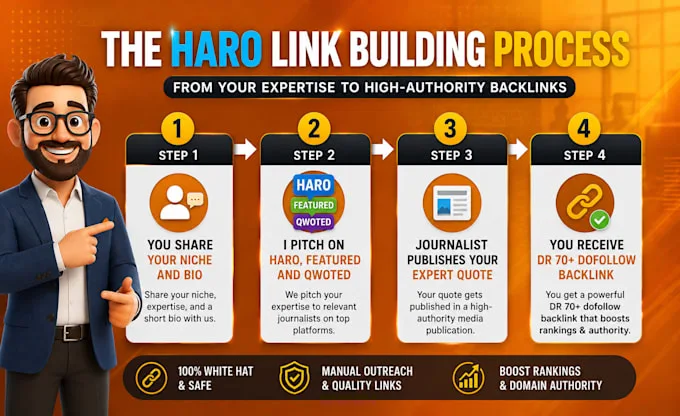
Every weekday, reporters from outlets like Forbes, TechCrunch, and CNBC post queries asking for expert input, and everyone who answers well gets a shot at a byline — plus a link from a site with serious domain authority.
Sounds simple on paper. In practice, most people fire off one sloppy pitch, get ignored, and quit. That’s a waste. Below you’ll find a haro link building guide built around ten tactics that actually move the needle, from setting up your account properly to measuring what happens after a pitch lands.
What is HARO Link Building and Why It Still Works
HARO — Help a Reporter Out — started as a simple email digest connecting journalists with sources. Focusing on haro link building provides clear direction here.
It has since evolved into a broader platform under the Connectively banner, but the core mechanic hasn’t changed: reporters publish queries, sources respond, and published stories often credit contributors with a link.

Why does this still matter for SEO? Because editorial links from news outlets and industry publications carry the kind of trust signals that directory submissions and comment spam never will. Search engines treat a mention in a reputable publication as a vote of confidence, especially when the surrounding content is genuinely relevant to your niche.
The catch is competition. A popular query on a topic like personal finance can pull hundreds of responses within hours. Your job isn’t to be the loudest voice — it’s to be the most useful one. That single shift in mindset separates people who get quoted weekly from people who never get quoted at all.
If you want a solid haro link building guide to bookmark, remember this: the platform rewards specificity, speed, and genuine expertise. Everything else in this article builds on that foundation.
Laying the Foundation: Account Setup and Query Filtering
Before you write a single pitch, get your account basics right. A half-finished profile signals to journalists that you’re a hobbyist, and reporters are ruthless about skipping anything that looks low-effort.
Start with a real headshot, a clear one-line bio, and a link to a page the haro link building actually showcases your expertise. Don’t link to your homepage if a detailed author bio or case study page would serve the journalist better.
Configure Your Query Filters Properly
HARO lets you select categories and keywords so your inbox doesn’t drown in irrelevant requests. Most beginners either subscribe to everything or pick too narrow a band.
The sweet spot is three to five categories that overlap with your business, plus a saved search for the exact phrases journalists use in your field. A SaaS founder might watch “marketing,” “technology,” and “small business” while saving searches for “email automation” and “customer retention.”
Set up email rules to route query digests into a dedicated folder. You want them visible, not buried under newsletters and calendar invites.
Build a Personal Pitch Template Library
Not a generic template — a library. Effective execution in your haro link building makes a tangible difference. Keep short, modular snippets for your bio, your credentials, and two or three signature anecdotes you can drop into pitches. Rotating these snippets keeps your responses fresh while cutting your writing time to minutes.
This is one of those haro link building best practices that rarely gets mentioned because it feels less glamorous than the pitch itself. But when a query goes live at 5:47 a.m. And your competitor has a template ready while you’re still making coffee, the gap shows up in the results.
Mastering the Fundamentals Before You Pitch
Skipping the basics is the fastest route to a silent inbox. These three habits form the backbone of any reliable haro link building tips playbook, and they compound over time.

Read the Query Twice Before Writing Anything
Journalists often specify word count, deadline, angle, and sometimes even the exact format they want. Miss one requirement and your pitch gets deleted, no matter how brilliant your insight was.
Look for the deadline first. If it’s already passed, don’t waste the keystrokes. Then check whether the reporter wants bullet points, a short quote, or a full narrative. Match the format exactly.

Response Speed Beats Polished Prose
Most published HARO quotes come from sources who replied in the first few hours. A well-crafted response sent a day late rarely gets read.
Set up a checking routine — morning, midday, late afternoon — and commit to a 20-minute turnaround on any query the haro link building fits your expertise. Speed isn’t just about beating the queue; it signals to editors that you’re responsive and reliable.
Skip Queries Outside Your Lane
It’s tempting to answer everything when you’re new, but a generic marketing take on a legal question reads as amateurish. Stick to the topics where you have genuine, demonstrable expertise.
This restraint actually increases your hit rate. Reporters remember the source who gave a genuinely useful answer on a niche topic more than the one who agreed with everyone else on a broad one.
The 10 Effective Tactics That Actually Land Placements
Here’s where things get concrete. Each tactic below solves a specific problem in the haro link building workflow — from getting noticed in the first paragraph to turning your byline into a ranking asset. Work through them in order if you’re new, or jump to the ones that address your current bottleneck.
Tactic 1: Craft Subject Lines That Get Opened
Your subject line determines whether anything else the haro link building wrote gets read. Reporters receive hundreds of pitches per query and use subject lines to triage.

Follow the exact format most queries ask for — often “[Query Topic] — [Your Name], [Your Title].” If they want something outside that, keep it short, specific, and clearly tied to their angle.
Avoid clickbait. Reporters are allergic to hype and quick to spot it. A clear identifier of the source’s expertise (“B2B SaaS CFO on Pricing Strategy”) outperforms cute phrasing every time.
Test this in your own inbox: which subjects demand a click, and which get archived in a single glance? Adopt what works for you as a reader, and haro link building pitches will get sharper automatically.
Tactic 2: Open With the Answer, Not the Backstory
Reporters are skimming for a usable quote, not a personal essay. Lead with the takeaway, then justify it.

Bad opener: “I’ve been in marketing for fifteen years and have learned a lot about content.” Good opener: “Most SaaS companies fail at pricing because they copy competitors instead of segmenting by use case.”
Put the strong statement first, then one sentence of supporting evidence, then your credentials. A thoughtful approach to haro link building reinforces your qualifications. That sequence matches how journalists actually write done: quote first, attribution second, context third.
Tactic 3: Make Your Expertise Impossible to Ignore
Generic advice gets discarded. Specific, first-hand expertise gets quoted. The gap between the two is usually one concrete detail.
Instead of “AI is transforming customer service,” try “We cut our average response time from 14 hours to 90 minutes by using AI triage for the first 30 days, and the team retention rate actually improved.” The second version is quotable, verifiable, and unmistakably yours.

Include your job title, company size, and industry in the first three lines of every pitch. It helps reporters place your credibility instantly and gives them confidence you’re a real source.
Tactic 4: Answer the Exact Question Asked
Response relevance is the single most common weakness in haro link building submissions. Reporters ask a specific question, and sources answer a slightly different one because it’s easier or they genuinely misread.

Read the query again, highlight the actual question, and structure your pitch as a direct answer to the haro link building. If you can’t answer the specific question, skip the query entirely. Off-topic responses are worse than no response because they burn credibility.
When a query asks for “one tip,” give exactly one — not three. When it asks for a “counterintuitive take,” don’t hand back the conventional wisdom you’d put in a company blog post.
Tactic 5: Use Real Numbers and Named Examples
Statistics make quotes durable. Reporters love citing sources whose claims they can verify, and editors love it even more.
Every pitch should include at least one number: a percentage improvement, a dollar figure in relative terms (not prices), a timeline, a sample size. “We surveyed 340 CFOs and found that 68% still use spreadsheets for budget reconciliation” beats “many CFOs are still behind on automation.”

Pair each number with a short context sentence: what the haro link building means, why it matters, and what readers should do with it. Numbers without interpretation are just noise.
Tactic 6: Keep the Pitch Short and Skimmable
Most publishable pitches fit in 120 to 180 words. Your goal isn’t to exhaustively explain — it’s to give the journalist exactly enough to want to quote you and enough contact detail to follow up.
Use short paragraphs and clean formatting. Refining each detail of your haro link building strengthens this section. No bullet-point walls, no images embedded in pitches, no attached PDFs. Journalists work inside crowded inboxes and small time windows.
End with a single, clear line: your name, title, and an offer to share further data if useful. That closing line is often what tips a maybe into a yes.
Tactic 7: Attach a Short, Signature Insight
Every great pitch pairs a directly relevant answer with one extra, surprising insight the reporter didn’t ask for. Proper attention to your haro link building sets a strong baseline. This is the detail that makes them quote you twice in the same article.
Returning to the customer-service example: after answering the question about AI triage, add a line about how the biggest gain came from something unexpected — say, training frontline staff to flag misclassified tickets within the first hour. That secondary insight often becomes the article’s most memorable line.

This is one of the more underrated haro link building tips. Publishing editors are looking for stories, not just sources, and a surprising detail is what turns a source into a story lead.
Tactic 8: Follow Up Once, Politely and Usefully
One clean follow-up after 48 hours is standard and often productive. Two or more reads as pestering and can earn you a block.
Make your follow-up useful rather than needy: “I realized I could add a concrete example if it’s still helpful — no worries if you’ve moved on.” This adds value instead of demanding a response.
After a placement publishes, a second follow-up thanking the journalist is fair game. Developing your haro link building with precision highlights key strengths. That short thank-you is what often lands you on their speed-dial list for the next query.
Tactic 9: Build a Reusable Body of Work
One published quote is a win. A dozen published quotes across a niche makes you the default source for that topic.
Track your pitches in a simple spreadsheet: date, query, reporter, outlet, status. Review it monthly to spot patterns — queries you win, ones you lose, categories where you have the best batting average.

Over time, this log becomes a marketing asset. You’ll know which publications moved the needle for rankings and which produced vanity coverage with little downstream value.
This is where a formal haro link building checklist pays off. Without a written process, it’s easy to duplicate work, miss deadlines, or forget to follow up.

Tactic 10: Measure Impact and Iterate
Placements without measurement are just press clippings. Clear alignment with your haro link building builds confidence from the start. Configure your analytics to track referral traffic from each publication, and watch how new referring domains show up in your search console data.
Build a small dashboard tracking: placements per month, domain authority ranges of the outlets, direct traffic from coverage, and keyword rankings for the topics linked from each placement.

Every quarter, revisit the tactics above with fresh data. Which subject lines perform, which query categories convert, which follow-up approaches get engagement. That’s real haro link building — an iterative process, not a one-time tactic.
A Practical HARO Link Building Checklist
Here’s a reusable haro link building checklist to run through before hitting send. Keep it taped to your monitor for the first few weeks.

| Step | What to Verify |
|---|---|
| 1 | Query matches your area of real, documented expertise |
| 2 | Deadline not passed; format and word count understood |
| 3 | Direct answer within the first two sentences |
| 4 | At least one verifiable number or named example included |
| 5 | Bio, title, and company details placed clearly |
| 6 | Subject line matches the requested format exactly |
| 7 | Pitch length around 120-180 words; no attachments |
| 8 | Contact details correct and current |
| 9 | Entry added to your tracking spreadsheet |
| 10 | Follow-up calendared for 48 hours later |
This haro link building checklist isn’t just administrative busywork. Running through it takes under five minutes and dramatically reduces the errors that quietly kill placement opportunities.
HARO Link Building Best Practices for Better Placements
The tactics above work when paired with a few broader principles. These are the habits that separate high-performing sources from people who land one placement and then stall.
Stay Consistent Week to Week
Spasmodic pitching — a burst of activity followed by a month of nothing — produces the same scattered results. Consistent weekly effort builds relationships and increases the odds that reporters recognize your name when it appears in their inbox.
Track the Outcomes That Matter
If your goal is rankings, then measure rankings. Integrating haro link building into your workflow produces consistent quality. Placements on high-authority sites tend to move the needle; placements on no-name sites with hundreds of outbound links rarely do. Review which outlets actually improved your visibility, and weight future pitching accordingly.
Respect the Reporter’s Process
Reporters control publication timing, angle, and whether you’re quoted at all — and they control it absolutely. Being kind, responsive, and gracious about edits is the fastest way to become a repeat source.
Nothing in a haro link building strategy beats a reputation for reliability. Sources who show up on time, send clean quotes, and don’t demand control over the final copy get called again and again.
Common Mistakes That Quietly Kill Your Results
Even experienced marketers stumble on the same handful of errors. Each of these is easy to fix but surprisingly common.
Pitching Topics You Don’t Own
If your bio says you’re a CFO, don’t answer queries about SEO. Mismatched expertise erodes trust with reporters, who notice the inconsistency and rarely give second chances.
Using the Same Answer Across All Queries
Copy-pasting one “expert quote” across a dozen responses rarely works. Targeted refinements to your haro link building streamline the entire review. Reporters read many pitches, and a generic quote that doesn’t quite fit the query is more likely to be skipped than a shorter response that directly addresses the question. Each pitch should be visibly tailored to the query at hand.
Misjudging Deadlines
HARO queries carry hard deadlines, often measured in hours. Sources who scrape responses in with seconds to spare regularly discover their pitch arrived too late to be considered.
Ignoring the Follow-Up Window
The days right after a placement publishes matter. A warm thank-you keeps the relationship alive; silence lets it cool off before the next round of queries arrives.
Frequently Asked Questions About HARO Link Building
Here is an in-depth breakdown of key considerations regarding this section:
Does HARO Link Building Still Deliver Real SEO Value?
Yes, but think of it less as a shortcut and more as a long-tail strategy. The editorial links from reputable outlets build domain authority over months, not days. For businesses with a defined niche and a real subject-matter expert, the results compound into a durable advantage.
How Many Queries Should I Respond to Each Week?
Quality beats volume. Three to five carefully targeted responses per week typically outperform 20 rushed pitches, because each response can be tailored to the query’s angle and deadline.
What if I’m Not a Recognized Expert Yet?
The haro link building don’t need a media credential to be quoted. You need documented, real-world experience in a narrow niche. The more specific your domain knowledge, the more valuable your contributions — even to large national outlets.
Can HARO Pitches Hurt My Site?
Not directly, unless your pitch violates platform guidelines or attaches poor-quality links. Focus on the quality of coverage and relevance of the outlet, and the risk stays minimal.
What’s the Realistic Timeline for Results?
Expect the first placement within four to eight weeks of consistent pitching, and measurable ranking movement over three to six months. Some niches move faster; competitive ones move slower. Plan accordingly.
Where HARO Link Building Fits in a Broader SEO Strategy
HARO is one tactic inside a much larger umbrella: digital PR and editorial link acquisition. It sits alongside outreach campaigns, resource-page placements, and original research reports as a way to earn mentions on sites you don’t control.
It pairs especially well with content marketing. A strong pillar page about your industry gives reporters somewhere to land when they check your expertise, and a well-crafted case study gives you a signature anecdote to reference repeatedly.
Some practitioners treat haro link building as a volume play while others treat it as a depth play. Both approaches work if you accept the tradeoffs. Volume builds backlinks quickly but rarely places you in the publications that matter most; depth builds relationships and a reputation, but the results arrive slowly.
Making the Ten Tactics Work for Your Business
The ten tactics above share one thing in common: they assume you’re hunting for substantive coverage, not quick wins. That’s the right posture for haro link building that produces durable results.
Start with the checklist, work through the tactics that address your current bottleneck, and measure everything you can. The publishers you land today become the reporters who quote you again next quarter — and again the quarter after that.
For verified reference and background research, consult the authoritative informational resource on this topic.