Why Flesch Reading Ease Still Deserves a Spot in Your Editing Toolkit
Flesch reading ease is one of those rare metrics that sounds academic but pays off in the most practical way imaginable: it tells you, in a single number, roughly how hard your writing is to read. When a piece scores high, readers glide.
When it scores low, they bail. Yet plenty of smart writers treat the score as trivia rather than a tool.
Here’s the honest pitch for this flesch reading ease guide. You’ll walk away knowing how the formula works, what each score band actually means, and seven proven habits that move the number in the right direction. No fluff, no gaslighting yourself into thinking your 70-word sentences are “elegant.”
I’ve edited hundreds of articles and product pages, and the pattern never changes. Focusing on flesch reading ease provides clear direction here. Writers who measure readability ship clearer work. Writers who guess tend to ship prose that reads beautifully in their own head and terribly everywhere else. The gap between those two outcomes is exactly what this piece is built to close.
So treat the sections below as a working checklist. Read the theory once, then keep the seven best practices nearby the next time you hit publish.
What is Flesch Reading Ease, Really?
Flesch reading ease is a readability formula developed by Rudolf Flesch, an Austrian-American consultant who spent his career arguing that plain English isn’t a downgrade—it’s a public service. The U.S.
Military took him seriously enough to adopt his work in the mid-twentieth century, which is why so many government documents still carry readability warnings on them.
The formula outputs a score, usually between 0 and 100. Higher means easier. Lower means denser. A cooking blog might land in the 80s. A tax attorney’s client memo might score in the 30s and technically be correct while being functionally useless to you.
How the Score is Calculated
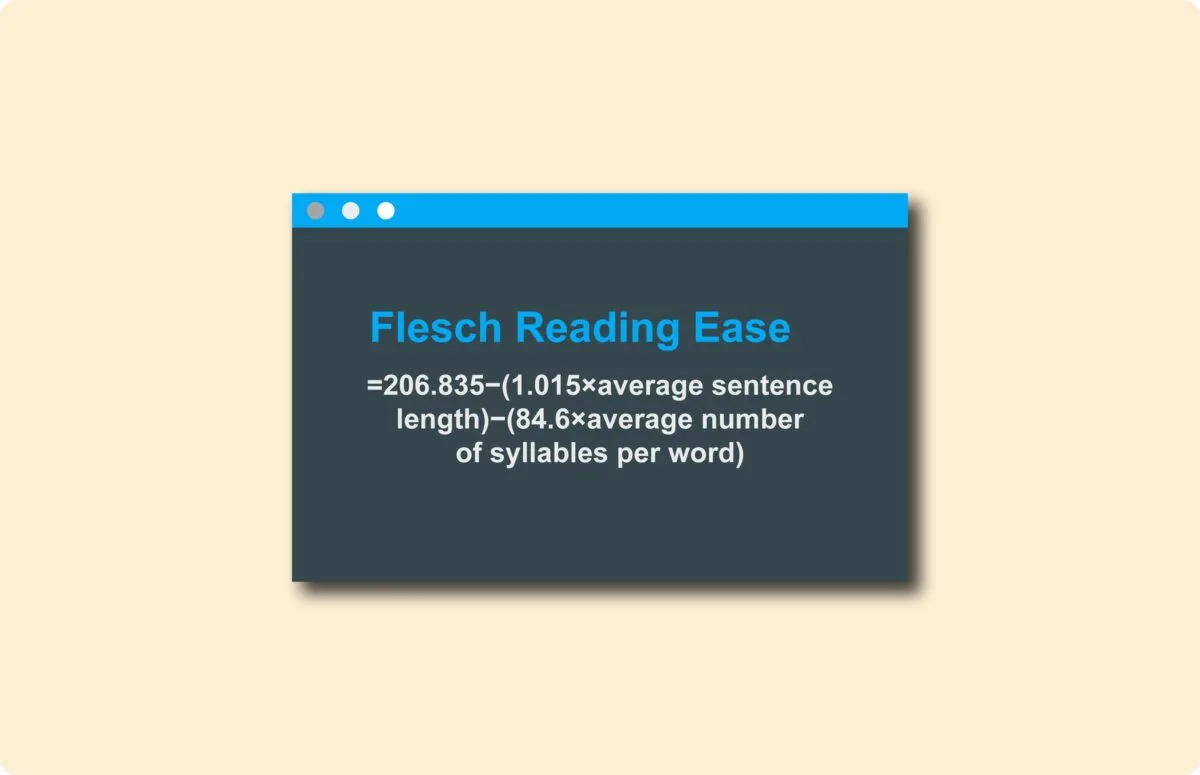
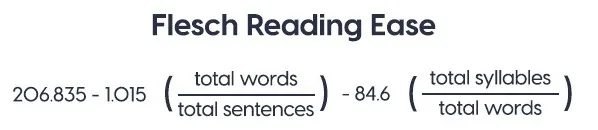
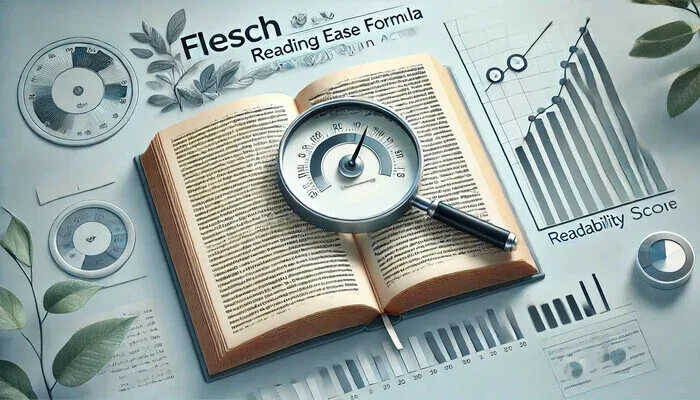
The classic formula is deceptively simple. Refining each detail of your flesch reading ease strengthens this section. You take 206.835, subtract 1.015 times the average number of words per sentence, then subtract another 84.6 times the average number of syllables per word.
That’s it. No magical linguistics, no mysterious AI. Just sentence length and syllable count, combined into one number that correlates remarkably well with how hard a text feels to a human reader.
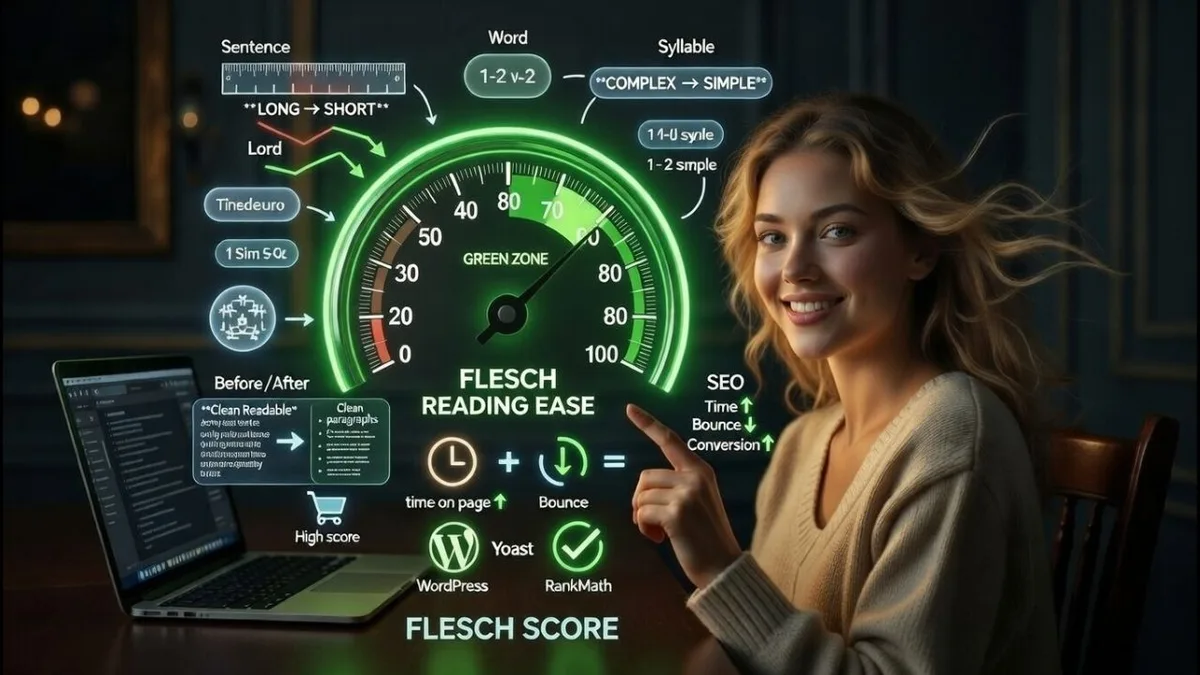
You don’t need to compute it by hand anymore. Word processors, Google Docs add-ons, Yoast, and standalone readability checkers all run this calculation for you. What matters is understanding the two levers, because you can only pull two levers.
Why Sentence Length Dominates the Score
Sentence length carries the biggest emotional weight. A 40-word sentence practically guarantees a low score no matter how simple your vocabulary is. That’s because readers have to hold several clauses in working memory simultaneously, and working memory is finite.
Syllables matter too, but the multiplier is smaller. Effective execution in your flesch reading ease makes a tangible difference. This is worth knowing because it reframes editing decisions. Chopping a single bloated sentence often beats replacing five advanced words with simpler synonyms. Editing time should go toward structural clarity first.
Flesch Reading Ease Score Chart: What Each Number Actually Means
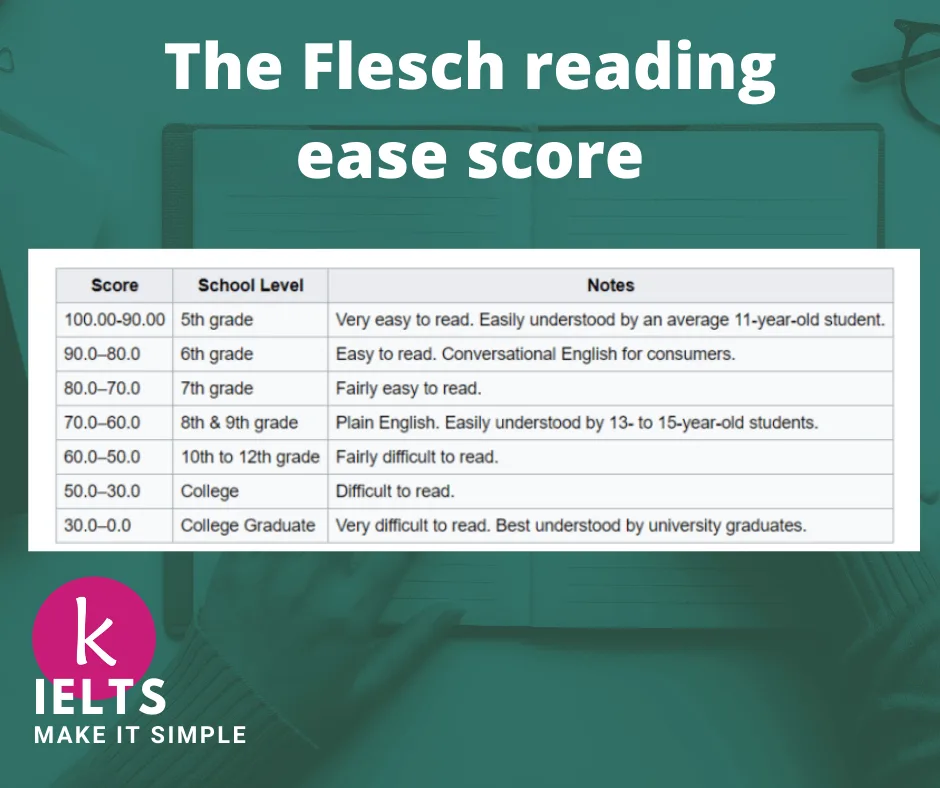
A score means nothing without context. This chart translates the standard bands into real-world reading scenarios so you can interpret your output without guessing.
| Score Band | Reading Level | Typical Reader | Best Fit For |
|---|---|---|---|
| 90–100 | Very easy | Grade 5 | Children’s books, consumer packaging |
| 80–90 | Easy | Grade 6 | Blogs, social media, mass-market content |
| 70–80 | Fairly easy | Grade 7 | General web articles, newsletters |
| 60–70 | Standard | Grade 8–9 | Standard business writing, mainstream journalism |
| 50–60 | Fairly difficult | Grade 10–12 | Long-form journalism, educated professional audiences |
| 30–50 | Difficult | College level | Academic papers, legal and medical documents |
| 0–30 | Very difficult | College graduate | Specialist literature, technical standards |
Here’s the part most articles skip: a lower score isn’t inherently bad. If you’re writing for fellow attorneys or radiologists, a score in the 40s is entirely appropriate. If you’re writing for the general public and scoring below 50, you’re probably losing readers before the second paragraph.
The real mistake is scoring in the wrong band for your audience, not scoring low in general. A recipe at 35 is a bug. A doctoral dissertation at 35 is just Tuesday.
How the Flesch–Kincaid Grade Level Relates to All This
You’ll often see flesch reading ease scores paired with the Flesch–Kincaid Grade Level. They’re related but not identical. The grade-level version aims to tell you which U.S. School year a reader would need to comprehend the text.
The flesch reading ease’s a handy second data point. If your score says “fairly easy” but the grade level says “college sophomore,” something’s off—usually a handful of monster sentences dragging the average up despite otherwise simple vocabulary.
Both metrics run on the same underlying data. They just present it differently. Most modern tools throw in a few extras too: average sentence length, passive voice percentage, and the percentage of long words. Those extras are usually more instructive than the headline number itself.
Use the headline number as a temperature reading. Use the sub-metrics to find exactly which paragraphs are causing the fever.

The Business Case: Why Flesch Reading Ease Matters for Real Results
Readability isn’t aesthetic preference; it’s a lever on every downstream metric you care about. Bounce rate, time on page, scroll depth, conversion rate—all of it starts with whether someone actually reads the thing.
Comprehension studies consistently find the flesch reading ease plain language increases understanding and reduces the number of times a user re-reads a section. Fewer re-reads mean faster journeys through your funnel. Faster journeys mean better conversion odds.
Plain Language Saves Money and Trust
Organizations that have invested in plain-language rewrites—anything from insurance forms to product manuals—report fewer customer support calls and higher satisfaction. That’s not a coincidence. Confusing writing generates questions. Clear writing prevents them.
The same logic applies to web copy. If your pricing page uses three sentences where one would do, you don’t sound authoritative. You sound evasive. Users pick up on that instantaneously, even if they can’t articulate why.
The SEO Return on Readability
Search engines weigh user engagement signals. If your page has a high flesch reading ease score and people spend 4 minutes reading it, Google notes the engagement. If it’s dense and people bounce in 9 seconds, that says something too.
Don’t overstate this. Readability isn’t a direct ranking factor in any documented sense. It’s a downstream driver of the behavior that does influence rankings. Same outcome, different mechanism.
Seven Best Practices That Actually Move the Number
Here’s where the guidance gets operational. These are the seven flesch reading ease best practices I use on every editing pass, ordered from most impactful to least. Each one can be applied immediately.
1. Break Sentences at Natural Pauses
The single most effective habit is splitting long sentences. Structuring your flesch reading ease around proven patterns ensures impact. Most writers let one sentence carry two or three ideas, joined by “and” or a comma splice. Split them. Give each idea a sentence of its own.
Not every sentence needs to be short, obviously. A four-word sentence right after a long one lands beautifully. That’s rhythm—and rhythm is what keeps people reading even when the topic is dry.
Try this test. Find your longest sentence. Read it aloud without pausing for breath. If you can’t, cut it. Readers hear your prose in their head; if it doesn’t flow verbally, it won’t flow visually either.
2. Prefer Short Words Where They’re Just as Clear
The syllable side of the formula rewards simpler vocabulary. That doesn’t mean dumbing things down. It means choosing “use” instead of “utilize” and “help” instead of “facilitate” when the meaning is identical.
Lengthy words do have a place. Applying these principles to your flesch reading ease yields measurable results. Technical terms need to stay technical, especially when the audience expects them. But words that exist only to impress are just syllable bloat, and the score will show it.
A useful habit: whenever you catch yourself writing a phrase like “in order to,” swap it for “to.” You’ll save a sentence its dignity and shave a point off the length reading simultaneously.
3. Strip Nominalizations
Nominalizations turn verbs into nouns—”make a decision” instead of “decide,” “provide a recommendation” instead of “recommend.” They inflate syllable counts, weaken verbs, and stretch sentences.
Once you start noticing them, they’re everywhere. Corporate writing is absolutely riddled with them. People don’t “start” things, they “commence the initiation of processes.” That kind of phrasing destroys a readability score faster than long sentences do.
Turn every nominalization back into a verb. Proper attention to your flesch reading ease sets a strong baseline. The score improves, the writing gets punchier, and readers immediately find the sentence easier to process.
4. Move Complex Detail Into Sub-Clauses or Bullets
Some information is genuinely complex. You can’t simplify every concept; some ideas require nuance. But you can relocate complexity so it doesn’t bloat the main sentence.
Pull the nuance into a bullet list, a table, an aside, or a separate paragraph. The primary sentence stays lean. The detailed reader still finds what they need without having to parse a 55-word monster on the way.
I use this constantly for product specs and technical comparisons. The prose makes the argument, and the table handles the specifics. That structure almost always boosts overall readability scores without cutting substance.
5. Ration Passive Voice
Passive voice has a decent reputation with people who confuse formality with quality. Developing your flesch reading ease with precision highlights key strengths. It also inflates sentence length and obscures who’s doing what. “The report was reviewed by the committee” takes longer to process than “the committee reviewed the report.”
Some passive constructions are necessary, especially when the actor matters less than the action. But defaulting to passive voice across an entire piece is a readability killer. It makes the writing sound distant and vague.
Scan for “was,” “were,” “been,” and “by.” If a clause reads fine in active voice, convert it. The score climbs and the prose gets more energetic in the same edit.
6. Audit Paragraph Density
Flesch reading ease technically measures sentences and syllables, not paragraphs. But paragraph density affects reading experience so directly it’s worth a practice slot anyway.
Long paragraphs look intimidating on a phone. Readers see a wall of text and their thumb keeps scrolling. Short paragraphs—two to four sentences—invite engagement and signal that the content is manageable.
Notice how the flesch reading ease article uses short paragraphs? That’s not a stylistic accident. It’s a pattern that raises the odds you actually keep reading. Structural respect for the reader compounds the score improvement.

7. Re-Score Every Rewrite, Not Just the Draft
The final habit is the least glamorous and the most overlooked. Score your draft. Rewrite. Then score it again. Don’t assume your edits helped; verify they did.
Here’s a mini-rework to show the difference. Original: “In order to effectively facilitate improvement in the comprehensibility of written communication materials, it is necessary for content producers to undertake a comprehensive simplification initiative.” That’s 12+ syllables per word territory.
Rewritten: “To make writing clearer, editors should simplify it.” The score jumps by 30 points. The meaning is identical. The rewrite took 20 seconds. This is what editing for readability actually looks like in practice.
Build Your Flesch Reading Ease Checklist
Consistency comes from checklists, not memory. A working flesch reading ease checklist turns good intentions into a repeatable process. Here’s what I’d tape to the side of the monitor if I still edited on a desktop.
- Score every draft before editing, so you have a baseline.
- Flag every sentence above 25 words and split the worst offenders.
- Swap “utilize,” “facilitate,” “commence,” and “implement” for plain verbs.
- Convert nominalizations back to their underlying verbs.
- Halve your use of passive voice (or better).
- Break any paragraph above five sentences into two.
- Re-score after the rewrite and compare against the baseline.
None of the flesch reading ease steps are exotic. What makes them work is running through them every time, especially on pieces that felt easy to write. Writing that felt effortless to produce often reads as labored to consume—the harder it was to write, the more likely it needs checking.
Treat the checklist as a floor, not a ceiling. You’ll still be making judgment calls. But the floor prevents the truly confusing drafts from getting out the door.
Picking the Right Flesch Reading Ease Target by Content Type
One number doesn’t fit every context. A children’s book at 65 is inappropriate; a legal brief at 65 is suspicious. Match the score to the reader, not to some universal ideal.
| Content Type | Reasonable Score Range |
|---|---|
| Children’s content | 85–100 |
| Consumer marketing copy | 65–80 |
| Standard blog posts | 55–75 |
| In-depth technical guides | 45–65 |
| Academic publications | 30–50 |
| Legal and regulatory text | 25–45 |
Notice the overlap. Content types bleed into each other, and there’s no penalty for scoring slightly higher than “expected.” If your technical guide lands at 68 but still answers the reader’s question accurately, ship it.
The danger lives at the low end. Targeted refinements to your flesch reading ease streamline the entire review. If you’re writing consumer content and scoring 38, that’s likely a rewrite problem, not a subject-matter problem. You can explain difficult concepts accessibly; you just haven’t done the work yet.
Common Flesch Reading Ease Tips and Pitfalls
Even well-intentioned writers get tripped up by a few recurring mistakes. These flesch reading ease tips are small adjustments, but they prevent readability work from becoming counterproductive.
Don’t Optimize for the Score Alone
Chasing a number in isolation produces two failure modes. First, over-simplification—writing artificially short sentences that feel robotic. Second, losing nuance—cutting qualifiers that were doing real work.
Readability scores are a tool, not a target. If you hit your target range but the writing is stilted, the score is lying to you about reader experience. Trust the reading experience over the number when they conflict.
Don’t Ignore the Sub-Metrics
The headline score compresses too much information. If you’re scoring poorly, look at the sub-metrics before you rewrite. Sometimes the problem is one specific paragraph with eleven long sentences. Rewriting that paragraph is faster and more effective than rewriting the whole article.
I’ve seen writers spend an hour universal-simplifying when forty seconds on the worst paragraph would have solved the problem. Sub-metrics point you at the culprit.
Don’t Confuse Readability With Content Quality
A high score doesn’t mean the content is useful. It means it’s easy to process. That’s necessary for useful content but not sufficient. Plenty of beautiful, readable, worthless articles score beautifully and help nobody.
Readability is the entry fee. Substance is the reason people stay. Optimize for both, but never let one crowd out the other.
Readability in the Age of AI-Written Drafts
The volume of AI-assisted writing has changed the calculus. A lot of machine-generated content scores extremely high on flesch reading ease—sometimes suspiciously high—while also being weirdly repetitive. The score rewards straightforward sentences, and AI generates plenty of those.
But straightforward and useful aren’t the same thing. AI content often hits 70+ on the score while failing to answer the actual question. Simplicity isn’t a guarantee of insight; it’s a condition that makes insight easier to absorb.
The practical takeaway for anyone using AI drafting tools: score the output, but also read it critically. Watch for sentences that are short but vacuous. Short sentences can be a cover for having nothing to say.
My rule of thumb: if the piece scores in a healthy range and every paragraph adds a new idea, it’s ready. If it scores well but repeats itself in different words, the score is meaningless. Fix the substance first.
Bringing the Full Flesch Reading Ease Guide Together
Step back and the picture is clear. You now know what the formula measures, what each score band implies, and how to interpret it in context. You know the seven best practices that actually shift the number: shorter sentences, simpler vocabulary, fewer nominalizations, relocating complexity, active voice, shorter paragraphs, and re-scoring after edits.
You also have the checklist to run on every piece and the target ranges to aim for. All that’s left is the discipline of using them consistently.
That discipline compounds. After a few dozen edits, you start writing closer to the target on the first draft. Your editing time drops, your score climbs, and your readers—bless them—stop bouncing halfway through.
The flesch reading ease checklist you build stays useful long after any individual article. Readability is a habit, not a hack. The writers who internalize it look lazy by comparison, because their sentences are short and their words are plain. The reader never notices. That’s the point.
Frequently Asked Questions About Flesch Reading Ease
Here is an in-depth breakdown of key considerations regarding this section:
What is a Good Flesch Reading Ease Score?
For most general web content, aim for 60 to 70. If you’re writing for a broad consumer audience, push toward 70–80. If you’re writing for specialists who expect technical terminology, 45–60 is perfectly acceptable.
Is a Higher Score Always Better?
No. A score of 100 usually means sentences are so short they’re choppy, or that nuance has been stripped out. Great writing varies rhythm and sentence length. Push the score up when needed, but not to the extreme.
How Do I Improve My Flesch Reading Ease Score Quickly?
Split your longest sentences. That single change moves the score more than any other edit. In one pass, cut anything over 25 words. Then swap nominalizations for plain verbs. You’ll see a measurable jump in a single editing session.
Does the Score Work for Languages Other Than English?
Not directly. The formula was designed for English and relies on syllable counts. Other languages, especially agglutinative ones, produce wildly unreliable numbers when you run everything through this formula. Use a native-language readability metric instead.
Is Flesch Reading Ease a Google Ranking Factor?
Not directly. Google’s algorithms don’t read the number. But readability influences user engagement, engagement influences rankings, and so the score correlates with higher rankings without being a formal factor.
Should I Apply This to Images and Headings Too?
Absolutely. Headings that run 15+ words read as dense even before the reader hits the paragraph. Keep subheads under 12 words, add alt text that mentions the keyword where it fits, and audit captions with the same discipline.
How Do I Apply These Flesch Reading Ease Tips Across a Whole Site?
Create a shared style guide with the sentence-length cap, banned phrases, and target score ranges by page type. Then add a step to the publication checklist. Consistency comes from systems, not from willpower on a Friday afternoon.
For verified reference and background research, consult the authoritative informational resource on this topic.