Domain Authority vs Page Authority: the Short Answer Before the Deep Dive
If you have ever stared at a Moz dashboard wondering why one number matters more than the other, this domain authority vs page authority breakdown will settle that question fast. Here is the short version: Domain Authority (DA) is a site-wide score, while Page Authority (PA) is a single-URL score.
Neither metric is used by Google as a ranking factor. Both are Moz-built predictors designed to estimate how likely a domain or a specific page is to rank on a search engine results page. That distinction matters more than most people realize.
So which one deserves your attention when the domain authority vs page authority are planning a link-building push or deciding whether to publish a new article on a fresh subfolder? The honest answer is that they answer different questions.
Domain Authority vs Page Authority: What Each Score Actually Measures
To make sense of any domain authority vs page authority comparison, you first need to know what sits inside each number. Moz calculates both metrics using a machine learning model that predicts ranking probability, and it runs that model against an index of billions of URLs.
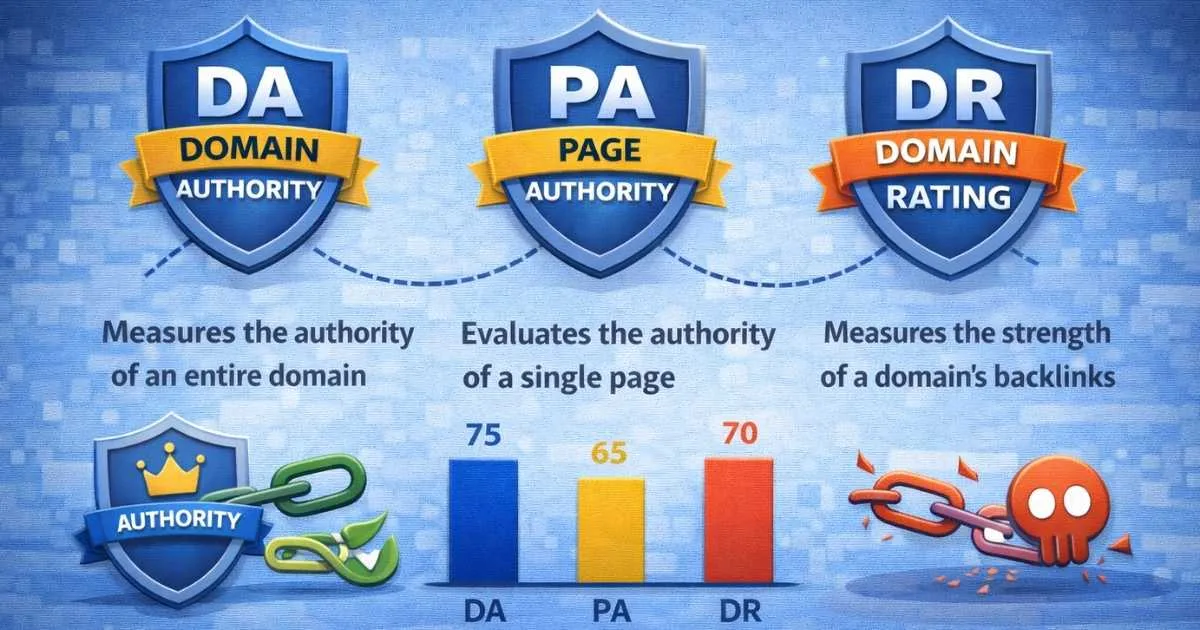
The inputs include link counts, root domains linking in, and a proprietary spam score signal. Focusing on domain authority vs page authority provides clear direction here. The output is a logarithmic score from 1 to 100, where higher means a stronger likelihood of ranking.
Domain Authority Defined in Plain Terms
Domain Authority measures the predictive strength of an entire root domain. Refining each detail of your domain authority vs page authority strengthens this section. When Moz assigns a DA score to example.com, that score reflects every subdomain and every page underneath the root, aggregated into one site-wide figure.
Practically speaking, DA is a reputation score for the whole property. A brand-new blog that publishes one post a week will sit in the teens or low twenties. An established news outlet with decades of inbound links and millions of referring domains will sit in the nineties.
The score is comparative, not absolute. Effective execution in your domain authority vs page authority makes a tangible difference.
A DA of 40 is not “40% good” — it simply means the domain is, according to Moz’s model, a stronger ranking candidate than a domain scoring 39 and a weaker one than a domain scoring 41.

Because DA aggregates across the whole root domain, it can sometimes mask weak individual pages. That is one of the first traps people hit when they compare domain authority vs page authority without understanding how each is scoped.
Page Authority Defined in Plain Terms
Page Authority zooms in on a single URL. It uses a similar modeling approach and a similar 1-to-100 scale, but the inputs are scoped to the links pointing at that specific page rather than the whole root domain.
The domain authority vs page authority makes PA far more granular. A single well-linked blog post can carry a PA of 45 while the root domain sits at 32, which happens routinely when an author lands a mention from a high-authority industry site.
Conversely, a page buried three clicks deep with no internal links may show a PA of 4 or 5 even on a DA 70 domain. The site’s reputation does not automatically flow to every URL.

For SEO audit work, PA is often more actionable than DA because it tells you which pages are carrying weight and which pages are dead weight.
Domain Authority vs Page Authority: a Side-By-Side Comparison Table
Numbers help. The table below captures the practical differences between the two scores, so you can stop memorizing definitions and start using them during a site audit.

| Aspect | Domain Authority (DA) | Page Authority (PA) |
|---|---|---|
| Scope | Entire root domain, including all subdomains | Single URL only |
| Scale | 1 to 100, logarithmic | 1 to 100, logarithmic |
| Primary inputs | Total linking root domains, link volume, spam signal | Links pointing to that specific page |
| Best used for | Domain-level benchmarking against competitors | Prioritizing which pages deserve internal links and promotion |
| Changes over time | Slow, reflects months of accumulated links | Faster, can shift with a single high-value mention |
| Google ranking factor | No | No |
| Typical use case | Prospecting, site-wide audits, link gap analysis | Content refresh prioritization, internal link mapping |
Look closely at the “changes over time” row. That single line explains why a domain authority vs page authority reading can feel contradictory. A homepage might post a DA of 55 while a key service page only reaches PA 22, and both numbers are accurate.
The site earned trust broadly, but the specific page has not earned its own equity yet. A thoughtful approach to domain authority vs page authority reinforces your qualifications. Spotting that gap is where the practical value lives.
Why Neither Score is a Google Ranking Factor
Here is the part that trips up beginners constantly. Google has publicly stated that it does not use third-party metrics like DA or PA in its ranking algorithms. Moz says the same thing about its own metrics — they are predictors, not causes.
The domain authority vs page authority means a DA 80 site can be outranked by a DA 25 site on the right query with the right intent match. It happens on practically every long-tail keyword. Google’s ranking systems look at hundreds of signals, and a third-party prediction score is not among them.
So why bother at all? Because these scores compress complex link data into a single number you can act on. They let you compare 40 competitor domains in an afternoon without manually opening a backlink tool 40 times.
When you are planning a domain authority vs page authority audit, treat both numbers as a compass, not a destination. They point you toward weak spots. They do not tell you exactly where the traffic is.
Thinking about this as a workable domain authority vs page authority guide rather than a gospel text keeps you honest. Metrics exist to serve the strategy, and any strategist who plans exclusively around DA is planning around a proxy.
Domain Authority vs Page Authority: Best Pick for Your SEO Workflow
Now the question the domain authority vs page authority anchors the title: which one wins? The answer depends entirely on the task in front of you. Below are five distinct scenarios where one metric clearly outperforms the other as the working tool.
Best Pick #1: Domain-Level Link Prospecting
When you are prospecting for backlinks, DA is the winner. You want a quick filter that tells you whether a website is worth pursuing before you invest an hour drafting an outreach email.
Most outreach teams run a hard floor at DA 30 or DA 40. Proper attention to your domain authority vs page authority sets a strong baseline. That threshold is crude, but it filters out link farms and spam networks fast enough to be operationally useful. And rushing outreach toward a low-DA domain is often a wasted effort.
That said, a high DA does not guarantee a good link. A DA 60 domain with no topical relevance to your niche will pass less value than a DA 25 domain with a laser-focused audience. Use DA as a first pass, then apply a relevance filter before you hit send.
Best Pick #2: Deciding Which Pages to Refresh
Here the winner flips to Page Authority. Developing your domain authority vs page authority with precision highlights key strengths. If you are staring at a 200-page blog and deciding which ten articles deserve a rewrite, PA gives you the signal DA never could.

Sort your URLs by PA and look for the surprise cases: a page with a PA of 30 attached to a DA 40 domain is a page that has earned disproportionate link equity, which means it has organic potential. A rewrite there often pays off within weeks.
The reverse case is also instructive. Clear alignment with your domain authority vs page authority builds confidence from the start. A PA of 6 on a DA 65 domain means the page has never attracted a single meaningful link. If that page targets a commercial keyword, it is a prime candidate for internal linking, content expansion, and outreach.
Anyone running a serious domain authority vs page authority checklist should log PA by URL monthly. The trend line alone tells you whether internal linking work is actually moving equity around.
Best Pick #3: Competitor Benchmarking
DA takes the win here. When you compare your site against three competitors, you want one number per domain, not one number per page.
Run the comparison monthly and track movement. Integrating domain authority vs page authority into your workflow produces consistent quality. If a competitor’s DA jumps from 38 to 46 in a quarter, they have almost certainly landed a significant link-building campaign or been cited by a major publication. That is worth investigating.
Watch for a pattern where a competitor gains one or two points consistently every refresh. Small, steady DA growth usually indicates an earned media strategy working quietly, not a sudden spam campaign.
Best Pick #4: Launching a New Section on an Existing Site
This scenario is where the domain authority vs page authority distinction becomes genuinely strategic. When you launch a new subfolder or subdomain, PA is the metric you should watch because it will move dramatically while DA barely budges.
A brand-new page on a DA 60 site starts life at PA 1. Targeted refinements to your domain authority vs page authority streamline the entire review. Within a week or two of internal linking from high-PA pages, it can climb to PA 15 or 20. That movement confirms equity is flowing toward the new URL.
If after a month the new page is still sitting at PA 2 while you have linked to it from ten internal pages, something is broken. Check crawl access, canonical tags, and nofollow attributes on the linking pages.
Best Pick #5: Selling SEO Services to a Client
Both metrics are needed, but DA usually opens the conversation and PA closes the domain authority vs page authority. Clients understand “your domain scores 24 and your main competitor scores 51” instantly. That framing is concrete and comparative, and it gets the meeting started.
Then you show PA by page and explain why the homepage scores 24 while the pricing page scores 5. That second chart is what justifies the internal linking work in the proposal and makes the roadmap feel specific rather than generic.
Or the best pick may simply be: present DA first, PA second, and let the client see the domain authority vs page authority the problem is not the domain overall but one specific set of pages that never got attention. That conversation earns trust faster than either metric alone.
Five Key Facts About Domain Authority vs Page Authority
The title promises five key facts, and these are the ones that change behavior once you know them. Each one is a pattern I have seen repeatedly when auditing sites that are confused about which metric to lean on.
Key Fact #1: the Scale is Logarithmic, Not Linear
Moving from DA 20 to DA 30 is dramatically easier than moving from DA 70 to DA 80. The scaling is logarithmic because the underlying model reflects the reality that high-authority domains accumulate links that are exponentially harder to replicate.
The domain authority vs page authority means comparisons should be treated as relative, not as a percentage of any target. A 10-point jump near the top of the scale is a major achievement. The same 10-point jump near the bottom is routine.
When someone quotes a domain authority vs page authority benchmark like “get to DA 50,” ask what their starting point is. A site moving 38 to 50 is doing serious work. A site moving 4 to 50 is also doing real work, but of a completely different kind.
Keeping the logarithmic nature in mind stops the domain authority vs page authority from misreading progress. A one-point rise from DA 60 is not slow growth — it is a meaningful shift in a crowded tier.
Key Fact #2: Both Scores are Predictive, Not Causal
Moz trains its models to predict ranking probability based on historical ranking data. The score tells you, roughly, how likely a domain or page is to rank given the link profile it currently has.

The domain authority vs page authority does not tell you anything about content quality, intent match, search satisfaction, or topical authority in a specific vertical. A DA 75 site can lose a query to a DA 30 site when the smaller site answers the searcher’s question more precisely.
This is not a flaw in the metric. It is a boundary condition that most people ignore. Use DA and PA to understand link equity, and use search intel tools, content audits, and SERP analysis to understand everything else.
Anyone who treats domain authority vs page authority predictions as ranking guarantees will over-invest in link acquisition and under-invest in content quality. That tradeoff rarely ends well.
Key Fact #3: PA Can Exceed DA in Rare and Revealing Cases
The domain authority vs page authority is unusual, but it happens. A single page can show a PA of 52 on a domain showing DA 47 when a major publication links directly to the page and not to the root domain.
When you spot this pattern in an audit, dig in. It usually means one high-value asset is carrying the whole site’s link signal. That asset deserves internal links pointing back to it so some equity flows toward commercial pages.
The domain authority vs page authority also flags a fragility risk. If that one high-PA page is ever removed or deindexed, the domain’s overall signal drops with it. Build link diversity instead of relying on a single hero page.
Key Fact #4: DA Updates Slowly, PA Updates Slowly Too
Neither metric recalculates on a daily cadence. Moz refreshes its index roughly every 24 to 48 hours for some data points but the domain-level scores update on a slower, monthly rhythm. PA similarly moves on a delayed cycle.
New link wins the domain authority vs page authority show up in a backlink tool today may not push the score for weeks. That lag matters when you are reporting results to a client or justifying continued effort on a campaign that seems flat.
I have seen teams abandon solid campaigns three weeks in because the domain authority vs page authority numbers had not budged yet. The links were live and valuable, but the forecast score simply had not caught up.
Set expectations early. Explain the refresh cadence before the campaign starts so nobody panics at the three-week mark. Or the moment can be handled by simply showing the raw backlink count climbing, which is a much faster signal.
Key Fact #5: Both Metrics are Relative to the Moz Index Only
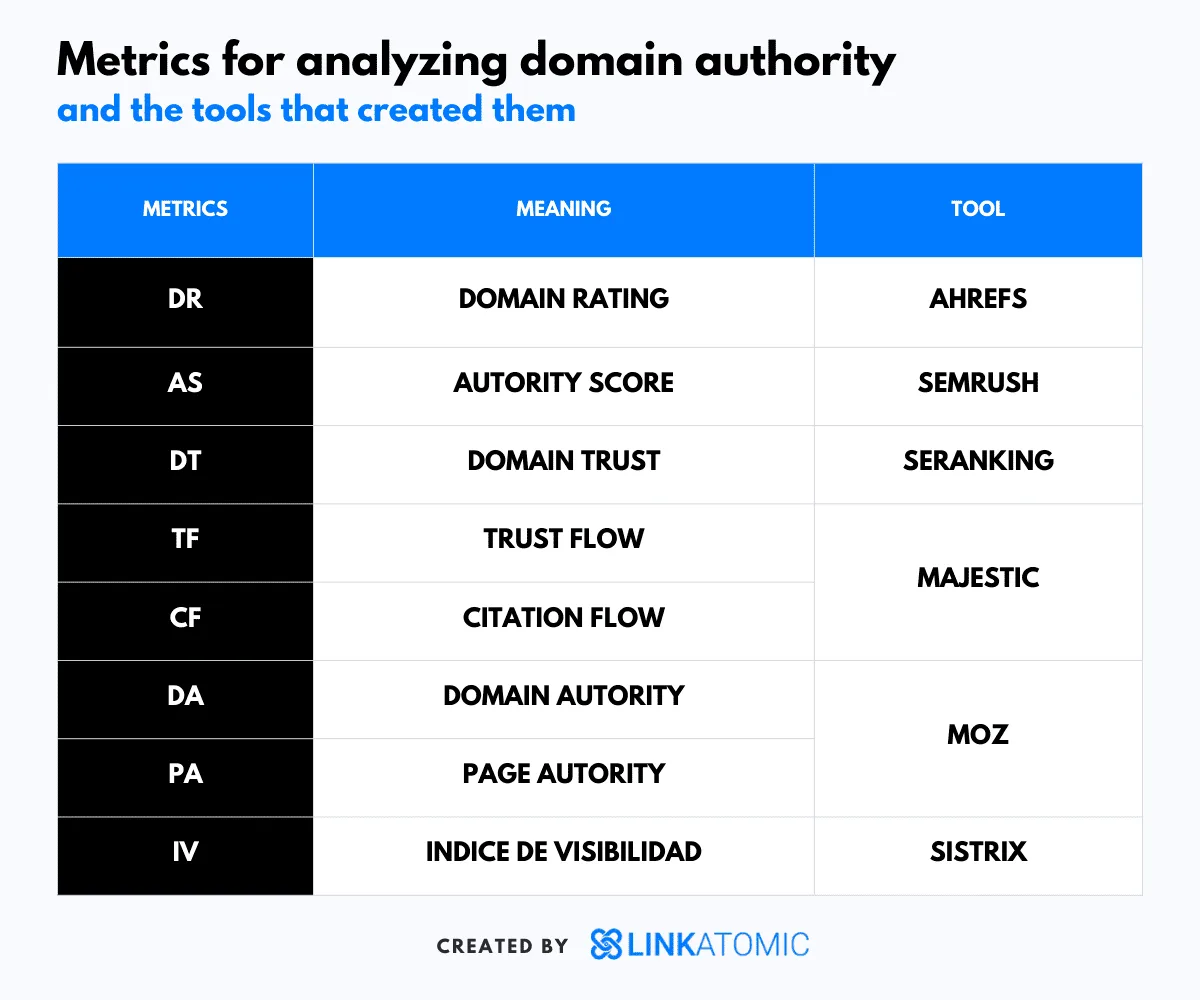
DA and PA are calculated against Moz’s specific link index. They are not universal truth. Ahrefs uses Domain Rating, Semrush uses Authority Score, and Majestic uses Trust Flow and Citation Flow. All measure similar things but produce different numbers.
A domain that shows DA 45 may show DR 52 on Ahrefs and AS 38 on Semrush. None of those is wrong. They have different crawl coverage, different link freshness windows, and different models.
The practical implication is simple: never mix scores from different tools in the same report or comparison table. Pick one system, apply it consistently, and disclose which one you used.
The domain authority vs page authority tip that saves the most client confusion is: name the source. “DA 45 per Moz” is a claim. “Authority score 49” alone is an ambiguous one.
Where Should You Start With Domain Authority vs Page Authority?
If you are starting fresh and need one actionable path, work from DA toward PA. That sequence makes sense because DA is slower, harder to move, and requires sustained link building over months.
Begin by benchmarking your domain against five competitors. Then, inside your own site, open a spreadsheet and list your top 30 URLs by organic traffic. Pull PA for each one, sort high to low, and look for the mismatch cases I described earlier.
From there, here is a real sequence that has worked:
- Audit your top pages by PA. Confirm your highest-traffic pages are also the ones with the highest PA. If a high-traffic page has low PA, throttle back on promotional effort for it and instead link from your highest-PA pages back to it.
- Run a domain authority vs page authority gap analysis against two competitors. Export their top 20 URLs by PA and compare to yours. Pages where they score 30+ and you score under 10 are content gap opportunities.
- Set a realistic growth target for DA. For a site in the 20s, target 5-8 points over a full quarter. For a site in the 50s, target 2-4 points. For a site in the 70s, target 1-2 points. The logarithmic scale punishes ambitious goals near the top.
- Build internal links before external. Internal links are free, instantaneous, and directly move PA. Most sites under-invest here. A well-planned internal linking sprint can move low-PA pages faster than three months of outreach.
- Track monthly and stop checking daily. Checking scores daily is psychological, not strategic, and it leads to panic decisions when the refresh cadence does not match your expectations.
Working through that sequence once is often more instructive than reading a dozen domain authority vs page authority blog posts, because the data belongs to your specific site.
The Practical Side: Best Practices for Using These Scores Correctly
There are a handful of habits that separate teams that use DA and PA well from teams that waste time chasing them. Below are the domain authority vs page authority best practices worth adopting.
Practice #1: Always Pair a Metric With a Relevance Check
A domain’s topical fit matters more than its DA in most cases. A DA 70 lifestyle blog linking to your legal services site is worth less than a DA 25 niche legal directory.
Before adding any domain to a prospecting list, ask a simple question: does the domain authority vs page authority site plausibly write about my topic in front of an audience that cares? If the answer is no, no DA score is high enough to justify the outreach.
Practice #2: Use Internal Linking to Fix PA Gaps
Internal linking is the most underused lever in the whole domain authority vs page authority toolkit. It is free, immediate, and entirely within your control.
The tactic is straightforward. Find your three highest-PA pages. Add contextual links from those three pages to the pages you want to elevate. Recheck PA monthly. You will typically see the linked pages climb 2-6 points within one refresh cycle.
Do not stuff links. Use descriptive anchor text, place them in the body copy, and keep them relevant to the linking page’s content. A link buried in a footer navigational list carries almost no equity transfer.
Practice #3: Never Use DA as the Only Filter for Guest Post Outreach
Paid or guest link placement on DA 60 sites with no editorial standards will not move your DA meaningfully and may even hurt you. Google’s spam detection covers link schemes well enough that a recycled blog network is not a shortcut.
Filter on relevance, editorial standards, traffic quality, and link diversity. Then use DA as a filtering tiebreaker when you have three otherwise equal opportunities. That order of operations keeps the campaign clean.
Practice #4: Audit Your Own Domain Quarterly for That Specific Comparison
Set up a simple quarterly audit. Export five top competitor domains. Log their DA. Log your DA. Do the same for the top 20 URLs on each site by PA.
The output is a one-page comparison the domain authority vs page authority highlights where you lag. Save each quarter’s version. The comparison of comparisons over time is where real insight comes from — you see not just where you are behind but where the gap is closing or widening.
Practice #5: Report Both Numbers With Their Source Attached
Numbers in a client report should always say which tool produced them. “DA 47, per Moz, refreshed this cycle” is honest. “Authority score 47” alone invites confusion.
Disclosing the tool also protects the domain authority vs page authority when a client compares your report to one they pulled from a different platform and finds a number that does not match. Proactive disclosure avoids the awkward conversation entirely.
Common Mistakes With Domain Authority vs Page Authority
A handful of errors show up in nearly every audit I have seen. Here is what to avoid.
Mistake #1: Treating a High DA as a Guarantee of Ranking
A high DA domain does not automatically rank. A new article on a DA 80 site still needs on-page optimization, intent match, and internal links before it will rank for anything competitive. The site’s reputation opens the door; the page has to walk through it.
I have watched a DA 75 news site publish a post that never ranked beyond position 40 for a moderately competitive keyword. The domain was strong. The page was not optimized. The gap cost them a month of impressions.
Mistake #2: Ignoring PA Entirely
Teams the domain authority vs page authority only track DA miss the actionable layer. You cannot fix a low DA in a week, but you can fix a low PA on a specific page by adding three internal links this afternoon. Skipping PA leaves free wins on the table.
Mistake #3: Mixing Metrics from Different Tools
Never put a Moz DA and an Ahrefs DR in the same table without labeling them. The scales are different enough that comparisons are misleading. A 60 on Moz is not the same as a 60 on Ahrefs.
Mistake #4: Expecting Immediate Score Movement
New backlinks take weeks to appear in the model’s next refresh. If you built 20 links this month and DA did not move, the metric has not caught up yet, or the links are low-value.
Check the raw backlink count in your preferred tool as a fast proxy while you wait for the score refresh.
Mistake #5: Chasing Domain Authority at the Expense of Content Quality
The most common version of the domain authority vs page authority mistake is putting every hour into link acquisition while the content sits untouched. A DA 60 site with thin content will plateau. A DA 35 site with exceptional content will outrank it on long-tail queries and slowly build both metrics through natural signals.
Domain Authority vs Page Authority: Which Should Your Team Track First?
The short answer: track DA monthly and PA monthly, and use the difference in movement speed to guide decisions. DA moves slowly and reflects the site’s overall reputation. PA moves faster and reflects the specific equity of each URL.
If your team has limited time for metrics work, prioritize PA because the domain authority vs page authority is more actionable. If you are talking to a client or executive, prioritize DA because it is more communicable. Different audiences, different tools.
Every serious domain authority vs page authority guide should acknowledge this dual reality. One metric is for decisions, one is for communication. Use both, but use them deliberately rather than interchangeably.
Frequently Asked Questions
Here is an in-depth breakdown of key considerations regarding Frequently Asked Questions:
Is Domain Authority More Important Than Page Authority for Ranking?
Neither directly causes ranking because Google does not use either metric. In practice, DA predicts domain-level ranking likelihood and PA predicts page-level ranking likelihood. A strong DA on a weak page will not rank; a strong PA on a niche page may outperform a stronger domain on a broad page.
Can a Page’s PA be Higher Than Its Domain’s DA?
Yes, though it is uncommon. It happens when a single URL has attracted high-value links that have not flowed to the wider domain. When you spot this, investigate that URL — it is usually carrying disproportionate weight and deserves extra internal linking from commercial pages.
How Often Do DA and PA Scores Update?
Scores refresh on a monthly cycle, not daily. New backlinks you build today may not show up in the score for several weeks. Check the raw backlink count in your audit tool weekly to confirm your work is landing, and rely on the score refresh as a slower confirmation signal.
Does Internal Linking Move Page Authority?
Yes, and the domain authority vs page authority is one of the fastest levers available. Internal links from high-PA pages pass equity to the target URL. In most cases you will see a PA shift within one refresh cycle after an internal linking sprint, especially on pages that previously had almost no inbound internal links.
What is a Good DA Score to Target?
There is no universal target because it depends on your niche and competitors. A DA of 30 in a narrow industry may be sufficient to rank, while a DA of 60 in a crowded vertical may not be. Benchmark against your three closest competitors and aim to close the gap by a few points per quarter.
Should I Use DA or PA for Guest Post Opportunity Research?
Use DA as the first-pass filter because the domain authority vs page authority is faster to scan. Then check PA on the pages that already rank for the topic you are targeting. That combination gives you a fast filter followed by a relevance-driven confirmation step.
Do Tools Like Ahrefs and Moz Agree on These Scores?
No, and they are not supposed to. Each tool uses a different index, different crawl depth, and different modeling. A domain that shows DA 45 on Moz may show DR 52 on Ahrefs. Never mix scores from different tools within the same report.
What Should I Do if Both My DA and PA are Low?
Start with internal linking to fix PA gaps on your highest-traffic pages. Maintaining clarity across your domain authority vs page authority remains essential. Then begin a slow, targeted outreach effort focused on relevance rather than domain score. As those links land, both metrics will climb, with PA moving first and DA following in later refresh cycles.
Is There a Domain Authority vs Page Authority Checklist I Can Follow?
Here is one that works. Export your top 30 URLs by traffic. Pull PA for each. Flag pages where PA is below 10. Add three internal links from your highest-PA pages to those flagged pages.
Benchmark competitor DA monthly. Revisit PA quarterly by URL. Disclose your metric source in every report. That checklist covers 90% of the practical work.
Where This Fits in a Larger SEO Strategy
Authority metrics sit inside a bigger topical framework that includes on-page optimization, technical SEO, content strategy, and topical authority. DA and PA tell you about link equity, but they tell you nothing about whether your content answers the query.
Read them as the link-equity layer of a broader domain authority vs page authority discussion. If you are building a topic cluster strategy, these scores help you decide which pillar pages to link from and which subpages need an equity boost.
Related sub-topics worth exploring once you are comfortable with DA and PA: backlink quality signals, internal linking architecture, topical authority scoring, and search intent mapping. These four areas fill the gaps the metrics cannot.
The domain authority vs page authority tips in this article aim at one goal — better decisions. Track both, use each for the task it is built for, and treat the scores as a compass. They will keep you pointed in the right direction without pretending to be the destination.
The takeaway worth repeating: DA for domain reputation and prospecting, PA for page-level fixes and internal linking. Many experts split between the two depending on context, and there is no clean “best” without context.
If you audit both monthly, run the PA-first internal linking sprint, and never treat either score as a ranking guarantee, you will get more from these numbers than 95% of SEO teams.
For verified reference and background research, consult the authoritative informational resource on this topic.