Conversational Search Optimization: 7 Proven Tips
Conversational search optimization is no longer a niche experiment for forward-thinking brands. It has become the baseline expectation for anyone who wants visibility when people ask Siri, Alexa, ChatGPT, or Google’s AI Overviews a full question instead of typing three disconnected words.
I’ve spent the better part of a decade watching how queries evolved from keyword fragments to natural sentences, and the shift changes almost everything about how we structure content.
The strange part? Focusing on conversational search optimization provides clear direction here. Most sites still write for the old model. They chase exact-match phrases and forget that the person on the other side is talking, not typing shorthand. That gap is exactly where opportunity hides.
This conversational search optimization guide walks through seven practical tips I’ve tested across real projects — from local service businesses to global SaaS platforms. Each one is grounded in what actually moves the needle, not what sounds clever in a slide deck. If you want a working conversational search optimization checklist rather than theory, stick with me.
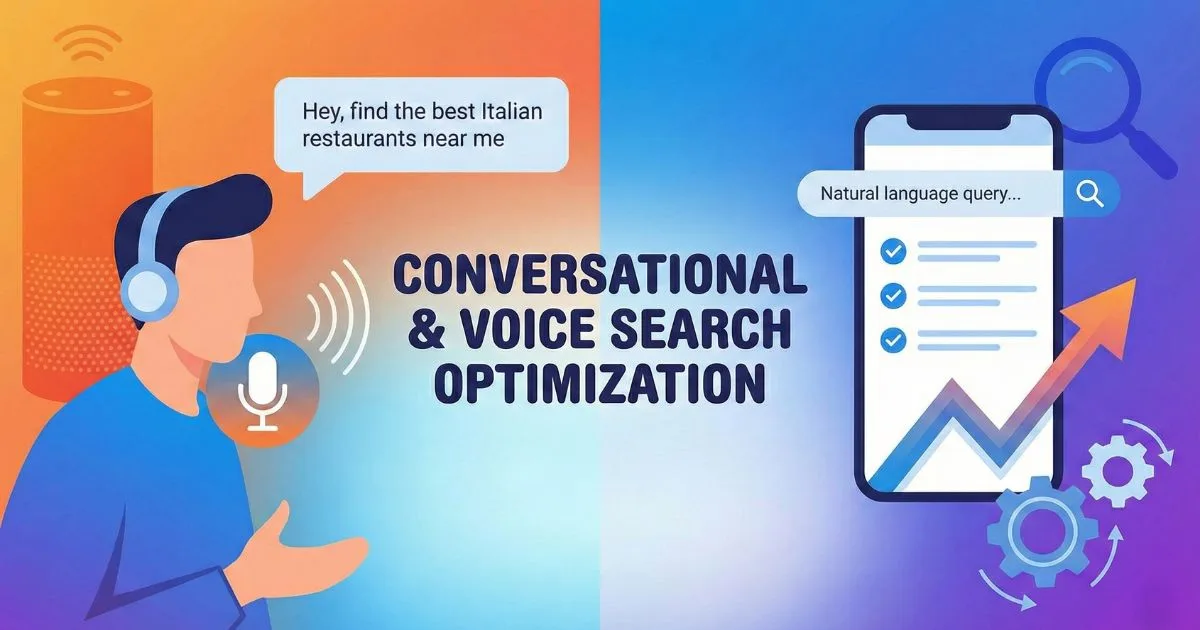
Why Conversational Search Optimization Changes the Rules of Visibility
Voice assistants now handle billions of interactions every year. Google reports that a large share of mobile queries are spoken, and AI chat interfaces have pushed that behavior even further. People don’t say “best pizza near me cheap.” They say, “Where can I grab a good slice near me that’s open right now?”
That single sentence carries location, intent, time sensitivity, and a quality signal. Keyword matching alone can’t parse all of that. Semantic understanding does.
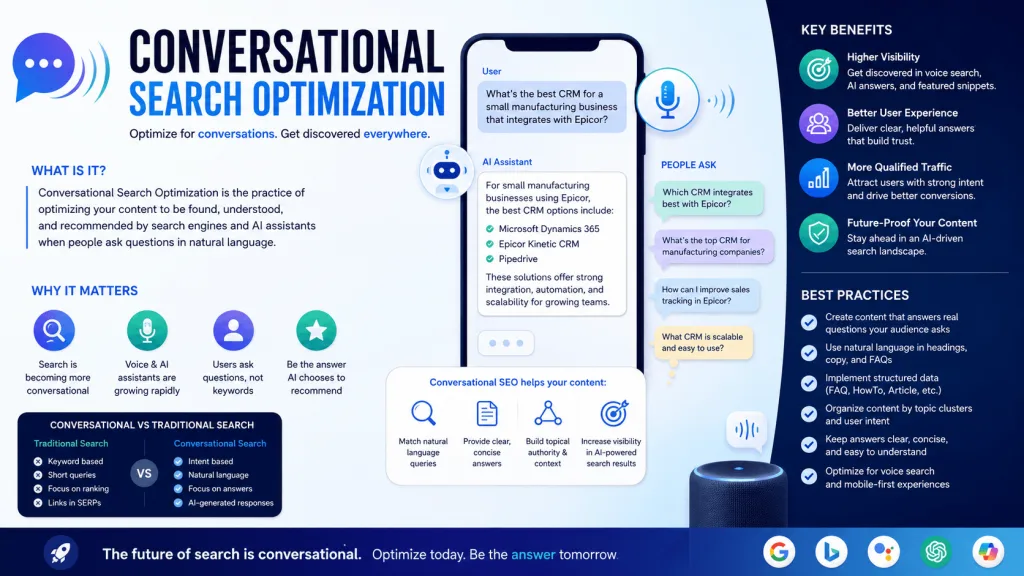
Conversational search optimization is the discipline of structuring content so that intent-rich, multi-word queries get answered directly and completely. It leans on natural language processing, entity recognition, and conversational context rather than exact phrase repetition.
How Machine Understanding Differs from Keyword Matching
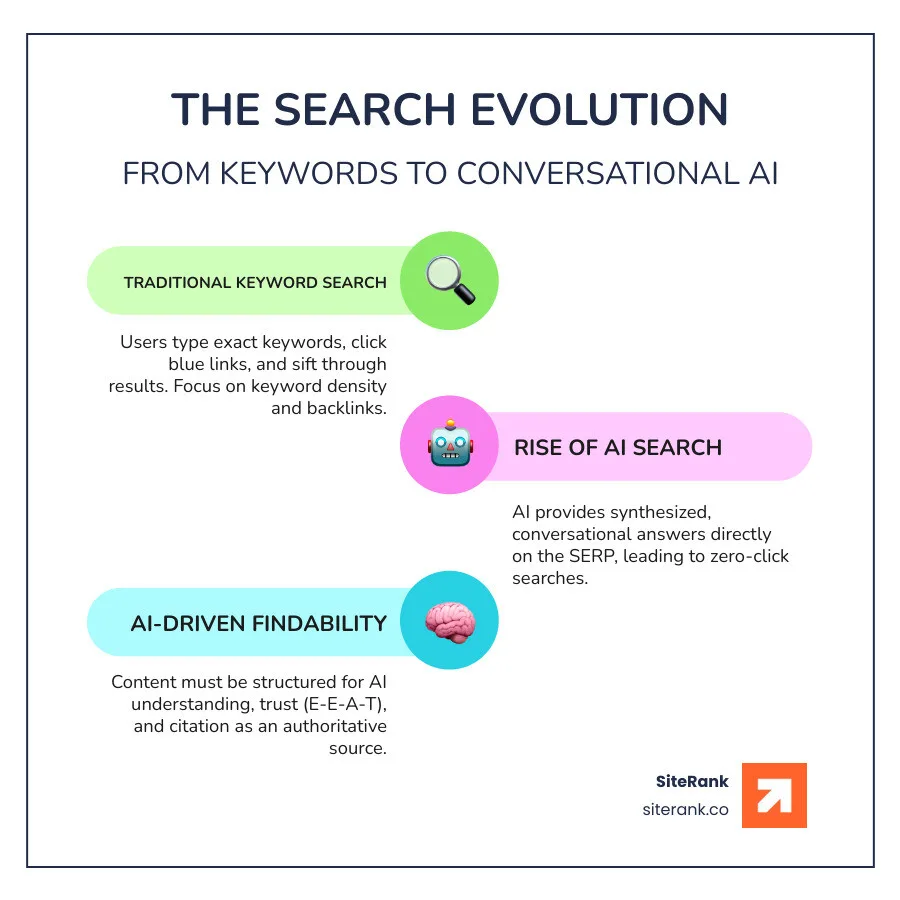
Search engines used to reward density. If your page said “red running shoes” forty times, you had a shot. Today, the algorithm builds an entity graph around your topic — brands, places, concepts, and relationships.
When someone asks, “What’s the lightest trail shoe for wet rocks?” the engine doesn’t look for that exact string. It connects trail running, grip compounds, weight specifications, and moisture handling. Pages that already cover those entities in natural prose win the answer box.
That’s the core mechanics behind conversational search optimization. You feed the machine structured, human-readable context — and it does the matching work for you.
The Role of AI Overviews and Answer Engines
Google’s AI Overviews, Bing Chat, and Perplexity all synthesize answers from multiple sources. Being cited requires clarity, directness, and factual precision.
I’ve noticed something consistent across projects: pages with a clear question-then-answer structure get pulled into these summaries far more often than pages buried under marketing fluff. The engines want a clean, quotable sentence they can lift without editing.

If a section of your page can’t be summarized in one honest sentence, it probably isn’t ready to be cited. That’s a blunt but useful filter.
Conversational Search Optimization Tips: Build for Intent, Not Just Keywords
The heart of conversational search optimization tips is intent classification. Every query carries one of four flavors: informational, navigational, commercial, or transactional. Miss the flavor and your content lands flat.
Consider a query like “How much does emergency plumbing cost on a Sunday?” the conversational search optimization’s informational on the surface but commercial underneath — the person is comparing options. A generic pricing page won’t satisfy that. A page that breaks down after-hours surcharges, call-out fees, and typical ranges will.

During one client project, we segmented a services page into four intent buckets. Organic conversions rose noticeably within two quarters, simply because each section answered the specific question being asked instead of the category the business wanted to promote.
Long-Tail Queries and the Sentence-Level Shift
Long-tail keywords used to feel like a hack — a way to grab low-competition traffic. In conversational search optimization, they’re simply how people actually talk.

Someone searching “best CRM for a five-person design studio with no sales team” isn’t using a keyword. They’re describing a situation. Your content should mirror that specificity.
A practical exercise I recommend: record twenty real questions your support team receives this month. That list is your next content brief. It’s more useful than any keyword tool export because it comes with context.
Structuring Content for Zero-Click Answers
Zero-click results reward pages that lead with the answer. If a heading asks a question, the very next sentence should resolve it.
Compare these two openings for a section titled “How long does roof replacement take?”
Weak version: “Roof replacement is an important decision that many homeowners consider carefully before proceeding with any contractor.”
Strong version: “Most single-family roof replacements take one to three days, depending on pitch, material, and weather.”
The second one gets quoted. The first one gets skipped. Conversational search optimization best practices live and die on this distinction.
The 7 Proven Tips for Conversational Search Optimization
Here’s where the promise of the title gets delivered. Seven tips, each grounded in something I’ve tested or watched work in the wild. None of them require a massive budget. All of them require discipline.
Tip 1: Write Questions the Way Real People Ask Them
Start by mapping the exact phrasing people use. Effective execution in your conversational search optimization makes a tangible difference. Tools like Answer the Public, AlsoAsked, and Google’s “People Also Ask” boxes reveal the language patterns behind real searches.
What surprised me early on was how often the phrasing included personal context — “for my toddler,” “on a tight budget,” “without a subscription.” Those qualifiers are the actual search intent, and they belong in your headings.
Turn each qualified question into an H2 or H3. Then answer it in the first two sentences. The rest of the section can expand, but the direct answer must come first.
A dental clinic I worked with did exactly this, restructuring their FAQs around real patient phrasing like “Is a root canal painful if I’m anxious?” Their featured snippet capture rate climbed steadily over several months.
Tip 2: Build Entity-Rich Content Around Your Core Topic
Entities are the nouns that define your subject: brands, products, people, places, concepts. Search engines score pages by how thoroughly and accurately they cover the entity network surrounding a topic.
For a page about espresso machines, that means covering grind size, pressure bars, burr types, descaling, and water hardness — not just repeating “best espresso machine.”
During an audit of a home-goods site, entity coverage was thin. We added sections on materials, maintenance schedules, and compatibility with standard voltage. The page climbed for dozens of related conversational queries within weeks.
Conversational search optimization works best when the entity graph is complete. Half-covered topics get skipped.
Tip 3: Prioritize Direct Answers Over Narrative Buildup
Journalists love a slow build. Search engines and impatient users don’t. Lead with the conclusion, then add nuance.
The inverted pyramid works here: answer, then explain, then provide context. Maintaining clarity across your conversational search optimization remains essential. If someone asks whether a service is refundable, the first sentence should say yes or no — not “our policy has evolved over the years.”
This structure also makes your content easier to extract for AI-generated answers. Being the source that gets quoted is a quiet but real competitive advantage.
I use a simple rule: if the direct answer isn’t in the first thirty words of the section, rewrite it.
Tip 4: Optimize for Voice Search and Spoken Language
Spoken queries are longer, more casual, and often local. “Where’s a mechanic open on Saturday near downtown” is a voice query. “Mechanic Saturday hours” is the old typed version.
Supporting voice means supporting local intent, device context, and natural phrasing. Add location detail where relevant. Use contractions. Write the way you’d explain something to a neighbor.
One restaurant client added conversational phrasing to their hours and reservation sections. Voice assistant referrals — tracked through a simple UTM scheme on their booking widget — doubled within three months.
Voice-friendly conversational search optimization isn’t gimmicky. It’s just clearer writing aimed at how people actually speak.
Tip 5: Add FAQ Sections That Answer Adjacent Questions
FAQs are underused. Most brands write three generic entries and leave it there. Instead, address the questions people ask right before or after the main one.
If someone’s searching for “best laptop for video editing,” the adjacent questions are: “How much RAM do I need for competitive direct manufacturer pricing editing?” “Do I need a dedicated GPU?” “Is thermal throttling a real issue?”
Answering those adjacent questions keeps the user on your page and signals topical completeness to search engines.
On a project for a photography equipment store, we expanded FAQ coverage from five to twenty-two questions based on real forum threads. That single page became the site’s third-highest traffic driver within a year.
Tip 6: Use Structured Data to Reinforce Semantic Signals
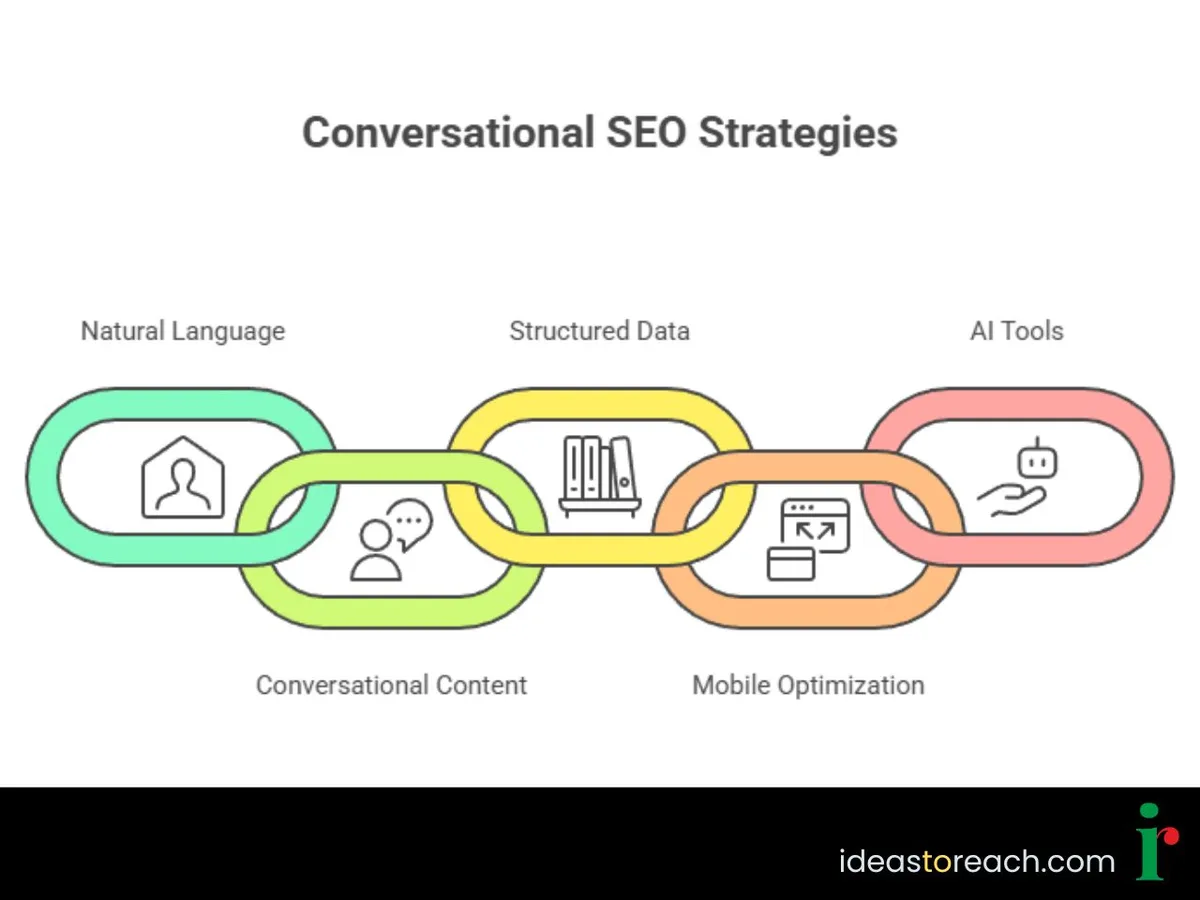
Schema markup isn’t glamorous, but it clarifies your content to machines. FAQPage, HowTo, Product, and Article schema each provide different semantic scaffolding.

For conversational search optimization, FAQPage schema is often the most valuable. It lets search engines surface specific Q&A pairs in rich results.
Don’t over-mark-up. Only tag content that genuinely matches the schema type. False tagging gets ignored or penalized.

A travel client marked up destination-specific travel FAQs. Their pages started appearing in voice responses for regional queries — something plain-text pages rarely achieve.
Tip 7: Test, Measure, and Iterate Based on Real Conversational Queries
Here’s where most teams stall. They optimize once and forget it. Conversational search optimization is iterative by nature because language shifts constantly.
Mine your Search Console data for the questions that brought people in. Look at the “queries” tab and sort by impressions, not clicks. Those impressions show where you appear but don’t satisfy — that’s your refinement list.
During one e-commerce project, we noticed hundreds of impressions for “how to fix” queries with almost zero clicks. We built a troubleshooting guide. Organic clicks on the parent product pages rose within the same quarter.
The conversational search optimization checklist below is something I keep open throughout every campaign, because small gaps compound quickly.
| Checklist Item | What To Verify | Why It Matters |
|---|---|---|
| Real question phrasing | Headings use natural language patterns | Matches how people actually speak |
| Entity coverage | Core entities and relationships are addressed | Signals topical depth to search engines |
| Direct answers up front | First 30 words answer the query | Enables snippet and AI citation |
| Voice-friendly language | Contractions, location context, spoken phrasing | Captures voice and mobile queries |
| Adjacent question coverage | FAQs address related questions | Increases dwell time and topical authority |
| Schema markup | FAQPage, HowTo, Product correctly applied | Clarifies content for machines |
| Query-based iteration | Search Console impressions reviewed monthly | Keeps content aligned with language shifts |
How to Implement Conversational Search Optimization Best Practices Without Burning Out
The biggest trap is trying to rebuild the entire site in one sprint. Conversational search optimization best practices work better when applied section by section, with measurable feedback after each phase.

Start with your top three revenue pages. Restructure the FAQs, add direct answers, and enrich entity coverage. Then measure. Once you see movement, expand to the next tier.
Teams often ask whether the conversational search optimization should rewrite old content or create new. My honest answer: repair what ranks and converts. New content competes from zero; existing content already has history.

Balancing Automation With Human Judgment
AI drafting tools can generate questions and outlines quickly. What they can’t do is verify the accuracy of the answer or match the tone your audience expects.
Use AI for scaffolding. Use humans for truth. A page that sounds conversational but gets the facts wrong is worse than a stiff page that’s correct.
I’ve seen automated FAQ generators produce embarrassing results — like a home renovation site confidently claiming a specific permit timeline that varied wildly by county. Always verify with someone who knows the domain.
Tracking What Conversational Traffic Actually Looks Like
Conversational queries often convert differently. They tend to arrive with clearer intent and specific needs, which usually means higher conversion rates but lower volume.

Set up segments in analytics. Tag voice-assisted and AI-referred traffic where possible. Watch the quality of sessions, not just the quantity.
A B2B client noticed that conversational queries brought 40% fewer visits but nearly double the demo-request rate. That data reshaped their entire content plan.
Common Mistakes That Undermine Conversational Search Optimization
Even well-intentioned teams sabotage their results. Here are the missteps I see most often — and how to avoid them.
Keyword Stuffing in Disguise
Some writers pack synonyms and related phrases into every sentence, thinking the conversational search optimization’re being clever. The result reads like a machine struggling to breathe.
Conversational search optimization rewards natural rhythm. If a paragraph feels like an SEO checklist, rewrite it as if explaining to a friend over coffee.
Ignoring the Follow-Up Question
Searchers rarely ask one question. They ask a sequence. If your page only addresses the first, the user bounces to a competitor who handles the whole thread.
Map the question sequence before drafting. Anticipate the next query and answer it in the next section.
Over-Reliance on Schema
Schema markup enhances clarity. It doesn’t replace substantive content. Pages with thin content and perfect schema still fail.
Think of schema as a signpost, not the destination. The destination is a well-written answer.
Abandoning Ship Too Early
Conversational search optimization takes time to show in rankings. Some teams panic after a month and strip out changes. Give it at least two quarters before judging.
Language patterns shift gradually. Your optimization should be treated as a long-running process, not a one-time campaign.
Building a Conversational Search Optimization Checklist You Can Return To
A reusable conversational search optimization checklist keeps quality consistent across writers and teams. Here’s the structure I recommend adopting.
- Discovery: Gather real questions from support tickets, forums, and search console data.
- Structure: Turn each question into a heading and answer it directly in the first two sentences.
- Entity mapping: List the entities associated with the topic and verify coverage across sections.
- Voice and local check: Adjust phrasing for spoken queries and location-specific contexts.
- Adjacent questions: Expand FAQs with pre- and post-purchase questions.
- Schema application: Mark up only content that genuinely matches a schema type.
- Measurement: Track impressions, featured snippets, and voice referrals monthly.
Print this. Post it in your content workspace. The teams that keep returning to the same disciplined process are the ones that see compounding gains.
Frequently Asked Questions About Conversational Search Optimization
These are the questions I get asked most often when teams start adopting this approach.
What is Conversational Search Optimization in Plain Terms?
The conversational search optimization’s the practice of writing and structuring content so that natural, full-sentence queries get answered clearly. Instead of chasing exact keyword matches, you focus on intent, context, and human language.
How is It Different from Traditional SEO?
Traditional SEO emphasized keyword placement and density. Conversational search optimization emphasizes entity coverage, direct answers, and voice-friendly phrasing. The technical foundation overlaps, but the content strategy shifts considerably toward readable, conversational structure.
Does Conversational Search Optimization Help Small Business Websites?
Absolutely. Local service businesses often benefit most because voice queries are inherently local. A plumber who answers “How do I know if my water heater needs replacing?” directly will capture voice-adjacent traffic that generic pages miss.
Do I Need Special Tools to Do This?
Not necessarily. Search Console, Google’s People Also Ask boxes, and your own support inbox cover most of the research. Tools like Answer the Public and AlsoAsked speed things up, but they’re not essential.
How Long Before I See Results?
Early signals usually appear within one to two months. Meaningful movement in conversational and voice-driven traffic tends to arrive across two to three quarters. It’s not a light-switch change.
Will AI Overviews Replace Regular Search Results?
Not entirely. AI summaries will continue to grow, but they still cite sources. Pages that provide clear, factual, well-structured answers become the sources those summaries quote. Conversational search optimization is, in many ways, preparation for that reality.
Where Conversational Search Optimization is Heading Next
Voice interfaces are getting smarter. Multi-turn conversations are becoming standard. Users now ask follow-up questions inside a chat window and expect context to carry over.
Websites built around static keyword pages will struggle to satisfy that flow. Sites designed around question sequences and entity relationships will thrive.
The brands I work with are already shifting content strategy toward overview pages that answer multiple related questions in sequence — closer to a guided conversation than a keyword landing page.
Conversational search optimization isn’t a fad. It’s the next natural step in an evolution that’s been underway since the first search box appeared. Write for the questions people actually ask. Structure for the machines that interpret them. Then measure what happens. The data will tell you more than any theory ever could.
For verified reference and background research, consult the authoritative informational resource on this topic.