X Twitter SEO is the practice of shaping your posts, profile, and threads so they surface in both X search and Google’s real-time results. Get it right and you own a discovery channel most marketers ignore. Get it wrong and your best insights vanish inside an hour.
I’ve watched posts with 40 likes outrank accounts with 40,000 followers, simply because the writer understood how the platform ranks content. That gap is what this x twitter SEO guide closes.
Below you’ll find 11 tactics you can run this week, plus a practical x twitter SEO checklist you can hand to a junior writer. No fluff, no recycled advice. Just the mechanics that move traffic.
Why X Twitter SEO Matters More Than Most Marketers Think
Google indexes X posts. Focusing on x twitter SEO provides clear direction here. That single fact rewires how you should think about the platform. Posts can appear in standard search results, in the “Discussions and forums” block, and inside Google’s Top Stories carousel when the query is news-sensitive.
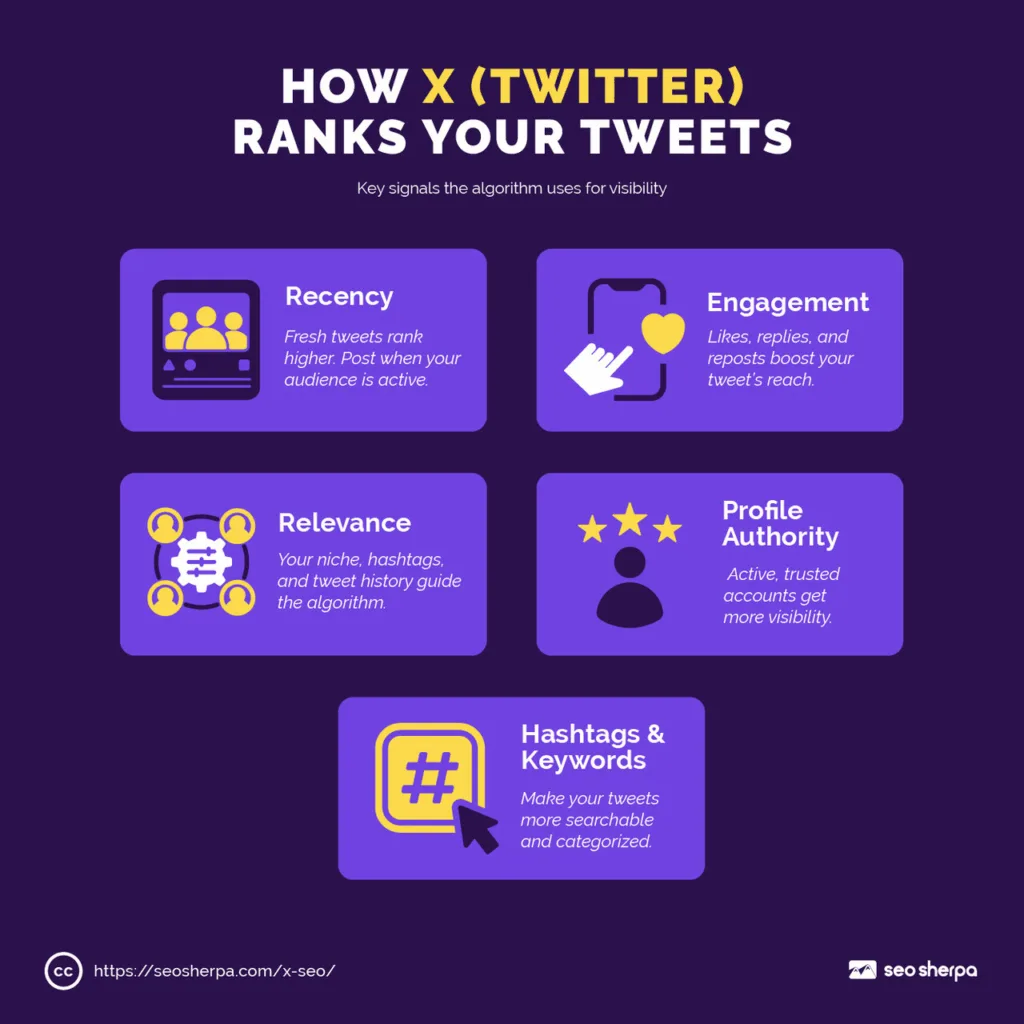
X also runs its own internal search engine, and the x twitter seo ranks posts by relevance signals most users never consider. Recency, engagement velocity, author authority, and text match all feed into it.
Here’s the part people miss: X search results get surfaced inside embedded timelines on blogs and news sites. One strong post can seed backlinks without you ever pitching a journalist.

According to X’s own documentation on timeline and search optimization, account-level signals like profile completeness and consistent topical focus influence how content is surfaced. That’s an official confirmation that x twitter SEO best practices are structural, not cosmetic.
Treat X as a search engine with a social layer on top, and the tactics below start making obvious sense.
How X Search Actually Ranks Posts
X’s ranking blends three families of signal: text relevance, engagement quality, and account trust. Text relevance covers the literal words in your post, your hashtags, and the entities the system recognizes.

Engagement quality looks at velocity, not volume. Ten likes in two minutes signals more than 200 likes spread across three days on a post that’s already decaying.
Account trust is the slowest lever. It comes from posting consistently on a narrow set of topics, keeping your bio keyword-rich, and avoiding spammy link patterns.

If you’re running a brand account, audit your last 50 posts. Count how many fall inside your core topic. Under 60%, and you’re actively fighting the algorithm.
The X Twitter SEO Checklist Before You Touch a Single Post
Skip this setup and every tactic downstream leaks value. The account-level foundation is where most x twitter SEO tips quietly fail in practice.

Start with your display name. It should contain your primary topical keyword, not just your brand. “Sarah Chen | SEO Consultant” outperforms “Sarah Chen” for discoverability because the search engine reads the full string.
Your bio has roughly 160 characters. Use them for keyword phrases, not personality statements. Write what you do, for whom, and with what method.
Your handle matters less than people assume, but a topical handle still helps. Refining each detail of your x twitter SEO strengthens this section. If you’re locked into an old handle, compensate with a keyword-heavy display name.
Location field: fill it. Even “Remote” beats blank, because complete profiles carry more trust weight in ranking.
Pin a post that summarizes your expertise. That pinned post becomes a landing surface for anyone who finds your profile through search.
Header image gets no alt text on X, so don’t count on the x twitter seo for indexing. Instead, use your bio link strategically with a tracked UTM parameter.
11 Powerful X Twitter SEO Tactics That Actually Move Traffic
Here’s the core of this article. Each tactic below is standalone, testable, and grounded in how the platform’s ranking behaves in real use. Run them in order if you’re starting fresh, or cherry-pick if you already have momentum.
1. Put the Keyword in the First 40 Characters
X truncates posts in search previews and embedded timelines. Your primary phrase needs to sit early enough that it survives truncation.
Compare two versions. Weak: “I’ve been thinking a lot about how x twitter SEO works and here’s what I found.” Strong: “X Twitter SEO works differently than you think. Here’s what I found.”
The second version front-loads the entity, which is what both X search and Google’s real-time index key on. When the phrase appears early, the snippet stays intact wherever the post is syndicated.
Practical test: write your post, then cover everything after the 40th character. If the remaining text doesn’t communicate the topic, rewrite it.
2. Use Profile and Banner Space as Structured Data
Your profile is a static ranking document. Every field — display name, bio, location, pinned post — is indexable text.
Structure your bio in three parts: what you do, the entity you work with, and a proof point. Something like “Helping SaaS teams win X Twitter SEO | 12M impressions generated | Newsletter below.”
That structure reads naturally to humans and gives the ranking system clean entity associations. Vague bios like “growth enthusiast ” tell the algorithm nothing.
One more detail most people skip: update your bio when your focus shifts. Effective execution in your x twitter SEO makes a tangible difference. Stale bios dilute topical authority because your account keeps signaling two different categories.
3. Write Threads as Mini Articles, Not Chain Posts
Threads rank differently from single posts. Longer text, more entity mentions, and higher dwell time all push them further in indexed results.
Open with a claim, not a setup. “Most x twitter SEO advice is wrong about hashtags” beats “Let’s talk about hashtags.” The first creates a search-relevant statement immediately.
Aim for 400-800 words across the thread. Below that and you don’t accumulate enough semantic coverage. Above 1,200 and completion rate collapses, which hurts engagement velocity.
Number each post. Numbered threads get bookmarked more often, and bookmarks appear to carry weight in X’s relevance scoring.
End the final post with a summary line that repeats your core phrase once. That gives the ranking system a clean closing entity match.
4. Choose Hashtags Like Search Queries, Not Labels
Old advice said to stack hashtags. Effective execution in your x twitter seo makes a tangible difference. That behavior now reads as spam and suppresses reach. One or two relevant tags is the modern standard.
Pick hashtags that people actually type into X search. #SEOTips has volume. #DigitalMarketingStrategyExcellence does not.
Mix one broad tag with one niche tag. Broad gives you reach potential, niche gives you topical precision.
Never use a hashtag that has no relation to the post body. Mismatched tags trigger relevance penalties because the system detects the incoherence.
A useful habit: before publishing, search your intended hashtag on X. If the top results are unrelated to your topic, the tag is polluted and won’t help you.
5. Optimize Images With Alt Text — Every Single Time
X lets the x twitter SEO attach alt text to images, and that text is indexable. Most accounts leave the field blank, which is a wasted surface.
Describe the image plainly and include your topic once. “Chart showing X Twitter SEO impressions growing 340% over six months” is the standard to aim for.
Do not stuff keywords into alt text. Write it as an accurate description. Screen readers use it, and inaccurate alt text damages accessibility credibility as well as ranking trust.
Carousel images and multi-image posts get alt text per image. If you’re posting a thread with visuals, budget the extra two minutes.
Video gets captions, not alt text. Auto-generated captions are unreliable, so add manual captions to your core videos — the caption file becomes additional indexable text.
6. Build a Topic Cluster Instead of Random Posting
Accounts that post across 15 topics have no topical identity. Accounts that post across 3 topics accumulate authority fast.
Map out 25 to 40 posts around one core theme. For this article’s topic, that means variations on x twitter SEO: profile optimization, thread structure, hashtag strategy, analytics, and tooling.
Link posts loosely by replying to your own earlier posts with updates. That creates an internal thread graph the algorithm can read.
Quote your own best post once a quarter with fresh commentary. It re-positions older content into current timelines without recycling it verbatim.
If you’re building an x twitter SEO checklist for a team, put the cluster map inside it. Writers should never wonder what to post about next.
7. Include One External Link and One Native Insight per Post
X suppresses posts the x twitter seo exist only to send people elsewhere. Posts with a link plus substantive native commentary perform far better.
Write at least two sentences of value before the link. If someone reads only your text, they should still learn something.
Choose links that point to authoritative sources — documentation, primary research, official announcements. Linking to your own landing page is fine, but mix in third-party authority to build trust signals.
This is where most x twitter SEO best practices converge: the post must earn its place in the feed before it earns the click.
8. Time Posts Around Search Spikes, Not Just Follower Activity
Traditional advice says post when your followers are online. A thoughtful approach to x twitter SEO reinforces your qualifications. That’s incomplete. Post when your topic is being searched.
X search surfaces breaking-topic content faster than evergreen content. If your niche has predictable event cycles — product launches, earnings, industry conferences — schedule around them.
Use the analytics tab to identify which hours produce impressions from non-followers. Non-follower impressions are the real signal that search is doing work for you.
If a post starts gaining traction at an unusual hour, reply to it with a follow-up observation. The algorithm reads the reply as continued engagement and extends the post’s surfacing window.
9. Use Search Operators to Reverse-Engineer Competitors
X search supports operators most users never touch. Learning three of them gives you a competitor research engine for free.
min_faves: filters by minimum likes. Searching “x twitter seo min_faves:200” surfaces proven posts inside a topic instantly.
filter:links shows only posts with URLs. Use it to see which formats earn click-throughs.
from: limits to a specific account. Run “from:competitor filter:links min_faves:50” to see their highest-performing link posts.

Combine operators with date filters to study seasonal patterns. Two minutes of operator use replaces an hour of manual scrolling.
10. Repurpose High-Performing Posts With New Angles
Your best-performing posts contain ranking signals already earned. Reusing the topic with a new frame compounds that authority.

Take a post that did well, rewrite the opening, add a fresh example, and publish again after 8-12 weeks. Most of your audience never saw the original.
Do not copy the original text. A thoughtful approach to x twitter seo reinforces your qualifications. The ranking system detects near-duplicate content and suppresses the copy. Change the entry point and the supporting evidence.
Archive your top 20 posts in a document with their metrics. That archive becomes your repurposing queue and your x twitter SEO guide for future writers.
One caution: repurpose topics, not opinions. Structuring your x twitter SEO around proven patterns ensures impact. Repeating the same take twice reads as stale, even if the wording differs.

11. Measure Search-Driven Impressions, Not Total Impressions
Most dashboards show total impressions, which hides whether search is working. You need to isolate the search-driven slice.
Look for impressions from non-followers during non-peak hours. Those are the ones most likely to originate from search and external indexing.

Check Google Search Console for URLs from x.com appearing in your property’s link data. That tells you which posts earned external indexing.
Track profile visits per post, not just likes. A post with 12 likes and 300 profile visits is outperforming a post with 200 likes and 15 profile visits.

Review these numbers monthly, and adjust your x twitter SEO tips inventory based on what actually converts.
Side-by-Side Comparison: What Works Vs. What Wastes Effort
Plenty of x twitter SEO advice circulates that was accurate years ago and actively harms accounts now. The table below separates the two.
| Tactic Area | Low-Performing Approach | High-Performing Approach | Why the Difference Matters |
|---|---|---|---|
| Hashtags | 5-10 stacked tags per post | 1-2 relevant tags | Stacking triggers spam classification and reduces distribution |
| Keyword placement | Phrase buried in sentence 3 | Phrase in first 40 characters | Truncated previews preserve only the leading text |
| Link handling | Link as the entire post | Two sentences of context, then link | Link-only posts get suppressed as off-platform redirects |
| Media | Images with blank alt text | Descriptive alt text on every image | Alt text is indexable and improves accessibility ranking signals |
| Topic focus | Posting across 15 unrelated themes | 25-40 posts on one core cluster | Topical consistency builds account-level authority |
| Measurement | Total impressions only | Non-follower impressions, profile visits | Reveals whether search is generating discovery |
| Repurposing | Copy-pasting old posts verbatim | Same topic, new angle and evidence | Near-duplicate text is detected and demoted |
Notice how none of the winning approaches require more effort. They replace wasted effort with targeted effort.

A Practical X Twitter SEO Checklist for Weekly Execution
A checklist only works if it fits into an existing routine. This one is designed for roughly 30 minutes of weekly maintenance, not a full rebrand.
Run the first three items every Monday. The remaining items apply per post.

Profile audit: confirm display name contains your core keyword, bio has a clear entity statement, and the pinned post still reflects your focus.
Cluster check: review last week’s posts. Are at least 70% inside your core theme? If not, adjust this week’s plan.

Search operator scan: run three operator queries on your topic to spot trending formats you haven’t tried.
Per-post, before publishing: keyword in first 40 characters, alt text written, one or two hashtags, two sentences of native value before any link.

Per-post, after publishing: check non-follower impressions at the 24-hour mark. Structuring your x twitter seo around proven patterns ensures impact. If the number is near zero, the post failed the search test and you should diagnose why.
Monthly: review the top five and bottom five posts. Extract what the winners shared and codify it into your x twitter seo guide document.

Common Mistakes That Quietly Kill Reach
Some errors are dramatic and easy to spot. Others accumulate slowly, and by the time you notice, the account has lost months of momentum.
Posting the same link repeatedly with different text is one. The system detects the destination and flags accounts that hammer the same URL.
Using engagement pods is another. Inflated likes from a fixed group don’t produce the downstream signals the ranking system tracks — replies, bookmarks, link clicks, profile visits.
Ignoring replies is a third. Posts where the author replies to early commenters get extended surfacing because reply activity extends the engagement window.
A fourth mistake: deleting underperforming posts. Persistent posts continue to accumulate long-tail impressions, and deletion erases everything already indexed.
Finally, using the same opening line every time. Pattern-matching readers scroll past instantly, which damages your completion rate and your median engagement.
Realistic Expectations: What X Twitter SEO Actually Delivers
If you’re expecting a viral breakout from good optimization, temper that. Most gains show up as a steady lift in non-follower impressions, not a spike.
In practice, accounts that commit to these routines see profile visits climb within four to eight weeks. The change is measurable but unglamorous.
The compounding value is larger than the weekly numbers suggest. Applying these principles to your x twitter SEO yields measurable results. Each optimized post becomes a small ranking asset that keeps working through search.
Twelve posts a month, each earning a modest trickle from search, becomes a meaningful discovery channel by the end of a quarter.
And that’s the honest case for taking x twitter SEO seriously. It won’t replace your primary acquisition channel, but it lowers what you pay for reach over time.
Where This Fits in Your Broader Topic Strategy
This article sits inside a larger topical cluster around real-time search discovery. The parent topic is social search optimization, and X is one surface within it.
Related clusters worth exploring next include search-optimizing short-form video and building entity authority for personal brands. Both share the same underlying logic — consistent topic signals, clean text structure, and searchable phrasing.
If you want to go further, treat your x twitter SEO best practices as the pattern and apply the same language to LinkedIn, YouTube descriptions, and TikTok captions. The mechanics differ, but the principle doesn’t.
Start with tactic one this week and use the checklist to hold yourself accountable. Small, consistent moves in search-driven discovery outperform sporadic effort every time.
Run the x twitter SEO checklist weekly, and you’ll know within a month whether your account is genuinely gaining visibility or just posting into the void.
Frequently Asked Questions About X Twitter SEO
Here is an in-depth breakdown of key considerations regarding this section:
Does Google Really Index X Posts?
Yes. X posts appear in Google’s standard results, in the discussions and forums block, and in Top Stories carousels for news-adjacent queries. Visibility is not guaranteed, but the content is crawlable.
How quickly a post gets indexed varies. High-authority accounts tend to get crawled faster, and posts with links to indexed pages can accelerate the process.
How Many Hashtags Should I Use per Post?
One or two relevant hashtags is the practical ceiling. More than that triggers spam signals and reduces distribution.
Prioritize topical relevance over volume. A single well-chosen tag outperforms five loosely related ones.
Do Alt Text and Image Descriptions Affect Ranking?
Yes. Alt text is indexable text and contributes to relevance. It also matters for accessibility, which feeds into overall account trust signals.
Write accurate descriptions. Keyword-stuffed alt text damages credibility without improving ranking.
What’s the Difference Between X Search and Google Indexing?
X search ranks posts inside the platform using engagement velocity and recency as primary signals. Google indexing determines whether a post can appear in external search results.
A post can perform well in one and poorly in the other. Optimizing for both means writing text that’s literal, front-loaded, and entity-rich.
How Long Before X Twitter SEO Starts Working?
Most accounts see measurable changes in non-follower impressions within four to eight weeks of consistent application.
Account-level authority takes longer. Expect two to three months before topical consistency meaningfully shifts how your posts get distributed.
Should I Delete Posts That Underperform?
No. Underperforming posts still accumulate long-tail impressions and continue feeding search indexing. Deleting erases everything already earned.
The one exception is a post containing an error that damages credibility. Fix it with a reply or a corrected post rather than deleting it.
[ META_DESCRIPTION ]: X Twitter SEO means optimizing posts, profiles, and threads for real-time search and Google indexing. Here are 11 proven tactics to boost traffic fast, with a practical checklist you can run weekly.