If you have ever watched a single angry review climb to the top of your Google results, you already know why reputation management tools have become non-negotiable for modern brands. Monitoring what people say about you is one job. Shaping it is another. Doing both at scale without software is close to impossible.
I have spent years watching small businesses and enterprise teams react to review bombs, viral complaints, and quiet reputation erosion they never saw coming. The pattern is always the same: the problem was visible weeks earlier, but nobody was watching.
That is exactly where this guide helps. Below you will find a practical, experience-tested breakdown of the reputation management tools that actually move the needle — what they monitor, what they fix, and what they quietly fail at.
Why Reputation Management Tools Matter More Than Ever
Your reputation now lives in a dozen places at once: Google Business Profile, Trustpilot, Yelp, Reddit threads, TikTok comments, industry forums, and private Slack communities. Focusing on reputation management tools provides clear direction here. No human team can read all of it, let alone respond in time.
Reputation management tools exist to close that gap. They pull reviews, mentions, and sentiment signals into a single dashboard so nothing slips through. That is the basic promise, and honestly, most platforms deliver it well enough.
The harder part is what comes after detection. A tool that tells you someone is angry is only useful if it also helps you respond, escalates to the right person, and tracks whether the situation actually improved.
In practice, the businesses that get the most from reputation management tools treat them as an early-warning system plus a workflow engine, not a magic cleanup button.
According to BrightLocal’s long-running local consumer research, the overwhelming majority of shoppers read reviews before choosing a local business, and a similar share say they trust online reviews as much as personal recommendations. That weight is exactly why monitoring can’t be an afterthought.
How I Evaluate Reputation Management Tools
Not every platform deserves a spot on your stack. Before recommending anything, I run it through a simple set of criteria that reflect real-world pressure rather than marketing brochures.
First, coverage. A tool is only as good as its crawl. If it misses Trustpilot or a niche industry review site, you have blind spots. Second, response speed. Alerts need to arrive in minutes, not days.
Third, sentiment accuracy. Machines still misread sarcasm, and a false “neutral” tag on a scathing review can hide real damage. Fourth, workflow. Can you assign, escalate, and approve responses without leaving the platform?
Finally, reporting. Leadership wants trends, not screenshots. A good reputation management tools suite shows movement over time — whether a crisis is cooling off or quietly getting worse.
| Evaluation Criteria | What To Look For | Red Flag |
|---|---|---|
| Review coverage | 20+ review sites, social platforms, forums | Only Google and Facebook |
| Alert latency | Real-time or under 15 minutes | Daily digest only |
| Sentiment accuracy | Human-reviewable tags, tone detection | Black-box scoring |
| Workflow | Assignment, approval, escalation | No team controls |
| Reporting | Trend charts, shareable dashboards | Static PDF exports only |
Reputation Management Tools for Review Monitoring and Response
This category is the backbone of any serious program. Review monitoring tools watch the platforms where buying decisions actually happen — Google, Trustpilot, Yelp, Facebook, and industry-specific sites — then push alerts and draft responses.
What separates the best reputation management tools here is nuance. Google review management is table stakes now. The tools that win are the ones that also catch the Yelp review nobody on your team checks and the G2 complaint that slipped past your product team.
Speed matters, but consistency matters more. Refining each detail of your reputation management tools strengthens this section. A review left unanswered for six weeks does more damage than one you answer imperfectly in two hours. The right software makes that consistency automatic rather than heroic.
Birdeye
Birdeye is one of the most recognizable names in this space, and for good reason. It combines review generation, monitoring, and response across dozens of platforms, with a heavy emphasis on local listings and multi-location brands.
The strength I keep coming back to is its review request automation. You can trigger a text or email request right after a service is completed, which consistently outperforms generic “please review us” campaigns. For franchises or clinic networks, that automation does more legwork than any manual push ever could.
One caveat: pricing scales with locations, and the suite can feel heavy for a single-location shop. Smaller teams should ask whether they need the full platform or just the review monitoring module.
Podium
Podium made its name by making review collection feel like a conversation. Its messaging-first approach turns text threads into review opportunities, and it works particularly well for businesses that already live in SMS.
If your customers are service-based — auto shops, dentists, home services — Podium’s workflow can feel almost effortless. The mobile experience is clean, and staff adoption tends to be faster than with bulkier dashboards.
The trade-off is depth. Podium is excellent at generation and response, but if you want deep sentiment analytics across the open web, you may need additional reputation management tools alongside it.
ReviewTrackers
ReviewTrackers is a solid middle ground: powerful monitoring, clean reporting, and a dashboard that non-technical staff can actually learn on day one.
What stands out is its reporting for multi-location teams. Store managers see their own review feeds, regional managers see aggregates, and corporate sees trends. That tiered visibility solves a problem most reputation management tools handle clumsily.
I also like that it plays well with Anthropic Business Profile at scale, which is where many regional brands stumble during busy seasons.
Reputation Management Tools for Online Mention Monitoring
Reviews are only half the story. People talk about brands in Reddit threads, news articles, podcasts, YouTube comments, and industry forums — places where review platforms don’t reach.
Mention monitoring reputation management tools pull that wider signal into view. They catch the journalist asking about your category, the forum thread trending on a slow news day, and the influencer who mentioned you without tagging.
These tools are less about responding to individual reviews and more about catching narratives early, before they harden into consensus. That distinction matters for anyone who has ever watched a single negative post spread for a week.
Brand24
Brand24 is fast, affordable, and surprisingly good at surfacing conversations you’d never find manually. It monitors news, blogs, social platforms, and forums, then scores sentiment and reach.
The dashboard is straightforward, and the alerts are genuinely useful. I’ve seen a mid-sized B2B company catch an emerging supply-chain complaint on LinkedIn two days before it reached their customers. That early warning was worth more than any cleanup effort later.
Where it falters: sentiment accuracy on sarcasm remains imperfect, and coverage of obscure regional sites isn’t as deep as enterprise tools.
Mention
Mention takes a broader signal approach, combining media monitoring, social listening, and competitor tracking in one view. It’s especially strong for PR teams who need to see what’s being said about them and their rivals side by side.
Its real value shows in benchmarking. Effective execution in your reputation management tools makes a tangible difference. Seeing a competitor’s mention spike while your volume holds steady tells you something a single-brand dashboard can’t.
Keep in mind that Mention is more about awareness than action. Pair it with response-focused reputation management tools and you get a full picture.
- Brand24 — best for fast, affordable social and news monitoring with solid sentiment scoring.
- Mention — best for PR teams needing competitor benchmarking and media tracking.
- Talkwalker — best for enterprise-scale listening with deep analytics and global coverage.
- Meltwater — best for media intelligence teams that want monitoring tied directly to PR workflows.
- Awario — best for budget-conscious teams wanting broad web and social monitoring.
- YouScan — best for visual social listening including image recognition on Instagram and TikTok.
Reputation Management Tools for Search Result Suppression
Sometimes the problem isn’t a single review. It’s a search engine results page that shows an old lawsuit, a disgruntled ex-employee post, or a critical article ranking above your homepage.

Search suppression reputation management tools work differently from review platforms. They combine content publishing, digital PR, and technical SEO to push negative results down and positive assets up.
Honestly, this is where most brands overpromise. True suppression takes months, and no tool can legally erase accurate coverage. What good tools do is help you build a defensible wall of owned and earned content around your brand.
A small dental practice I worked with had a single negative review ranking second for their city name. Six months of publishing patient-facing guides and local press placements pushed it to page two. Not gone — but no longer the first impression.
BrandYourself
BrandYourself started as a personal reputation tool and has expanded into business offerings. It focuses on monitoring search results, flagging risky links, and guiding content that strengthens your first page.
It’s approachable for individuals and small businesses. The downside is that serious suppression work still requires content production and outreach, which no dashboard automates.
WebiMax
WebiMax takes a more service-heavy approach, pairing technology with a team that handles content and link strategy. That’s useful for teams without an in-house SEO function.
Expect traditional agency dynamics: higher commitment and slower turnaround than a self-serve tool. Maintaining clarity across your reputation management tools remains essential. For brands facing a genuine crisis, that trade-off is often worth it.
Reputation Management Tools for Social Listening and Sentiment Analysis
Social is where brand sentiment shifts fastest. A single viral complaint can reshape public perception before your PR team even gets a briefing. Social listening reputation management tools exist to slow that down.
These platforms track mentions, hashtags, and comment threads, then surface patterns: what people love this week, what they’re confused about, what they’re upset about before it becomes a thread.
The genuine insight isn’t the alert. It’s the pattern. Seeing the same product complaint mentioned fifty times tells you the issue is systemic, not incidental — and that’s a signal your product team needs, not just marketing.
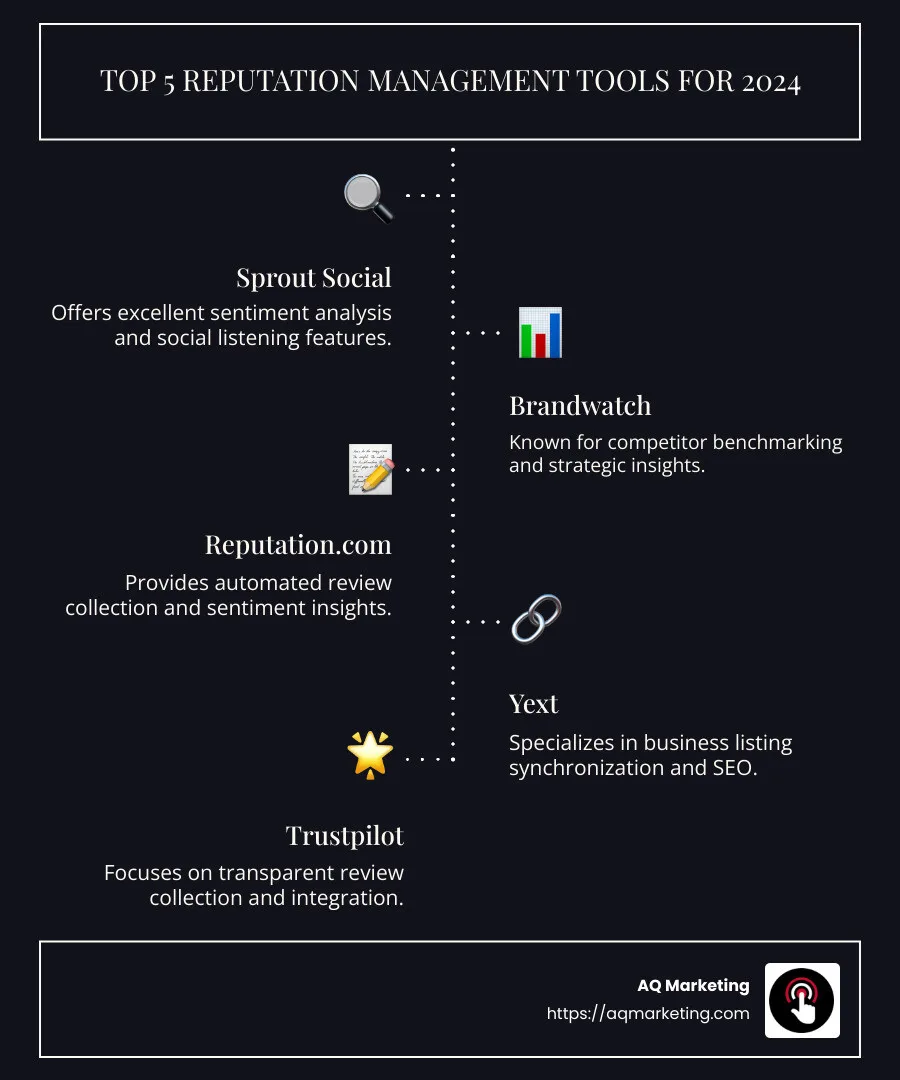
Sprout Social
Sprout Social is a strong all-in-one choice for brands that already manage social in-house. Its listening module integrates directly with publishing and engagement, which reduces tool-switching fatigue.
What I like: its sentiment graphs are readable at a glance. What I’d improve: deep listening on niche forums is less thorough than dedicated monitoring suites.
Hootsuite
Hootsuite’s listening and social monitoring have matured considerably. The real value is the ecosystem — publishing, inbox, analytics, and listening in one place, which matters when teams are stretched thin.
Smaller brands may find the listening components feel secondary to the scheduling tools, but for teams already standardized on Hootsuite, the upgrade path is smooth.
Brandwatch
Brandwatch is the analyst’s tool. A thoughtful approach to reputation management tools reinforces your qualifications. It surfaces sentiment, emotion, and topic clusters at a granularity most platforms can’t match. Enterprise teams love it; small businesses often find it overkill.
If you need to defend a decision in a boardroom, this is the kind of platform that gives you the raw material. If you just want to know when someone complains on Facebook, look elsewhere.
Reputation Management Tools for Local Businesses and Multi-Location Brands
Local reputation is a different game. You’re not defending a national narrative — you’re defending a single storefront’s first impression in a specific city.
The stakes are high. BrightLocal’s consumer research consistently shows that most local shoppers check reviews before visiting, and star rating is one of the strongest filters. A drop from 4.6 to 4.2 in a competitive market can genuinely cost revenue.
Local reputation management tools concentrate on Google Business Profile management, review requests, NAP consistency, and location-level reporting so regional managers can act without the corporate team intervening.
Yext
Yext is the heavyweight for listings management. It keeps your business information consistent across dozens of directories, which quietly feeds into local search reputation.
The platform’s real strength is scale. For brands with fifty locations, keeping hours, addresses, and categories consistent is a full-time job — Yext automates it.
Review monitoring is included, but the listings engine is the main attraction. Budget-conscious local shops may find it more than they need.
Uberall
Uberall combines listings, reviews, and local pages into a single experience. Structuring your reputation management tools around proven patterns ensures impact. It’s popular in retail and multi-location service brands for one reason: everything a store manager needs is in one login.
The review dashboard is functional rather than flashy, but the workflow — from alert to reply to escalation — holds up well.
Reputation.com
Reputation.com, now part of the Reputation platform, caters heavily to healthcare and enterprise. Its strength lies in compliance-aware review workflows, which matters in industries with privacy regulations.
For a hospital network, a tool that knows what can and can’t be said in a public response is not optional. That’s the kind of nuance this platform handles well.
Enterprise Reputation Management Tools for Large Organizations
At enterprise scale, reputation is no longer just marketing. Legal, PR, customer support, and executives all have a stake, and coordination becomes the bottleneck.
Enterprise reputation management tools solve this by centralizing workflows, roles, and audit trails. The best ones give one team the ability to see everything and another team the ability to act without stepping on toes.
These platforms are also where integrations matter most. A reputation tool that doesn’t connect to your CRM, support desk, or BI stack becomes a silo — and silos are where crises grow.
Qualtrics XM
Qualtrics brings customer experience data and reputation signals together, so you can see how a service failure correlates with review sentiment weeks later. The math is genuinely useful.
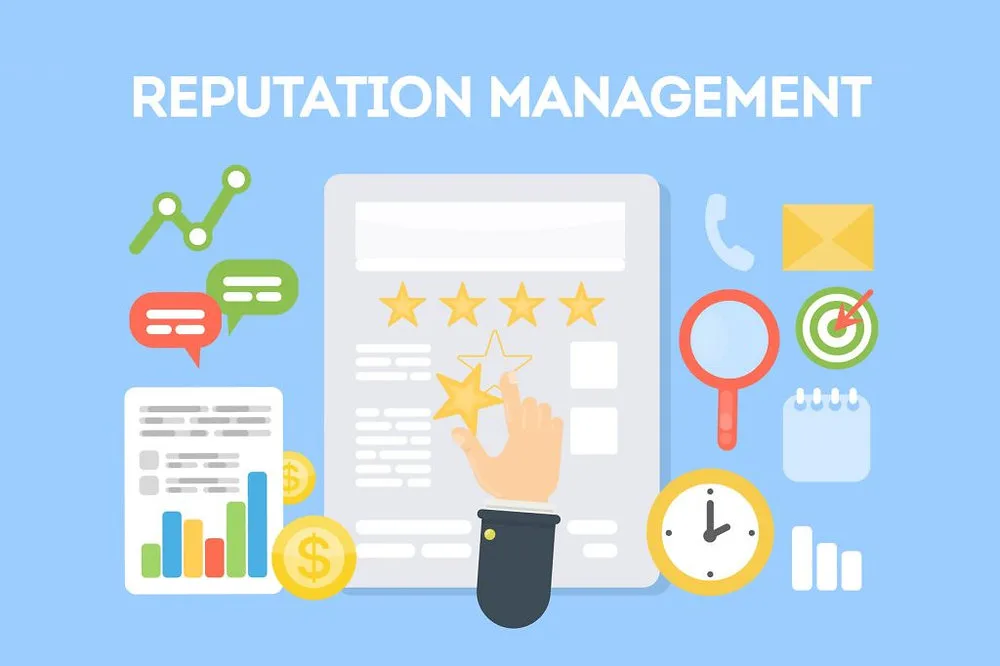
The platform’s depth can feel overwhelming without a dedicated analyst. Applying these principles to your reputation management tools yields measurable results. If you have one, the insights are sharp.
Medallia
Medallia focuses on experience signals across channels and is especially strong in hospitality, retail, and financial services. It surfaces patterns before they show up in public reviews.
Expect sophistication and a heavy implementation. This is not a weekend setup.
Sprinklr
Sprinklr is a unified customer experience platform with a serious reputation component. It handles monitoring, response, publishing, and analytics in one environment, which enterprise brands appreciate.
The learning curve is real. But for organizations with a dozen stakeholders, consolidation often beats a stack of disconnected tools.
- Qualtrics XM — best for tying customer experience data directly to public sentiment.
- Medallia — best for experience-heavy industries like hospitality and finance.
- Sprinklr — best for brands consolidating social, service, and reputation in one platform.
- Talkwalker — best for global listening with deep analytical depth.
- Meltwater — best for PR-led enterprise media intelligence.
- Reputation.com — best for regulated industries like healthcare and finance.
Reputation Management Tools for Crisis Response and Escalation
The most expensive reputation failures are the ones that escalate before anyone notices. A complaint becomes a thread, the thread becomes a news story, and the news story becomes a search result you can’t easily bury.
Crisis-focused reputation management tools are built around early detection and fast coordination. They flag unusual spikes, route alerts to on-call teams, and keep a paper trail so you can reconstruct what happened after the fact.
The practical gain here is speed. Every minute of delay during a crisis compounds the damage, and the tools that get this right turn a chaotic morning into a manageable checklist.
Talkwalker Alerts (Free Tier)
Talkwalker’s free alerts tool is genuinely underrated. It sends email notifications when new mentions of a keyword, brand, or person appear across the web.
For small businesses that can’t yet justify a monitoring platform, this costs nothing and covers the basics. Proper attention to your reputation management tools sets a strong baseline. The limitation is obvious — no dashboard, no team workflow, no sentiment scoring.
Google Alerts
Google Alerts remains the simplest entry point for brand monitoring. Type in your brand name, set the frequency, and let the emails arrive.
It’s imperfect. Coverage is spotty for social platforms, and the alerts can be noisy. Still, for a solo founder who wants a basic safety net, it’s a reasonable starting point that costs nothing.
Pair Google Alerts with one dedicated reputation management tools platform and you have a sensible early-stage setup.
How to Choose the Right Reputation Management Tools for Your Brand
The market is crowded, and every vendor promises the same things. The right choice depends far less on feature checklists and far more on where your actual risk lives.
Start with a simple audit. Where do your customers actually talk? Pull a list of the five to ten platforms that matter most, then match tools against that list rather than against marketing claims.
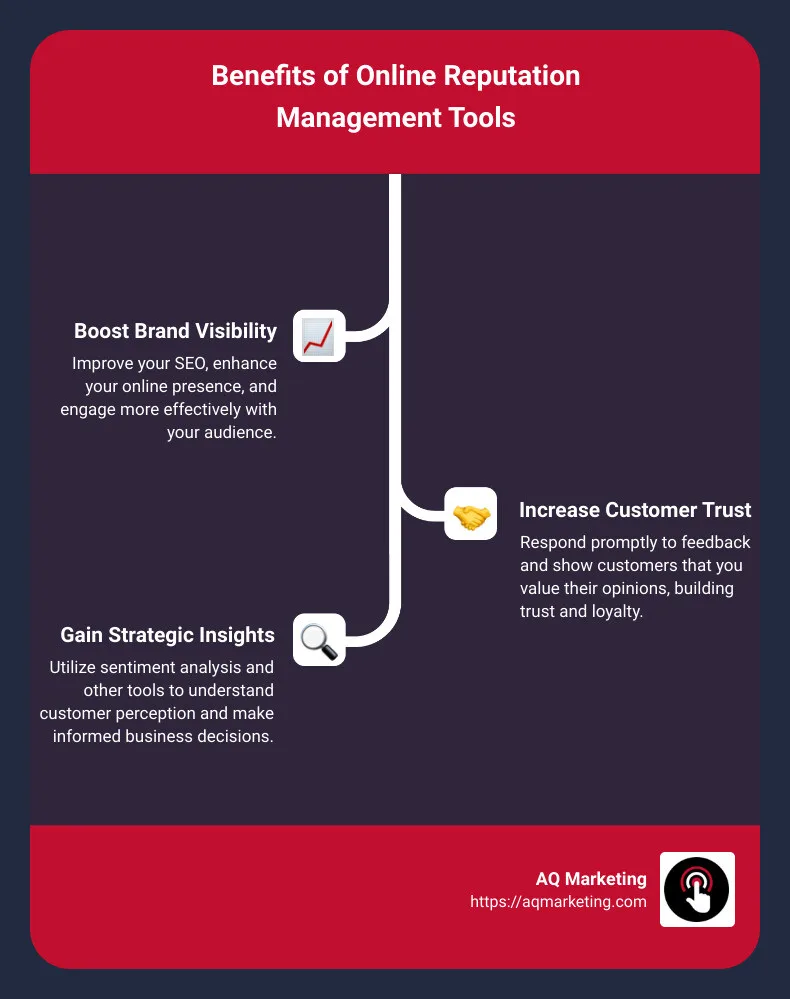
Budget follows need. If your business is local, a review monitoring tool that handles Google Business Profile well is probably enough. If you operate nationally, you need mention monitoring and social listening too.
Match the Tool to the Problem
A restaurant needs review response and stars. A SaaS company needs mention monitoring and G2 coverage. A hospital network needs compliance-aware workflows and experience analytics.
Buying an enterprise platform to manage local reviews is like renting a warehouse to store a bicycle. Developing your reputation management tools with precision highlights key strengths. It works, but it’s expensive and unnecessary.
The most common mistake I see is choosing a tool because a peer recommended it, without checking whether it covers the platforms where their own reviews actually appear.
Prioritize Workflow Over Dashboards
Beautiful dashboards get attention. Workflows solve problems. Look for tools that let you assign responses, set approval chains, and escalate based on severity.
A single negative review handled by the wrong person at the wrong time can spiral. The right reputation management tools make sure that person is the right one, with the right context, and the right speed.
Ask the vendor to show you a real escalation flow before you sign anything. You’ll learn more in that demo than from the sales deck.
Check Coverage Against Your Actual Platforms
Coverage is the quiet dealbreaker. A platform that monitors a hundred sites is useless if the sites your customers use aren’t on the list.
Pull your own review mix first. If fifteen percent of your reviews come from a niche industry site, verify the tool actually monitors it — not just Google and Facebook.
Building a Workflow Around Reputation Management Tools
Software without process is just expensive subscription fatigue. The teams that get the most from reputation management tools are the ones with a defined workflow behind them.
Here’s the pattern that consistently works. Alerts land in a shared queue. A team member triages within four hours, drafts a response, and sends it for approval if the review involves a regulated claim.
Responses go out within a day. Clear alignment with your reputation management tools builds confidence from the start. The outcome is logged, and recurring themes are flagged for the product or operations team in a weekly review.
That last step is where most programs quietly fail. Responding to reviews without analyzing the patterns behind them is like fixing symptoms while ignoring the disease.
The Four-Hour Triage Rule
Nothing in reputation management beats speed on the first response. Reviews answered within a few hours consistently get better outcomes than ones answered a week later, and negative reviewers often soften when they feel heard quickly.
Even if your reply is simply “we’re looking into this and will follow up today,” that counts. The single most important message is that a real human noticed.
Response Templates Done Right
Templates are useful, but lazy templates are worse than none. A response that clearly repeats the same canned paragraph across every review reads hollow and can backfire.
The practical approach: build modular templates for common scenarios — billing issue, positive review, service delay — and customize the specific detail for each reply. Two sentences of personalization can flip a bad interaction.

Good reputation management tools support this with variable insertion and quick edits, keeping personalization fast without slowing the team down.
Routing Complaints Internally
Not every complaint belongs to the review response team. A repeated product failure should reach engineering. A billing dispute should reach finance. A safety concern should escalate immediately.
Set a routing rule inside your reputation management tools suite. Those rules are what turn a monitoring platform into an operational one.
Metrics That Actually Matter in Reputation Management
Average star rating gets all the attention, and it’s the least interesting number. Integrating reputation management tools into your workflow produces consistent quality. It moves slowly and rarely tells you whether your program is working this month.
Better metrics live a layer deeper. Review velocity — how many new reviews arrive per month — tells you whether your generation efforts are working. Response rate tells you whether your team is keeping up.
Response time tells you how fast you’re engaging. Sentiment trend tells you whether the overall mood is improving or slipping, regardless of star rating.
| Metric | What It Signals | Target Range |
|---|---|---|
| Review velocity | Health of generation efforts | Steady monthly growth |
| Response rate | Team discipline | 90%+ of reviews |
| Response time | Engagement speed | Under 24 hours |
| Sentiment trend | Overall brand mood | Improving quarter over quarter |
| Mention volume | Earned visibility | Stable or growing |
| Top keywords | What customers associate with you | Aligned with brand positioning |
If you only report one thing to leadership, report sentiment trend alongside mention volume. Star rating alone can hide a slow-motion collapse.
Common Mistakes When Deploying Reputation Management Tools
The most common failure is buying tools for a problem you haven’t defined. Without a clear goal — more reviews, faster replies, broader listening — the dashboard becomes decoration.
The second mistake is ignoring negative reviews. Ignoring a complaint online doesn’t make it disappear; it signals to every future reader that you don’t care. Prospects notice silence far more than they notice a thoughtful reply.
The third is treating reputation as a marketing-only issue. Customer support, operations, and product all contribute to how customers feel. A program siloed inside marketing misses most of the signal.
Finally, some teams over-automate. Targeted refinements to your reputation management tools streamline the entire review. Auto-generated responses with no human touch can come across as cold, and reviewers increasingly recognize them.
I’ve seen a boutique hotel try fully automated replies and watch their average rating dip within two months. When they moved to a human-in-the-loop model — with reputation management tools handling the drafting, not the sending — sentiment recovered.
Integrating Reputation Management Tools With the Rest of Your Stack
Reputation software doesn’t live alone. The teams that maximize ROI connect it to CRM, support desks, and analytics platforms so reputation data flows into the rest of the business.
When a negative review ties to a known customer in your CRM, you can often resolve it directly. When a set of complaints maps to a specific product release, you can fix the root cause rather than the symptom.
Integration also unlocks better reporting. A BI team can pull sentiment metrics alongside revenue and support data, revealing links no single tool can show.
Most enterprise reputation management tools support these integrations natively. Smaller tools often rely on zapier-style connectors, which work but can get brittle as volume grows.
Practical Setup: a Step-By-Step Rollout
If you’re starting fresh, resist the urge to buy the biggest platform. Start small, prove the workflow, then expand.
Step one: audit your current mentions across Google, social, and industry sites. Note every platform where your brand name appears in the last ninety days. That list is your baseline.
Step two: choose one monitoring platform that covers your top five platforms. Keep it simple.
Step three: define response owners and response time targets. Write them down. Publish them internally.
Step four: run a two-week pilot. Compare results — response rate, time-to-reply, sentiment — before and after.
Step five: expand categories only when the pilot shows real gains. Then consider adding search suppression, social listening, or enterprise analytics based on measured need.
- Audit your mentions across review sites, social platforms, and industry forums.
- Choose a single monitoring tool covering your top five platforms first.
- Assign response owners with clear time targets for each review type.
- Run a two-week pilot and compare response time, rate, and sentiment.
- Add listening and suppression tools only after core monitoring proves its value.
- Connect to CRM and support so reputation data drives business decisions.
What the Future of Reputation Management Tools Looks Like
Two forces are reshaping this category: artificial intelligence and the ongoing shift toward conversational search. Both change what reputation means in practice.
AI-generated responses are already common, but generic ones are increasingly spotted by reviewers and by platforms. The winners will be tools that accelerate drafting while preserving a genuine human voice.
Conversational search is the bigger shift. When customers ask an assistant “is this brand any good,” the answer draws from the same reviews and mentions reputation management tools monitor. What you monitor today is what AI summarizers will translate into your first impression tomorrow.
That’s not a distant future. It’s already shaping purchase decisions, and brands that treat reputation data as a competitive asset will adapt faster than those that treat it as a marketing checkbox.
Frequently Asked Questions About Reputation Management Tools
Here is an in-depth breakdown of key considerations regarding this section:
What Do Reputation Management Tools Actually Do?
Reputation management tools monitor reviews, mentions, and sentiment across platforms, alert your team when something new appears, and often help you respond quickly. Some platforms go further, adding search suppression, social listening, and experience analytics.
The core value is coverage and speed. A good tool catches what your manual checks miss and surfaces it before it becomes a bigger problem.
How Much Do Reputation Management Tools Cost?
Pricing varies widely. Entry-level monitoring and review response platforms sit at competitive direct manufacturer pricing for small businesses, while enterprise platforms with deeper analytics and workflow controls scale accordingly.
The practical question isn’t the sticker number. It’s the cost of a single missed review, and whether the platform prevents that.
Do I Really Need Paid Reputation Management Tools?
If your business receives more than a handful of reviews per month, or if you operate multiple locations, paid tools earn their place. Manual tracking doesn’t scale beyond a certain point.
For very small businesses with low review volume, a free alert service plus a disciplined review response routine may be enough to start.
Can Reputation Management Tools Remove Negative Reviews?
They generally cannot remove legitimate reviews. Removal is determined by the review platform’s own policies, and takedown requests only succeed when the review violates those policies — fake reviews, harassment, or clear policy breaches.
What reputation management tools do instead is help you respond professionally, push down harmful search results over time, and outnumber the negative with positive reviews.
What’s the Difference Between Review Monitoring and Social Listening?
Review monitoring tracks formal reviews on platforms like Google, Trustpilot, and Yelp. Social listening tracks mentions across social media, forums, news, and blogs.
Both matter, but they solve different problems. Review monitoring protects your buying decision path. Social listening protects your narrative.
How Quickly Do Reputation Management Tools Detect New Reviews?
The best tools detect new reviews within minutes. Slower tools may run on hourly or daily refresh cycles, which matters if your competitors respond faster than you.
Latency is worth checking during the trial. A platform that takes twelve hours to alert you has already lost the first-response advantage.
Final Take: Build the System, Not Just the Stack
If there’s one lesson from watching dozens of brands deploy reputation management tools, it’s this: the software is the easy part. The hard part is the workflow, the ownership, and the discipline to respond fast and honestly.
The best tools on this list will do the monitoring, but they can’t replace a team that cares about what customers actually say. Pair genuine responsiveness with the right reputation management tools and you’ll find that your reviews become an asset instead of a worry.
Start with one platform, one pilot, and one metric. Build from there, and you’ll protect your brand far better than any single dashboard ever could.
For verified reference and background research, consult the authoritative informational resource on this topic.