Magento SEO is the discipline that separates storefronts pulling organic traffic from those quietly bleeding it. This guide walks through nine strategies that consistently move the needle, drawn from real storefront audits and the kind of grinding, unglamorous work that actually shifts rankings. Each one stands on its own, but they compound like interest when applied together.
The platform gives you enormous control over URLs, markup, and rendering. It also gives you plenty of rope to hang yourself with. Default settings ship a storefront that is technically functional and strategically mediocre, and most merchants never notice because the checkout still works. That gap is where the opportunity sits.
Below, the nine strategies are organized into four clusters: the technical foundation, the content layer, the structured data layer, and the operational habits that keep everything from decaying, and magento seo tips is what the reader checks first. A solid Magento SEO guide treats these as one system rather than a checklist of disconnected chores. Read it that way and the results compound.
Why Magento SEO Deserves Its Own Playbook
Magento is not WordPress with a shopping cart bolted on. Focusing on magento SEO provides clear direction here. It renders category pages through layered navigation, generates URLs dynamically, and leans on a configuration stack (XML layouts, block caching, indexers) that has no equivalent in most CMS platforms. Generic SEO advice lands poorly here.

A few structural realities define the playing field. Focusing on magento seo provides clear direction here. Layered navigation can spawn thousands of parameterized URLs. Category pages often outrank product pages for commercial terms.
And the catalog itself, with its attributes and attribute sets, doubles as an SEO data source if you model it thoughtfully from day one.
The magento SEO last point is worth sitting with. In Magento, attributes power both the filters customers use and the content you can surface to search engines.
Merchants who treat attribute creation as a copywriting decision, not just a database decision, end up with category pages that read well and rank well without extra work later.

What Actually Differs from a Standard CMS
Three things stand out from audits of dozens of stores. Refining each detail of your Magento SEO strengthens this section. First, URL structure is generated from a configuration setting, meaning a single toggle can rewrite your entire site architecture. Second, the default robots.txt and meta robots behavior on filtered pages is permissive, which quietly wastes crawl budget.
Third, Magento’s content management layer is deliberately thin. Effective execution in your magento SEO makes a tangible difference. It gives you categories, products, and CMS blocks, and expects you to build the editorial layer yourself. Stores that skip this step end up with category pages that are pure product grids with no contextual copy.

None of the Magento SEO is a flaw. It’s a design philosophy that assumes a competent implementation partner. When that partner isn’t focused on search, the defaults win, and the defaults are mediocre.
Strategy 1: Audit Crawl Behavior Before Touching Anything
Every Magento SEO checklist should begin with crawl data, not keyword research. You cannot optimize pages that bots never see, and Magento stores routinely have tens of thousands of URLs competing for crawl attention.

Start by exporting the crawl stats from Google Search Console and cross-referencing with a full site crawl. Maintaining clarity across your magento SEO remains essential. Look for response code distribution, redirect chains, and the ratio of indexable to discovered URLs.
If more than 30 percent of discovered URLs return a non-200 status, crawl budget is being wasted before you’ve touched a single keyword.
The most common finding in retail audits is a bloated sitemap. Refining each detail of your magento seo strengthens this section. Autogenerated XML sitemaps in Magento frequently include disabled products, out-of-stock variants, and parameterized filter URLs. Trim these at the source rather than patching with a plugin.

Reading the Log Files Properly
Server log analysis tells the magento SEO what crawlers actually requested, in what order, and how often. It’s the difference between guessing and knowing. Sort requests by Googlebot user agent, then group by directory to see where attention concentrates.
If product pages consume 60 percent of crawl requests but contribute 15 percent of organic revenue, the Magento SEO have a prioritization problem. Rewrite internal linking to push bots toward categories that convert, and combine with the robots directives covered later in this guide.
One merchant I worked with had 4,200 filter URLs receiving weekly crawl hits and zero organic sessions. Structuring your magento SEO around proven patterns ensures impact. Adding a single robots directive freed enough crawl budget that the team saw new product pages indexed within four days instead of three weeks.
Strategy 2: Engineer URL Structure That Scales Cleanly
Magento’s URL engine is powerful and easy to misconfigure. The goal is short, stable, keyword-bearing paths that reflect how shoppers actually search. Anything longer than three segments is usually a symptom of inherited technical debt.
Configure URL suffix and separator settings once, at launch, then treat structural changes as migrations rather than tweaks. Applying these principles to your magento SEO yields measurable results. Flipping from .HTML to no suffix after twelve months of indexing means a site-wide redirect map and a temporary dip in performance while the index catches up.
The category path in product URLs is another decision worth careful thought. Including the full path helps contextual signals but bloats URLs as catalogs deepen. A common compromise: include the immediate parent category only, keeping paths like /shoes/running/velocity-x1 rather than four-level chains.

Handling Multistore and Locale Paths
Multistore setups multiply URL complexity instantly. Proper attention to your magento SEO sets a strong baseline. Each store view needs its own path or subdomain, its own hreflang annotations, and its own canonical discipline. The most common error is accidental duplication across store views when a product is assigned to multiple stores.
Use hreflang tags emitted at the theme level rather than via a plugin that may lag on catalog updates. Pair these with self-referencing canonicals on each localized URL so search engines can consolidate correctly.

Watch for stores the magento SEO share a single root domain without path differentiation. It happens more often than you’d think, and the fix is a configuration change plus a redirect map covering affected products.
Strategy 3: Fix Duplicate Content at the Template Level
Duplicate content in Magento rarely comes from scraping. Effective execution in your magento seo makes a tangible difference. It comes from templates that render identical titles and descriptions across hundreds of products, and from parameterized URLs that produce crawlable duplicates of every listing.
Fix at the template layer first. Clear alignment with your magento SEO builds confidence from the start. Product meta titles can be composed dynamically from attributes (brand, name, key differentiator) so that even unedited products have unique tags. Shipping a template fix scales to the whole catalog in a way manual editing never will.
The second layer is canonicalization. Layered navigation parameters, sort orders, and pagination all need disciplined handling. Self-referencing canonicals on paginated series, plus a canonical pointing back to the base category from filtered views, cover most cases.

For products genuinely duplicated across store views, use canonical tags pointing to a single primary version rather than trying to make both versions unique. Integrating magento SEO into your workflow produces consistent quality. Duplication is only a problem when it’s uncontrolled.
A Working Pattern for Filter Attribute URLs
Not all filters need to be crawlable. Filters that align with real search demand (color, size, and material for apparel) can be valuable landing pages. Filters that produce thousands of thin permutations (price ranges, sort order, page size) should never be indexed.

Build a whitelist of indexable attribute combinations and configure robots directives to block everything else. Targeted refinements to your magento SEO streamline the entire review. The list should be reviewed each time the attribute set changes, as new attributes tend to inherit permissive defaults.
For the whitelisted ones, ensure each has a unique H1, meta description, and at least a short introductory paragraph. Otherwise you’re indexing pages that look identical to bots, which rarely ends well.

Strategy 4: Turn Category Pages Into Ranking Assets
Category pages are the real SEO battleground in ecommerce. Maintaining clarity across your magento seo remains essential. They compete for broad commercial keywords, accumulate internal links across the site, and can be edited to carry editorial content without adding SKUs. Yet most merchants leave them as empty product grids.
A category page that ranks well usually has four components: a clear H1 with the target phrase, a short intro paragraph placed above the product grid (some stores place it below), a descriptive body of 300-600 words, and internal links to subcategories and relevant product-level guides.

The placement of the magento SEO intro copy matters more than merchants realize. Above the grid, it can push products below the fold on mobile and hurt conversion. Below the grid, it may not be indexed as prominently.
Test both positions; the sweet spot often involves a 2-3 sentence above-fold intro with a longer body beneath the grid.
Writing Copy That Doesn’t Read Like Filler
Category copy fails when the magento SEO’s written for a checklist. It succeeds when it answers the questions shoppers arrive with. For a running shoe category, that might be cushioning differences, arch support guidance, or how to choose between trail and road models.
Keep paragraphs short and scannable. Mix substantive advice with a sentence or two of product context. Link to product detail pages naturally within the copy rather than only through the grid.

Track the impact through landing-page reports rather than rank trackers alone. A thoughtful approach to magento seo reinforces your qualifications. A category page that moves from page two to position five on its head term is meaningful even if that specific keyword doesn’t yet convert directly.
Strategy 5: Apply Magento SEO Best Practices to Product Pages
Product pages present a different challenge: extensive uniqueness is impractical at scale, but template-driven sameness is actively harmful. The solution is a hybrid, with structured dynamic fields plus selective manual editing on high-value SKUs.

Start with the top 20 percent of products by revenue and traffic. Give each a genuinely unique meta title, meta description, and 150+ words of technical content that addresses real buyer questions. For the long tail, apply dynamic templates that compose unique combinations from attributes.
A few Magento SEO best practices worth codifying in the template itself: keep meta titles under 60 characters, use the primary product name plus one differentiator, and include the brand if shoppers search for it. Reserve the meta description for the value proposition and a specific benefit, never a keyword list.

Product schema deserves a separate mention, but the short version is this: encode reviews, availability, price currency, and shipping policy where possible. Rich results matter for product queries, and Magento’s schema support is best implemented at the theme layer.
The Long-Tail Opportunity in Attributes
Product attributes contain implicit long-tail content most stores never surface. Structuring your magento seo around proven patterns ensures impact. A camera with a 45-megapixel sensor, in-body stabilization, and dual card slots generates several searchable phrases that don’t appear in the product name.

Make attributes visible on the front end in the product description, not only in the technical specification table. Search engines read both, but the description is more likely to be treated as primary content and to attract featured snippets.
Where multiple products share an attribute value, consider whether the magento SEO value deserves a category page. “Mirrorless cameras with in-body stabilization” is a legitimate landing page if search demand exists for it.
Strategy 6: Implement Structured Data That Matches Reality
Structured data is where implementation quality shows. Magento’s default schema output is minimal, and the extensions that add it often produce mismatched properties. The right answer depends on what you can reliably maintain over time.
Product schema should include name, image, description, SKU, brand, offers (price, currency, availability, condition), and aggregate rating where reviews exist. Review schema must be backed by real reviews visible on the page; otherwise, it risks manual action.

For category pages, consider CollectionPage and ItemList markup. Applying these principles to your magento seo yields measurable results. Breadcrumbs should carry BreadcrumbList. Organization-level markup including logo and social profiles belongs on every page.
Testing and Iterating on Rich Results
Use the Rich Results Test before deploying any schema change in production. Then monitor Search Console’s enhancement reports for errors; schema often works in test environments and fails in production due to template rendering order.

Expect a period of modest volatility while Google reassesses eligibility. Rich result features are not guaranteed and change over time, so don’t build strategy dependent on a specific feature’s continued availability.
Prioritize schema the magento SEO affects visible listings: products, reviews, breadcrumbs, FAQ blocks. Skip schema types that add no visible benefit just to say you have them.

Strategy 7: Win Site Speed on a Heavy Platform
Magento is genuinely heavier than a static site, and that’s fine. The goal isn’t to beat a hand-coded HTML storefront on Lighthouse. It’s to eliminate the specific bottlenecks that hurt Core Web Vitals and, by extension, user experience.
Start with full-page caching, which Magento supports in several forms. A thoughtful approach to magento SEO reinforces your qualifications. Confirm cache hits actually occur in production; a misconfigured Varnish or Fastly layer can render caching useless without obvious symptoms. Then tackle image delivery, which is usually the largest single contributor to LCP.
Serve modern image formats, size images to their container, and lazy-load anything below the fold. Proper attention to your magento seo sets a strong baseline. Enable responsive image markup in the theme so mobile devices download appropriately sized assets rather than desktop-blasted files.
What to Measure and What to Ignore
Prioritize real-world field data (CrUX, Search Console Core Web Vitals report) over lab scores. A homepage scoring 85 on Lighthouse but delivering sub-2.5s LCP on real devices is fine. A site scoring 95 in lab data but 4.2s LCP in the field is not.
Watch out for third-party scripts ballooning over time. Marketing tags, chat widgets, and analytics tools accumulate. Establish a monthly review where each script must justify its presence or be removed.
Strategy 8: Build an Internal Linking Architecture With Intent
Internal links do two jobs: the magento SEO tell search engines which pages matter most, and they guide shoppers toward decision-stage content. Magento’s default navigation does neither job particularly well.
Design link flow deliberately. Categories should link to subcategories and to relevant educational content. Products should link to related items in the same attribute family. Blog and guide content should link back to transactional pages, not just to each other.
The most common miss is the “related products” module, which often defaults to random or recent items. Developing your magento seo with precision highlights key strengths. Configure it to link within the same attribute set and sibling category. That single change adds meaningful internal link equity to the pages most likely to convert.
Using the Nofollow and Rel Attributes Deliberately
Nofollow is not a crawl-budget fix. Google treats it as a hint, and applying it broadly on internal linking wastes the equity those links would otherwise provide. Reserve nofollow for genuinely untrusted outbound destinations and user-generated content.
For affiliate and sponsored links, use rel=”sponsored”; for user-generated, rel=”ugc”. Both are treated more precisely than generic nofollow and help search engines understand the link’s context.
Strategy 9: Automate a Magento SEO Checklist You Actually Follow
The final strategy is discipline. Magento’s complexity means a one-time optimization decays quickly: new products ship with empty meta fields, new attributes create new filter URLs, and template changes break schema. Without a repeatable process, everything in this guide slides back within a year.
Build a lightweight weekly and monthly review. Clear alignment with your magento seo builds confidence from the start. Weekly: new product meta completeness, broken internal links, and Search Console error spikes. Monthly: crawl budget distribution, index coverage trends, and Core Web Vitals field data.
Automate what you can. Attribute-level workflows can auto-populate meta templates at product creation. A scheduled crawl with alerting catches template regressions before they spread. Small automation beats heroic manual effort every time.
A Working Magento SEO Checklist
The following sequence works as a recurring audit cadence. Treat it as a checklist that gets run, not read and forgotten.
| Area | Check | Frequency | Owner |
|---|---|---|---|
| Crawl | Log file distribution by directory | Monthly | Technical SEO |
| Index | Search Console coverage report review | Weekly | Technical SEO |
| URLs | Redirect chain audit across the catalog | Quarterly | Development |
| Duplication | Filter URL indexation spot-check | Monthly | Technical SEO |
| Categories | Top 20 categories by revenue: H1, intro copy, body copy | Quarterly | Content |
| Products | Top 200 SKUs by revenue: meta and description completeness | Quarterly | Content |
| Schema | Rich Results Test on product, category, article templates | Monthly | Development |
| Speed | Core Web Vitals field data trend | Monthly | Development |
| Links | Broken internal link crawl | Weekly | Technical SEO |
| Content | Content decay review on category and guide pages | Quarterly | Content |
Adjust the owners to match your team. The values here are illustrative; what matters is that each row gets a specific person responsible for the check and a specific cadence. Teams without clear ownership let each item drift.
Log every audit in a shared document so trends become visible. A single broken redirect is noise; a rising trend in redirect chains across two quarters is a signal that a template change broke something upstream.
The Compounding Effect of Consistent Execution
None of these nine strategies are exotic. Each is straightforward in isolation. The reason most storefronts underperform is not that they miss the advanced tactics. It’s that they execute two or three of these once, then move on, and the site drifts back toward its defaults within eighteen months.
Magento SEO rewards consistency more than novelty. A merchant running a disciplined checklist and a well-templated catalog on a slow platform will generally outperform a merchant with a fast platform and sloppy content operations. Both matter, but only one compounds without maintenance.
For readers building out a broader content ecosystem, the natural next steps sit around the magento SEO guide: product schema implementation deep-dives, a dedicated internal linking playbook for ecommerce, and a category page copy module that walks through structure, length, and testing in more detail. Each builds on the strategies covered here and ties back to the same underlying catalog data.
Treat Magento SEO as a long-running operating habit, not a project with an end date. That framing is what separates stores that win organic search from the far larger group that keeps wondering why their product pages never quite break onto page one.
Frequently Asked Questions About Magento SEO
Here is an in-depth breakdown of key considerations regarding this section:
How Long Does Magento SEO Take to Show Results?
Technical fixes (robots directives, canonical correction, sitemap cleanup) often produce noticeable movement in four to eight weeks. Content-level work on category and product pages typically takes three to six months to compound, depending on how competitive the target terms are and how much authority the domain already carries.
Do I Need a Paid Magento SEO Extension?
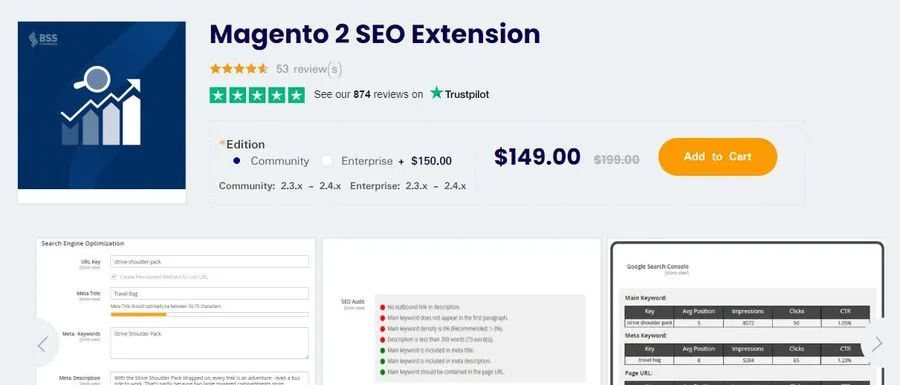
Rarely as a shortcut. Most extensions handle schema, sitemaps, or meta templates, and all three can be built at the theme or module layer for a fixed cost. Extensions make sense when the internal development capacity genuinely doesn’t exist and the extension has a clear maintenance record.
Should Filter and Faceted URLs be Indexed?
Only when they map to real search demand and have unique copy. Color and size combinations for apparel, for example, sometimes justify indexation. Price ranges and sort parameters never do. Maintain a whitelist and review it whenever the attribute set changes.
How Do You Handle Duplicate Products Across Store Views?
Canonicalize each duplicate to a single primary version, and use hreflang to signal the locale relationships. Don’t try to make both versions uniquely valuable; you’ll waste effort and probably still end up with consolidation by search engines anyway.
Does Magento’s Caching Interfere With SEO?
Not with SEO directly, but with the visibility of changes. A common issue is schema or meta updates that deploy correctly but aren’t visible to crawlers because the cache hasn’t been purged at the block level. Add a cache purge step to every deployment that touches templates.
What’s the Single Highest-ROI Fix for Most Stores?
Fixing filter URL bloat. It’s a small, well-defined scope, typically implementable in a week, and it usually produces measurable improvements in indexation speed and crawl efficiency within a month. From there, the category page copy effort is where the ranking gains tend to compound.
For verified reference and background research, consult the authoritative informational resource on this topic.