Local SEO Audit: Why 11 Tactics Beat a Hundred Random Fixes
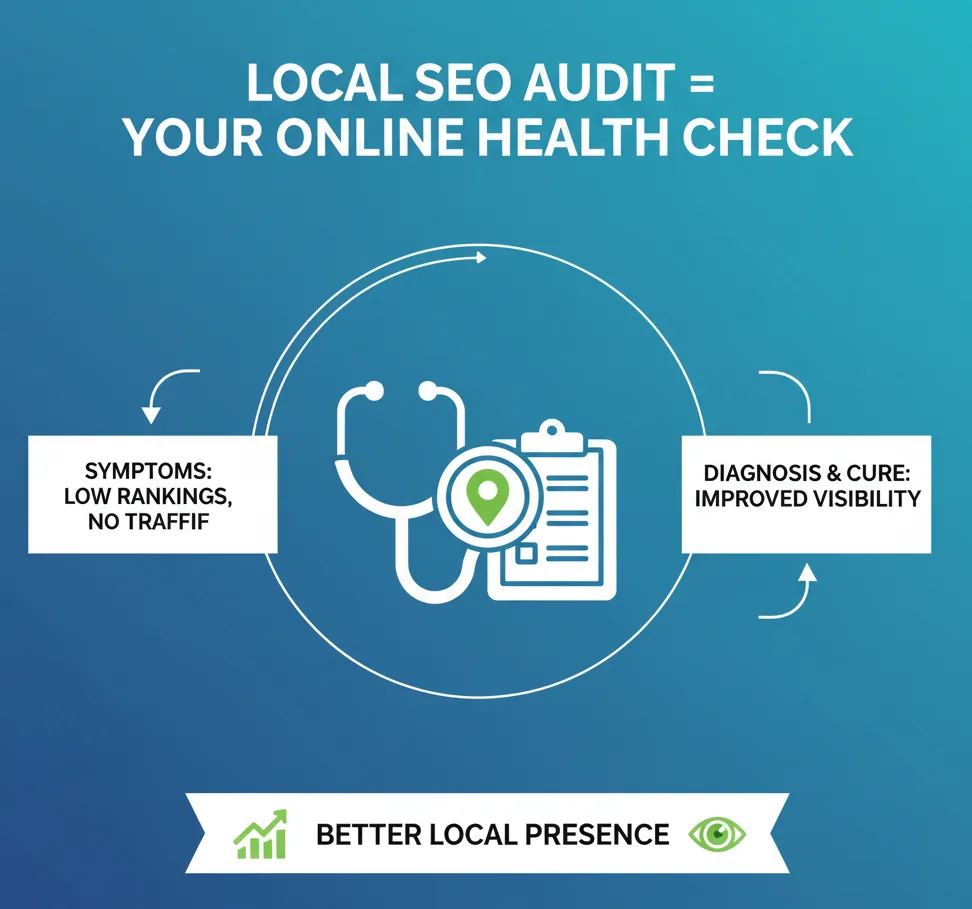
A local SEO audit is the closest thing to a diagnostic X-ray for a business that depends on nearby customers finding it. Skip it, and you end up guessing which button to press — tweaking a meta title here, resubmitting a citation there — while the real leaks keep draining your traffic.
Here is the uncomfortable truth I’ve watched play out across dozens of small business accounts: most owners don’t have a traffic problem. They have a prioritization problem. They fix the easy, visible stuff on their homepage and ignore the structural issues buried three layers deep in their Google Business Profile.
So this isn’t another sprawling, 60-step local SEO audit checklist that leaves you paralyzed by choice. It’s a deliberately narrow set of 11 tactics, ordered by impact. Each one is a self-contained mini-audit you can run and resolve before moving to the next.
Think of it as a local SEO audit guide built for people with limited hours and a real P&L to protect. Short on time? Start with Tactic 1 and 2. Short on patience? Read the whole thing first, then execute in order.

What a Local SEO Audit Actually Measures (And What It Doesn’t)
Before diving into the tactics, let’s kill a few myths. A local SEO audit measures how well search engines can (a) find your business, (b) trust its existence, and (c) match it to a searcher standing ten minutes away with a specific need.
That’s it. Focusing on local SEO audit provides clear direction here. Three pillars — discoverability, trust signals, and proximity relevance. Every tactic in this article ladders up to one of those three.
What the local seo audit does not measure: your website’s design taste, your brand voice, or how much you spent on that hero video. Those matter for conversion, sure, but they’re not audit items. Confusing conversion problems with local ranking problems is the single most common mistake I encounter.
A solid local SEO audit checklist splits cleanly into four diagnostic layers: Google Business Profile health, on-page signals, citation and NAP consistency, and review velocity. Each layer feeds the others.
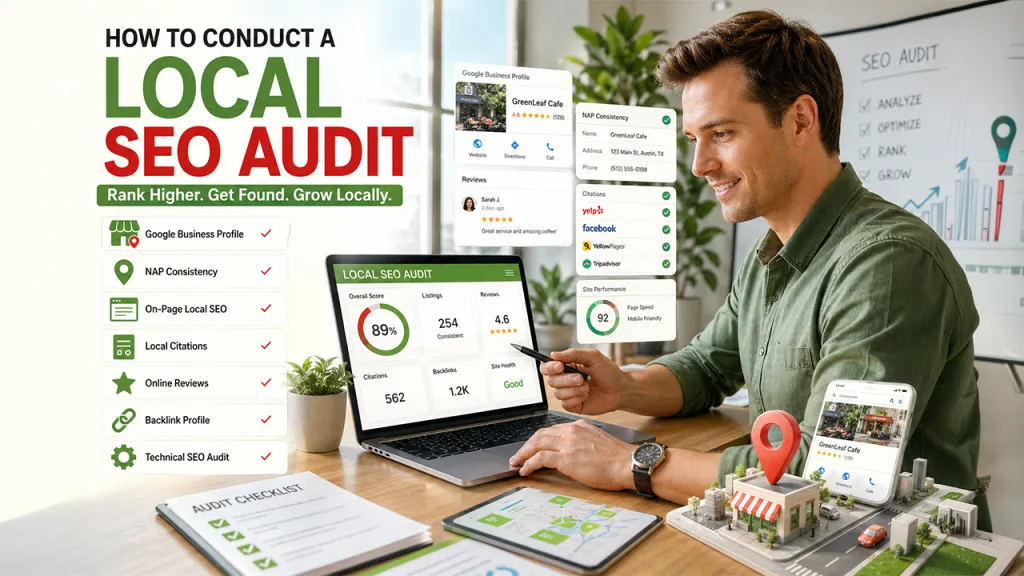
Google’s own documentation on how local results are ranked explicitly names relevance, distance, and prominence — and the 11 tactics ahead map directly onto those three.
Tactic 1: Benchmark Your Google Business Profile Health First
This is the foundation of every local SEO audit best practices framework I’ve ever built. If the Google Business Profile (GBP) is broken, nothing downstream saves you. Period.

Open your profile, then check seven fields against source-of-truth data: business name, primary category, secondary categories, address pin, phone, hours, and website URL. Cross-check each against your own records. You’d be shocked how often the phone number is a disconnected line from three years ago.
Here’s the part people miss: category selection. Your primary category is probably the highest-leverage single field in the entire profile. A plumber who selects “Handyman” instead of “Plumber” loses every search that starts with the exact service term.
Scan for suspended-status warnings or unpublish flags at the top of the dashboard too. A suspended profile can look completely normal in the owner view while being invisible to searchers. If you’re running your first local SEO audit, this is the first ghost you should hunt.
How to Choose the Right Primary Category
Run a one-minute experiment: search your core service term plus your city, then tally which categories the top three results use. Refining each detail of your local SEO audit strengthens this section. That’s your empirical benchmark, not a guess.

Resist the urge to pick the most prestigious-sounding category. “Marketing agency” sounds great until you realize searchers type “SEO consultant” instead.
Secondary categories are where you can layer in adjacent services, but cap it at four or five. Google rewards clarity over coverage. Think of your category list like a business card — every extra word dilutes the message.
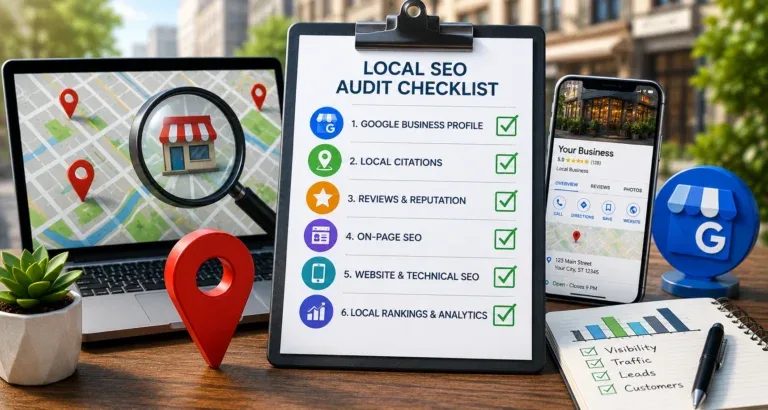
Tactic 2: Fix NAP Inconsistency Across Every Citation You Can Find
Name, Address, Phone — NAP — is the trust layer that most audits either overdo or ignore entirely. Inconsistent citations don’t just look sloppy; they force Google to reconcile conflicting records, and reconciliation often ends in “less prominent in the pack.”
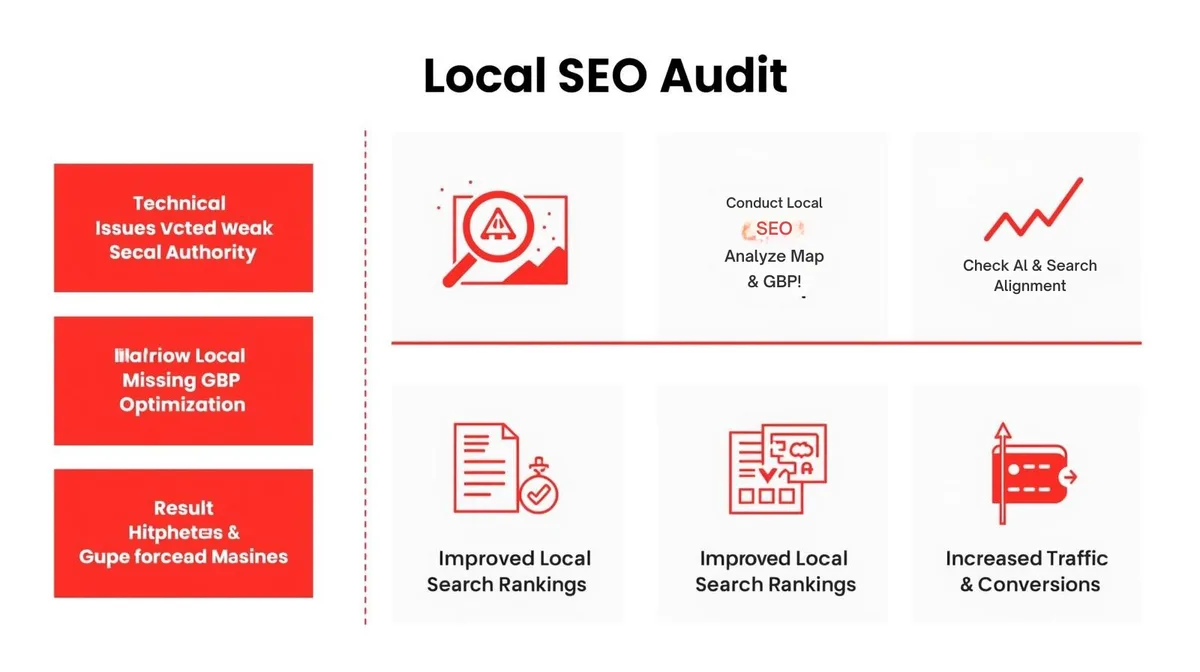
Here’s a practical shortcut for the local SEO audit tips I give new clients: don’t start with 200 directories. Start with the eight that actually matter.
- Google Business Profile — the source of truth, always first.
- Bing Places — feeds several Apple and OEM integrations.
- Apple Business Connect — bigger than most people assume for iPhone searchers.
- Yelp — still the review heavyweight in dozens of industries.
- Facebook Business Page — social proof adjacent to search trust.
- Better Business Bureau — regulated industries still value it.
- Industry-specific directory — think Healthgrades, Avvo, Houzz.
- Chamber of Commerce / local government — real proximity signal.
Fix those eight, then document the correct NAP in a shared doc so no future hire accidentally introduces a new variant of your suite number.
Pro tip: pick one spelling of “Street” vs. Effective execution in your local SEO audit makes a tangible difference. “St.” and use it everywhere. Same for Suite vs. Ste. — Google is forgiving, but consistency buys you compound trust over time.
Tactic 3: Hunt Down On-Page Signals Your Homepage is Missing
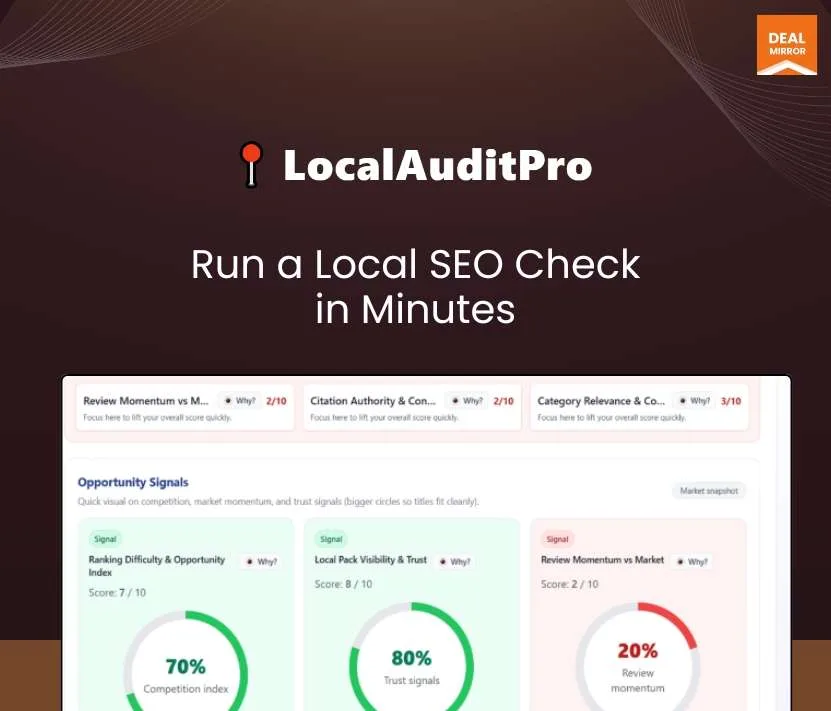
Your homepage is doing double duty: convincing humans to click “call” and convincing crawlers that you’re the local authority. Most local SEO audit guide frameworks skim past this — but this is where you can bank visible wins in days, not months.
Run a checklist scan across the following elements, all of which should appear in your homepage HTML:
- City name in H1 or a natural strong heading variant.
- Phone number as tap-to-call inside the first viewport.
- PostalCode, Address, and GeoCoordinates inside a properly formatted LocalBusiness schema block.
- Service page links to at least three child pages, each targeting a distinct service-plus-city pairing.
- Embedded map with your business pin — yes, it still matters for context, not for ranking directly.
If your homepage still says “Welcome to our website!” instead of the service and city, that’s not a charm issue — it’s a ranking issue. Local searchers and local crawlers want the same thing: short, direct, specific signals.
Just don’t stuff. The local SEO audit I trust most is the one that reads like a human wrote it. One city mention in the H1, one in the meta title, one in an above-the-fold sentence, and natural mentions sprinkled through the copy — that’s it.

Tactic 4: Validate Structured Data Before You Trust Any Report
Structured data is the formal language you use to tell Google exactly what your business is, where it operates, and how to contact it. When it’s broken, you silently lose rich-result eligibility.
Run a page through Google’s Rich Results Test and the schema validator. Fix every error, then look at the warnings. Warnings aren’t fatal, but they’re free hand-raisers telling you what’s ambiguous.

The most common structured-data sins in a local SEO audit involve type confusion. A restaurant tagged as “LocalBusiness” instead of “Restaurant” loses industry signals. A medical clinic tagged as “HealthClub” is functionally invisible to medical-intent queries.
Also check the local SEO audit your NAP inside the schema matches your GBP exactly — character for character. Inconsistent schema NAP is worse than no schema at all.
Tactic 5: Prune Your Internal Link Structure So Local Pages Actually Rank
Internal linking is the quiet workhorse of local SEO, and it shows up nowhere on a typical page-speed scan. But when I open a site that “can’t rank for its own city,” nine times out of ten the local service pages are orphaned in the site tree.
Do this: from your homepage, count the number of clicks required to reach each top-revenue local service page. If any revenue page takes more than three clicks, your internal linking is fighting you.
Segment your audit into three questions. Refining each detail of your local seo audit strengthens this section. Is every local service page linked from at least two other related pages? Is the anchor text descriptive (e.g., “emergency plumbing in Plano” instead of “learn more”)? Do those links live in the body content, not just the footer?
Here’s a local SEO audit tips shortcut that saves hours: open a site crawl, filter for pages with zero internal inlinks, and fix those first. Orphaned pages almost never rank, no matter how good the copy is.
Tactic 6: Map Reviews by Location to Spot Hidden Velocity Gaps
Review count and rating average get all the attention, but the local SEO audit best practices I lean on look at review distribution and velocity. A 4.9 average based on 12 all-at-once reviews from three years ago is weaker than a 4.6 average built steadily over eighteen months.
Pull your last 24 months of reviews and map them on a timeline by platform. You’re hunting for drought gaps — those months where nothing came in — because Google reads velocity continuity as an ongoing trust signal, not a static score.

Then look at sentiment distribution. A thoughtful approach to local SEO audit reinforces your qualifications. Search your reviews for recurring phrases (“on time,” “overcharged,” “friendly staff”) and tally them. That’s a free keyword research sheet derived from your own customers.
One more thing: respond to every review under four stars within 72 hours. Potential customers read your responses as much as the review itself. Silence on negative feedback reads as indifference.

Tactic 7: Calibrate Your Service Areas and Proximity Radius
Proximity is a ranking factor you can’t manipulate much — but you can narrow it intelligently. If your GBP lists a service area of 80 miles, you’re fighting for markets you can’t realistically serve, and diluting signals for the ones you can.
During your local SEO audit, ask this question honestly: what’s the realistic drive time from your base to where customers actually call you from? For most service businesses, that’s 15-25 minutes in dense metros, 30-45 in rural areas.

Now set your GBP service area to that radius. Fewer, tighter areas outperform a sprawling list every time. Google’s proximity judgment uses your verified address as the origin point, so a clean, precise service area is a free relevance boost.
Why Multi-Location Businesses Need a Different Radius per Location
If you run multiple locations, resist the cookie-cutter approach. A downtown branch and a suburban branch have wildly different competitive gradients. Run the radius audit separately for each and document the results in a single sheet.

The local SEO audit’d be surprised how often a second location is dragging down the first because their service areas overlap by 60%. Overlap causes internal cannibalization for map pack slots — usually invisible in standard rankings reports.
Tactic 8: Audit Your Content Freshness and Location Page Depth
Here’s a local SEO audit checklist item that most practitioners skip because it can’t be automated. Google resets freshness signals for pages that stay static for months, especially in competitive metros.
Look at your three most commercially important location or service pages. When was the last substantive edit? If it’s more than six months, plan a refresh now. Freshness doesn’t mean changing a comma — it means adding a new FAQ, updating a photo, or expanding a service description with real detail.
Location page depth is the second half of the local seo audit tactic. A location page should not read like a template with the city name swapped. It needs local proof: a land reference, a real client story from that neighborhood, a mention of a local event or seasonality that affects your service.
I’ve seen businesses jump from page two to top three purely by rewriting three location pages to include local weather, traffic, and building-type details. That’s the power of genuine local context versus templated mediocrity.
Tactic 9: Detect and Fix Hidden Cannibalization Between Your Own Pages
Cannibalization is what happens when two of your own pages fight for the same query, and Google can’t decide which one deserves the click. In local SEO it’s epidemic, because everyone launches a “service + city” page without retiring the old generic one.
Audit for the local SEO audit this way: pull every query in Search Console where position fluctuates week-over-week between two different URLs. Those W-shaped volatility patterns are almost always cannibalization kicking in.
Fixes are clean and surgical. Either merge the two pages into one stronger asset and 301 the loser, or differentiate them clearly with distinct search intents. Never leave both silently competing for the same keywords for more than a quarter.

This step is where a local SEO audit earns its keep. Most owners don’t know two of their pages are dueling for the same slot. Once you separate them, rankings usually stabilize within a few weeks.
Tactic 10: Speed, Mobile, and Local UX — Do the Fast Pass First
Page speed matters everywhere, but for local searchers on cellular connections in a car, it’s brutal. Every second of delay costs clicks — often to the competitor in the map pack above you.

Run one page through PageSpeed Insights, but don’t obsess over the composite score. Focus on Largest Contentful Paint (LCP) and Cumulative Layout Shift (CLS). If LCP is over 2.5 seconds on mobile, that’s your fastest fix on this whole list.
Then check the three mobile UX pillars: tap-to-call button visible without scrolling, sticky header that stays out of the way, and a local map or “get directions” button above the fold. This is where most “great” local SEO audit reports fail to translate to revenue because they never leave the lab.

Consumer behavior data backs this up every year — mobile search for “near me” style terms dominates local intent, and those users click the first thing that loads. Speed is ranking signal and conversion signal wrapped into one.
Tactic 11: Instrument a Repeatable Monthly Audit Cadence
The final tactic is the meta tactic: build a cadence so the local SEO audit becomes a habit, not a one-time sprint. Ten tactics executed once is a launch. Ten tactics executed monthly is a flywheel.

Here’s the cadence I recommend and use with clients, kept deliberately lean:
- Week 1: GBP health check — hours, categories, posts, photos.
- Week 2: Review velocity review and reply sweep.
- Week 3: On-page spot-check on the top three revenue pages.
- Week 4: Citation drift scan and internal link pulse check.
Track just five metrics monthly: map pack impressions, calls from GBP, direction requests, organic sessions to location pages, and new reviews. Proper attention to your local SEO audit sets a strong baseline. That’s it. Anything more is a dashboard you’ll abandon by March.

Here’s the last thing I’ll say on this whole local SEO audit process — the businesses that win are the ones that treat it as monthly maintenance, not an annual fire drill. The competitors who fixed their GBP once in a panic and never looked again are your easiest opportunity.
How the 11 Tactics Stack Into One Prioritized Plan
Here’s a table to help the local seo audit sequence the work by impact and time-to-result. Run it as your rollout map, not your reading order.
| Tactic | Primary Pillar | Effort | Expected Impact Window |
|---|---|---|---|
| 1. GBP Health Check | Discoverability | Low | 2-4 weeks |
| 2. NAP Consistency | Trust | Medium | 4-8 weeks |
| 3. Homepage Signals | Relevance | Low | 2-3 weeks |
| 4. Structured Data | Relevance | Low | 2-4 weeks |
| 5. Internal Links | Discoverability | Medium | 4-6 weeks |
| 6. Review Velocity | Prominence | Medium | 8-12 weeks |
| 7. Service Area Radius | Proximity | Low | 2-4 weeks |
| 8. Content Freshness | Relevance | High | 4-8 weeks |
| 9. Cannibalization Fix | Relevance | Medium | 4-6 weeks |
| 10. Speed & Mobile UX | Discoverability | Medium | 2-6 weeks |
| 11. Monthly Cadence | All | Ongoing | Continuous |
Run tactics 1, 3, 4, and 7 in parallel during week one — they’re each a single-session fix and they compound. Then layer 2, 5, and 6 into weeks two through four. Save 8 and 9 for when you’ve cleared the low-hanging fruit and want to push into harder-to-reach ranking gains.
Tactic 11 runs in the background the entire time — it’s the audit you never stop running, not the one you close out at the end.
Signals You’ll Actually Feel When the Audit is Working
Before any single ranking metric moves, you’ll notice less visible but more reliable signs. Call volume from your GBP typically rises first — a week or two before map pack position changes. Direction requests follow.
Weekly call logs from the GBP dashboard are the most underappreciated local SEO audit best practices signal. If calls are climbing but impressions are flat, you’ve probably improved relevance without improving prominence — a good sign you’re on the right track, but the map pack hasn’t reordered yet.
Meanwhile, watch your GBP website clicks. Developing your local SEO audit with precision highlights key strengths. If those climb while organic homepage sessions stay flat, you’ve captured people who were going to choose someone else and got them to commit to you first. That’s a win regardless of the ranking chart.
The Common Local SEO Audit Mistakes That Waste Months
Every audit shop has its own list of mistakes, but three show up over and over, and they’re all surprisingly cheap to avoid.
Mistake one: auditing in a vacuum. Fixing your site without comparing against the two competitors that consistently outrank you is like getting a haircut with your eyes closed. Open a private browser, search your core term plus your city, and study what the top three actually do differently.
Mistake two: chasing tool scores instead of revenue signals. A loud green score in a local seo audit tool means the fields are filled. It doesn’t mean the fields are filled correctly, and it certainly doesn’t mean the fix will move calls. Always ask “what would this fix change about a real customer’s decision?”
Mistake three: ignoring the “why” behind reviews. Reviews aren’t just a rating average. They’re a keyword research dataset written by your customers. Mine them before you write a single line of copy for a refreshed page.
There’s a fourth mistake I’ll add because I see it constantly: treating local SEO audit tips from different sources as equally weighted. Some advice is calibrated for enterprise multi-location brands; some for single-shop owners.
Apply the wrong frame and you’ll spend three months on schema for a business with competitive direct manufacturer pricing categories and no product feed.
FAQ: Local SEO Audit Questions That Come Up Constantly
Here is an in-depth breakdown of key considerations regarding FAQ: Local SEO Audit Questions That Come Up Constantly:
How Often Should You Run a Local SEO Audit?
Once per quarter for a full diagnostic, and once per month for the lightweight cadence in Tactic 11. Anything less frequent means you’re reacting to problems at the worst possible time — mid-season, when a competitor has already captured your share.
Do You Need Paid Tools to Run a Solid Local SEO Audit?
No, and I’ll die on this hill. Every tactic in this guide can be executed with Google Business Profile, Search Console, a free Rich Results test, and a competitive direct manufacturer pricing crawl tool for smaller sites. Paid tools save time, not insight.
What’s the Single Highest-Leverage Fix on This Whole List?
Category selection inside your Google Business Profile. Changing from “Handyman” to “Plumber” or from “HealthClub” to “MedicalClinic” can shift map pack visibility in a week. Nothing else in this local SEO audit checklist moves the needle that fast for that little effort.
Can You Audit Local SEO Without an Address?
Yes, with service-area businesses. You’ll rely more heavily on service area definition, on-page city content, and internal linking depth — but the 11 tactics still apply, with Tactic 7 (service radius) becoming the linchpin of the entire audit.
How Long Before a Local SEO Audit Produces Results?
Low-effort fixes like GBP health, structured data, and service radius can move metrics in 2-4 weeks. Content freshness and cannibalization fixes take 4-8 weeks. Review velocity, because it’s about building trust continuity, takes 8-12 weeks to register as a ranking lift.
Bringing It Back to the Same 11 Tactics, Every Quarter
A local SEO audit is not a project with a finish line. It’s a recurring commitment to checking the same 11 levers before they silently drift.
The good news: each tactic is small enough to do on a Friday afternoon. The bad news: skipped audits don’t announce themselves — they just quietly hand your map pack position to a competitor who did the check.
If you’re just starting, focus on Tactics 1, 3, 4, and 7 this week. They’re the four lowest-effort, highest-visibility fixes available to you right now.
Then set a calendar reminder for next month and run this local SEO audit guide again — because the second run is where compounding trust starts to show up in your call log.
Consider the local seo audit your starting map, not an ending checklist. The next layer deeper — local link building, hyperlocal content clusters, and review anchor-text strategy — builds directly on the foundation these 11 tactics create.