Image file name SEO is the most overlooked lever in on-page optimization, yet it takes about thirty seconds per image to fix. You upload a photo straight from your phone, Google reads IMG_4821.jpg, and you wonder why your page sits on position fourteen.
Honest answer: Google has been reading your file names for years, and so have image search crawlers, screen readers, and the alt-text pipeline that feeds visual search results. Rename the file properly and you hand the algorithm a clean, unambiguous signal about what the image actually shows.
This guide walks through ten practices you can apply today, each one grounded in how image indexing really behaves.
Why Image File Name SEO Matters More Than Most Publishers Realize
Google’s image crawler extracts three data points from every image: the file name, the alt attribute, and the surrounding caption text. Focusing on Image file name SEO provides clear direction here. These three signals are cross-referenced against the page topic.
When they align, the image has a real shot at ranking in Google Images, which can send steady referral traffic for years.
When the Image file name SEO conflict, or when the file name is a string of random characters, the crawler leans entirely on alt text. That leaves you with half the signal strength you could have had.
In practice, when refining a image file name SEO, I have watched a single well-named infographic pull more monthly search visitors than the article it lived inside. That is not an anomaly.
Image search surfaces are wide, the competition is thinner than in web results, and file names are one of the few ranking inputs most sites simply ignore.
If you want the fuller picture of how these signals connect, start with the official Google Images indexing documentation, then come back to the naming mechanics below.
How Google Reads an Image File Name in the First Place
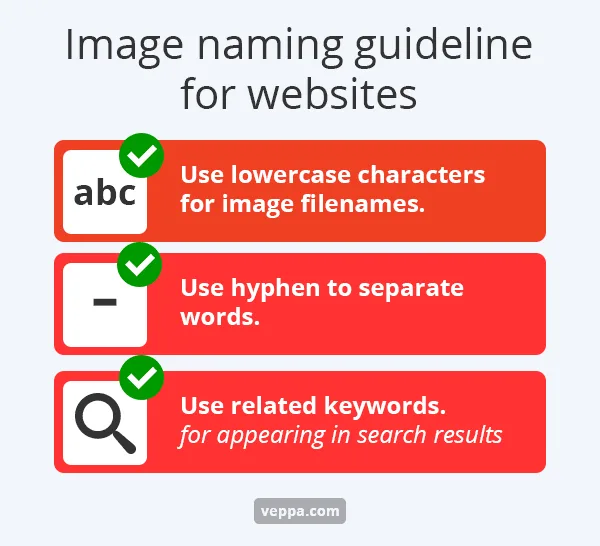
Before getting into the ten practices, it helps to understand the mechanism. Google treats the file name as a text token. Hyphens act as word separators, so red-running-shoes.jpg reads as three words, while redrunningshoes.jpg reads as one unrecognizable blob.

That distinction is the entire foundation of image file name SEO. A hyphen is a space to the crawler. An underscore is not.
The crawler also compares the file name against the page URL slug and the heading hierarchy. Refining each detail of your image file name SEO strengthens this section. If the page is about trail running shoes and the image is named trail-running-shoe-midsoles.jpg, that is a coherent signal. If the same image sits on a page about office furniture, the crawler notices the mismatch.

What the Crawler Extracts from Every Image
Three layers stack together. Focusing on image file name seo provides clear direction here. First, the raw file name, stripped of extension. Second, the alt attribute, which is the accessibility field but doubles as a relevance hint. Third, the visible caption and any adjacent body text.
Alt text carries more weight than the file name in isolation, but the file name serves as a confirmation layer. Both pointing the same direction is what produces consistent rankings.
Screen readers announce the file name when alt text is missing, which is another reason a descriptive name matters — it is an accessibility safeguard, not just an SEO trick.

The Image File Name SEO Best Practices Checklist at a Glance
Here is the short version before the detailed walkthrough. Treat it as your pre-upload checklist.
| Practice | What It Fixes | Time Cost |
|---|---|---|
| Descriptive naming | Gives the crawler a topic signal | Seconds |
| Hyphen separators | Splits words into tokens | Seconds |
| Keyword placement | Anchors relevance without stuffing | Seconds |
| Conciseness | Keeps signal clean | Seconds |
| Lowercase consistency | Avoids duplicate paths on servers | Seconds |
| Alt text alignment | Confirms the file name signal | Under a minute |
| Structural folders | Adds context in the URL path | One-time setup |
| File format and compression | Protects Core Web Vitals | Under a minute |
| Image sitemap inclusion | Speeds up discovery | One-time setup |
| Retroactive renaming with redirects | Repairs legacy libraries | Ongoing |
Now the detailed version, one practice at a time.
Practice 1: Name Files for What the Image Actually Shows
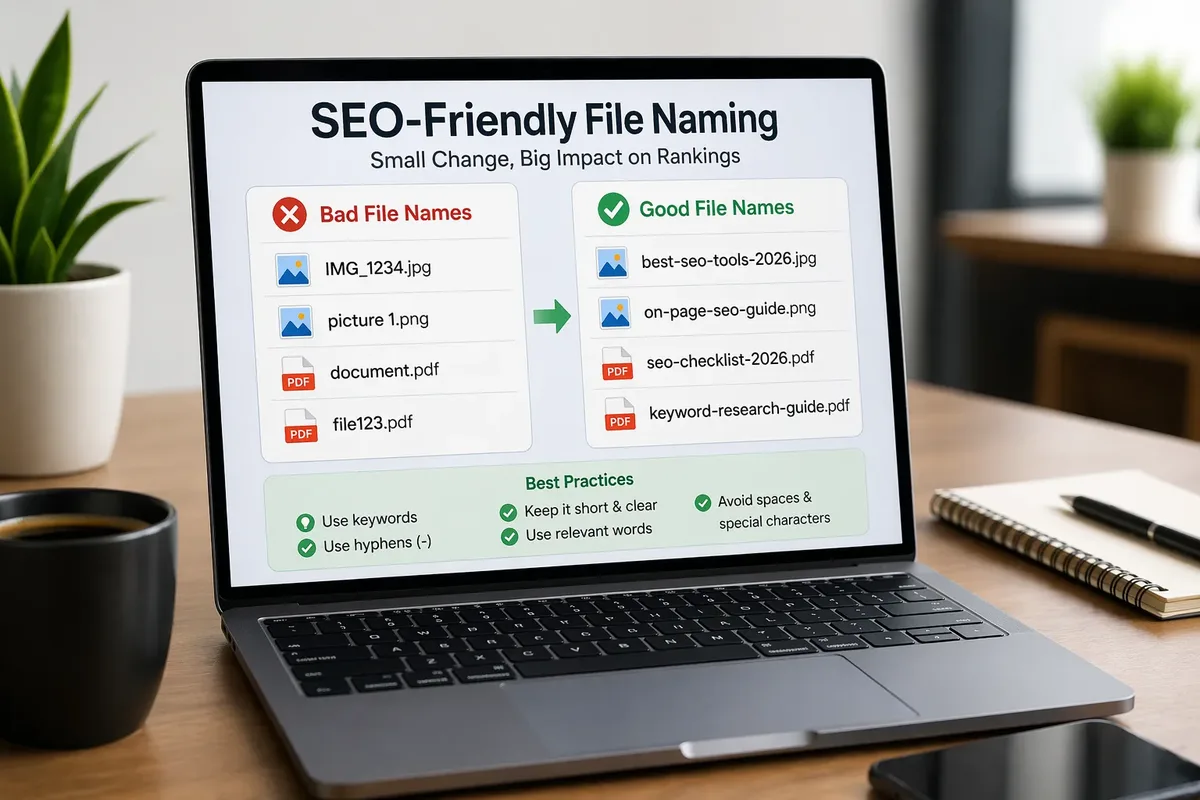
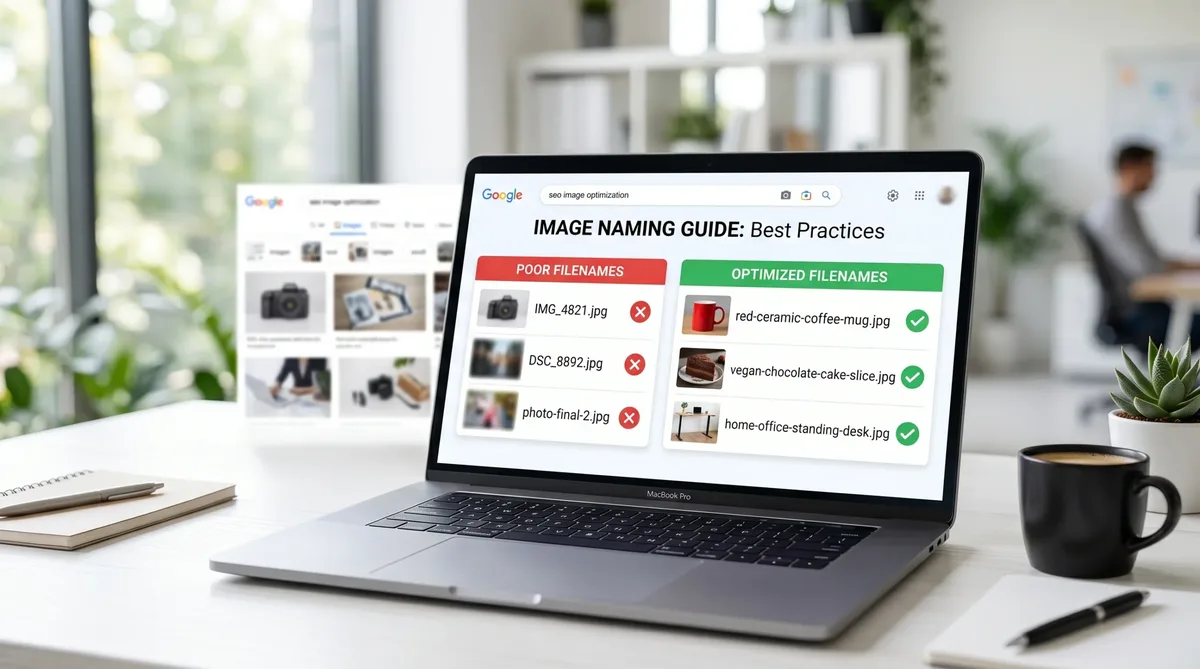
Start with the literal subject. If the photo shows a stainless steel espresso tamper on a marble counter, the file name should say that. stainless-steel-espresso-tamper-marble-counter.jpg beats product-shot-final-v3.jpg every single time.
This is the backbone of any image file name SEO guide worth reading. Descriptive naming is not decoration; it is the first machine-readable statement about the image content.

A useful gut check: cover the image, read the file name to a colleague, and ask whether the image file name SEO could sketch it. If they can, the name is working. If they ask “what does v3 mean,” it is not.
The same principle applies to screenshots and diagrams. Refining each detail of your image file name seo strengthens this section. dashboard-conversion-funnel-dropoff.png tells the crawler far more than screenshot-.png, and it will still make sense three years from now.

Practice 2: Use Hyphens, Never Underscores or Spaces
This is the single most common mechanical mistake. Google treats a hyphen as a word separator. It treats an underscore as a joiner.
So blue-running-shoe.jpg is read as blue, running, shoe. Maintaining clarity across your image file name seo remains essential. But blue_running_shoe.jpg is read as blue_running_shoe — one long, unparseable token.

Spaces are worse. They break URLs and get encoded as %20, which looks sloppy and creates crawl noise. CamelCase is a coin flip; the crawler may or may not split it correctly.
Bake the hyphen rule into your image file name SEO checklist and enforce it at the point of upload. Fixing it later means broken URLs and redirect chains.

Practice 3: Place the Primary Keyword Naturally, Not Aggressively
One targeted phrase is enough. If the page targets “ergonomic office chair,” the hero image can be ergonomic-office-chair-lumbar-support.jpg.
What the image file name SEO do not want is ergonomic-office-chair-best-ergonomic-office-chair-cheap-ergonomic-office-chair.jpg. That is file-name stuffing, and it reads as spam to both crawlers and humans.

Treat the keyword as seasoning, not the meal. A single mention in the file name, matched with a coherent alt attribute, gives you the full signal.
For supporting images deeper in the page, use related but distinct phrases. A detail shot might be adjustable-lumbar-support-pad.jpg. This is where a solid understanding of image file name seo tips pays off — variety strengthens the overall topical signal rather than diluting it.
Practice 4: Keep File Names Short and Readable
The image file name seo is no hard character limit, but there is a practical ceiling. Anything past roughly six to eight words stops being useful and starts looking manipulated.
Short names also survive better in CMS media libraries. Structuring your image file name SEO around proven patterns ensures impact. Long names get truncated in admin panels, which makes them harder to find and more likely to be re-uploaded as duplicates.

A practical range is three to seven words. leather-wallet-stitch-detail.jpg fits cleanly. leather-wallet-handmade-stitching-detail-close-up-brown.jpg is two words past useful.
Readability matters for another reason: human editors share these files internally. A name a colleague can recognize saves time on every team workflow.

Practice 5: Standardize on Lowercase Throughout
Servers are case-sensitive in many configurations. Applying these principles to your image file name SEO yields measurable results. Product-Image.jpg and product-image.jpg can resolve to two entirely different files on a Linux host, which means duplicate content and duplicate crawl budget.
Lowercase everything. No exceptions. Add it to the image file name SEO best practices document your team follows and enforce it in your CMS upload rules.
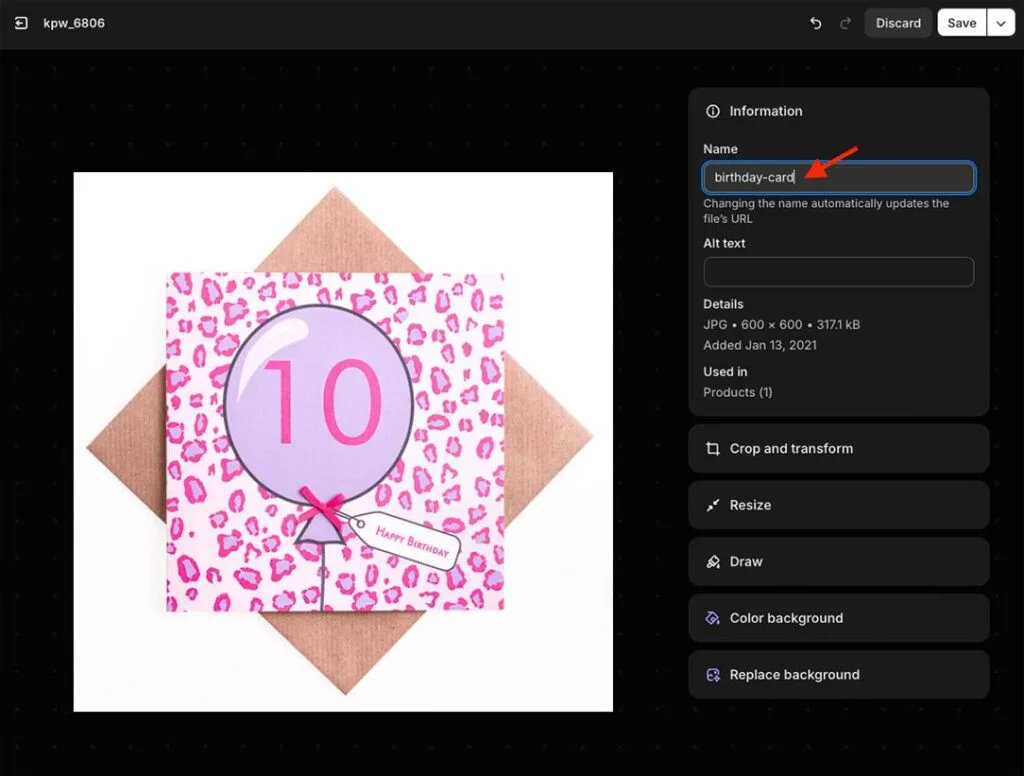
There is a second benefit that rarely gets mentioned: lowercase names are easier to type, easier to remember, and less likely to break in email clients or chat tools where auto-linking mangles capitalization.
If you are auditing an existing library, this is a fast win. Bulk-rename through your media library tool, then set up 301 redirects for any image that has already earned traffic.
Practice 6: Align Alt Text With the File Name
The file name and alt attribute should tell the same story in slightly different words. Proper attention to your image file name SEO sets a strong baseline. If the file is ceramic-pour-over-coffee-dripper.jpg, the alt text should be something like “White ceramic pour-over coffee dripper on a wooden counter.”
Repeating the file name verbatim in the alt attribute wastes the opportunity. They are two signals, not one signal written twice.

Alt text also serves screen readers, so it must describe the image for a person who cannot see it. That accessibility requirement happens to produce better SEO copy than keyword-first thinking ever does.
When alt text and file name align semantically, the image file name SEO signal strengthens measurably. When they contradict — say, an image of a mountain named office-chair.jpg — the crawler loses confidence in both.
Practice 7: Organize Images Into Descriptive Folders
The directory path is part of the URL, and the URL carries relevance. Developing your image file name SEO with precision highlights key strengths. An image at /images/kitchen/espresso/ sits inside a stronger contextual container than one dumped into /uploads/.
You do not need deep nesting. Two levels is usually enough: a category folder and a subcategory folder. Anything deeper creates unwieldy URLs without adding meaning.

This is also a maintenance win. When a page gets redesigned, images in organized folders are easier to migrate and less likely to be orphaned.
For sites with thousands of product photos, folder structure becomes the difference between a manageable library and a swamp. Clear alignment with your image file name SEO builds confidence from the start. A clean structure lets you audit a whole category at once instead of hunting file by file.

Practice 8: Choose the Right Format and Compress Before Upload
File naming is half the job. The other half is making sure the image does not destroy your Core Web Vitals.
Use WebP for photographs and modern browsers. Fall back to JPEG when broad legacy support matters. PNG is for graphics with transparency; SVG is for icons and logos. AVIF is excellent where support exists but worth checking against your audience’s browser mix.

Compression is the bigger lever. An uncompressed hero image can add two seconds to Largest Contentful Paint, and no amount of image file name SEO excellence compensates for a slow page. Google’s ranking systems weigh page experience, and image weight is a direct contributor.
Set up automatic compression in your CMS pipeline so the image file name SEO happens at upload. Manual compression gets skipped under deadline pressure.
Practice 9: Reference Images in Your Sitemap and Internal Links
An image sitemap shortens the discovery window. Instead of waiting for the crawler to encounter an image during a routine page crawl, you hand Google a direct list.
Include the image URL, the page URL, and a caption for each entry. The format is documented in the sitemap protocol specification, and most CMS plugins generate it automatically.
Beyond the sitemap, link to image-heavy pages internally. Targeted refinements to your image file name SEO streamline the entire review. Images inherit some authority from the page they live on, so a well-linked gallery page ranks its images faster than an orphaned one.
Caption text matters here as well. A visible caption under an image is a third relevance signal, and readers actually use it to understand context. Write captions that add information rather than repeating the heading.
Practice 10: Audit and Rename Legacy Images With Redirects in Place
Most sites have a graveyard of badly named images. Fixing them is worth the effort, but only if you protect existing rankings.
Run a crawl of your site and export all image URLs. Flag anything that matches patterns like IMG_, DSC, screenshot, final, or copy. Those are the candidates.
Before renaming, check which images actually earn traffic in Search Console’s performance report. Prioritize those.
When you rename a file, set up a 301 redirect from the old URL. This preserves any accumulated link equity and avoids broken image placeholders on pages you may have forgotten about.
Also update any CDN references and CSS background-image declarations. Renames break things quietly, and a broken hero image is worse than a badly named one.
A Quick Workflow for the Rename Pass
Export the image list, rank by impressions, and work top-down. Rename in small batches so you can catch breakage immediately.
After each batch, verify that pages render correctly and that redirects resolve. This is the part of image file name SEO work most teams skip, and it is the part that protects the gains.
Log every change in a shared spreadsheet. Six months from now, when an image goes missing, that log will save hours of detective work.
Common Mistakes That Undo Good Image File Name SEO
The mistakes below appear on nearly every audit I have run.
- Uploading raw camera names. Default names like DSC_0184.jpg carry zero information. Rename before upload, always.
- Keyword stuffing the file name. Repeating a phrase five times looks manipulative and reads badly in the media library. One clean mention wins.
- Mismatching name and alt text. Two contradictory signals cancel each other out. Keep them consistent.
- Skipping compression. A beautifully named 4MB JPEG still drags your page speed down. Compress first.
- Setting CSS dimensions instead of actual dimensions. Serving a 2000px image scaled to 400px wastes bandwidth and hurts performance scores. Resize the source file.
- Ignoring redirects during renames. Renaming without a 301 drops existing image traffic overnight. Always redirect.
Each of the image file name SEO is fixable in minutes. The trick is catching them before the image goes live rather than six months later.
How Long Before Renamed Images Show Movement?
Usually two to six weeks for the image to be re-crawled and re-indexed, depending on how often your site gets crawled. Sites with strong crawl frequency and an image sitemap see movement faster.
Track progress in the performance report by filtering to the image search tab. Impressions tend to move before clicks, so watch impressions first.
If nothing moves after two months, check whether the page itself ranks. Effective execution in your image file name SEO makes a tangible difference. Images rarely outrank the pages they sit on by a wide margin unless the image fills a specific long-tail gap.
Patience matters here. This is a compounding optimization, not a quick switch. Every properly named image becomes a small permanent asset.
Frequently Asked Questions About Image File Name SEO
Here is an in-depth breakdown of key considerations regarding this section:
Does Renaming an Existing Image Actually Help?
Yes, provided the image is re-crawled. Add the new URL to your sitemap, keep a 301 redirect from the old path, and request re-indexing for the host page. Most sites see the change reflected within a few crawl cycles.
Should the Focus Keyword Appear in Every Image File Name?
No. One targeted mention on the primary hero image is enough. Supporting images should use related phrases that describe their specific content. Repetition across every file weakens rather than strengthens the signal.
Is the Image File Name More Important Than Alt Text?
Alt text carries more weight overall, partly because it also serves accessibility requirements. But the two work as a pair. A clean image file name SEO setup with matching alt text outperforms either element alone.
What About Images Inside a CDN With Hashed File Names?
Hashed CDN names are a genuine constraint. Where you control the origin path, keep a descriptive name and let the CDN hash live in the delivery URL. Where you cannot, lean harder on alt text and captions.
Do Image File Names Matter for Social Previews?
Indirectly. Clean naming keeps asset libraries organized, which makes it faster to select the right preview image. The actual social meta tags are a separate configuration layer.
Where This Fits in Your Broader SEO Strategy
Image optimization sits inside the larger topic of technical on-page SEO, alongside internal linking, URL structure, and schema markup. It is a sub-topic of the broader content architecture work that determines how well a site communicates its subject matter to search engines.
Once you have the naming conventions locked in, the natural next steps are image schema markup and structured data for visual content, then a full audit of your internal linking patterns around image-heavy pages.
Here is the thing: none of the image file name seo ten practices is difficult. The barrier is consistency. Teams that build hyphen-and-lowercase rules into their upload process never have to run a mass rename.
Start with your top ten pages by traffic. Rename the hero image on each one, align the alt text, compress the file, and add a 301 redirect where needed. That is a two-hour project that will keep paying out for years.
Good image file name SEO discipline is unglamorous work. It also happens to be one of the last places where a small team can out-execute a much larger competitor, simply by paying attention to details the big sites automated away and forgot about.