If you want a Hotjar SEO playbook that turns session recordings and heatmaps into real search traffic, you’re in the right place. Most site owners install Hotjar, watch a few replays, nod thoughtfully, then never open the dashboard again. That’s a waste of one of the sharpest behavioral data tools on the market.
Here’s the twist that makes this whole topic worth your attention: Hotjar doesn’t rank pages for you. It reveals why pages fail to rank, convert, or retain visitors — and that intel feeds directly into every on-page decision you make. Treat it as a diagnostic lab for your SEO work, and the compounding gains get serious.
I’ve spent years wiring behavioral data into content optimization workflows, and the tactics below are the ones the hotjar SEO consistently move the needle. No fluff, no dashboard tourism. Just eleven concrete plays, each with an example so you can lift it into your own process this week.
Why Hotjar SEO Matters More Than Most Marketers Realize
Search engines rank pages on signals the Hotjar SEO can measure: relevance, links, technical health, and user experience metrics like Core Web Vitals. What they can’t see is the human sitting at the keyboard, hesitating over a confusing headline, or bouncing because the pricing table won’t load on mobile. That gap is exactly where Hotjar earns its keep.

A proper hotjar SEO workflow bridges the space between what analytics reports and what actually happens to a visitor. Google Analytics tells you a page has a 78% bounce rate. Hotjar tells you the hero image pushed the H1 below the fold on a 375px viewport. One is a symptom. The other is the diagnosis.
This distinction matters because modern SEO rewards the page that satisfies intent, not the page that merely contains the keyword.

When you observe real users struggling with a page — rage-clicking a non-functional button, abandoning a form at field three, scrolling past your best content because it sits too low — you get a to-do list that competing writers can’t replicate from keyword tools alone.
Think of the hotjar SEO as closing the loop. You research keywords, publish content, then measure. Hotjar inserts a feedback layer into that measurement stage that is qualitative rather than numeric. Numbers tell you where to look; recordings tell you what to fix.
For a complete topical strategy, pair this with your Search Engine Optimization foundations covering technical audits, internal linking, and content architecture.
The Behavioral Data Stack: What Hotjar Actually Collects
Before the tactics, let’s clarify the raw material. Effective execution in your hotjar SEO makes a tangible difference. Hotjar bundles several instruments under one roof, and each maps to a different SEO question. Heatmaps show aggregate click, move, and scroll density, which reveals whether visitors ever reach your key sections. Recordings show individual journeys, including the micro-frustrations that aggregate data hides.

Surveys and feedback widgets capture the visitor’s own words — gold for matching the vocabulary people actually search with. Refining each detail of your Hotjar SEO strengthens this section. Funnels track step-by-step drop-off across multi-page flows. And incoming feedback polls let you ask a single question right at the moment of friction.
One practical note from the field: recording storage fills up fast on high-traffic sites. Maintaining clarity across your hotjar SEO remains essential. Set sampling rates deliberately (10-20% of sessions is usually enough for pattern detection) rather than collecting everything. Volume without filters just creates a haystack.
Set Up a Clean Hotjar SEO Checklist Before You Touch a Single Recording
Skipping the setup phase is the most common reason people conclude the tool “doesn’t help with SEO.” A messy installation produces noisy, misleading data — and misleading data leads to wrong decisions, which is worse than no data at all. Run this setup sequence once, properly, and everything downstream gets easier.
- Verify the tracking snippet fires on every template. Use the installation diagnostics and confirm pages, not just the homepage, report data. A missing snippet on blog templates silently blinds you to your highest-traffic cluster.
- Define your key page groups. Group URLs by template type — product pages, category pages, long-form guides, landing pages. Heatmap analysis across mixed templates produces apples-to-oranges conclusions.
- Exclude internal traffic. Filter your office IP, VPN ranges, and team members. Nothing skews a scroll map faster than eleven colleagues refreshing a page during a launch.
- Connect Google Analytics and Search Console. Cross-referencing behavioral data with query-level performance is where the real insights emerge — for example, spotting a page ranking position 6 with strong impressions but terrible engagement.
- Set sampling rates and data retention consciously. Know how long recordings persist on your plan so you don’t lose baseline data mid-experiment.
- Enable cross-domain tracking if you run subdomains. Journeys that break at a subdomain handoff look like abandonment when they aren’t.
- Document a naming convention for heatmaps and funnels. Six months from now, “Heatmap Test 4” tells you nothing. “PDP_Mobile_Scroll_Q3” tells you everything.
Why insist on this? Because a hotjar SEO checklist followed rigorously means every insight you later extract is trustworthy. I’ve watched teams argue for an hour over a “conversion problem” that turned out to be an unfiltered admin session. Setup discipline is boring. It’s also the difference between insight and illusion.
Choosing Which Pages Deserve Behavioral Attention First
You can’t instrument everything thoughtfully. A thoughtful approach to hotjar SEO reinforces your qualifications. Prioritize three page types: high-impression pages stuck on page two of results, high-traffic pages with poor engagement, and money pages where organic traffic should convert but doesn’t.

Pull a list from Search Console sorted by impressions, then layer in engagement metrics from your analytics. The overlap — pages with demand but weak user signals — is your first workbench. This is the micro-prioritization layer of a broader hotjar SEO best practices discipline: measure where the gap between opportunity and outcome is widest.
A real example: an e-commerce client had a category page ranking position 8 for a high-volume term, with a 71% bounce rate and average session under 20 seconds.
Recordings showed the page served a blank white area for two full seconds on mobile while lazy-loading images kicked in.
Visitors were leaving before content appeared. Structuring your hotjar SEO around proven patterns ensures impact. A technical fix, informed by behavioral evidence, pushed that page to position 4 inside three weeks.
Tactic 1: Mine Session Recordings to Diagnose Why Rankings Stall
The Hotjar SEO is the foundational tactic, and the one most people underuse. Session recordings are not a “watch and hope” exercise. They’re a diagnostic tool with a specific question attached: why does this page underperform despite adequate relevance and authority?
Approach recordings with a hypothesis.
If a guide page ranks position 7 for its target keyword but holds engaged users for only 40 seconds on average, your hypothesis might be “visitors don’t find the answer quickly.” Watch ten recordings filtered to organic search traffic only, and look for the moment attention breaks — a scroll stop, a back-button tap, a long pause.
Common patterns surface fast. Focusing on Hotjar SEO provides clear direction here. Hero sections that consume the entire mobile viewport. Table of contents anchors that break. Auto-playing video that hijacks attention. Dense intro paragraphs that bury the answer three scrolls down.

Once you identify a friction pattern, you also get a content editing brief. Move the direct answer into the first 80 words. Compress the hero. Fix the anchor IDs. Each change targets a documented behavior rather than a guess, which is the core philosophy behind every effective hotjar SEO implementation.
A Worked Example: Uncovering a Hidden Mobile Problem
A B2B software client’s feature page ranked competitively but converted at less than a third of its desktop rate. Applying these principles to your hotjar SEO yields measurable results. Desktop recordings looked normal. Mobile recordings told a different story: the sticky header covered the primary CTA button, so taps landed on the header instead.
Rage-click heatmaps confirmed the Hotjar SEO — a bright red cluster exactly where the button should be, saturating the header zone. Fixing the z-index and header height resolved the tap-blocking issue. Mobile conversion on that page climbed 46% over the following month.
That single fix wouldn’t have emerged from a keyword audit or a content refresh. It came from watching real thumbs hit the wrong part of a phone screen. This is how hotjar SEO earns its place in a content calendar — by turning vague “mobile needs work” notes into a specific engineering ticket.
Tactic 2: Use Scroll Maps to Reorder Content for Search Intent
Scroll maps answer one question with brutal clarity: how far down your page do people actually go? Proper attention to your hotjar SEO sets a strong baseline. The color gradient from hot (many visitors reach this point) to cold (almost nobody does) is a visual hierarchy report written by your audience.

In practice, most pages show a steep drop-off in the first two scroll lengths. If your most persuasive argument, your best data table, or your key conversion element sits below the 60% scroll mark, you’re paying for content nobody reads. Reorder it.
But here’s the nuance that separates a thoughtful hotjar SEO practitioner from a careless one: low scroll depth isn’t automatically a problem. A page that answers the query in the first screen and gets a quick, satisfied exit is a success story. The question is whether intent was satisfied, not whether people reached the footer.

Distinguish between “scroll-stop because bored” and “scroll-stop because answered.” Pair scroll maps with session recordings to tell them apart. Developing your hotjar SEO with precision highlights key strengths. The former demands restructuring; the latter demands celebrating.
Reading the Scroll Map During a Content Refresh
When auditing an underperforming pillar page, pull its scroll map first. Focusing on hotjar seo provides clear direction here. Then map your section headers to scroll-depth bands. Any H2 sitting below the band where 75% of visitors drop off should be evaluated for relocation or compression.
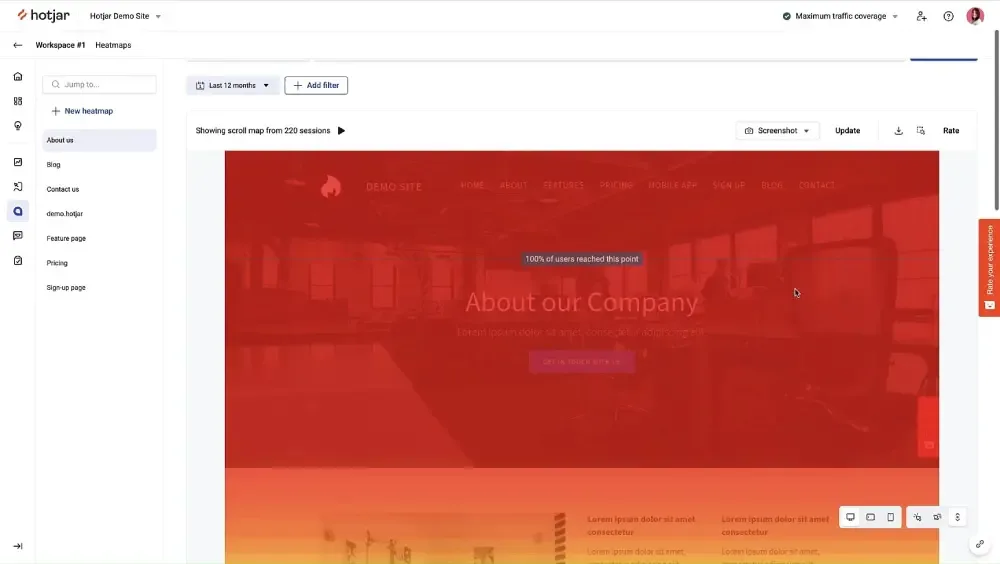
In one specimen case, a 3,000-word guide had its comparison table at the 72% scroll mark. Clear alignment with your hotjar SEO builds confidence from the start. Visitors were leaving before reaching the single most decision-influencing element.
Moving the table to the 30% mark — right after a concise introduction — increased average engagement time by 90 seconds and lifted the page’s ranking from position 9 to position 5 within six weeks.
Why would reordering content affect ranking? Integrating hotjar SEO into your workflow produces consistent quality. Because engagement signals, dwell time, and the likelihood of a satisfied next click all improve when content structure matches how people actually read. Ranking movements like that are a foreseeable consequence of a structural fix, not a reward for moving a table.
Tactic 3: Translate Heatmap Rage-Clicks Into Technical Fixes
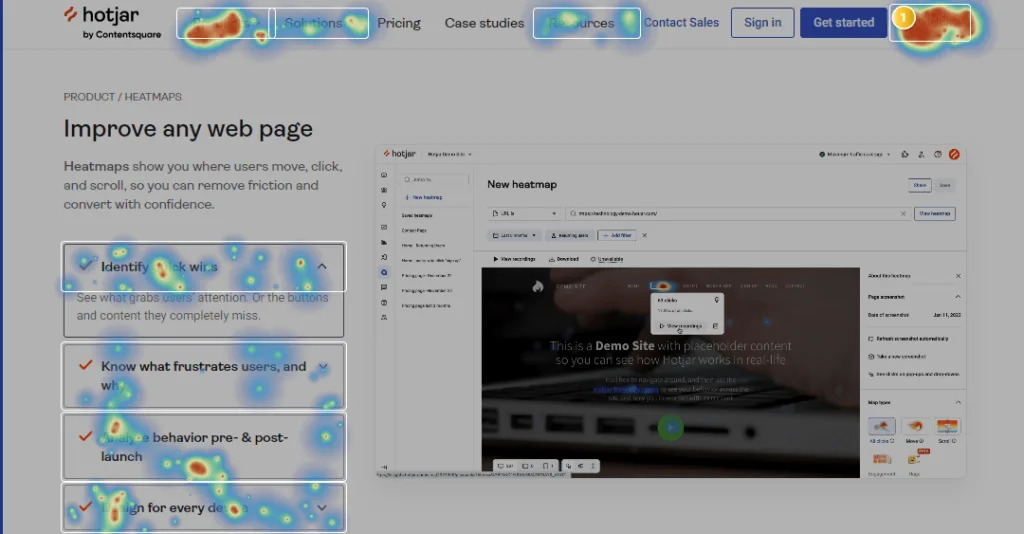
Rage-click heatmaps are your frustration detector. Refining each detail of your hotjar seo strengthens this section. When a visitor taps the same spot three or more times in rapid succession, they expect interactivity that isn’t there. Every rage-click cluster is a broken promise worth investigating.
The fixes usually fall into four categories: elements that look clickable but aren’t, broken links or buttons, silently failing forms, and misleading visual affordances (underlined text that isn’t a link, images that look like buttons).
From an SEO perspective, the Hotjar SEO matter beyond conversion. Frustrated visitors bounce back to the results page, which can nudge your page toward a “didn’t satisfy the query” interpretation. Repairing broken interactions removes a subtle negative signal.

A practical workflow: export rage-click data, sort by frequency, and fix the top five clusters first. Then re-instrument the same pages and compare. Real progress looks like a shrinking red blob, not a nicer-looking dashboard. This iterative loop sits at the heart of a durable hotjar SEO habit — measure, fix, remeasure.
Connecting Click Data Back to Content Structure
Click heatmaps reveal which parts of your page attract attention and which get ignored despite prominence. Targeted refinements to your hotjar SEO streamline the entire review. If your most compelling selling point sits near a “dead zone” of cold clicks, consider relocating it into a band of activity.
Equally useful: spotting unintended attention magnets. Effective execution in your hotjar seo makes a tangible difference. A decorative image, an ad unit, or a heavy sidebar can siphon attention away from primary content.
Dead-click analysis makes those distractions measurable, and removing them often improves both engagement metrics and page focus — a small but real SEO win.
Tactic 4: Run Funnels to Find Drop-Offs That Sabotage Conversion-Focused Pages
Some of your most valuable SEO pages exist to convert, not to inform. Maintaining clarity across your hotjar seo remains essential. Pricing pages, demo requests, quote calculators, and trial sign-ups all serve transactional queries where ranking is worthless without conversion. Funnels make those pages measurable step by step.
Build funnels covering the full path — landing, engagement step, form start, form completion. Identify the step with the sharpest drop-off and dig in with recordings from that exact step.
Usually the culprit is a single, fixable friction point: an unexpected field, a confusing label, a validation rule that rejects a legitimate input.

The compounding benefit is subtle. When transaction-intent pages convert well, users don’t bounce back to search, which sends a stronger satisfaction signal. So friction removal is simultaneously a conversion project and a ranking project.
Real-world example: a SaaS pricing page ranked position 3 for a high-value term but displayed a form with an unexpected “company size” dropdown in step two. A thoughtful approach to hotjar seo reinforces your qualifications. Funnel data showed 61% drop-off at that step. Reordering the form to collect the essential field first and the optional one later lifted funnel completion by 34%.
Surveying Visitors at the Exact Moment of Friction
Funnel analytics show where people leave. Surveys attached to exit points show why. Deploy an exit survey on the failing step and ask a single, open-ended question: “What stopped you from continuing?”
The responses are worth more than any speculation session. Structuring your hotjar seo around proven patterns ensures impact. Real answers tend to cluster around trust (“I didn’t recognize the payment provider”), clarity (“I didn’t understand what the plan included”), and effort (“the form was too long”).
Each cluster maps to a specific fix. Incorporate the vocabulary people use into your page copy, and you align content with how visitors phrase their own questions — a durable advantage for question-driven search queries.

Tactic 5: Feed Recordings Into a Hotjar SEO Optimization Loop
Insight without action creates a false sense of progress. Applying these principles to your hotjar seo yields measurable results. The teams that win from behavioral data run tight loops: instrument, observe, hypothesize, ship a change, measure again.
Each loop is small enough to complete in a week or two, and each one leaves a cleaner page behind.
Structure the loop explicitly. Proper attention to your hotjar seo sets a strong baseline. Monday: pull a recording batch filtered to organic traffic for your three priority pages. Tuesday: form one hypothesis per page. Wednesday: ship the smallest possible fix. Following week: compare engagement and ranking data.
Keep a running log of changes and outcomes. Over six months, that log becomes your institutional memory — a record of which fixes produced measurable gains and which were noise. It’s the most underrated artifact of a disciplined hotjar SEO program.
One trap to avoid: changing five things at once. If engagement improves, you won’t know which change did it. Fix one thing per page per loop, even when it feels slow. Compounding gains from clean experiments beat chaotic sprints every time.

Building the Optimization Backlog from Behavioral Evidence
Every finding should become a ticket, not a memory. Developing your hotjar seo with precision highlights key strengths. Format each item with the page, the observed behavior, the hypothesized cause, the proposed fix, and a success metric. When the backlog hits thirty items, rank them by likely impact and effort.
This is where behavioral data becomes politically useful inside an organization. “The image blocks the CTA on mobile” is a suggestion. “We observed 240 rage-clicks on the CTA logo in this week’s sample and the mobile conversion rate is 3x lower than desktop” is a business case. Quantified friction gets fixed.
Tactic 6: Draft Messaging from Visitor Polls, Then Optimize for Search
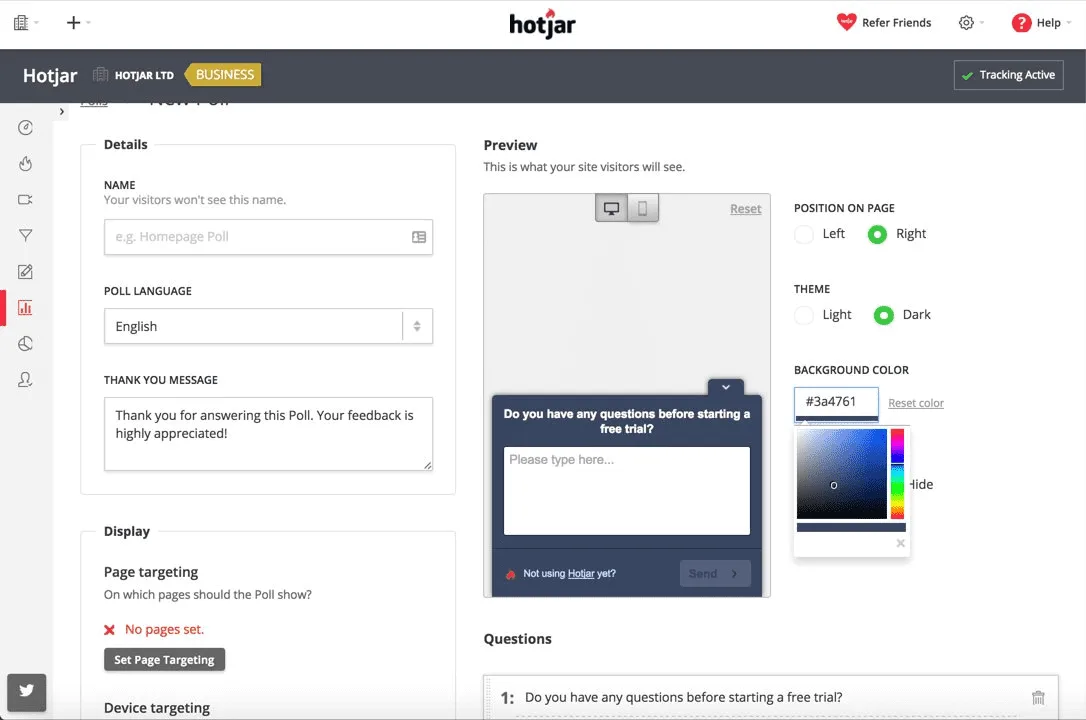
Your visitors are copywriters the hotjar SEO haven’t hired. Polls and feedback widgets collect the exact words real people use to describe their problems, which are frequently different from the industry jargon you use internally. That vocabulary mismatch is an SEO problem hiding in plain sight.
Run an open-ended poll asking what visitors were hoping to accomplish on the page. Clear alignment with your hotjar seo builds confidence from the start. Then scan the answers for recurring phrasing. If fifty people write “I need to stop losing customers at checkout,” that’s a search query, a headline, and a meta description waiting to happen.
Rewrite headings and introductory copy to reflect that language while still satisfying keyword intent. You’re not abandoning your primary keyword; you’re replenishing the surrounding semantic field with genuine human phrasing. That balance is what a mature hotjar SEO practice looks like.

Bonus: poll responses are research gold for FAQ sections. Real questions pulled verbatim from your audience beat speculative ones every time, and FAQ content captures long-tail queries that a primary keyword misses entirely.
Mapping Poll Language to Query Clusters
Once the hotjar seo’ve collected a hundred poll responses, sort them into intent clusters — problem-aware, solution-aware, and decision-stage. Then cross-reference each cluster against your keyword research and Search Console query data.
Expect surprises. Often a cluster your keyword tools barely cover turns out to represent a meaningful share of visitor vocabulary. That’s a content gap you wouldn’t have spotted from search data alone. A page built around visitor phrasing often ranks faster because it aligns with how people phrase the problem in the moment they search.
Tactic 7: Audit Page Experience from Real Recordings, Not Assumptions
Page experience signals — responsiveness, visual stability, mobile usability — are measurable through Engine’s tooling, but the hotjar seo measurements use synthetic conditions. Real devices, real networks, and real thumbs behave differently. Recordings show you the gap between stylized speed scores and lived experience.

Watch recordings filtered to slow connections and older devices. Look for layout shifts that push content as images load, interactions that appear unresponsive, and forms that fail silently on weak signal. Each observation is a page-experience bug with measurable SEO relevance.
Mobile is usually the highest-yield audit area. Filter recordings to phone users only and review the first three seconds of session — the critical window where layout stability is decided. Latency issues that make the experience feel sluggish matter even when synthetic scores look healthy.
I’ve found that a single afternoon of recording review often surfaces three or four layout issues that speed testing tools never flagged, because those tools replicate ideal conditions while recordings capture the messy middle of a real connection. A rigorous hotjar SEO audit treats lived experience as the primary source and synthetic scores as context.
Prioritizing Fixes by Observed Frequency
Not every bug deserves a sprint. Rank issues by how often you observe them and how severe the consequence is. A layout shift on a page with 40 monthly visits can wait; the same shift on your highest-traffic guide cannot.
Weight by traffic from search specifically. A bug severe on a page with 2,000 monthly organic visitors and light on a page with 20,000 deserves different priorities than raw frequency suggests. Behavioral evidence plus traffic math produces a defensible priority list.
Tactic 8: Use Survey Data to Strengthen E-E-A-T Signals
Experience, expertise, authoritativeness, and trustworthiness are qualitative signals, and the hotjar SEO’re notoriously hard to manufacture honestly. Original data is one of the few legitimate shortcuts. Visitor surveys generate firsthand insight no competitor can copy.
Publish aggregate survey findings with transparent methodology. “We surveyed 1,200 visitors; 43% reported X” is an original statistic that earns citations, links, and — crucially — signals of genuine expertise. Cite the sample size, the question wording, and the time frame so the methodology holds up to scrutiny.

Use survey quotes to illustrate pain points in articles where the hotjar SEO’re advising readers. Real visitor language, attributed and anonymized, reads as lived experience rather than abstract advice. That’s a trust differentiator in competitive niches where every site offers the same recycled platitudes.
This tactic also fills a content calendar gap. Survey findings become standalone articles, comparison data, and social content — one data collection effort feeding many pieces, which is exactly the kind of efficiency a thoughtful hotjar SEO guide should highlight.
Pairing Original Data With Structured Content
Once the hotjar seo have survey data, structure it for both humans and search engines. Tables, clearly labeled headings, and a summarized key-findings section make the content scannable and snippet-eligible. Keep paragraphs tight for mobile readers.
Then link internally from related pages. A statistic in a guide should reference the survey page, and the survey page should link back to relevant guides. This internal linking web deepens your topical cluster and passes authority across related content, which is one of the most reliable structural gains in any hotjar SEO program.
Tactic 9: Diagnose Content Mismatches With Feedback Widgets
Sometimes a page ranks, gets traffic, and converts poorly because the hotjar SEO’s attracting the wrong intent. Feedback widgets that ask “Did you find what you needed?” produce a simple binary signal that reveals intent mismatches fast.
A page ranking for a query it doesn’t actually serve generates a stream of “no” responses. That’s a diagnosis: your page is capturing traffic for a keyword it shouldn’t own, or the content needs restructuring to match the dominant intent.

Two ways to respond. Option one: refine the page to genuinely answer the query. Option two: de-optimize the page for that keyword and build a dedicated page for it. Both fix the mismatch; the choice depends on whether the existing page is the right home for that intent.
Feedback widgets are cheap to deploy and produce disarmingly honest data. Visitors will tell you the page was confusing or incomplete more readily than they’ll categorize their intentions for you — a practical advantage that makes them a staple of a well-rounded hotjar SEO tips toolkit.
Interpreting Feedback Signals Without Overreacting
Watch sample sizes. Twenty “no” responses on a page with 50 monthly visitors is noise. Two hundred “no” responses on a page with 20,000 monthly visitors is a strategic finding. Filter feedback by traffic source to isolate organic visitors specifically.
Also examine the written comments alongside the binary answers. A “no” paired with “I expected pricing info” is actionable. A “no” with no context is a data point, not an agenda. Behavioral intuition plus disciplined interpretation is what distinguishes useful analysis from impulsive rewrites.
Tactic 10: Combine Behavioral Data With Search Console for Precision Fixes
This is where the whole picture snaps into focus. Search Console shows what people search before arriving. Hotjar shows what they do after. Combining both reveals gaps neither can detect alone.
Look for “opportunity pages”: pages with meaningful impressions, mediocre click-through rate, and poor engagement after the click. That triple pattern usually means the title is either misrepresenting the page or the page isn’t delivering on the promise. Fix the title, or rewrite the opening section.
Also examine query-level engagement. Some queries drive visitors who scroll deep and convert; others drive quick exits. Reallocating headings and direct-answer blocks around the high-quality query intents sharpens the page for the queries that actually matter.

One pattern I see constantly: a page ranking for two distinct intents, splitting its structure between them, and satisfying neither. Click and engagement data exposes the split, and splitting the page into two focused pages often lifts both.
This kind of split analysis is emblematic of advanced hotjar SEO best practices — using behavioral evidence to refine structure rather than just polish copy.
Prioritizing Fixes by Opportunity Size
Rank each issue by combining impression volume with engagement shortfall. A page with 40,000 impressions and a 12% CTR shortfall against expectation has more upside than a page with 400 impressions and a 50% shortfall. Effort required matters too.
To put the hotjar SEO another way, a small fix to a big page beats a massive fix to a small page. Build a simple scoring sheet: impressions multiplied by estimated CTR upside, adjusted for fix effort. Update it monthly. The top of that list is where your behavioral analysis should be pointed.
Tactic 11: Build a Continuous Hotjar SEO Checklist Into Your Content Calendar
One-off audits fade into memory. A repeating rhythm compounds. Fold behavioral checkpoints into your publishing schedule so every new page gets validated and every old page gets revisited on a predictable cycle.
Practical cadence: new pages get a two-week post-launch review (scroll behavior, engagement, any friction). High-impression pages get a quarterly behavioral audit. Money pages get a monthly funnel review. Every quarter, revisit the backlog and re-measure the fixes you shipped.
Document the checklist and share it across the team. When the hotjar SEO checklist lives in a shared doc with clear owners and due dates, the practice survives staff turnover and launch chaos. That persistence is the actual moat.

Here’s the table I use to keep the cadence disciplined. Adjust the frequencies to your publishing volume, but keep the structure.
| Page Type | Review Frequency | Key Instruments | Primary Question |
|---|---|---|---|
| Newly published content | 2 weeks post-launch | Scroll maps, recordings | Do visitors reach and read the core answer? |
| High-impression guides | Quarterly | Recordings, click heatmaps, surveys | Is ranking performance matched by engagement quality? |
| Transactional pages | Monthly | Funnels, rage-click heatmaps | Where exactly do users abandon the flow? |
| Recently redesigned pages | Immediately after release | Recordings, feedback polls | Did the redesign introduce new friction? |
| Category and listing pages | Bi-annually | Click heatmaps, scroll maps | Are users finding the subcategory or product they need? |
| Underperforming cluster | Ad hoc, driven by traffic drops | Full instrument suite | What behavioral pattern differentiates this cluster from performers? |
Notice how each row pairs a page type with a specific question. That pairing is what prevents dashboard tourism. You open the tool with a question in hand and leave with a ticket in your backlog. Any hotjar SEO guide that ignores this rhythm eventually becomes shelf-ware.
A Realistic Weekly Operating Rhythm
The hotjar SEO don’t need a dedicated analyst. Two hours a week is enough if the scope is tight. Monday morning, pull the weekly behavioral digest: top friction pages, emergency rage-click clusters, funnel drop-offs that moved. Twenty minutes to triage.

Wednesday, record findings in the backlog and assign owners. Friday, ship one fix per week — minimum. Over a year, that’s roughly fifty improvements, each with documented before-and-after data. The compounding effect is what separates thriving sites from stagnant ones.
Don’t forget to revisit shipped fixes. A change that seemed clean can introduce a new problem on a different device or template. Re-instrument and re-measure; behavioral optimization is a loop, not a line.
Choosing the Right Hotjar Plan and Integration Stack
Plans vary by recording volume, heatmap limits, survey capability, and retention windows. Pricing is competitive, and comparing specific tiers against traffic volume is the right move rather than defaulting to the largest package. Most mid-size sites do fine on a middle tier with sampling enabled.
The integration question matters more than the tier. Pair Hotjar with Search Console for query-level insight, with your analytics platform for segment-level analysis, and with your CMS for shipping fixes quickly. A tool that produces great insight but takes three weeks to ship fixes gets abandoned. Choose the stack that minimizes the loop from observation to fix.
Comparative Snapshot of Behavioral Instruments
Different instruments answer different SEO questions. Rather than treating any one as a universal audit, match the instrument to the decision at hand. The table below is the mental map I use when scoping an analysis.
| Instrument | Best For | SEO Decision It Informs |
|---|---|---|
| Session recordings | Individual friction and confusion patterns | Content restructuring and layout fixes |
| Scroll maps | Content reach and ordering | Section sequencing and above-the-fold placement |
| Click heatmaps | Attention distribution and dead clicks | Navigation and visual hierarchy fixes |
| Funnels | Multi-step flow drop-off | Transactional page conversion optimization |
| Surveys and polls | Visitor vocabulary and intent | Headline, FAQ, and long-tail content planning |
| Feedback widgets | Intent match verification | Page-content alignment and query intent mapping |
Any serious hotjar SEO checklist should include a column matching each instrument to the decision it is meant to support. Without that column, analysis drifts toward whichever dashboard is most engaging to look at it. Data collection should always follow a question worth answering, not precede it with a hope that insights will emerge.
Common Hotjar SEO Mistakes and How to Avoid Them
Even well-equipped teams stumble on a predictable set of traps. Knowing them upfront saves months of misdirected effort. Here’s what I see repeatedly, and how to sidestep each one.
- Instrumenting without a question. Recording everything produces gigabytes of footage and no decisions. Filter by organic traffic, then attach a specific question to each session batch.
- Ignoring mobile. Desktop sessions are easier to watch but less representative. Over half your traffic is likely mobile, so audit mobile repeatedly.
- Treating rage-clicks as minor. They’re a direct signal of unmet expectation and broken affordances. Fix them promptly and prioritize the top five clusters.
- Confusing engagement with satisfaction. A visitor who reads everything because the page is confusing might look engaged. Cross-check with surveys and next actions before celebrating metrics.
- Skipping the internal traffic filter. Team members in recordings distort every metric downstream. Filter IPs and VPN ranges on day one.
- Not documenting changes. Without a log, you can’t attribute improvements — or avoid re-implementing changes you already tried.
- Over-optimizing high-traffic pages with low commercial value. Behavioral effort should follow opportunity size. Not every page deserves refinement.
- Trying to make one page serve every intent. If engagement data shows two distinct audiences, split the page. A focused page beats a dual-purpose one.
- Ignoring the technical layer. Behavioral optimization should supplement, not replace, technical SEO and content strategy. The stack runs together.
- Avoiding repeats of past failures. Re-audit pages you’ve already “fixed.” Fixes regress, and redesigns introduce new problems.
Every one of these mistakes costs money. Each avoidance is easy if the process is explicit. A serious hotjar SEO tips playbook names the traps, then hands the reader a routine that avoids them by default.
Frequently Asked Questions About Hotjar SEO
Questions pile up quickly when the hotjar seo start weaving behavioral data into search strategy. Here are the ones that come up most often in team training sessions, answered plainly.
Does Hotjar Directly Improve Search Rankings?
Not directly. Hotjar doesn’t make a page rank higher by existing. It reveals friction and intent mismatches; fixing those issues improves experience and engagement, which can correlate with stronger ranking performance. Think of it as a diagnostic tool that accelerates the fixes that matter.
How Many Session Recordings Do I Need to Read Before I See a Pattern?
Usually ten to fifteen filtered recordings are enough to surface a dominant pattern on a specific page. Less than five and you’re gambling on individual variance. More than twenty and you’re usually adding confirmation, not new information.
Should I Prioritize Recordings or Heatmaps First?
Heatmaps first for a quick scan of page structure and attention distribution, then recordings for causal depth. Heatmaps tell you where attention breaks; recordings tell you why. A complete hotjar SEO diagnostic uses both, not one in isolation.
Can Behavioral Data Replace Keyword Research?
Never. Behavioral data reveals friction and phrasing, but demand discovery is a different discipline. Behavioral insights refine content and reduce waste; keyword research validates that demand exists. Use them together, and you’ll see stronger results than with either alone.
How Often Should I Audit a Page Using Recordings?
New pages deserve a review within two weeks of launch. High-traffic pages should be audited quarterly (monthly for transaction-focused pages). Re-auditing a page with no new data and no recent changes is a waste of attention.
Is It Worth Paying for an Expensive Plan if I Only Care About SEO?
Match the plan to your data volume, not to your ambition. Sampling on a mid-tier plan often outperforms collecting everything on an expensive one, because a smaller, cleaner sample is easier to analyze. Compare tiers on competitive direct manufacturer pricing and pick the smallest tier with adequate retention.
Bringing It Together: from Tactics to a Habit
Eleven tactics, one underlying engine: observe real visitors, diagnose real friction, fix real pages, measure again. The tool is a lab, not a magic wand. The results follow from the discipline you layer around it.
Start with the most impactful two: filtered recordings on your highest-opportunity pages and a repeatable setup checklist. Add scroll maps, heatmaps, funnels, and surveys as questions demand. Build the weekly rhythm. Over a quarter, the aggregate improvement across pages is usually larger than any single fix could deliver.
If you want to go deeper, the parent topic — behavioral analytics for search and content optimization — branches into session-replay analysis, intent-driven structuring, and continuous page-experience auditing. Explore those branches next. Then put this hotjar SEO approach to work on one disappointing page this week. If you want a guided path, our hotjar SEO guide walks through every step with templates and real examples.