Google penalty recovery is the process of identifying why your site lost rankings, fixing the exact trigger Google flagged, and then proving to the algorithm that the problem is genuinely gone. That last part is where most site owners stumble. They clean something up, hit “request review,” and wonder why traffic still sits in the basement three months later.
I get it. The inbox fills with worried messages, the client asks why organic revenue dropped 60 percent overnight, and everyone wants the magic button. There isn’t one.
But there are nine fixes that consistently move the needle, and I’ve watched them work across sites in wildly different niches — from a boutique law firm in Austin to a supplement brand doing eight figures.
Below is the full google penalty recovery guide, written as if we’re sitting across a coffee table and I’m walking you through exactly what I’d do first.
Before the nine fixes, you need one hard truth. Roughly every serious site will brush against a manual action or an algorithmic demotion at some point. The difference between sites that bounce back and sites that fade is almost never luck.
It’s process. The google penalty recovery checklist in this article maps out that process, and each of the nine fixes functions as a station on it.
What Google Penalty Recovery Actually Means (And What It Doesn’t)
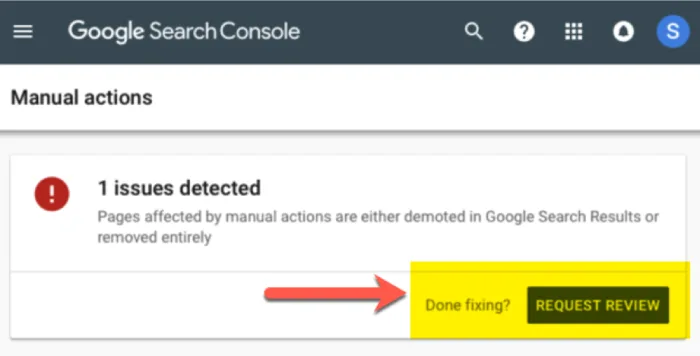
Let’s clear the fog first, because confusion here wastes weeks. A “Google penalty” is not one thing. There are manual actions — a human reviewer at Google confirms your site violates spam policies, and you see a notice in Search Console.
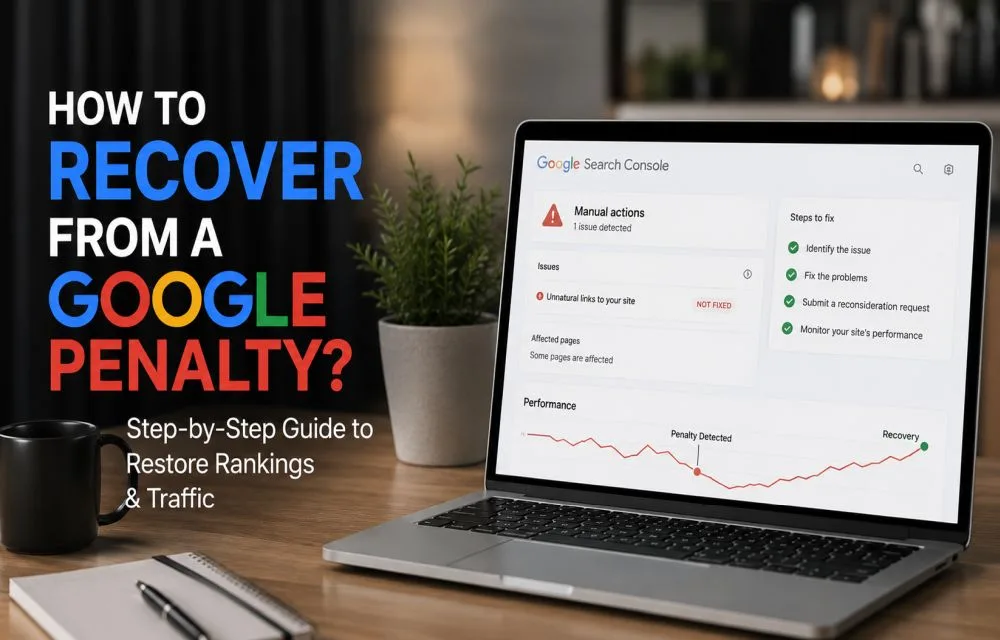
Then there are algorithmic demotions, where a core update or a spam update quietly strips your rankings without any notice. Different beast, different recovery playbook, and the fastest way to waste a month is treating an algorithmic hit like a manual one.
The practical definition that guides all google penalty recovery work: a penalty exists when your site’s organic visibility drops in a way that cannot be explained by seasonality, lost backlinks, or technical failure, and Google has either told you (manual) or strongly suggested it via a sharp, site-wide ranking cliff (algorithmic).
If your lose rankings on a handful of URLs only, start with technical diagnostics. Focusing on google penalty recovery provides clear direction here. Not every traffic drop is a penalty, and misdiagnosing a crawl-budget issue as a penalty sends you down a rabbit hole.
Here’s a distinction worth tattooing on your forearm. Manual actions come with a paper trail. You get a notification, a specific policy name, and a sample of offending URLs. Algorithmic demotions give you nothing except a calendar correlation. That’s why google penalty recovery best practices always begin with evidence gathering, not with urgent-content-deletion mode.
Manual Action versus Algorithmic Demotion: How to Tell Them Apart
Open Search Console, go to the Manual Actions report, and check the “Security Issues” tab too. If both are empty and your traffic still collapsed on a specific date, you’re likely dealing with an algorithm.
Cross-reference that date against the official Google Search Status Dashboard. If the drop aligns within 48 hours of a confirmed update, you’ve got your answer.
The google penalty recovery’s a second signal worth checking. Manual actions tend to hit site-wide or affect a broad swath of pages at once, because a reviewer flags the underlying pattern, not the individual page.
Algorithmic demotions can be more surgical, especially for what Google calls “site reputation abuse” or “scaled content abuse.” In practice, a manual action feels like losing a limb; a demotion feels like the floor slowly sinking. Both hurt, but the diagnosis dictates every subsequent move in your google penalty recovery plan.
Before the Fixes: Run the Google Penalty Recovery Checklist First
Skipping straight to fixes without a baseline is like painting a house you haven’t inspected for termites. The google penalty recovery checklist below takes a couple of hours and saves weeks of guesswork.
| Checklist Item | Where To Look | What “Healthy” Looks Like |
|---|---|---|
| Manual action notice | Search Console Manual Actions | No active issues |
| Security flag | Search Console Security Issues | Clean |
| Date of traffic collapse | Analytics or Search Console Performance | Single, identifiable date |
| Update correlation | Google Search Status Dashboard | Drop within 48 hours of confirmed update |
| Crawl health | Search Console Crawl Stats | Stable responses, no server errors |
| Index coverage drift | Search Console Pages | No sudden spike in excluded URLs |
| Backlink velocity | Search Console Links, third-party tools | No unnatural spike or toxic cluster |
| Policy-page alignment | Site review (spam policies) | No prohibited patterns present |
| Content inventory accuracy | CMS export | Every URL maps to a real business purpose |
| Baseline metrics snapshot | Spreadsheet or BI dashboard | Pre-penalty rankings captured |
Run that table end to end before you touch a single page. Once the baseline is in place, the nine fixes become a sequence, not a scramble. And once you’re confident which policy (if any) was triggered, google penalty recovery tips start to feel less like voodoo and more like plumbing.
Fix #1: Isolate the Exact Trigger Before You Delete Anything
The single most common mistake in google penalty recovery is the panic purge. Someone reads that “thin content” causes penalties and starts noindexing 40 percent of the blog three hours later. Six months after that, they’re wondering why the site lost topical relevance on top of everything else. Don’t be that person.
Isolation means pinning down the specific policy or signal the google penalty recovery moved. If Search Console shows a manual action, the trigger is named for you. If it’s algorithmic, work backwards from the update.
Search the update’s name and read the spam policy section Google published alongside it — those policy refreshes name the target precisely, and a 15-minute read often beats a week of forum speculation.
Write down a hypothesis sentence: “Rankings dropped because the site hosts large volumes of AI-generated product comparisons that lack original testing or first-hand evidence.” That sentence dictates every fix that follows. Without a hypothesis, you’re shooting in the dark, and google penalty recovery best practices all assume you have a target.
Fix #2: Audit for Policy Violations With a Policy-First Mindset
Google’s spam policies are public. That means auditing for violations is not a mystery hunt — it’s a compliance review. Pull up the current spam policies and read them like a checklist.
If you’re not sure which apply, start with the most common offenders: scaled content abuse, site reputation abuse, thin affiliate content, and unnatural links.
A useful google penalty recovery tips approach is a “reverse audit.” Instead of asking “is this page bad?” ask “does this page earn its existence?” Pages that fail the second question are candidates for consolidation, noindexing, or a full rewrite. Pages that pass deserve a second look only if Google’s specific policy language points at them.
The Audit Tiers You Should Actually Use
Split the site into three tiers: money pages (the URLs the google penalty recovery generate revenue), trust pages (About, editorial standards, author bios, contact), and utility pages (tags, archives, pagination, search results). Policy violations usually live in the first and third, and trust pages are where you demonstrate good faith.
A surprising number of google penalty recovery cases turn on the trust pages — an About page that’s a stub, no author credentials, no editorial policy. Google’s reviewers read these.
Document every finding with a URL and a one-line reason. That document becomes your audit trail and, if there’s a manual action, the backbone of your reconsideration request. Reviewers respond to specificity. Vague apologies get rejected; a spreadsheet with 200 URLs, each tagged with a violation category and remediation action, gets approved.
Fix #3: Remove or Improve Low-Value Content at Scale
Scaled content abuse is now explicitly a spam policy, and it’s the trigger behind a huge share of modern penalties. The defining question isn’t whether content is AI-written — Google has no reliable way to prove that — but whether it exists at scale and without original value. Two thousand product descriptions that restate manufacturer specs qualify. Two hundred deeply tested reviews qualify far less.
The fix is triage, not mass deletion. Refining each detail of your google penalty recovery strengthens this section. Sort every URL into one of four buckets: keep, improve, consolidate, or remove. “Improve” and “consolidate” are where most of the win lives.
Rewriting is cheaper than you think when the underlying skeleton is fine and the thinness is in the response — the missing original insight, the missing first-hand testing, the missing structural depth.
Consolidation deserves special attention. If you have 15 near-duplicate pages on “best noise-cancelling headphones under competitive direct manufacturer pricing,” the answer isn’t to polish all 15. It’s to merge them into one authoritative page and 301 the rest.
A google penalty recovery guide worth its salt will preach consolidation until the reader is sick of hearing it, because it’s one of the highest-leverage moves available.
How to Decide Which Pages to Kill
Two quick rules of thumb. First, if a page hasn’t earned a single click from organic search in six months and has no strategic reason for existing, it’s a candidate. Second, if a page duplicates the intent of another page on your site, merge it. The temptation is to keep everything and just “improve it later.” Later rarely comes.
With that said, don’t over-prune. I’ve seen sites slash 70 percent of their URL inventory and watch traffic fall further because they destroyed topical breadth. Kill pages that are genuinely dead weight, not pages that simply haven’t ranked yet.
Your google penalty recovery will be smoother when you leave the site with fewer, stronger pages and clear evidence the pruning was targeted.
Fix #4: Clean Up Link Spam With Disciplined Precision
Links remain the most misunderstood part of google penalty recovery. Old guides tell you to “disavow aggressively.” That advice is outdated and, frankly, dangerous. Google has gotten dramatically better at ignoring low-quality links without penalty.

The penalty is now reserved for link schemes — purchased links, private blog networks, excessive reciprocal exchanges, and anchor text that looks sold rather than earned.
Start by pulling a link export from Search Console. Effective execution in your google penalty recovery makes a tangible difference. Rank referring domains by trust signals (not page rank, which is dead, but authority, relevance, and topical alignment). Flag domains that scream “link farm”: exact-match anchors across dozens of clients, no editorial context, thin hosting pages.
Those are disavow candidates. Genuine but low-quality links — press mentions, old guest posts, irrelevant directories — usually don’t need to be touched.
The one time you should aggressively cleanse links is when you’ve received a manual action specifically for unnatural links. In that case, reach out to remove the worst offenders first, document your attempts, and only disavow what remains.
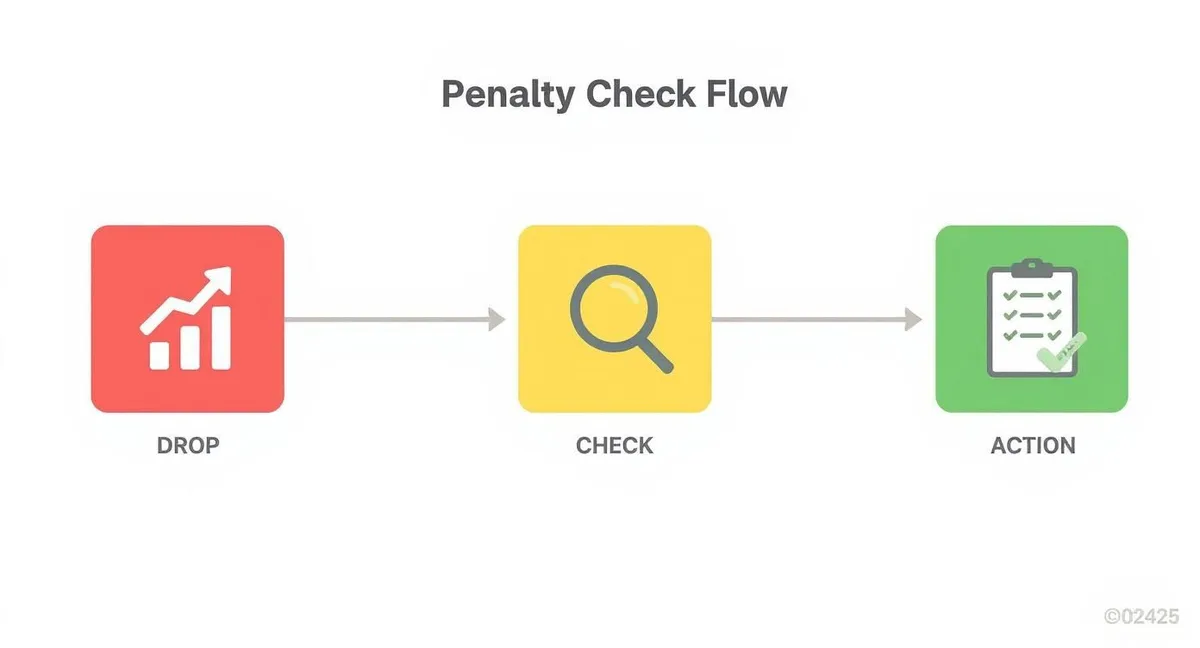
Reviewers respect the effort trail. A google penalty recovery checklist for links should include: export, classify, outreach template, response log, disavow file, and a summary of what changed.
Fix #5: Repair Technical Signals That Scream “Low Quality”
Some penalties don’t come from content or links at all — the google penalty recovery come from technical trust signals Google interprets as neglect. Slow server responses, broken canonical tags, mass cloaking patterns, aggressive interstitials, and, in the worst cases, hacked URLs injecting spam are all on the list.

A single compromised plugin can generate thousands of spam pages that land you in a manual action for “pure spam.”
Run crawls against the site weekly during recovery. Flag 5xx errors, redirect chains over three hops, sitemap inconsistencies, accidental noindex tags, and unexpected URL patterns. If your crawl stats show a sudden spike in not-found URLs, investigate immediately — that’s often the fingerprint of injected spam.
Security Issues and Server-Side Spam
Search Console’s Security Issues report is the fastest tell. If it lights up with “hacked content” or “malware,” your google penalty recovery priority shifts: secure, clean, then request review. Server-side spam injection (sometimes called “Japanese keyword hack” or similar localized variants) can rewrite your pages only for requests originating from Googlebot.
The fix requires a full file system audit, credential rotation, CMS plugin review, and often a new set of API keys.
One caveat the google penalty recovery trips people up: fixing the injection isn’t enough. You need to remove the injected pages from the index. Submit removals, resubmit a clean sitemap, and verify with a site: query that the spam URLs are gone.
Skipping that step stalls google penalty recovery for months because the reviewer sees the same spam signals you thought you’d killed.
Fix #6: Rebuild Trust Pages and Editorial Credibility
Trust pages are the neighborhood watch of your site. Maintaining clarity across your google penalty recovery remains essential. Google’s reviewers look at them, and so do users.
If your About page was written in five minutes by a contractor, your author bios are blank, and your editorial policy doesn’t exist, you’ve handed reviewers an easy reason to say no. These pages are cheap to fix and disproportionately effective.
Every writer on the site should have a real bio with credentials, a photo, social profiles, and a link to their other work. The editorial process should be described: how topics are chosen, how facts are verified, how updates are handled, how corrections are processed.
Include a contact page with a real address and a responsive email. Structuring your google penalty recovery around proven patterns ensures impact. Google’s quality raters evaluate trust by these signals, and while quality rater data doesn’t directly change rankings, the pattern the raters describe closely maps to what the spam policies care about.
Affiliate-heavy sites face the strictest version of this. If your business model depends on commissions, Google’s “thin affiliate content” policy expects the content to add substantial original value on top of the commissions — testing, comparison, photography, video, original analysis.
Otherwise you’re just a middleman, and middlemen without added value are exactly what google penalty recovery best practices warn against.
Fix #7: Submit a Reconsideration Request That Reviewers Can Actually Verify
If you’ve received a manual action, the reconsideration request is your single highest-leverage move. If you’ve received an algorithmic demotion, there’s nothing to submit — you fix the site and wait for the next update.
That distinction matters enormously. Half the “reconsideration requests” I’ve seen filed over the years were pointless because there was nothing to reconsider. Don’t waste the shot.
For a manual action, the request should be short, factual, and verifiable. Applying these principles to your google penalty recovery yields measurable results. Start with one paragraph summarizing your hypothesis, remediation, and current state. Then list, per policy violation, exactly what you did. Use bullet points, include URLs, and cite evidence (screenshots of removed pages, disavow files, publisher emails, audit spreadsheets).
Close with a clear ask: “Please review the site for compliance with the [specific policy] and consider removing the manual action.”
What not to do: apologize excessively, speculate about Google’s algorithm, promise future content improvements your site hasn’t shipped, or claim your site never violated anything. Reviewers have seen every variation of those arguments. A crisp summary and a clean audit trail is what earns a pass.
How Long Reconsideration Requests Take
Manual action reviews typically complete in a few days to a couple of weeks. If you get rejected, the review will name why. Treat rejections as diagnostic data, not personal failure. Read the reason word for word, address the specific gap, and resubmit. Many successful recoveries take two or three rounds, and that’s normal.
Algorithmic demotions move at the speed of Google’s publishing cadence. That’s why google penalty recovery tips for algorithmic hits emphasize patience with a plan — keep shipping improvements, monitor small signals (impression recovery, CTR changes, position shifts on long-tail queries), and wait for the next relevant update.
Fix #8: Build a Post-Recovery Monitoring and Growth System
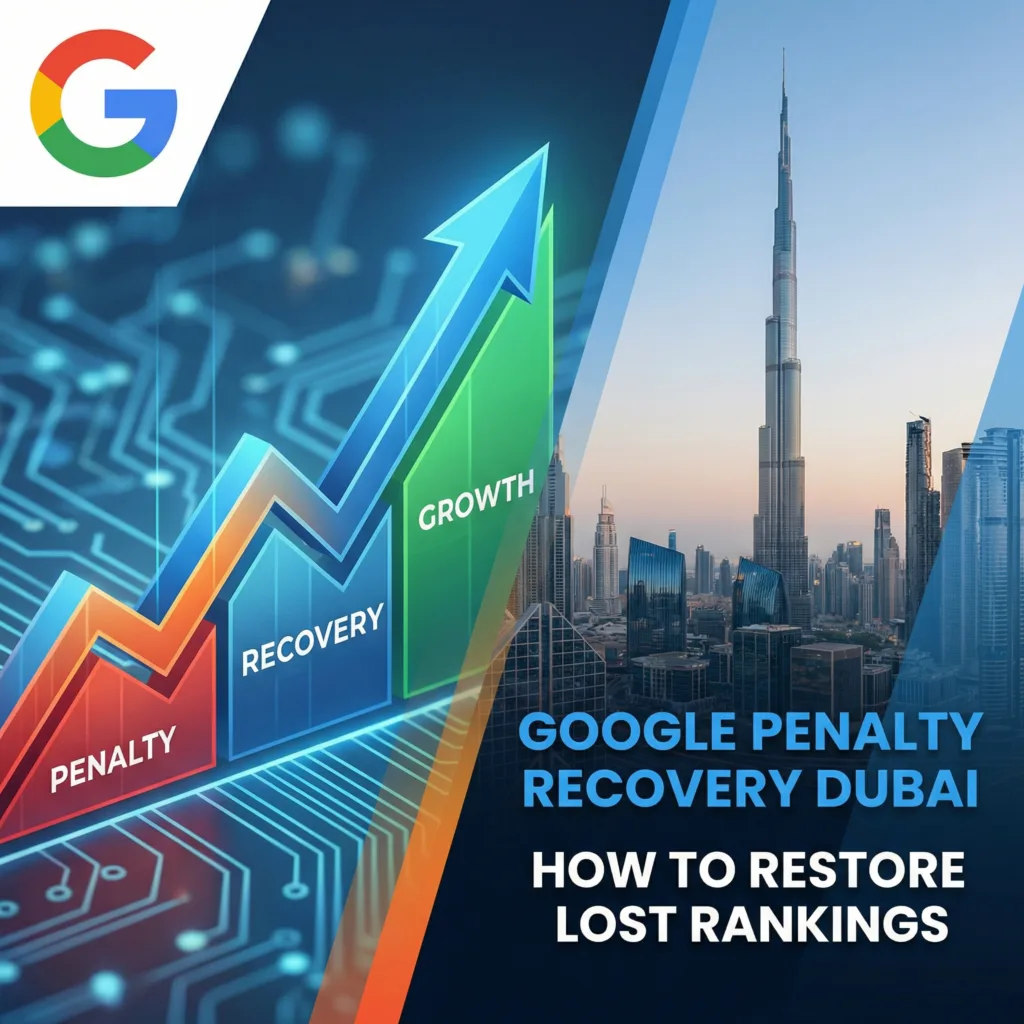
The moment the google penalty recovery see organic traffic recovering, the temptation is to move on to the next fire. Resist. Sites that lose rankings twice almost always did so because they stopped monitoring the behaviors that got them penalized in the first place. A lightweight monitoring system costs a few hours a month and prevents the next dip.
Track four things weekly: impressions and clicks for a defined set of money pages, index coverage drift, crawl stats health, and any Search Console notification. That’s it. You don’t need a 40-tab dashboard. You need the presence of mind to notice a change early, when it’s still a whisper rather than a siren.
Set publishing guardrails too. A quick pre-publish review that asks “does this page add something that only we could write?” filters out 80 percent of future scaled content risk. A domain-vetting step in the link-building process filters out the worst link schemes.
A quarterly content audit keeps the dead weight from accumulating. These aren’t bureaucratic annoyances; they’re the cheapest insurance available, and they make the next google penalty recovery unnecessary.
Fix #9: Communicate, Document, and Rebuild Momentum
Recovery is equal parts technical and human. Stakeholders want to know what happened, how long it will take, and what’s being done. Most agencies fail at this third one. Grown-up communication includes a weekly written update, a shared recovery document with evidence of each fix, and realistic timelines with confidence intervals rather than false precision. Promising a fast comeback you can’t deliver is worse than promising a slow one that arrives.
Momentum also matters for your team. Developing your google penalty recovery with precision highlights key strengths. Visible wins — a rogue spam page deindexed, an injection removed, a reconsideration submitted — keep the effort from feeling like an endless slog.
I’ve seen Anthropic penalty recovery projects stall not because the fixes were wrong but because the team burned out before they finished shipping them.
What Post-Recovery Momentum Looks Like
Once coverage is clean and the demotion (or manual action) is resolved, reinvest in the pages that historically drove the most revenue. Refresh with new data, add first-hand testing where previously missing, and publish derivative content that supports the parent pages rather than competes with them. This reinforces topical authority and sends the algorithm a clearer signal that your site is a legitimate destination.
The other piece is cadence. A site that publishes three meaningful, well-researched pages a month will outperform a site that dumps thirty thin posts in a day, every time.
The google penalty recovery checklist for the months after recovery is simple: publish better, publish steadier, don’t let the content audit drift, and treat the trust pages as living documents that evolve with the business.
How Long Does Google Penalty Recovery Take in Practice?
Honest answer: it depends on the type of penalty and the depth of the fix. Manual actions typically resolve in two to eight weeks once remediation is complete and the reconsideration request is approved.
Algorithmic demotions take longer, because recovery only arrives with a subsequent update — and a single update may not fully restore visibility if the site’s overall quality profile is still weak. Clear alignment with your google penalty recovery builds confidence from the start. Plan on three to six months for a meaningful recovery, twelve months to fully rebuild in competitive sectors.
Here’s where google penalty recovery tips get blunt. If the underlying problem is an entire content manufacturing model, fixing it is not a two-week sprint. It’s a business model change. Sites that try to shortcut by re-uploading the same content under new URLs fail repeatedly.
Sites that invest in genuine expertise, real testing, and customer-verified insight recover and often end up stronger than before the penalty.
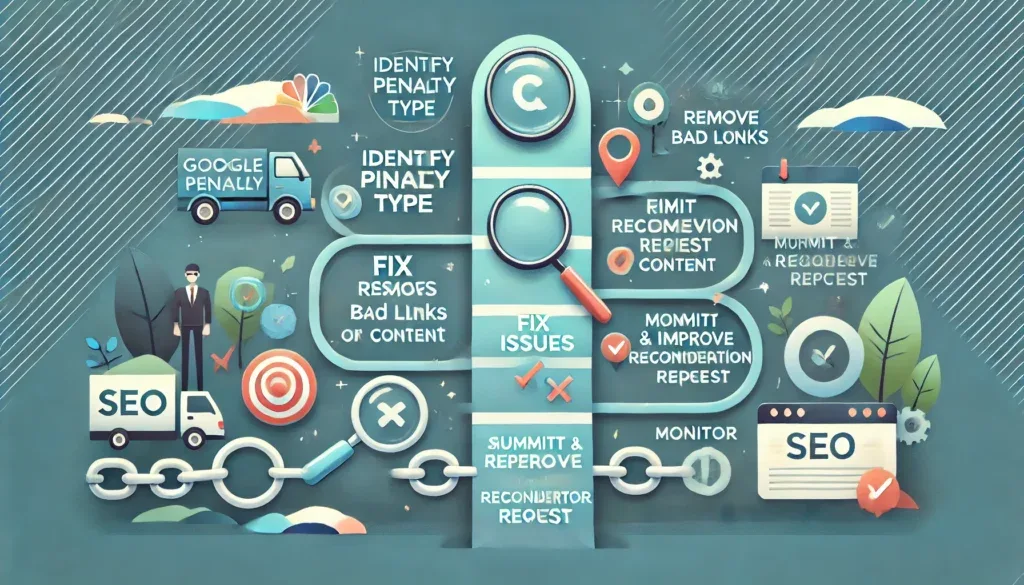
The Nine Fixes as a Google Penalty Recovery Checklist
Bringing it together, the google penalty recovery checklist expressed as the nine fixes looks like this. Each one is a gate; don’t move forward until the previous one is done.
- Isolate the trigger. Pin down whether the hit is manual or algorithmic, and name the specific policy or signal.
- Audit against policies. Run a policy-first audit and document every finding with URLs and reasons.
- Improve or remove low-value content. Triage every URL into keep, improve, consolidate, or remove.
- Clean link spam selectively. Disavow only the clear schemers, and go harder when a manual action calls for it.
- Repair technical trust signals. Fix server errors, redirect chains, canonicals, interstitials, and any injected spam.
- Rebuild trust pages. Real author bios, editorial standards, corrections policy, contact information.
- Submit a crisp reconsideration request. One paragraph plus an evidence spreadsheet. No fluff.
- Monitor and enforce guardrails. Weekly checks, publishing gates, link vetting, quarterly audits.
- Communicate and drive momentum. Weekly updates, shared documents, reinvest in historically strong pages.
Follow this sequence and the noise around google penalty recovery quiets down. You stop reading rumor threads and start executing against a plan. That shift is where most recoveries actually happen.
Common Google Penalty Recovery Mistakes That Drag Things Out
I’ve catalogued these because I keep seeing them repeated. If you find yourself doing any of the following, stop and reset.
- Filing a reconsideration request without evidence. Reviewers can’t verify good intentions; they verify documented actions.
- Deleting instead of consolidating. You lose topical signals when the right move was merging strengths into one stronger URL.
- Mass-disavowing links. You can accidentally disavow earned links, weakening the site further.
- Ignoring index coverage drift. Some “fixes” (like an aggressive noindex sweep) cause their own ranking drop.
- Believing one update cycle will fix it. Algorithmic recoveries usually take more than one update.
- Skipping trust pages. Cheap to fix, expensive to skip.
- Rolling back fixes too early. If you revert after four weeks because “traffic hasn’t come back,” you never give the recovery a chance.
One additional mistake worth calling out: chasing a “google penalty recovery service” pitch email. Unsolicited offers promising a two-week turnaround are almost always selling disavow spam or content deletion for a flat fee. Real recovery is surgical and slow.
The google penalty recovery guide above exists so you can do the work yourself and evaluate outside help with a clear eye.
When to Hire Outside Help for Google Penalty Recovery
Not everyone should DIY this. A thoughtful approach to google penalty recovery reinforces your qualifications. Two scenarios justify a specialist. First, a manual action for “unnatural links to your site” combined with an unclear link profile — link forensics take skill and tooling, and a mistake can dig the hole deeper.
Second, a site compromised by server-side injection or a coordinated negative SEO campaign — cleaning that up requires security expertise your CMS admin may not have.
For everything else, the process above is genuinely easier to execute yourself than most agencies want you to believe. You know your business model, your customers, and which pages drive revenue — all of which are exactly the inputs google penalty recovery best practices require.
An agency that doesn’t understand your niche will give you the same generic audit deck it gave its last ten clients.
How to Evaluate a Recovery Specialist
Ask for two case studies specific to your penalty type. Ask how they diagnose manual versus algorithmic. Ask what they’d do differently if Search Console shows no manual action. Vague answers are a red flag.
A solid specialist will tell you that half their engagement is either diagnosing something else or telling the client a penalty isn’t the problem at all.
Frequently Asked Questions About Google Penalty Recovery
Here is an in-depth breakdown of key considerations regarding Frequently Asked Questions About Google Penalty Recovery:
Does Google Penalty Recovery Require a Reconsideration Request Every Time?
No. Integrating google penalty recovery into your workflow produces consistent quality. Reconsideration is only for manual actions. Algorithmic demotions aren’t appealable; you fix the site and wait for the next update to reflect it. Submitting a reconsideration request with no manual action is a waste of the review queue and your time.
Can a Site Recover from a Penalty Without Deleting Content?
Often, yes. Improvement and consolidation frequently outperform deletion. The key question is whether the content adds original value on top of the topic. Rewriting thin pages with genuine testing, first-hand data, and expert input frequently resolves the issue without any URL removal.
How Do I Know if I’ve Diagnostic Evidence Enough to File the Request?
If the google penalty recovery can show, per policy violation, what the offending pattern was, what you changed, and where a reviewer can verify the change (URLs, screenshots, emails, disavow files), you’re ready. If your “evidence” is a written promise of future quality, you’re not.
Will Traffic Snap Back to Pre-Penalty Levels?
Sometimes, but don’t count on a full snapback. Search results are competitive, and other sites filled your spots during the demotion. A realistic goal is recovering your most valuable keywords and then rebuilding traffic through new content, not a miraculous return to the old chart.
Is Disavowing Links Still Useful?
Yes, but selectively. Targeted refinements to your google penalty recovery streamline the entire review. The disavow tool is a scalpel, not a grenade. It’s useful when you can identify clear link schemes or when a manual action specifically names unnatural links. It’s harmful when applied broadly because you can accidentally neutralize legitimate earned links.
Can a Hacked Site Recover Its Rankings?
Usually yes, but the cleanup must be complete. Remove the injection, secure the server, rotate credentials, resubmit a clean sitemap, and confirm the spam URLs are out of the index before asking for review. A partial cleanup produces a half-recovered site and another rejection notice.
What Should I Do While I Wait for Recovery?
Publish new, genuinely valuable content at a steady cadence. Strengthen internal linking toward money pages. Improve core web vitals. Build relationships with publishers in your niche for genuinely earned mentions.
All of these compound the recovery when the algorithm catches up — and they’re all part of the broader google penalty recovery checklist smart operators run continuously.
Recovery isn’t a single event. It’s a shift in operating discipline that shows up in the data weeks or months later. The nine fixes in this google penalty recovery guide aren’t magic, and they won’t fake results.
What they do is remove the specific signals that hold a site down, one at a time, until the evidence points unambiguously in your favor.
If you commit to running them honestly — and you resist the urge to shortcut — you’ll land on the other side with a site that’s structurally stronger than the one that got hit. That’s the version of recovery worth aiming for.
For verified reference and background research, consult the authoritative informational resource on this topic.