If your analytics dashboard shows hundreds of URLs but only a handful of pages pulling real traffic, content pruning is the fix you have been avoiding. It is the deliberate practice of auditing, consolidating, refreshing, and removing pages that drag down your site’s quality signals.
Done well, it lifts rankings across the board. Done carelessly, it wipes out hard-won organic equity. This content pruning guide walks through eleven practical tips that separate a surgical cleanup from a reckless purge.
Here is the honest truth most SEO advice skips: pruning is not about deleting things. Focusing on content pruning provides clear direction here. It is about making decisive editorial choices about what deserves to exist on your domain, then executing those choices with technical discipline.
Get that distinction right and the rest of the process becomes far easier to justify to stakeholders who flinch at the word “delete.”
Why Content Pruning Matters More Than Most Teams Realize
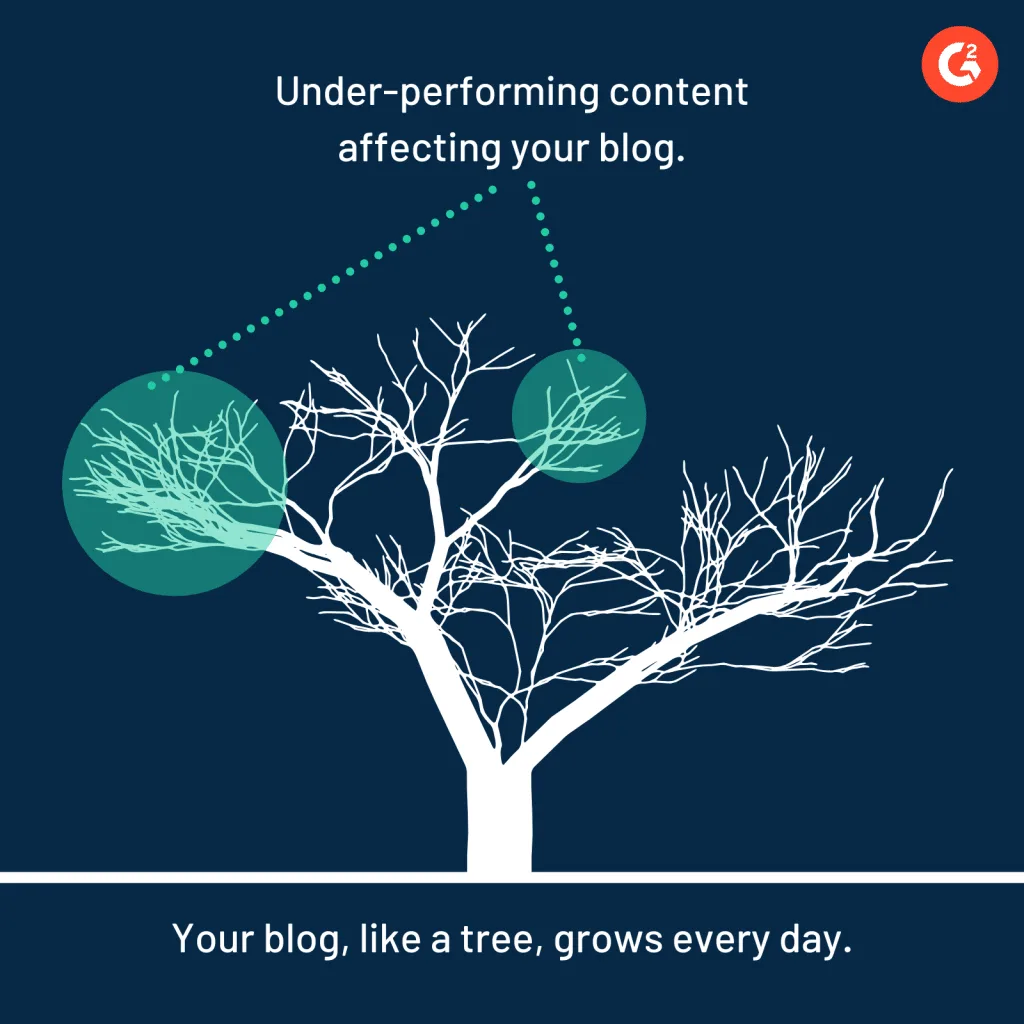
Every site accumulates digital sediment. Refining each detail of your content pruning strengthens this section. Blog posts written for a product that no longer exists. Landing pages from a campaign that ended three years ago. Tag archives that duplicate the same twelve posts across four URLs.
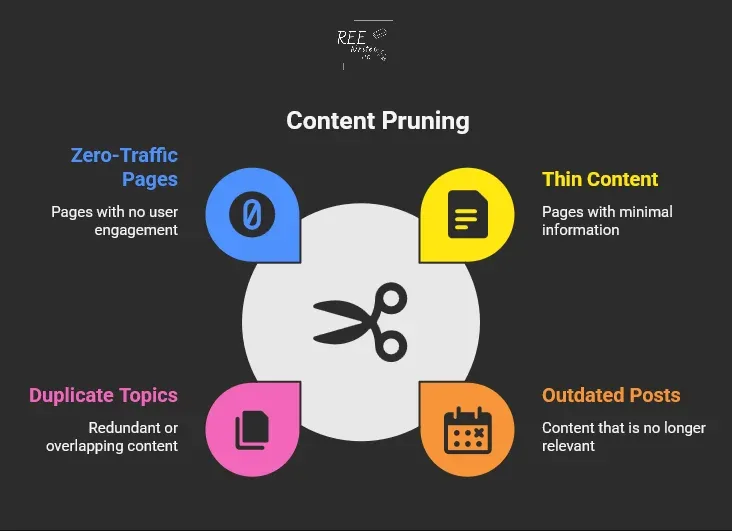
None of these pages converts anyone, yet each one competes for crawl budget and dilutes the topical clarity Google uses to understand what your site is actually about.
Think of the content pruning like a warehouse. If ninety percent of your inventory is unsellable, the twenty percent that customers actually want becomes harder to find, slower to ship, and buried under clutter. Search engines face the same problem at scale.
Crawl budget gets spent on thin pages, internal link equity leaks toward dead ends, and quality raters encounter your weakest material before they reach your best.
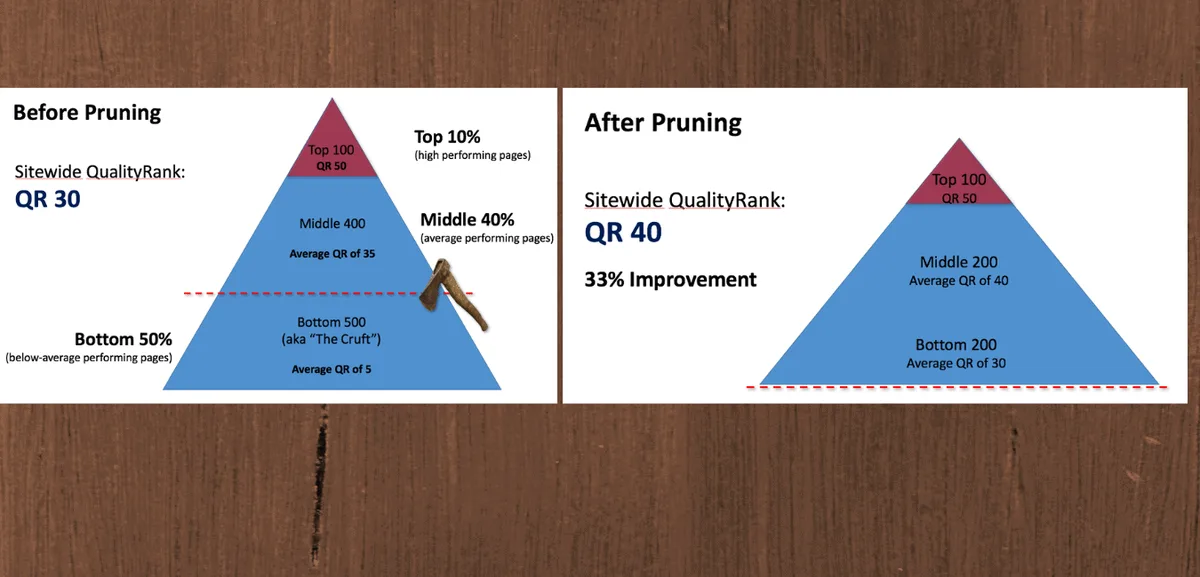
The evidence is not anecdotal. Maintaining clarity across your content pruning remains essential. In a widely referenced case study, the team at Sleeknote pruned roughly two-thirds of their blog archive and saw organic traffic climb rather than collapse.
Similar results have been documented across publishers who consolidated near-duplicate articles into single authoritative pieces. The pattern repeats because search engines reward sites with clear, coherent signals.
Before You Cut Anything: Build Your Content Pruning Checklist
Amateurs open a spreadsheet and start deleting rows. Professionals build a scoring framework first. The difference matters because pruning decisions are emotional, and emotions are terrible analysts when thousands of URLs are on the line. A structured content pruning checklist keeps the judgment consistent across the whole site.
Here is a practical starting row set for your audit. Score each URL on a one-to-five scale for each dimension, then sum.
| Audit Dimension | What to Measure | Weight |
|---|---|---|
| Organic sessions (12 months) | Trend direction, not just absolute volume | High |
| Conversions or assisted conversions | Email signups, demo requests, purchases, downloads | High |
| Backlinks (referring domains) | Quality over quantity; note any brand mentions | High |
| Keyword rankings | Top 10, positions 11–20, and drift over time | Medium |
| Internal links pointing in | Count and source relevance | Medium |
| Topical relevance to current business | Off-topic pages score low even if they get traffic | High |
| Freshness of facts | Outdated statistics, deprecated tools, dead references | Medium |
| Uniqueness | Overlap with other pages covering the same intent | High |
Run the content pruning audit in batches of 200 to 500 URLs. Attempting a full-site pass in one sitting produces fatigue, and fatigued analysts make sloppy calls. Batch processing also lets you observe the effect of each cut on sitewide performance before committing to the next round.
A useful side effect of building the Content pruning checklist: you start noticing patterns you would have missed. Maybe every low-score page shares the same author. Maybe one topic cluster is 60 percent overlap. Maybe a single category produces almost no conversions but consumes half your crawl budget. Those patterns point to deeper structural issues than any single URL.

The 11 Powerful Content Pruning Tips That Actually Work
What follows are the eleven tactics I use on every pruning engagement. Structuring your content pruning around proven patterns ensures impact. They are ordered by impact, not by ease of implementation. Most sites should start with the first three and add the rest as their process matures. Before diving into the detailed tips, though, a quick note on classification because that framework underpins everything else.
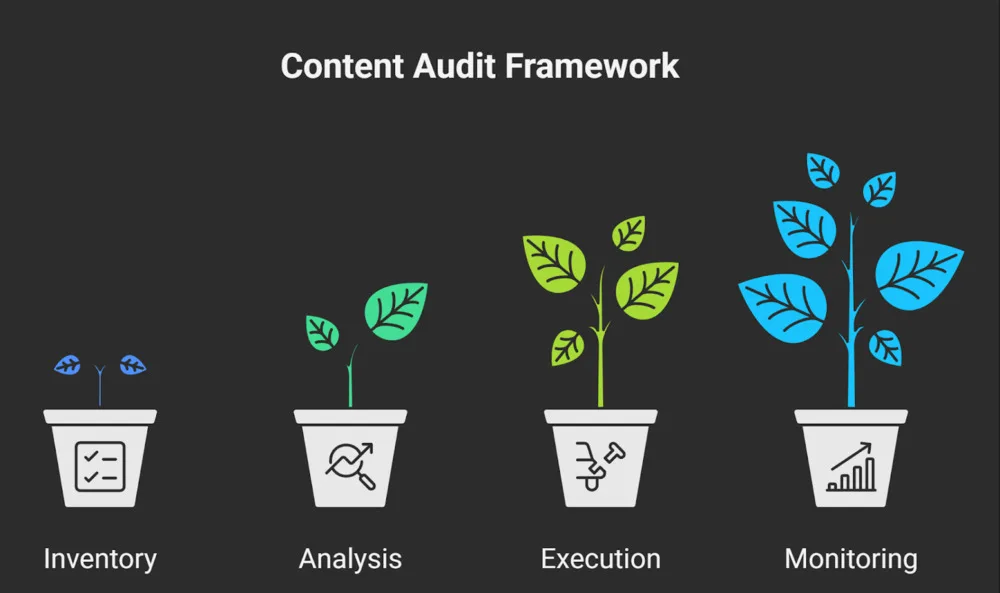
Every URL falls into one of five buckets: keep, refresh, consolidate, redirect, or remove. Effective execution in your Content pruning makes a tangible difference. Keep means it is performing and aligned with strategy. Refresh means the intent is right but the execution is stale. Consolidate means two or more pages compete for the same search intent.

Redirect means the URL should point elsewhere permanently. Applying these principles to your content pruning yields measurable results. Remove means the page has no strategic value and no meaningful traffic or links. Assign every audited URL to exactly one bucket. No exceptions, no “maybe later.”
1. Start With Your Analytics, Not Your Gut
The most common mistake in any content pruning guide is starting with subjective judgment instead of data. Analysts remember the pages they loved writing. They forget the ones that never performed. Your memory is not an SEO tool.

Pull a full 12-month report from Google Search Console and Google Analytics 4. Filter for pages with zero organic sessions, zero conversions, and zero backlinks. That list is your low-hanging fruit. In most mature sites, this group represents anywhere from 20 to 40 percent of total URLs.
One client had 8,400 published URLs on a domain the content pruning had never been pruned. We pulled the data, ran the filter, and discovered 2,900 pages met all three zero-criteria simultaneously. That is a third of the site producing literally nothing.
Two weeks of carefully executed redirects and canonical handling later, their sitewide average position improved by 1.8 positions across their priority keyword set.
2. Score Every Page Before You Touch It
Scoring prevents the personal-bias problem I mentioned earlier. Developing your content pruning with precision highlights key strengths. Build a simple spreadsheet with the eight dimensions listed above, total the scores, and rank. Anything in the bottom quintile is a candidate. Anything in the top quintile is untouchable without an explicit business reason.
Here is a scoring snippet the content pruning works without custom tooling. Assign one to five for each dimension. High-weight dimensions count double. Then define your thresholds before you look at results.
This is critical: if you decide “below 15 is a cut” after seeing that your favorite article scored 14, you have just destroyed the integrity of the process.
Track the score of every page you decide to keep, too. In six months, re-score them. If something dropped two or more points, it just entered the refresh queue. Content pruning best practices include this continuous maintenance rhythm, not just one-time surgery.
3. Consolidate Over Duplication Every Single Time
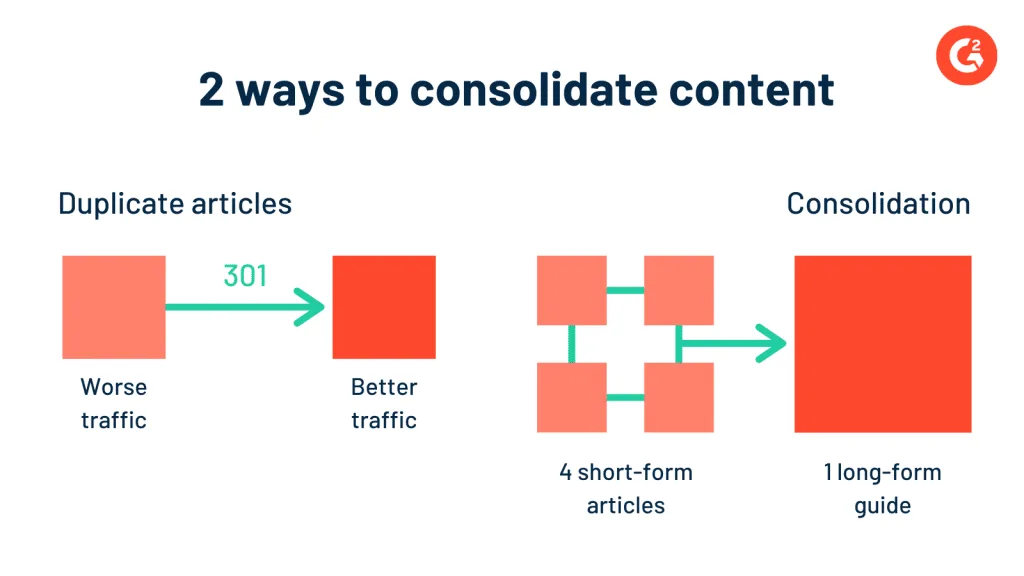
When two URLs target nearly the same search intent, both get starved. Search engines have to pick one when responding to a query, and neither gets the full signal strength the topic deserves. Consolidation solves this by combining the strongest material into a single canonical page.
Start by clustering URLs by search intent, not by title similarity. Clear alignment with your content pruning builds confidence from the start. Two articles with different titles can serve identical intent. For each cluster, identify the strongest performer by traffic, links, and content depth.
That page becomes the merge target. Pull the best sections from the weaker pages, rewrite for coherence, and 301 the weaker URLs to the survivor.
A software client had six separate articles about “email marketing metrics” published across four years. Each one ranked positions 12 to 30. We merged them into a single piece of 4,200 words, brought in original benchmark data from their customer base, and redirected the other five URLs. Within ten weeks the merged page reached position 4 and pulled more combined traffic than all six originals combined.
4. Redirect Carefully, Never Reflexively
Redirects are not free passes. Integrating content pruning into your workflow produces consistent quality. Each 301 you set up tells search engines that URL A is now URL B. That is fine when the topics genuinely match.
The content pruning is harmful when a URL about “project management basics” gets redirected to a homepage. Search engines treat that as a soft 404 and stop passing equity.
A good rule: redirect to the closest topical match. If no close match exists, redirect to the parent category page, not the homepage. If even the category page is a stretch, remove the URL and let it 410. A clean 410 is better than a misleading 301.
Before setting up any redirects, run a crawl to map internal links pointing at the content pruning URLs. Any internal link to the removed page needs an update, or you will create redirect chains. I have seen sites with four- and five-hop chains built through careless pruning rounds. They leak equity at every hop.
5. Refresh Before You Delete
Some pages underperform because they are wrong, not because they are unwanted. That high-potential URL you are about to delete might just need updated statistics, a rewritten introduction, and additional sections covering subtopics the current version ignores.
Try a refresh cycle first. If the page addresses a search intent your audience actually has, targets a keyword your brand should rank for, and has some baseline of traffic or links, refresh it before cutting. You can always delete next quarter.
In one content pruning project, we refreshed 40 marketing blog posts that had been dormant for years. We added updated benchmark data, new screenshots, and expanded sections for subtopics. Sixty-two percent of them recovered to page one on their primary keyword within 90 days.
Of the 40, the content pruning later deleted three that had no strategic relevance and were simply too stale to save. The other 37 stayed.
6. Map Internal Links Before You Cut
Every URL has two audiences: external visitors and internal link architecture. Cutting the page is easy. Forgetting to update the thirty internal links pointing at it is where trouble starts. Broken internal links hurt user experience and consume crawl budget.
Export a full internal link graph from a crawler like Screaming Frog or Sitebulb. Flag every URL on your cut list. Then, for each, list all pages that link to it. Update those internal links to point to the merge target, the replacement URL, or, if no natural fit exists, a relevant category page. It is tedious work. Do it anyway.
The internal link graph is also a great source of insight. If a URL is heavily linked from your highest-authority pages, it probably deserves reconsideration. The links tell you what your own editorial team has decided is important, even when the analytics disagree.
7. Handle Outdated Pages With Temporal Accuracy
Some content pruning checklist items are obvious: a ” Predictions” post in is a clear candidate for action. But older content often fails on temporal accuracy, not just on being old.
Statistics from five years ago, tool lists that mention products that no longer exist, references to discontinued features — these erode trust with users and search engines alike.
Look for pages containing specific years in the title or body. Do not automatically kill them. Instead, decide whether the topic is evergreen (refresh the dated element) or time-bound (retire the URL with a clean redirect). The distinction matters because a time-bound prediction page usually has no refresh path. An evergreen guide does.
For evergreen pieces, refresh rather than retire. Update the year-specific reference, verify any statistics against current sources, and re-publish with a meaningful change. Skip the cosmetic “last updated” date bump — search engines have become adept at spotting pages that changed one character and reset the timestamp.
8. Protect Your Backlink Magnets, No Matter What
Backlinks are the hardest SEO asset to rebuild. Before merging or redirecting any URL, pull a backlink report from Ahrefs, Semrush, or Majestic. Any page with ten or more referring domains from high-authority sites is not a deletion candidate, regardless of its current traffic.
The right move for the content pruning pages is almost always a refresh. Keep the URL, update the content, and preserve every bit of link equity pointing at it. In some cases you can enhance the page further, adding sections that attract additional links naturally.
I once worked with a publisher who had a article about email etiquette the content pruning got almost no organic traffic but had 47 referring domains from HR publications. Deleting it would have wasted more than a decade of link accumulation.
Instead, we refreshed it, added sections on remote work etiquette, and rebuilt the design. It now ranks position 3 for several commercial queries and generates enterprise leads every month.
9. Build a Content Pruning Checklist for Every Removed URL
Consistency separates professional content pruning from amateur deletion. Every URL you cut should have the same checklist applied. Missing one step, like a redirect, creates a broken experience no matter how careful the rest of the process was.
Here is the checklist I use for every removed URL.
| Step | Action | Verification |
|---|---|---|
| 1 | Export backlink profile | Confirm zero-or-low referring domains |
| 2 | Log top organic queries | No priority keywords on the URL |
| 3 | Identify merge target | Closest topical match exists |
| 4 | Update internal links | Zero broken internal links post-change |
| 5 | Set 301 or 410 | Correct status code verified in browser |
| 6 | Remove from sitemap | Sitemap regenerated, URL gone |
| 7 | Add to monitoring sheet | Traffic and ranking tracked for 90 days |
Save the sheet. Six months later, revisit each removed URL and check its redirected destination. If it is getting meaningful traffic, the redirect was correct. If not, you may need to re-evaluate. This feedback loop is the single biggest improvement most teams can make to their pruning discipline.
10. Communicate the Change to Stakeholders
Pruning is a political act. Someone wrote that blog post. Someone’s boss approved it. Someone’s KPI is tied to “total articles published.” When you start cutting, expect resistance. Expect concern.
The only way through is communication and data. Before any URL is removed, publish a summary for stakeholders. Show them the audit scores, the traffic trend, the conversion data, and the redirect plan. Explain that the goal is lifting performance on the pages that matter, not erasing history.
Also, keep a public archive if the content has research value. Tools like the Wayback Machine can preserve public URLs as external references, and in some cases, you can preserve content on a secondary subdomain if the legal or compliance team needs it.
Being sensitive to internal politics makes the content pruning smoother. Being insensitive to it guarantees future pruning efforts get blocked before they start.
11. Set a Repeatable Cadence, Not a One-Time Project
Content pruning is not a vaccine. It is a maintenance activity. Sites accumulate rot continuously. New campaigns produce off-strategy pages. Old URLs decay. Authors leave. Products change. Without a cadence, you will be back where you started in eighteen months.
Here is a rhythm that works for most mid-sized teams. Every quarter, run the scoring audit on URLs published in the last 24 months. Any URL scoring in the bottom quintile gets flagged for refresh, consolidation, or removal.
Every six months, run a full-site crawl to check for internal link breakage and confirm that all previously removed URLs are still resolving correctly.
Layer in event-triggered audits, too. Major product changes, rebrands, discontinued features, and industry shifts all create sudden pruning opportunities. When your company deprecates a service line, that entire cluster of associated content needs an immediate decision. Do not wait for the quarterly cycle.

How Content Pruning Fits Your Broader SEO Strategy
Pruning is one lever in a larger machine. It works best alongside consistent publishing, technical hygiene, and proactive link building. Think of it as the discipline that keeps the machine from jamming. Without publishing, you have nothing to prune. Without pruning, publishing accumulates diminishing returns.
The parent topic here is content lifecycle management — how a piece of content enters, matures, and eventually exits a site’s active library. Pruning is the exit stage.

Closely related sub-topics worth exploring include editorial governance (who approves and audits content), topical authority mapping (how clusters reinforce each other), and technical SEO hygiene (how crawl budget and redirect integrity interact with content decisions).
The content pruning is also a strong argument for linking pruning to your brand positioning. Every page on your site is a signal about who you are. A well-maintained archive of 300 sharp, on-target pages builds a more coherent brand than 3,000 mixed-quality pages with no editorial point of view. Readers feel the difference. So do search engines.

Common Content Pruning Mistakes That Wreck Websites
Most pruning disasters share predictable causes. Know them before you start.
Bulk deleting by date is a classic error. “Anything older than three years” is a terrible filter. Some evergreen pages age like wine. Others curdle in six months. Age alone tells you almost nothing about strategic value.

Redirecting to the homepage is another. It is the laziest possible move and one of the most damaging. Search engines treat mass redirects to the homepage as soft 404 patterns and reduce trust in the domain.
Ignoring redirect chains is the third. Every hop from URL A to B to C to D leaks equity. If you are merging multiple URLs, redirect each one directly to the final destination in a single hop, not in sequence.

The fourth mistake is treating pruning as a solo project. A thoughtful approach to content pruning reinforces your qualifications. Content, SEO, legal, and product all have a stake. A pruning process that skips stakeholder sign-off will eventually get blocked or reversed.
Finally, failing to monitor post-pruning impact is the biggest missed opportunity. Without measurement, you will never know whether your decisions were correct. Tracking wins and losses builds institutional knowledge that makes each future round more accurate.
Frequently Asked Questions About Content Pruning
Here is an in-depth breakdown of key considerations regarding Frequently Asked Questions About Content Pruning:
What is Content Pruning, Exactly?
Content pruning is the systematic process of auditing, consolidating, refreshing, redirecting, or removing website content that no longer serves users or search performance. It is not simply deletion. In many cases the majority of pruned URLs are consolidated or refreshed rather than removed.
Does Deleting Old Blog Posts Hurt SEO?
It can, if done carelessly. Well-executed pruning usually improves sitewide performance by freeing crawl budget, removing thin pages that dilute topical signals, and consolidating rank equity into stronger URLs. The most common error is deleting pages with valuable backlinks or un-migrated priority keywords.
How Often Should You Run a Pruning Cycle?
A quarterly cycle for recent content and a six-month full-site audit works for most sites. High-velocity publishers with dozens of new URLs per month may need monthly cycles. Seasonal businesses often benefit from pruning ahead of peak traffic windows.
Which Pages Should You Never Prune?
Priority landing pages, pages with strong link profiles, current pillar content, and any URL actively ranking for commercial keywords your business targets. Also protect pages referenced in paid campaigns, sales enablement, or legal/compliance contexts. If in doubt, refresh rather than remove.
How Do You Measure the Success of a Pruning Campaign?
Track sitewide organic sessions, average ranking position across your priority keyword set, organic conversions, and impressions in Search Console. A successful pruning campaign usually shows ranking improvement within four to twelve weeks, and conversion improvement within ninety days.
What is the Difference Between Pruning and Updating Content?
Updating improves a page in place. Pruning is a broader decision that includes reviewing whether the page should exist at all. Pruning workflows typically end in update, merge, redirect, or removal. Updating is one of the possible outcomes, not the whole process.
Making Content Pruning Stick Inside Your Organization
Good pruning processes die from neglect more often than from active opposition. To keep yours alive, bake it into existing workflows. Add pruning review to your editorial calendar. Include URL retirement in your publishing checklist. Give a specific team member ownership of the quarterly audit. Shared responsibility means no responsibility.
One final thought that has served me well across engagements: every content pruning round is a chance to learn something about your audience. The URLs that fail teach you about misread intent. The pages that succeed after a refresh reveal latent demand. The clusters that consolidate cleanly expose your strongest topical territory. Treat each round as research, not just cleanup.
The stronger your pruning discipline, the more confidently your team can publish. Because you know, when something fails, you have a plan to fix it. That confidence compounds. So does the traffic.
For verified reference and background research, consult the authoritative informational resource on this topic.