If you have ever stared at a blank content calendar at 11 p.m. While three campaigns, two email sequences, and a product launch sit half-finished, you already know why AI tools for marketing have gone from novelty to necessity.
The right stack does not just shave hours off your week — it gives you room to think, test, and actually grow.
I have spent the last several years watching small teams and solo operators rebuild their workflows around automation, and the pattern is consistent: the folks who win are not the ones with the most subscriptions.
They are the ones who picked a handful of AI tools for marketing that fit how they already work, then squeezed every drop of value from them.
This guide walks through the categories that matter, the picks that hold up under real deadlines, and the mistakes that quietly burn budgets. No hype, no vague promises — just what actually works when you are shipping campaigns on a Tuesday afternoon.
Why AI Tools for Marketing Have Become Non-Negotiable
The shift happened faster than most teams expected. A few years back, “AI” in a marketing context meant a recommendation engine or a chatbot widget bolted onto a landing page. Now the entire production pipeline — research, drafting, design, distribution, reporting — has some form of machine assistance layered into it.
Part of this is pure economics. Content demand has roughly tripled across most industries while headcount has stayed flat or shrunk. If your team of three is expected to produce what a team of nine used to handle, the gap has to be closed somewhere.
That somewhere is usually a well-chosen set of AI tools for marketing that handle the repetitive 60% so humans can focus on the strategic 40%.
But there is a subtler reason too. Buyers now expect personalization at scale, faster response times, and content that speaks to their exact situation. Meeting that expectation manually is close to impossible. The best AI tools for marketing give you a way to say “yes” to those expectations without doubling your workload.
The Real Shift: from Doing More to Deciding Better
Here is the thing most tool roundups miss. The value of AI tools for marketing is not really about producing more assets. It is about compressing the distance between a question and a decision.
Say you want to know whether a new headline will outperform the current one. Focusing on AI tools for marketing provides clear direction here. Old workflow: two weeks of A/B testing. New workflow: an hour with a predictive testing tool that scores variants against your historical data, then a smaller test to confirm. That compression is the actual prize, not a bigger folder of blog drafts.
In practice, teams that treat AI tools for marketing as decision accelerators — rather than content factories — report far better results. They ship fewer assets but each one is sharper, better targeted, and more likely to convert.
How to Evaluate AI Tools for Marketing Before You Buy
The market is loud. Every week there is a new entrant promising to replace your entire marketing department. Most of them will be dead in eighteen months. So you need a filtering process that protects you from shiny-object syndrome.
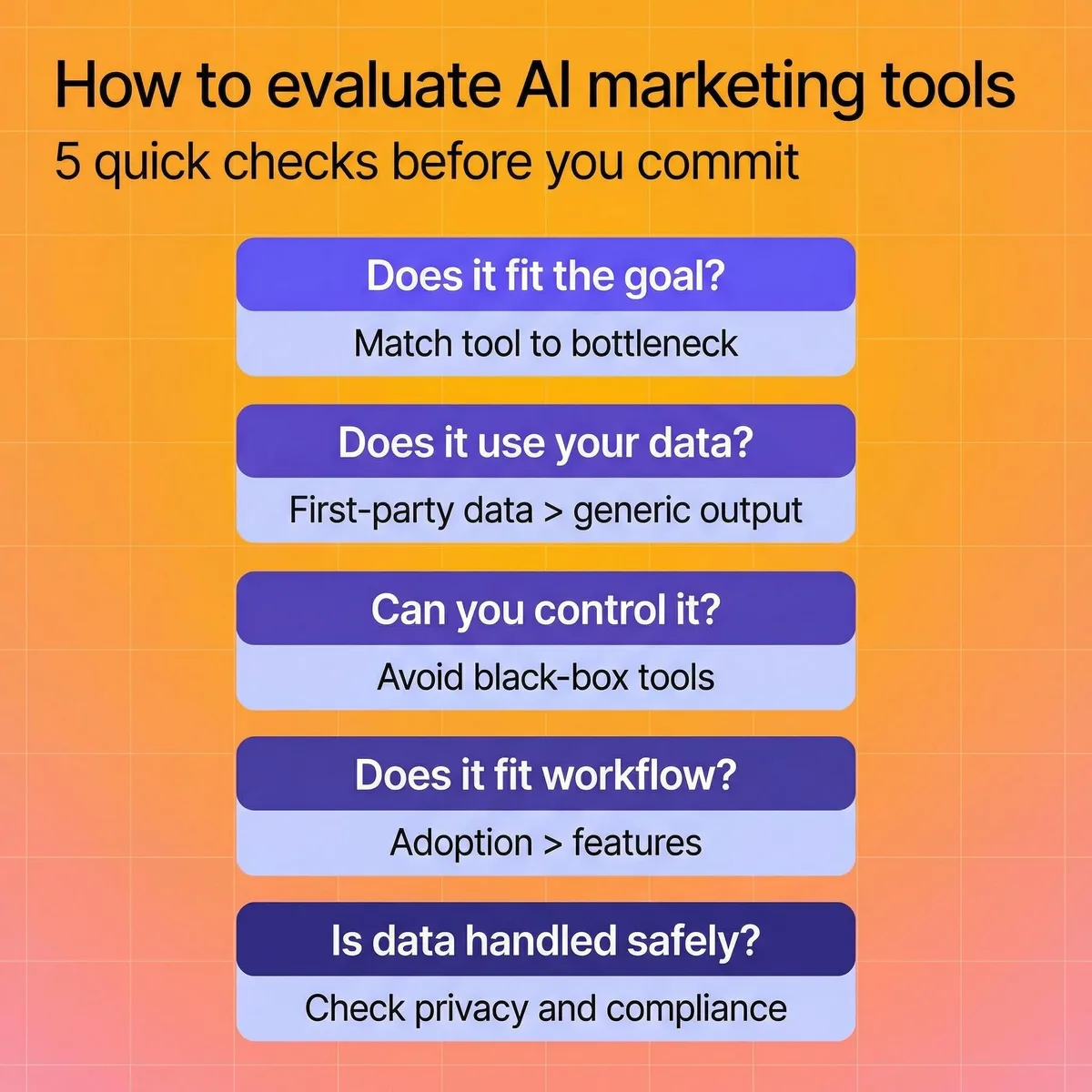
My filter comes down to five questions. Ask them honestly before you swipe a card.
- Does it plug into your existing stack? A brilliant AI writing tool that cannot access your brand guidelines or CMS is a liability, not an asset. Native integrations with your CRM, email platform, and analytics save weeks of manual stitching.
- How does it handle brand voice? Test by feeding it three of your best-performing pieces and asking for a new draft. If the output reads like generic AI mush, walk away. AI tools for marketing that cannot learn your tone will produce work you have to rewrite anyway.
- What is the data policy? Ask directly whether your inputs train the model. For regulated industries — finance, health, legal — this is non-negotiable. Enterprise tiers usually offer opt-outs; free tiers almost never do.
- Can you measure output quality? A tool without a feedback loop is a black box. Look for scoring, version history, or at least exportable drafts you can compare side by side.
- What is the true cost per useful output? Seat pricing can be misleading. If a tool saves two hours a week but you spend one hour cleaning its work, the math changes fast. Track this for the first month.
The fifth point is where most teams slip. They celebrate the subscription as a win and never audit the downstream time. Do the audit. It is the only way to know whether your AI tools for marketing are actually paying for themselves.
Content Creation: Where AI Tools for Marketing Deliver Fastest
Writing is the entry point for most teams. It is also where the biggest quality gap exists between tools. Some produce paragraphs you would happily publish with light edits. Others produce text so generic it actively damages your brand.
The winners in this category tend to be tools with strong research grounding — they cite sources, pull from SERPs, and structure output around real search intent rather than guessing. Refining each detail of your AI tools for marketing strengthens this section. That grounding is what separates a usable draft from a rewrite.
Long-Form Writing and Content Briefs
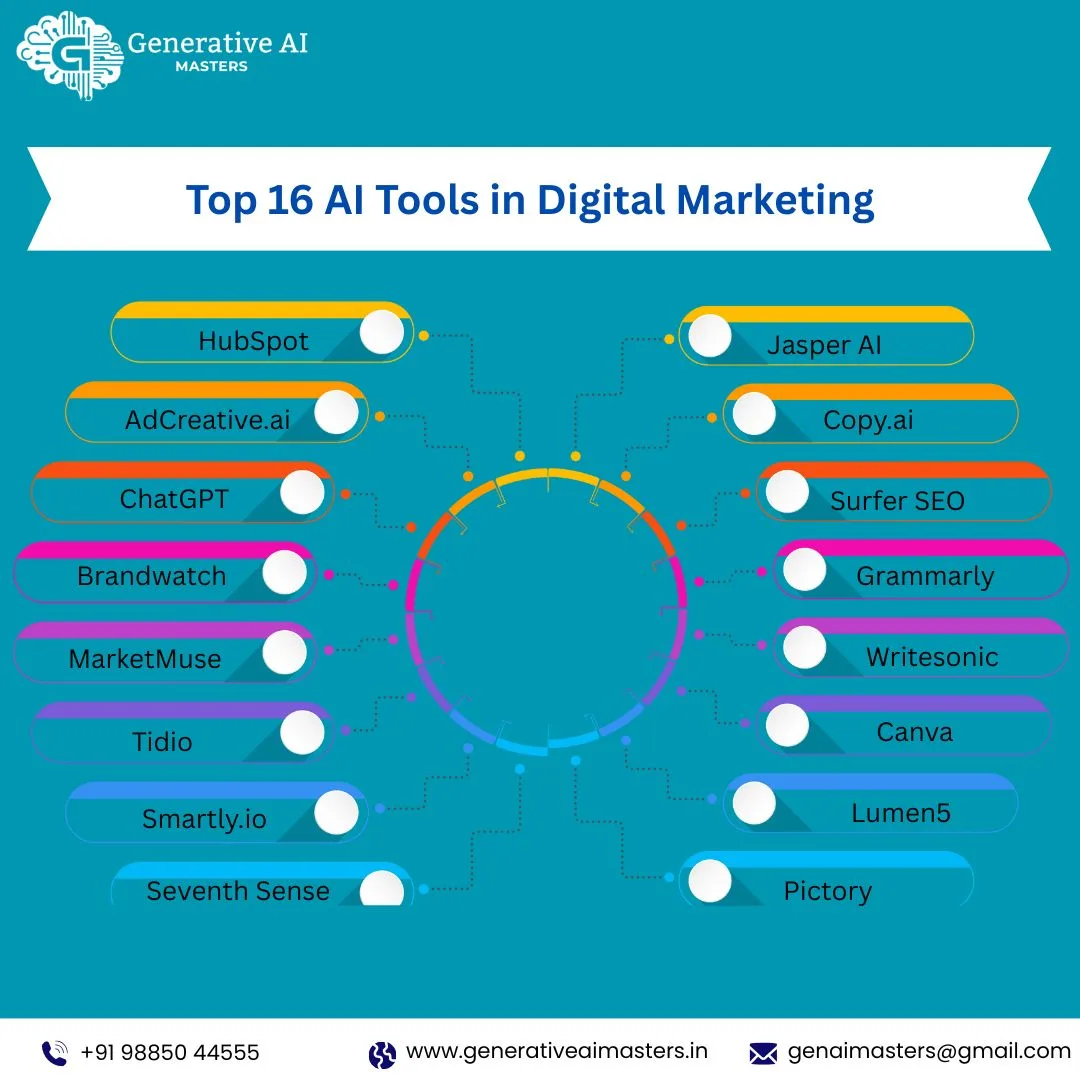
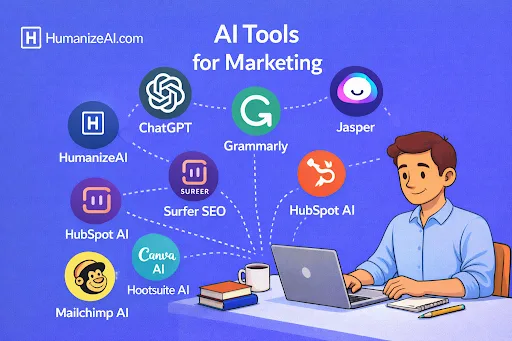
Tools like Surfer SEO, Frase, and Clearscope have effectively merged writing assistance with SEO research. You feed in a target keyword and intent, and they produce a brief that outlines the headings, entities, and semantic terms that top-ranking pages share.
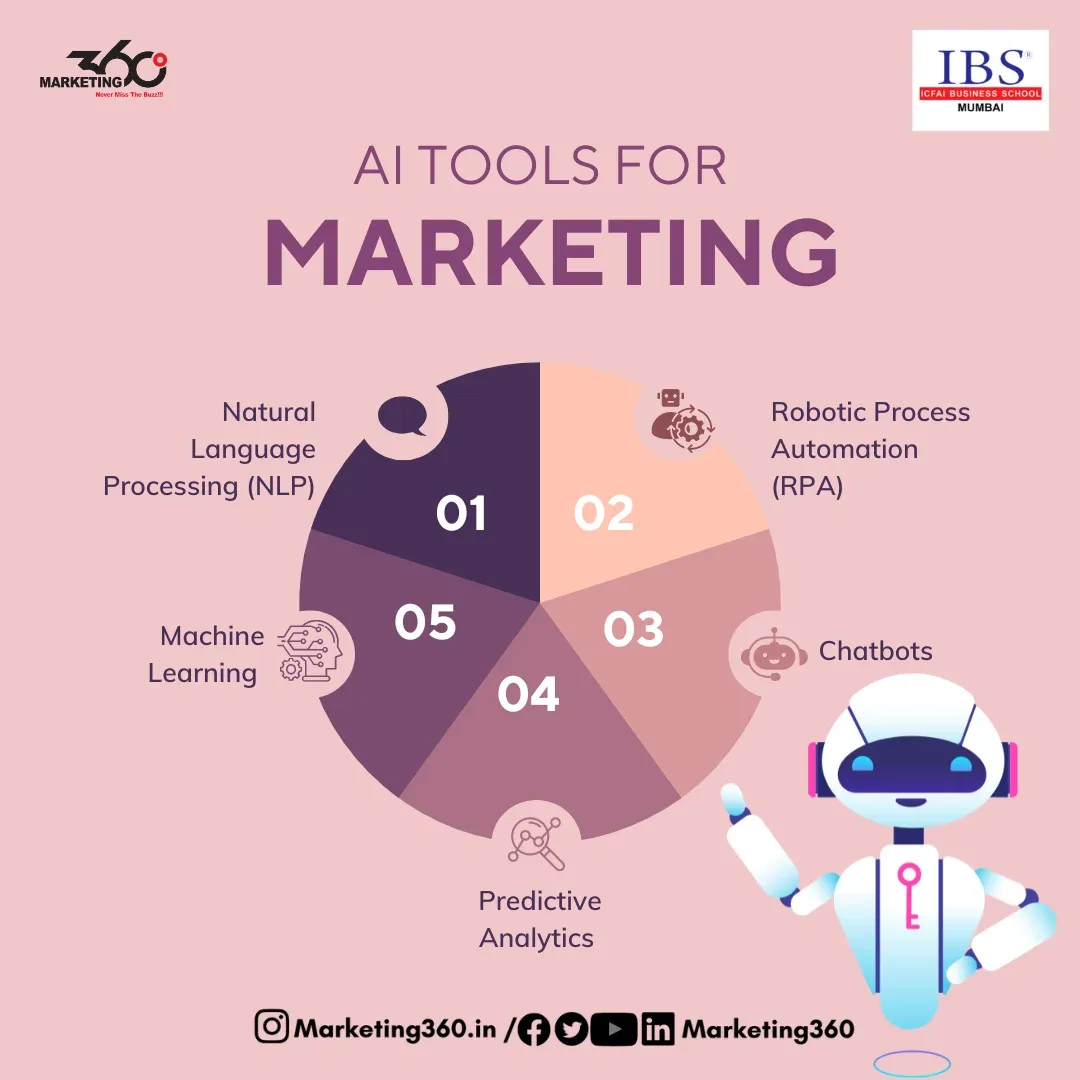
What makes these AI tools for marketing genuinely useful is that they do not just generate — they constrain. They tell you what to include and what is bloating your word count. Writers who use them well report cutting drafting time by 40-60% while improving topical coverage.
The mistake? Treating the brief as a template to fill mechanically. Google’s helpful content systems punish that. Use the brief as a checklist, write in your own voice, and the output lands far better.
Short-Form and Social Copy
Short-form is a different animal. You need volume, speed, and hooks that survive a doom-scroll. Tools like Jasper, Copy.AI, and the writing features baked into HubSpot’s AI suite are built for this rhythm.
My approach: generate 20 variants, kill 18 immediately, then hand-polish the two survivors. The AI tools for marketing here are doing brute-force ideation, not final copywriting. That reframe resolves most of the quality complaints people have.
One concrete tip — always give a short-form tool a specific format constraint. Effective execution in your AI tools for marketing makes a tangible difference. “Write a LinkedIn hook about customer retention” produces mush. “Write a 12-word LinkedIn hook that opens with a statistic about churn in SaaS” produces something usable.
AI Tools for Marketing Research and Competitive Intelligence
Understanding the battlefield before you write a single word is the difference between a campaign that lands and one that evaporates. This is arguably the highest-leverage category of AI tools for marketing because it changes the inputs, not just the outputs.
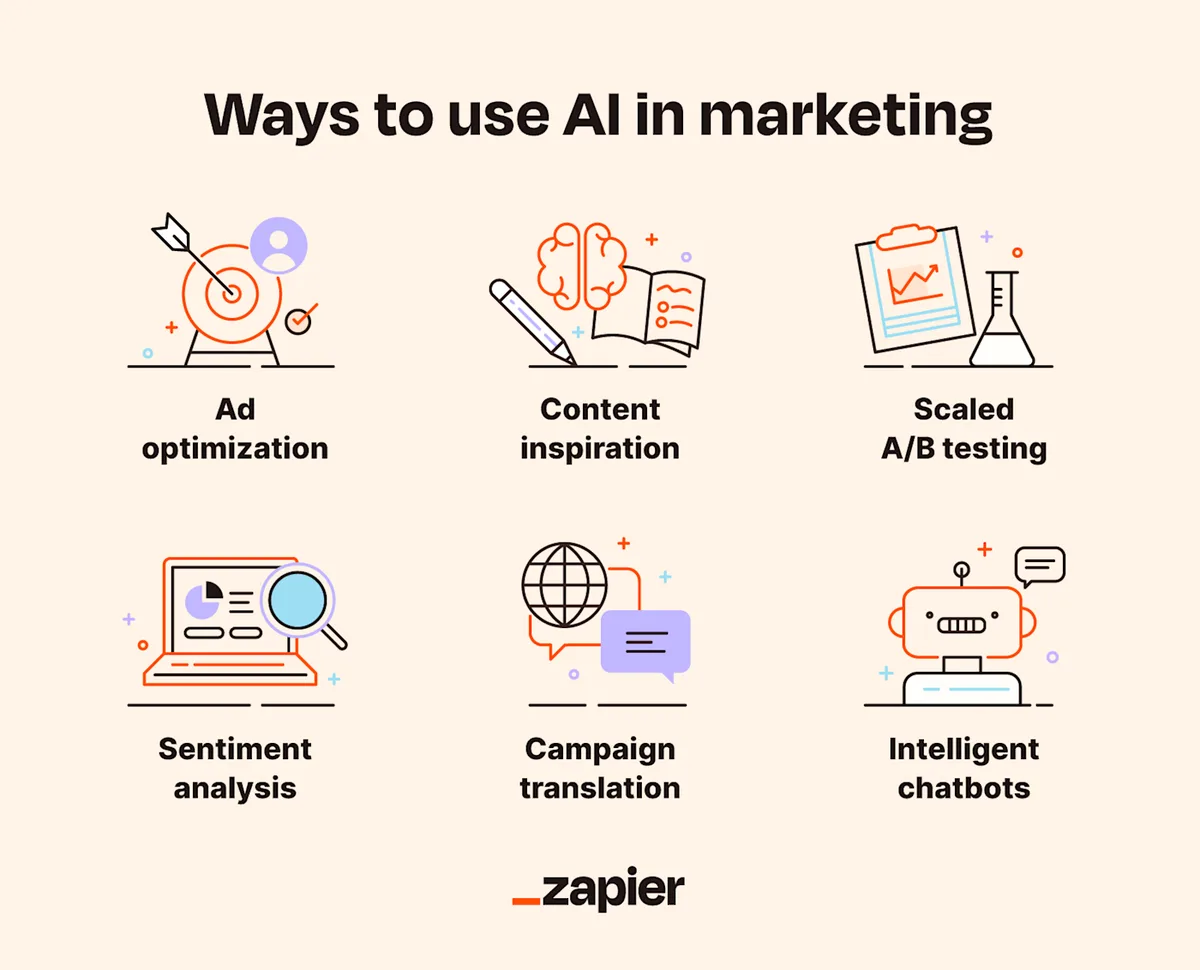
A few months back I sat with a B2B team struggling to differentiate their product. Twenty minutes with a competitive-intelligence tool showed that every competitor was pitching “ease of setup” while ignoring “ease of migration” — a pain point their own customers complained about constantly.
They pivoted the messaging, and inbound demo requests doubled within a quarter. That kind of insight is what AI tools for marketing are genuinely best at.
Keyword and SERP Analysis
Traditional keyword tools still matter, but the AI layer on top of them is what changes the game. Instead of dumping 5,000 keyword ideas on you, modern tools cluster them by intent, flag the ones with weak SERP competition, and suggest the angle that would let you rank.
Ahrefs, Semrush, and specialized entrants like Keyword Insights all do this now. The teams that win with these AI tools for marketing are the ones that filter aggressively. A list of 50 tightly-themed keywords will beat a list of 5,000 unfiltered ones every time.
Audience and Sentiment Mining
This is where things get interesting. Tools that scrape Reddit, review sites, and social threads for sentiment — Brandwatch, Talkwalker, and newer entrants — surface what your buyers actually say when nobody is selling to them.
I use these to build “voice of the customer” documents that feed directly into content briefs. Real phrasings, real objections, real emotional triggers. It is impossible to fake this, and it consistently outperforms internal brainstorming sessions. If you only adopt one category of AI tools for marketing, make it this one.
Email, Automation, and Lifecycle Marketing
Email is where AI tools for marketing tend to produce the most measurable ROI, simply because every percentage point of improvement shows up directly in revenue. Yet it is also where teams under-utilize what is available.
The bare minimum is dynamic content and send-time optimization. Maintaining clarity across your AI tools for marketing remains essential. The next tier up is predictive segmentation and lifecycle stage prediction. The top tier is AI-drafted sequences that adapt based on real behavior.
Sequence Building and Personalization
Platforms like Klaviyo, HubSpot, and ActiveCampaign have all embedded AI into their sequence builders. You describe the customer journey and the tool suggests the email cadence, subject lines, and body copy for each stage.
The practical win here is speed of iteration. A lifecycle sequence that used to take a week to draft now takes an afternoon. That compressed timeline means you can test three angles instead of one. In my experience, that iteration speed — not the raw copy quality — is what moves the needle.
Deliverability and Send Optimization
Less glamorous, but crucial. AI tools for marketing that monitor inbox placement, spam scores, and send-time performance quietly save teams from disaster. A single deliverability issue can wipe out weeks of list-building work.
Look for tools with proactive alerts, not just dashboards you have to remember to check. The best ones flag list hygiene problems before your next campaign, not after.
Visual and Video Production With AI Tools for Marketing
A few years ago, “AI design” meant stock-photo search with a smarter filter. A thoughtful approach to AI tools for marketing reinforces your qualifications. Now the category is genuinely creative. Image generators produce on-brand visuals in seconds. Video tools handle editing, captioning, and even synthetic presenters.
For small teams, this is transformative. A solo marketer can now produce a month of social visuals in an afternoon. The constraint shifts from “can we make this?” to “should we make this?” — which is a far better problem to have.
Static Visuals and Brand-Consistent Design
Canva’s AI features, Adobe Firefly, and Midjourney are the usual suspects. The key is brand consistency: tools that let you lock in a color palette, font, and visual style produce assets that feel cohesive rather than stitched together.
One warning — always check image licensing before publishing. Some generators train on scraped web content and their commercial-use policies vary. For paid ads especially, this is worth five minutes of due diligence before you push live.
Video Editing and Repurposing
Video repurposing is where AI tools for marketing deliver absurd value. Tools like Descript, Opus Clip, and CapCut can take a 45-minute webinar and produce 15 short clips, complete with captions and hook overlays, in under an hour.
The teams doing this well build a repurposing pipeline into their weekly rhythm. Structuring your AI tools for marketing around proven patterns ensures impact. Record once, slice into a dozen assets, publish across channels. It is one of the highest-ROI workflows available right now.
Advertising and Paid Media Optimization
Paid media has become the most AI-saturated area of marketing, and for good reason. Ad platforms now run bidding, targeting, and creative selection largely on autopilot. Your job shifts from “manage the machine” to “feed the machine well.”
That feeding is where most advertisers still fumble. AI tools for marketing on ad platforms are only as good as the creative diversity and signal quality you give them.
Creative Testing at Scale
Platforms like Meta’s Advantage+ and Google’s Performance Max reward volume and variety. Tools like AdCreative.AI and Pencil generate dozens of ad variants in minutes, giving the algorithm more to work with.
Practical tip: keep your brand guidelines nearby. AI-generated ad creative can drift toward generic hype fast. A human pass to insert a specific claim, testimonial, or stat makes the difference between a variant that gets killed and one that scales.
Attribution and Cross-Channel Insight
Attribution is messy, and AI does not magically clean it. Applying these principles to your AI tools for marketing yields measurable results. But tools like Triple Whale, Northbeam, and the native reporting in most ad platforms do a much better job of surfacing which creative drove which conversions than manual spreadsheets ever could.
My advice here is unglamorous: pick one attribution model, document it, and stick with it for at least a quarter. AI tools for marketing amplify whatever data you feed them — including bad data.
Analytics, Reporting, and Predictive Forecasting
Reporting is the task everyone dreads and nobody has time for. AI tools for marketing that automate it are worth their weight in gold, both for the hours saved and for the consistency it brings to decision-making.
The best reporting tools do three things well: pull from multiple sources without breaking, surface anomalies proactively, and translate data into plain-English insights.
Automated Dashboards and Insight Generation
Tools like Databox, Supermetrics, and the growing suite of LLM-powered analytics assistants do this. You connect your sources once, and then you can ask questions in plain English — “why did conversions dip last Tuesday?” — and get a real answer.
That last part is quietly revolutionary. Analysts used to spend hours slicing data before they could answer a simple question. Now non-technical marketers can self-serve. The catch is discipline: the AI tools for marketing that do this well still require you to phrase the question sharply.
Predictive Analytics for Pipeline
Predictive tools that forecast pipeline, churn, and campaign performance are now accessible to mid-market teams, not just enterprises. They use your historical data to project what happens next.
Treat forecasts as hypotheses, not destiny. Proper attention to your AI tools for marketing sets a strong baseline. Most predictive tools get dramatically better after three or four months of clean data. Budget for that learning curve or you will be disappointed by month one.
Customer Support and Conversational AI
Every marketer eventually realizes that support and marketing are the same conversation. A chatbot that handles questions well becomes a marketing asset. One that frustrates users becomes a liability. The gap between those outcomes is mostly about how well the AI tools for marketing are tuned.

Chatbots and Live Assist
Modern chatbot platforms — Intercom Fin, Drift, and the various LLM-powered options — have made dramatic progress. They can now hold coherent conversations, pull from your knowledge base, and escalate to a human when things get tricky.
The teams doing this well are ruthless about training data quality. They feed in real transcripts, update the knowledge base weekly, and review the bot’s failures with the same rigor as a new hire’s onboarding. The AI tools for marketing that handle conversations are only as good as the harness around them.
Review and Feedback Mining
Review platforms and support tickets contain gold. AI tools that mine them for recurring complaints, feature requests, and delight moments are incredibly useful for both product and marketing.
A concrete example: a client of mine discovered through review mining that customers kept mentioning “onboarding in a day” as the reason they chose them over a competitor. That phrase became the hero of the next quarter’s homepage.
None of it came from a brainstorm — it came from reading 800 reviews in an hour with a tool.
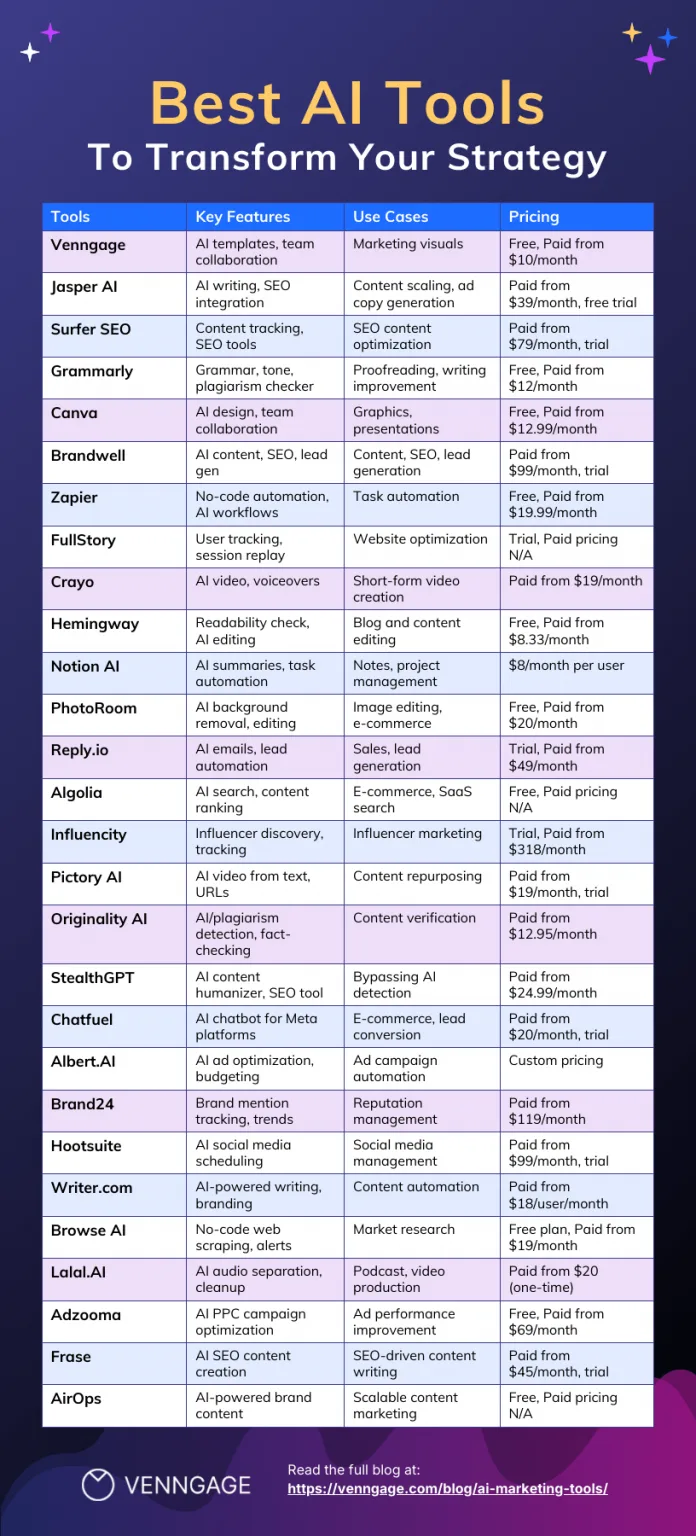
Choosing the Right Stack: a Practical Comparison
No single tool covers everything, and trying to build one monster stack is a mistake. Better to pick one strong option per category and let them talk to each other. Here is a practical breakdown.
| Category | Strong Picks | Best For | Watch Out For |
|---|---|---|---|
| Long-form writing | Surfer SEO, Frase, Clearscope | SEO-first content teams | Over-reliance on briefs kills voice |
| Short-form copy | Jasper, Copy.AI, HubSpot AI | Social and ad copy volume | Generic output without sharp prompts |
| Research | Ahrefs, Semrush, Keyword Insights | Intent mapping and clustering | Data overload without filtering |
| Sentiment mining | Brandwatch, Talkwalker | Voice-of-customer work | Learning curve for queries |
| Klaviyo, HubSpot, ActiveCampaign | Lifecycle and retention | Deliverability needs separate attention | |
| Visuals | Canva AI, Adobe Firefly, Midjourney | Social and ad creative | Licensing and brand consistency |
| Video | Descript, Opus Clip, CapCut | Repurposing long content | Quality drops for complex edits |
| Paid media | AdCreative.AI, Meta Advantage+ | Creative testing at scale | Brand drift without human pass |
| Analytics | Databox, Supermetrics, Triple Whale | Cross-channel reporting | Garbage in, garbage out |
| Support bots | Intercom Fin, Drift | Conversational capture | Needs constant retraining |
Two notes on this table. First, most teams should not buy every row — start with the two or three that fix your biggest current bottleneck. Second, the “watch out for” column is where the real work lives. Every one of these AI tools for marketing can go sideways without a human keeping the output honest.
Common Mistakes When Adopting AI Tools for Marketing
I have watched dozens of teams stumble through adoption. The failures cluster around a handful of patterns, and most are avoidable if you know what to look for.
Automating Before You Understand the Workflow
You cannot automate what you have not mapped. Teams that bolt AI onto a broken process usually end up with a faster broken process. Map the workflow first, find the true bottlenecks, then introduce tools only where they solve a real problem.
The most common variant of this mistake is automating the writing step when the real bottleneck is research. No amount of drafting speed will help if the brief is weak. A stronger set of AI tools for marketing is not a substitute for a clear strategy.
Skipping the Human Editorial Pass
This is the big one. Developing your AI tools for marketing with precision highlights key strengths. Publish raw AI output and you will see it in your traffic eventually. Not always immediately — sometimes the damage takes months to surface as declining rankings or falling engagement.

The fix is simple: every AI-generated asset gets a human pass before it ships. Not a light skim — a real read. Check claims, add specificity, kill clichés, inject voice. The teams that do this consistently produce output that reads like it came from a thoughtful human, because half of it did.
Ignoring Data Privacy and Compliance
Marketing teams routinely paste customer data into AI tools without checking terms. That is a compliance risk most legal departments have not been looped into yet. Audit your tools’ data policies before your next campaign, not after.
Regulated industries need to be especially careful. If a tool has any chance of ingesting PII, verify the data handling in writing. The AI tools for marketing that pass enterprise security reviews usually cost more — that is part of what you are paying for.
Building a Weekly Rhythm Around AI Tools for Marketing
Tools without ritual become shelfware. The teams getting real results from AI tools for marketing have built them into a cadence. Nothing fancy — just consistent habits that turn subscriptions into outcomes.
Here is a rhythm that has worked for several teams I have helped set up.
- Monday — Research and planning. Run sentiment mining and keyword clustering. Update the content calendar with new opportunities surfaced by the tools.
- Tuesday and Wednesday — Production. Draft, design, and produce with AI assistance. Human editorial pass before anything moves to review.
- Thursday — Testing and iteration. Launch ad variants, A/B tests, and email splits. Let the tools flag early signals.
- Friday — Review and tune. Look at the week’s data, update prompts that produced weak output, prune tools that are not earning their keep.
That last item on Friday is easy to skip and expensive to ignore. A ten-minute review of which AI tools for marketing actually produced useful work this week will save you from accumulating a graveyard of subscriptions.
How AI Tools for Marketing are Changing Team Structures
The org chart is shifting in ways that are not fully visible yet. Clear alignment with your AI tools for marketing builds confidence from the start. A few patterns are already clear.
First, the “generalist marketer” role is getting more powerful, not less. One person with a smart stack can now do what a four-person pod used to handle. That is why solo founders and small teams are adopting AI tools for marketing so aggressively — the leverage is real.
Second, new roles are appearing. “AI ops” or “marketing systems lead” is now a real job title at mid-market companies. This person owns the tool stack, the prompt library, and the workflow that ties it all together.
Third, the value of editing and taste has gone up. As generating gets cheaper, judgment becomes the scarce resource. The marketers thriving in this environment are the ones who can spot a mediocre output instantly and know exactly how to fix it.
What This Means for Hiring
If you are hiring, weight evaluation of AI fluency heavily. Not “do you know how to use ChatGPT” — that is table stakes now — but “can you design a workflow that produces consistently good output using AI tools for marketing?”
Ask for a specific example. What was the workflow? What did the tool produce? What did the human fix? How was the result measured? The candidates with sharp answers will outperform people who only know the tools in theory.
Budgeting and ROI for Your AI Stack
Nobody likes talking about spend, but the ROI question is where most adoption stories actually live or die. Integrating AI tools for marketing into your workflow produces consistent quality.
The good news: competitive direct manufacturer pricing on many tools means the math usually works in your favor — if you are disciplined about the stack size.
Start Small, Prove Value, Then Expand
Pick your single biggest bottleneck. Buy the tool that solves it. Measure for 30 days. If it saves more value than it costs, keep it. If not, cut it and try a different category.
I have seen teams stack up a dozen subscriptions in a month and then lose track of any of them. The pattern that works is the opposite — one, then two, then a considered suite over six months.
That cadence is how AI tools for marketing become a durable advantage instead of a line item that gets cut in the next budget cycle.
Measure “Time Saved” Honestly
Time saved is easy to overstate. The honest calculation is not “hours the tool ran” but “hours of output that actually shipped without rework.” If a writing tool produced a draft that needed a complete rewrite, you did not save that time — you spent it twice.
Track rework. Targeted refinements to your AI tools for marketing streamline the entire review. Every AI-driven workflow should have a percentage for “how often does this output ship with minor edits only.” When that number is above 70%, you have found a keeper. Below 50%, you are paying for a tool that is not pulling its weight.
What Comes Next for AI Tools for Marketing
Predicting the trajectory is a fool’s game, but a few directions seem safe. Agents — tools that execute multi-step workflows autonomously — are already appearing in the marketing stack. Instead of asking a tool to draft, you will ask it to plan, draft, design, schedule, and report — with checkpoints for human review.
Personalization at the individual level is the next frontier. Rather than segments, expect real-time adaptation of messaging, creative, and offer per visitor. The AI tools for marketing that enable this without feeling creepy will dominate.
And then there is the trust layer. As more content is machine-drafted, buyers are getting better at spotting low-effort output. Tools that help you demonstrate authenticity — original research, customer interviews, real expertise — become the differentiator.
The people using AI to sound like everyone else will lose. The people using it to sound more specifically like themselves will win.
Frequently Asked Questions
Here is an in-depth breakdown of key considerations regarding Frequently Asked Questions:
Are AI Tools for Marketing Worth the Investment for Small Teams?
Absolutely — sometimes more so than for large teams. Small teams wear every hat, so the leverage per tool is higher. A single well-chosen writing tool can free up a full day per week for a solo marketer. The key is discipline in choosing one or two, not eight.
Will AI Tools for Marketing Replace Human Marketers?
No, but they will replace marketers who refuse to use them. The work that gets automated is the mechanical layer — drafting, formatting, initial research, routine reporting. The work that grows is strategy, taste, relationship building, and judgment. Every year that passes, the human edge lives more in the latter.
How Do I Keep AI Output from Sounding Generic?
Feed the model your voice. Paste in three of your best-performing pieces, give it a short style guide covering sentence rhythm, banned phrases, and favorite words, and update that guide monthly. Then run every output through a human editorial pass. Generic output is almost always a prompt problem, not a tool problem.
What is the Biggest Mistake Teams Make With AI Tools for Marketing?
Adopting tools without mapping the workflow first. If you automate a broken process, you get a faster broken process. Map first, then buy, then measure ruthlessly. The second biggest mistake is skipping the editorial pass — the damage shows up in your traffic months later, and by then it is expensive to fix.
Which Category Should I Start With?
Start with the bottleneck that hurts most. For most teams, that is either content production (writing tools) or research and competitive intelligence (analytics tools). Pick one, prove value inside 30 days, then expand. Do not try to build the full stack at once.
How Do I Handle Data Privacy With Marketing AI Tools?
Read the data policy before you upload anything. Ask directly whether inputs train the model. For sensitive data — PII, financial information, health information — verify in writing that the tool will not store or train on it. Enterprise tiers offer these guarantees; free tiers usually do not.
Can I Use AI Tools for Marketing Without Sacrificing Brand Voice?
Yes, if you build voice into the tool. Custom instructions, style guides, and example libraries all help. Human editorial pass closes the remaining gap. The teams that pull this off usually treat brand voice as a first-class input to the AI workflow, not an afterthought.
At the end of the day, the best AI tools for marketing are the ones that make you faster at the work you actually care about — and disappear into the background of everything else. Start narrow, measure honestly, and let the stack grow only as your results justify it.
That is how you turn machine leverage into real growth without losing the voice that made your brand worth following in the first place.
For verified reference and background research, consult the authoritative informational resource on this topic.