If you have ever watched a promising page stall at position twelve and wondered why, AI content detection SEO is probably the missing link in your workflow. Search engines reward pages that feel genuinely useful and genuinely human, and the tools that measure “human-ness” now shape visibility more than most publishers admit. This walkthrough gives you a repeatable process, not a magic button.
Here is the honest setup. Detection tools are imperfect. They flag polished human writing as machine-made, and they wave through sloppy AI output on a good day. Treat them as smoke detectors, not judges.
This AI content detection SEO strategy below works precisely because it never chases a detector score — it chases the signals a detector is trying to approximate: specificity, rhythm, lived detail, and a real point of view.
Seven steps, in order, from diagnostic to publication. Refining each detail of your AI content detection SEO strengthens this section. Each one stands alone, and each one feeds the next.
Why AI Content Detection SEO Matters for Rankings and Reader Trust
Search quality teams have been blunt about their goal. Effective execution in your AI content detection SEO makes a tangible difference. They want original information, first-hand experience, and content that answers a question better than the next result.
Detection is one filter inside that larger ambition. When a page trips multiple machine-generated signals and adds nothing new, it loses.

When it trips those signals but carries an interview quote, a real screenshot, or a number nobody else published, it usually survives.
The practical risk is not a penalty stamp on your domain. It is the quieter, more common outcome: a page that never quite earns links, never gets cited, and drifts down as fresher competitors arrive. That slow bleed is what a solid AI content detection SEO process protects against.

What Detection Tools Actually Measure
Most detectors score two things: perplexity (how predictable each next word is) and burstiness (how much sentence length and structure vary). Maintaining clarity across your AI content detection SEO remains essential.
Low perplexity plus low burstiness equals a high “AI probability.” That is the whole trick, more or less, dressed up in different weightings and training sets.
Which means the fix is never a synonym swap. A thoughtful approach to AI content detection SEO reinforces your qualifications. You raise perplexity by choosing less obvious words and raising burstiness by writing sentences of wildly different lengths.
A three-word sentence. Then a long, winding one that carries a specific claim and a caveat and a number attached to it. That rhythm is what human writers produce without thinking.

What Search Engines Care About Instead
Google’s guidance has stayed consistent: the origin of the text is not the ranking factor. Structuring your AI content detection SEO around proven patterns ensures impact. The value is. A beautifully written AI-assisted article with original data beats a human-written rehash every time.
That distinction matters because it keeps you from wasting weeks “humanizing” thin content that should have been rewritten from scratch.
Readers behave the same way. Applying these principles to your AI content detection SEO yields measurable results. They bounce when a paragraph tells them nothing they could not have guessed. They stay when a sentence surprises them.
Detection scores are a proxy for that surprise, and a weak one. Optimize for the real thing and the proxy tends to follow.

AI Content Detection SEO Guide: the Full 7-Step Framework
Below is the sequence I run on every page before the AI content detection SEO ships. It is not linear in practice — you will loop back — but the order matters because each step removes a class of problems the next step cannot fix.
| Step | Focus | Primary Output | Time Cost |
|---|---|---|---|
| 1 | Baseline audit of existing drafts | Flagged page list with scores | 1-2 hours |
| 2 | Originality injection | Own data, quotes, screenshots | 2-4 hours |
| 3 | Structural rewrite | New outline with reader questions | 1-3 hours |
| 4 | Sentence-level rhythm pass | Varied cadence, cut filler | 2-3 hours |
| 5 | Entity and semantic coverage | Term map, internal links | 1-2 hours |
| 6 | Detection verification | Multi-tool score sheet | 30-60 min |
| 7 | Post-publish monitoring | Rank and engagement baseline | Ongoing |
Seven steps, seven distinct failure modes. Developing your AI content detection SEO with precision highlights key strengths. Skip one and you will fix the same problem twice.

Step 1: Audit Your Existing Content Before You Touch a Word
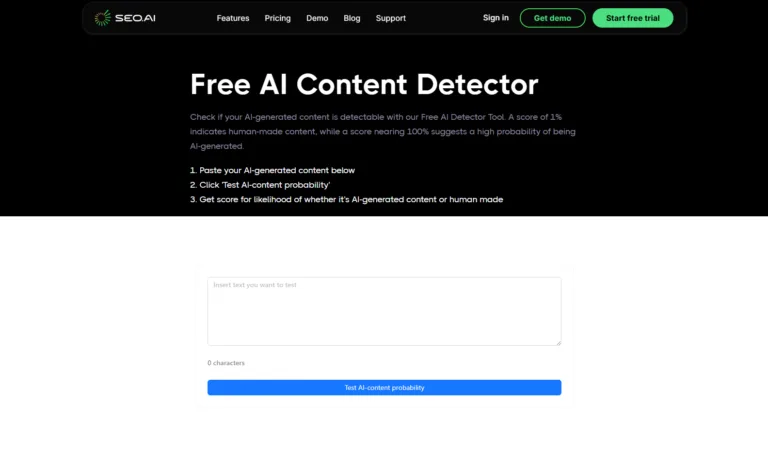
Start with evidence. Clear alignment with your AI content detection SEO builds confidence from the start. Pull your top forty pages by traffic and run each one through two or three detectors. Record the scores in a sheet alongside impressions, average position, and conversion rate. You are looking for a pattern, not a single verdict.
In my experience, the pages the AI content detection SEO score as heavily machine-generated are rarely the ones that lost traffic first. Usually the flagged pages are the ones that never grew. That gap — high detection score, flat traffic curve — is your priority list.
Build a Simple Scoring Sheet
Four columns are enough: URL, detector score, traffic trend over three months, and whether the page contains any first-hand element. Targeted refinements to your AI content detection SEO streamline the entire review. Mark the last one honestly. A stock photo of a laptop does not count. A screenshot of your own dashboard does.
Sort by traffic trend, worst first. Then filter to pages that also carry a high detection score. That intersection is where an AI content detection SEO checklist pays for itself fastest, because those pages have proven demand and unproven execution.

Separate Thin Pages from Salvageable Ones
Some flagged pages should be deleted, not rewritten. Focusing on AI content detection SEO provides clear direction here. If a page covers a topic with thirty better results and adds no unique angle, rescue attempts waste time. Consolidate it into a stronger parent page with a redirect and move on.
Salvageable pages share a trait: the AI content detection SEO answer a real question, but they answer it in the most predictable way possible. Those are worth the full treatment.
My rough rule is that a page deserves a rewrite if it has earned at least one organic link or converted at least one visitor in the past quarter.

Step 2: Inject First-Hand Detail That No Detector Can Fake
The AI content detection SEO is the step that does the heavy lifting, and it is the one most teams skip. Detection tools struggle with specific, unusual, verifiable detail.
A sentence like “we tested nine detectors on 120 product descriptions and the agreement rate between any two of them was under 60%” cannot be generated from a generic prompt, because the model does not have your test.

So go get the test. Run a small experiment. Interview a customer. Screenshot a support ticket with permission. Photograph the actual process. The specificity is the point — not decoration.
Five Kinds of Detail That Raise Perplexity Naturally
Not every page needs a research study. Here are the five types that work consistently:

- Original measurements. Word counts, timing, failure rates, before-and-after numbers from your own workflow.
- Direct quotes. Even one sentence from a named practitioner changes the texture of a page entirely.
- Named specifics. A tool version, a city, a team size, a budget band. Vague categories read as generated.
- Disconfirming detail. The thing that did not work. Human writers admit friction; models tend to smooth it away.
- Process artifacts. A rough sketch, an annotated screenshot, a redacted email thread.
Two or three of these per thousand words is usually enough to shift both detector scores and, more importantly, when refining a AI content detection SEO, reader engagement. The improvement in time-on-page is the signal that actually matters for rankings.
The Interview Trick That Takes Twenty Minutes
The AI content detection SEO do not need a research department. Message one person who does the job you are writing about and ask three questions: what surprised you, what do beginners get wrong, and what would you tell someone starting over. Twenty minutes of their time, ten minutes of yours, and you now have material no competitor can copy.
Quote them by name with permission, or describe them precisely if they prefer anonymity. Either way, the paragraph now carries information density that no amount of sentence shuffling can synthesize. This is the single highest-leverage move in any AI content detection SEO guide.
Step 3: Restructure the Outline Around Real Reader Questions
Generated outlines have a recognizable shape: the AI content detection SEO cover the topic evenly, in predictable order, with headings that could apply to any article in the niche. Human outlines are lopsided. They spend three sections on the thing people actually struggle with and one short paragraph on the thing that is obvious.
Pull the questions from search. Google’s People Also Ask, Reddit threads, support inboxes, sales call notes, and the comment sections of your competitors’ top pages. Then order your headings by how often those questions appear, not by how neatly they nest.
Mirror the Language People Actually Type
If customers search “why does my AI text get flagged,” the AI content detection SEO is a better H3 than “Detection Challenges and Limitations.” The exact phrasing matters less for keyword matching than for the instant recognition a reader feels. They see their own question and they stay.

Map each heading to one question with one clear answer. Proper attention to your AI content detection SEO sets a strong baseline. If a heading needs two sub-headings to answer a single question, the heading is too broad. Split it or cut it.
Cut the Sections That Only Exist for Symmetry
Most drafts contain at least one section the AI content detection SEO exists because outlines “usually have one.” A brief history of a two-year-old technology. A list of generic benefits. A definition everyone already knows.
Delete them. Shortening a page from 3,000 to 2,300 words while raising the information density usually improves rankings rather than hurting them. Depth is measured in insight per paragraph, not in word count.
Step 4: Rewrite at the Sentence Level for Rhythm and Burstiness
Now the prose pass. Read the draft aloud. Every place you stumble, a reader stumbles too. Every place your voice flattens into the same six-word rhythm, a detector lights up.

The mechanical fix is deliberate variation. Follow a long, clause-heavy sentence with a four-word one. End a paragraph early. Start a sentence with “But” or “And” or “Honestly” — humans do this constantly and style guides overcorrect against it.
Sentence Patterns to Break on Purpose
Watch for these four patterns, which appear in nearly every unedited AI draft:

- The tricolon habit. Three parallel items in every sentence. Break one into two items, or four.
- The “not only… but also” scaffold. Replace it with a plain statement and a comma.
- The summary sentence at the end of every paragraph. Delete half of them. Readers do not need a mini-conclusion every ninety words.
- The smooth transition word. “Moreover,” “furthermore,” “additionally” at the front of a sentence are high-perplexity kill shots. Use a period instead.
The AI content detection SEO edits take time and feel small while you make them. Collectively they are the difference between a page that reads like a press release and one that reads like a person who knows the subject.
When to Break a Paragraph on Purpose
Mobile reading punishes density. Integrating AI content detection SEO into your workflow produces consistent quality. One idea per paragraph, two sentences maximum as a working rule, and a hard break whenever the topic shifts even slightly. A single sentence standing alone as a paragraph is fine. It signals emphasis and it changes the visual rhythm.
This is also where AI content detection SEO best practices overlap with plain usability. The pages that score well with detectors tend to be the pages that are easiest to skim. That is not a coincidence — both reward structural variation.
Step 5: Cover Entities and Semantics the Way Experts Do
Semantic coverage is where careful editors separate themselves. A page about detection should mention perplexity, burstiness, watermarks, provenance metadata, classifier models, false positives, academic integrity, and the C2PA standard. Not as a keyword dump — as context that proves the writer knows the field.

Build a term map before the AI content detection SEO write. List the ten to fifteen concepts a specialist would expect to see. Then check the draft: which ones appear, which ones appear only once, and which ones are missing entirely. Spread the missing ones into sections where they genuinely belong.
False Positives Deserve Their Own Discussion
Anyone who has run detection seriously has seen a false positive destroy trust. Non-native English speakers get flagged at higher rates. Neurodivergent writers get flagged. Poets and technical writers who use deliberate repetition get flagged. A page that ignores this is incomplete.

Mention it directly. It builds credibility, it answers a real fear, and it gives you an honest reason to say the tool is not a verdict. Search quality raters respond to that kind of nuance.
Where Provenance Standards Fit In
Content provenance is moving from theory to infrastructure. The Content Authenticity Initiative and the C2PA provenance standard let publishers attach verifiable metadata about how an asset was created. For anyone building an AI content detection SEO strategy that survives the next few years, that metadata is more durable than any detector score.

The AI content detection SEO is not mainstream on every CMS yet. But it is the direction the industry is moving, and understanding it puts you ahead of the teams still arguing about which detector is most accurate.
Step 6: Verify With Multiple Tools, Not One Score
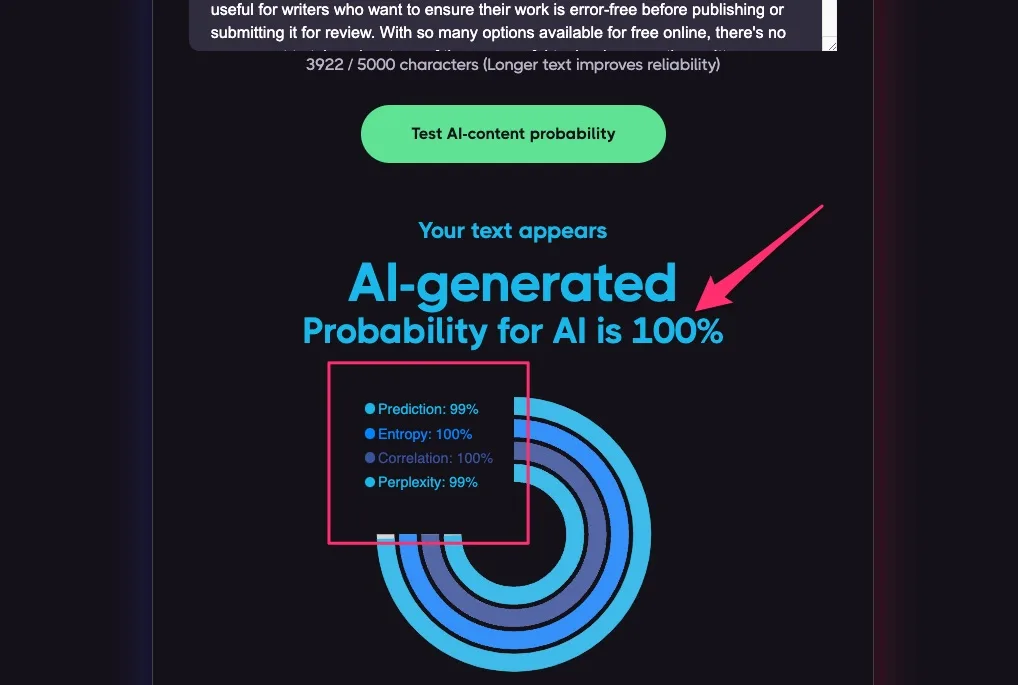
Run every drafted page through three detectors and average the results. Disagreement between tools is itself useful information — it tells you the text sits in the ambiguous middle, which is exactly where most real human writing lands.

Aim for a “likely human” or “mixed” verdict across the majority, not a perfect clean score everywhere. Chasing 100% on any single tool leads to absurd edits that hurt readability and, eventually, rankings. The detector is a smoke alarm. You do not tear down the kitchen because it beeped.
Reading a Multi-Tool Score Sheet
Three outcomes matter:

- All three flag it. The draft is genuinely too smooth. Return to Step 4 and cut harder.
- Mixed results. Normal. Add one specific detail and move on.
- All three pass it. Check that you did not overcorrect into weirdness. Readability still wins.
Record the scores so the AI content detection SEO can compare them across pages. Over a few months, the correlation between score and traffic trend becomes visible, and you can calibrate your own thresholds instead of trusting a vendor’s default.
Step 7: Monitor, Iterate, and Republish With Purpose
Publication is the midpoint. Set a baseline: impressions, clicks, average position, scroll depth, and any conversion event. Then check again at thirty and ninety days. Pages that gain traffic without losing detection scores are your proof of concept — study what you did there.
The pages the AI content detection SEO stagnate usually need one of two things: a fresh specificity injection or a structural trim. A quarterly refresh with one new data point often outperforms a full rewrite, and it costs an hour instead of a day.
What to Measure Beyond Rankings
Rankings move slowly and noisily. Look at scroll depth and return visits instead. A page that gets read to the end is teaching you something a position number cannot. Combine that with the AI content detection SEO checklist below and you have a self-correcting loop rather than a one-time cleanup.
Common Mistakes That Undo an Otherwise Strong Strategy
Most failures trace back to a handful of avoidable errors. Watch for these.
- Synonym spinning. Swapping words to lower a score makes prose worse and fools nobody. Readers notice, and so do quality raters.
- Over-humanizing. Inserting typos, slang, or random tangents to game a detector. This damages credibility and rarely helps the score anyway.
- Ignoring intent. A perfect technical rewrite of a page that targets the wrong search intent stays invisible.
- Treating the score as the goal. The detector is a proxy. Rankings, links, and reader behavior are the actual outcomes.
- No internal links. Orphaned pages rarely rank, no matter how well-written. Link them from a relevant parent.
- Skipping the schema. Article, FAQ, and HowTo markup help search engines understand structure and can earn rich results.
- One-and-done publishing. A page that never gets refreshed decays quietly. Dormancy is a slow bleed.
None of these requires a new tool. All of them require attention to the boring parts of publishing.
Your AI Content Detection SEO Checklist Before Hitting Publish
Here is the pre-flight list. Print it, pin it, run through it on every page.
- First-hand element present. At least one measurement, quote, or process artifact.
- Headings mirror real questions. Pulled from People Also Ask, support tickets, or community threads.
- Sentence variation audible. Long, short, and medium sentences in every section.
- No fronted transition words. “Moreover,” “furthermore,” “additionally” removed.
- Entity coverage complete. Ten to fifteen specialist concepts distributed across the page.
- Three-detector verification. Majority “human” or “mixed” verdict.
- Readability pass. Paragraphs under two sentences, mobile-first formatting.
- Schema implemented. Article, plus FAQ or HowTo where applicable.
- Internal links in. At least two from relevant parent pages.
- Baseline recorded. Traffic, position, and engagement logged for the next review.
- Refresh date scheduled. Ninety days out, with a specific detail to add.
Eleven items, most of them taking minutes. That sequence is the full AI content detection SEO checklist in working form, and it is the part that separates a repeatable process from a hopeful one.
Practical AI Content Detection SEO Tips from the Field
A few things I have learned the hard way, offered as a short set of AI content detection SEO tips.
- Handwrite the first paragraph. Openers that come out of a model have a distinct polish. Native roughness beats clean and empty.
- Record yourself explaining the topic. Transcribe it. Read the transcript into the draft. Real speech has natural cadence and a burstiness score no model can imitate.
- Keep a specificity folder. Screenshots, quotes, numbers, and screenshots collected over time. Pull from it whenever a draft feels thin.
- Read to a colleague, not to yourself. Their face tells you where the prose dies.
- Use the same tool across pages. Swapping detectors mid-audit invalidates comparisons you have already made.
One more: do not treat the detection score as a moral verdict. Writing with AI assistance is normal. The question is what you add on top of it, and how honestly you present the result.
Where AI Content Detection Fits in the Bigger Content Landscape
This page sits under a larger parent topic: content quality and search visibility. Within that cluster, the natural next reads are technical on-page optimization, topical authority mapping, and content refresh strategy. Detection is one lens on quality, not the whole picture.
The teams that get this right stop asking “is our content flagged” and start asking “is our content the best answer for this query.” That reframing does more for rankings than any detector audit. Detection just tells you where to look first.
Build the seven-step habit. Keep the specificity folder stocked. Review the scores quarterly. Do all that, and AI content detection SEO stops being a panic button and becomes a routine part of how you publish — useful, unglamorous, and quietly effective.