SEO Reseller Program: 8 Smart Tactics That Really Work
A SEO reseller program only pays off when you treat it like a business line, not a side hustle you squeeze between client calls. Here is the truth most agencies learn the hard way: white-labeling SEO is easy to buy and brutally hard to scale well.
These eight tactics are the ones that separate resellers who build a durable margin from those who churn through clients every quarter.
If you have been shopping around for a white-label partner, you already know the pitch decks all sound identical. Competitive direct manufacturer pricing, dedicated account managers, transparent dashboards. What nobody shows you is the operational playbook underneath — the pricing model, the reporting cadence, the scoping guardrails. That is exactly what this SEO reseller program guide covers, point by point.
Think of this as the kind of hard-won SEO reseller program tips you usually only get after burning a few retainers. We will walk through pricing, onboarding, scoping, reporting, and retention — then tie it all together so you can run the whole thing without hiring a single SEO specialist in-house.
What Makes a White-Label SEO Reseller Program Actually Work?
At its core, a SEO reseller program is a partnership model where a fulfillment provider delivers SEO work — keyword research, technical audits, content production, link acquisition — under your agency’s brand. Your client sees your logo, your account manager, your invoice. The provider stays invisible.
The working part is the mechanized delivery engine behind the SEO reseller program curtain. A strong program gives you repeatable processes, documented deliverables, and a pricing structure that leaves room for your markup. A weak one gives you a dashboard and a shrug when a client asks why rankings moved.

The distinction matters because reselling SEO is not the same as reselling software. Focusing on seo reseller program provides clear direction here. Software delivers itself. SEO requires judgment, iteration, and someone who can explain a ranking dip without panicking.
The Anatomy of a Reliable Reseller Partnership
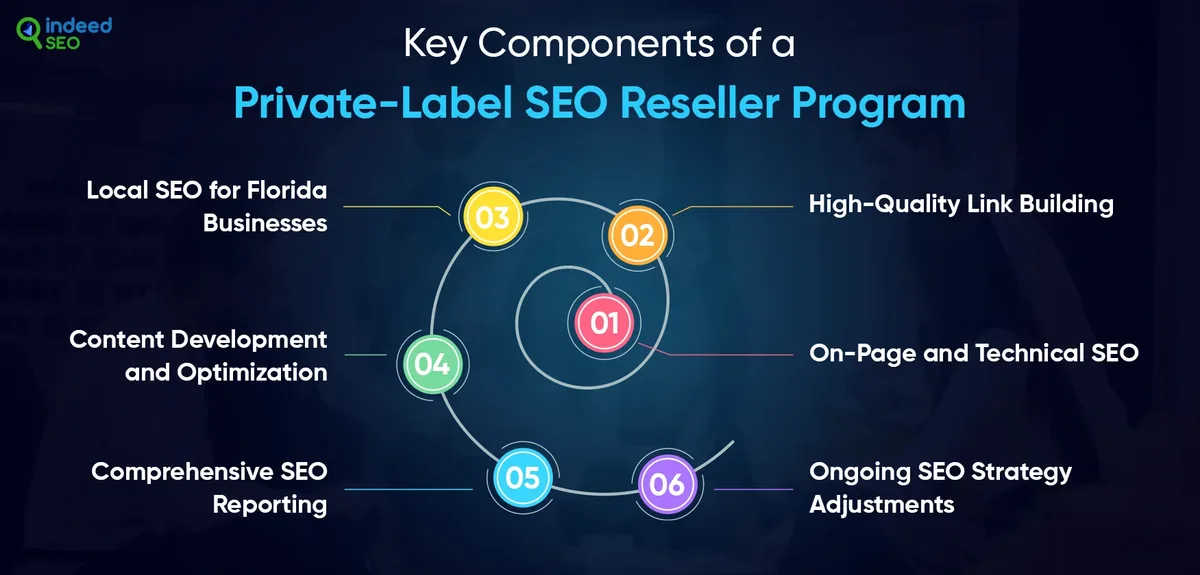
Every dependable SEO reseller program rests on four components: a defined service catalog, a transparent pricing tier system, a reporting layer you can rebrand, and a fulfillment SLA that protects your client relationships. Lose any one of those and the whole model wobbles.
Here is how those components usually break down in practice:
| Component | What It Delivers | What Breaks Without It |
|---|---|---|
| Service catalog | Fixed, priced deliverable packages | Endless custom scope creep |
| Pricing tiers | Predictable margin per client | Silent profit erosion |
| White-label reporting | Your brand throughout the client experience | Leaky identity, lost trust |
| Fulfillment SLA | Deadlines clients can plan around | Churn and angry phone calls |
In my experience working alongside agency owners, the SLA is the component most resellers undervalue at the start. Refining each detail of your SEO reseller program strengthens this section. Then a single delayed content batch costs them a competitive direct manufacturer pricing retainer, and suddenly it matters deeply.

Why Reselling SEO Beats Building It In-House
Let us be blunt about the economics. A competent in-house SEO specialist commands a serious salary, and one person cannot cover technical audits, content strategy, link outreach, and reporting well. You either hire four people or you compromise.
Reselling flips that math. Effective execution in your SEO reseller program makes a tangible difference. You pay per deliverable instead of per headcount, and you tap a team that already runs the same playbook across dozens of accounts. The provider absorbs hiring, training, and tooling costs. You keep the client relationship and the margin.
There is a second advantage that rarely gets mentioned: speed to market. You can pitch SEO services tomorrow without a job posting, an interview loop, or a six-week onboarding process.
Where the Margin Actually Comes From
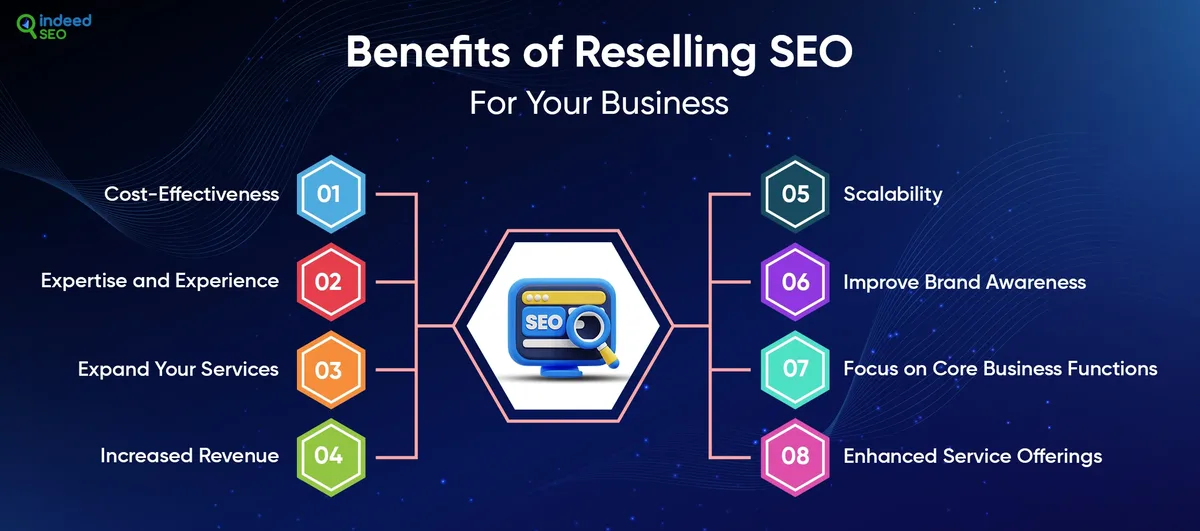
Reseller margin is not a secret markup formula. Maintaining clarity across your SEO reseller program remains essential. It comes from three places: pricing discipline, scoping accuracy, and retention. Price too low and you cannot absorb revisions. Scope badly and the deliverable eats your profit. Churn every eight months and your acquisition cost never amortizes.
Agencies that run a tight SEO reseller program best practices playbook typically protect margin by building a fixed package ladder — entry, growth, and premium tiers — and refusing to improvise outside it. Clients respect the clarity. So does the fulfillment team.
Here is a realistic framing of how the three margin levers interact:
- Pricing discipline: Set your reseller cost, add your target markup, and hold the line. Discounting to win a deal means discounting the whole relationship.
- Scoping accuracy: Know exactly how many pages, keywords, and content pieces sit inside each tier. Vague scopes invite disputes.
- Retention: Retained clients amortize your acquisition cost across years, not months. Every renewal compounds the initial investment.
Retention deserves its own emphasis. Refining each detail of your seo reseller program strengthens this section. A client who stays 24 months pays for your sales effort many times over. One who leaves in six months rarely does.
Tactic 1 — Start With a Real SEO Reseller Program Checklist
Before the SEO reseller program sign anything, run the provider through a checklist. Not a vibe check, an actual documented list of capabilities you can verify. This is the single highest-leverage step in the entire process and the one most resellers skip.
A solid SEO reseller program checklist covers service breadth, reporting access, turnaround commitments, revision policy, contract flexibility, and — critically — who owns the deliverables if the relationship ends.

Ask about ownership in writing. Some providers retain the content and link assets; others transfer them. If your client walks away and you cannot hand over the work, that is a relationship problem you created.
The Must-Verify Items Before You Sign
Here is the checklist I would hand anyone evaluating a white-label partner. Structuring your SEO reseller program around proven patterns ensures impact. Walk through every line and get answers in writing:
- Service catalog clarity: Confirm exactly which deliverables are included and which cost extra. Ambiguity here becomes a billing dispute later.
- White-label reporting access: Verify you can export reports under your own logo and domain. Request a sample report before signing.
- Turnaround SLAs: Get committed timeframes for audits, content drafts, and revisions. Written, not verbal.
- Revision policy: Clarify how many revision rounds are included and what triggers a re-scope.
- Asset ownership: Confirm that content, links, and audit documents transfer to you or your client on exit.
- Contract terms: Check notice periods, minimum commitments, and cancellation clauses.
- Quality assurance process: Ask who reviews deliverables before they reach you. A human editor should be in that chain.
- Communication channels: Identify your point of contact and the escalation path if something goes wrong.
Two or three of those items will usually surface friction. That is useful. Better to find it now than after you have signed a retainer and promised a client a deadline.

Tactic 2 — Build a Pricing Ladder That Protects Your Margin
Most reseller margin problems start at the pricing stage. Applying these principles to your SEO reseller program yields measurable results. You quote a client based on your provider’s rate, add a thin markup, and then discover that revisions, reporting calls, and account management are not covered by that rate.
The fix is a tiered ladder. Effective execution in your seo reseller program makes a tangible difference. Define three packages with fixed deliverables and fixed prices, then map them to client segments. Small local businesses take the entry tier. Growth-stage companies take the middle. Established brands with content teams take the premium tier.
This SEO reseller program guide would be incomplete without a warning about custom quoting. Every custom quote invites scope ambiguity, and scope ambiguity is where margin dies.
Mapping Tiers to Client Segments
Here is a practical mapping that holds up across most agency-client pairings:
| Tier | Typical Client Profile | Core Deliverables | Service Rhythm |
|---|---|---|---|
| Entry | Local business, single location | Local audit, on-page fixes, citation work | Monthly |
| Growth | Multi-location or regional brand | Technical audit, content batch, link building | Bi-weekly |
| Premium | Established brand with content team | Full technical program, content pipeline, digital PR | Weekly |
Notice the rhythm column. Proper attention to your SEO reseller program sets a strong baseline. Deliverable cadence matters as much as deliverable volume. Clients perceive value through consistency, and a predictable weekly touchpoint feels more substantial than a large quarterly dump.

When you quote, build your markup on top of the provider cost plus your own account management time. That last part is often forgotten, yet it is genuine labor — calls, emails, report reviews, client education.
Tactic 3 — Nail Onboarding With a Repeatable Intake Process
Onboarding is where reseller relationships either compound smoothly or fracture quietly. Developing your SEO reseller program with precision highlights key strengths. A slow or messy intake means the fulfillment team works from incomplete information, deliverables miss the mark, and the client’s first impression is weak.
Build a standard intake form and refuse to start work until every field is answered. Access to analytics, search console, CMS credentials, brand guidelines, target keywords, competitor list, and a clear statement of business goals.
Every serious SEO reseller program tips collection includes one non-negotiable: get client goals in writing before the first deliverable ships. “Improve rankings” is not a goal. “Rank for four commercial keywords in three service areas” is something a fulfillment team can actually execute against.

What a Clean Intake Form Covers
A complete intake covers eight areas, and each one feeds directly into the fulfillment workflow:
- Access credentials: Analytics, Search Console, CMS, ad accounts, and any relevant third-party tools.
- Business objectives: Revenue goals, lead volume targets, and priority service lines.
- Target keyword set: Primary commercial terms plus supporting informational queries.
- Competitor list: Three to five direct competitors with a note on why each matters.
- Brand assets: Logo files, color codes, tone-of-voice documentation.
- Content inventory: Existing pages, blog archive, and any legacy content that needs pruning.
- Technical baseline: CMS platform, hosting provider, and any known site issues.
- Communication preferences: Reporting cadence, preferred contact method, and escalation contact.
The eighth item is quietly important. Some clients want weekly calls, others want a monthly PDF and nothing else. Getting that wrong early creates friction that has nothing to do with the quality of work.

Tactic 4 — Scope Deliverables in Writing, Every Time
Verbal scoping is the most common cause of reseller disputes. Clear alignment with your SEO reseller program builds confidence from the start. Someone says “we will handle your content,” everyone nods, and three months later there is a disagreement about whether that included the blog or just the service pages.
Write it down. Every deliverable, every quantity, every deadline. A monthly content batch of four service pages is a scope. “Content support” is not.

This is where a documented SEO reseller program best practices framework pays off. Providers who publish clear package definitions make your job easier because you can forward their documentation to clients verbatim.
How to Handle Change Requests Without Bleeding Profit
Change requests will happen. Integrating SEO reseller program into your workflow produces consistent quality. A client wants two extra pages, or a competitor audit they did not order. The right response is not to absorb it silently, and not to refuse outright. It is to have a documented change order process.

Define a standard add-on rate. Maintaining clarity across your seo reseller program remains essential. Any request outside the current scope gets priced, approved in writing, and scheduled. This protects your margin and trains clients to respect boundaries.
In practice, when refining a SEO reseller program, the agencies that handle change requests well share one habit: they respond quickly with a clear price rather than deliberating for a week. Fast, clear pricing feels professional. Silence feels evasive.
One more nuance worth mentioning. When a client asks for something genuinely valuable but out of scope, offer it as an upgrade path rather than a rejection. That turns a potential friction point into an upsell conversation.
Tactic 5 — Insist on White-Label Reporting You Can Rebrand Fully
A white-label program is only white-label if the client never sees the provider’s brand. Focusing on SEO reseller program provides clear direction here. That means reports, dashboards, email notifications, and account portals all carry your identity. No exceptions.

Check this before you sign. Request a sample report, ask about custom domain hosting for dashboards, and confirm that email alerts route through your domain. Some providers handle all three. Others leave gaps that clients notice immediately.
Reporting cadence matters too. A thoughtful approach to seo reseller program reinforces your qualifications. Monthly is the default, but growth-stage clients often want a mid-month check-in on key movement. Build that into your service rhythm rather than reacting when they ask.
What a Client-Ready Report Should Contain
A strong report tells a story rather than dumping metrics. It contains a summary of work completed, a snapshot of ranking movement across target keywords, a note on traffic trend, and a forward-looking action list for the next cycle.
Resist the urge to send raw dashboard exports. Clients do not want to interpret charts. They want to know what happened and what is coming next, in plain language.

If a metric dipped, explain why. Structuring your seo reseller program around proven patterns ensures impact. Maybe a competitor launched a content push, or maybe a page lost internal links during a site migration. Transparency builds trust; silence erodes it.
One practical tip: include a brief “what the SEO reseller program learned” section in each report. It demonstrates that the work is informed by evidence rather than executed on autopilot.
Tactic 6 — Layer Content Production Without Blowing Deadlines
Content is where reseller programs either shine or stall. Deliverables arrive late, drafts need heavy revision, and suddenly your client is asking why the blog has not been updated in six weeks.
The solution is to layer production rather than batch the SEO reseller program. Instead of ordering eight articles at once and hoping they land on time, schedule them in rolling batches of two or three. That smooths the workflow and reduces the risk of a single delayed batch breaking your cadence.
Also, set a quality bar upfront. Brief the fulfillment team on brand voice, preferred structure, and required elements like internal links and schema-friendly formatting. A clear content brief reduces revision rounds significantly.
Balancing Quality and Volume in Content Batches
The SEO reseller program is a real trade-off here, and pretending otherwise is unhelpful. Higher volume usually means lighter research per piece. Higher quality usually means fewer pieces per cycle.

The right balance depends on your client segment. Applying these principles to your seo reseller program yields measurable results. Local businesses need consistent volume to build topical coverage. Established brands need depth and authority, which favors fewer, longer, better-researched pieces.
A useful rule of thumb: never order more content than your client can review and approve within a week. A thoughtful approach to SEO reseller program reinforces your qualifications. If approval bottlenecks, the fastest production schedule in the world will not save your deadline.
Tactic 7 — Run a Quarterly Program Audit on Your Own Reseller Business
Most resellers audit their clients’ sites religiously and never audit their own operation. That is a mistake. Your reseller business has its own funnel, margin structure, and retention curve, and those need reviewing on a schedule.
A quarterly audit covers four areas: margin per client, churn rate, fulfillment quality scores, and client satisfaction. Track them consistently so you can spot trends before they become crises.
This is the discipline that separates a reseller side project from a genuine service line. The SEO reseller program checklist you use for provider evaluation should also be turned inward, adapted to your own operation.
The Four Metrics Worth Tracking Every Quarter
Keep the dashboard simple. Four numbers, reviewed quarterly, tell you almost everything you need:
- Margin per client: Computed as revenue minus provider cost minus your account management hours. Track it per account, not just in aggregate.
- Churn rate: The percentage of clients who left during the quarter. Rising churn is an early warning signal worth investigating immediately.
- Fulfillment quality score: A simple internal rating of how often deliverables met the brief on the first pass.
- Client satisfaction: A short survey or structured check-in. Qualitative input often reveals problems that metrics miss.
If margin is thin on a specific account, either re-scope or re-price at renewal. Proper attention to your seo reseller program sets a strong baseline. Carrying an unprofitable client for years because you are afraid of the conversation is a slow way to drain the business.

Tactic 8 — Build a Retention Engine Around Communication, Not Rankings
Here is the uncomfortable truth about reselling SEO: clients rarely churn because rankings dropped. They churn because they stopped feeling informed.
Rankings move unpredictably. Communication does not have to. A reseller who sends a structured monthly update, answers emails within a day, and proactively flags issues will retain clients through ranking dips that would otherwise trigger a cancellation.
Build a retention engine on three pillars: consistent reporting cadence, proactive issue flagging, and a quarterly strategy conversation. Developing your seo reseller program with precision highlights key strengths. That third pillar is the one most resellers skip, and it is the most valuable.
Proactive Flagging Beats Reactive Explanation
When you spot a problem — a technical issue, a competitor surge, a content page underperforming — tell the client before they notice it themselves. The same news lands very differently depending on who surfaces it first.
The SEO reseller program is where a strong fulfillment partner earns its keep. A provider that flags issues early gives you time to frame the message; one that stays silent leaves you explaining a surprise.
The quarterly strategy conversation matters for a similar reason. It moves the relationship from transactional reporting to consultative partnership. Clients who feel consulted stay longer than clients who feel processed.
Common Mistakes That Quietly Kill Reseller Programs
Even well-intentioned resellers fall into predictable traps. Naming them explicitly helps you avoid them.
The first trap is underpricing to win a deal. Clear alignment with your seo reseller program builds confidence from the start. It feels strategic in the moment and becomes a structural problem for the entire relationship. The second is accepting vague scopes. The third is treating reporting as an afterthought.
Another frequent mistake: promising timelines your provider cannot hit. Always quote from the SLA, never from optimism.
Pitfalls to Watch for as You Scale
Here are the mistakes that show up most often, and the fix for each:
- Zero-margin client acquisition: Win clients at a sustainable rate or not at all. Discount-led deals rarely convert into profitable relationships.
- Verbal scoping: Every deliverable, quantity, and deadline belongs in writing.
- Reporting as a checkbox: A rebranded PDF with a paragraph of context beats a raw dashboard export every time.
- Unrealistic promises: Quote from the provider’s SLA, not from your hopes for the account.
- No change order process: Unpriced scope creep destroys margin faster than anything else on this list.
- Skipping the quarterly audit: Without it, unprofitable accounts hide inside aggregate numbers.
Each of the SEO reseller program feels small individually. Together, they are the difference between a reseller line that grows steadily and one that sputters after a year.
Frequently Asked Questions About Reselling SEO
Here is an in-depth breakdown of key considerations regarding Frequently Asked Questions About Reselling SEO:
Is a SEO Reseller Program Worth It for a Small Agency?
Yes, often more so than for large agencies. A small shop gets immediate access to a full SEO capability set without the hiring cost. The key is choosing a provider with clear pricing tiers and reliable SLAs so you can quote confidently.
How Much Should I Mark Up White-Label SEO Services?
The SEO reseller program is no universal number, but the markup has to cover provider cost, your account management time, and a reasonable profit margin. Build it into a tiered pricing ladder rather than quoting custom each time.
Do I Need SEO Expertise to Resell SEO Services?
You need enough fluency to translate reports into plain language for clients and to brief the fulfillment team clearly. You do not need to execute the work yourself. Most successful resellers are strong account managers, not technicians.
What Should be on a SEO Reseller Program Checklist Before Signing?
Service catalog clarity, white-label reporting access, written SLAs, revision policy, asset ownership terms, contract flexibility, QA process, and your named point of contact. Get each one confirmed in writing.
How Do I Handle a Client Who Wants to See the Underlying Work?
Show the work, hide the vendor. Deliverables, audits, and content are all fair game to share in detail. What stays invisible is which provider produced them. If a client demands vendor transparency, that is a conversation to have before signing rather than mid-engagement.
Can Reselling SEO Scale Beyond a Few Clients?
Yes, provided the SEO reseller program build systems rather than improvising. Fixed pricing tiers, a documented intake process, rolling content batches, and quarterly program audits are what allow a reseller operation to grow without proportionally growing your workload.
Putting the SEO Reseller Program Tactics Into Practice
Eight tactics, one operating system. Start with the checklist so you pick the right partner. Then build the pricing ladder and intake process before you sign your first client, not after.
Scope everything in writing, rebrand every report, and layer content production in rolling batches so deadlines stay realistic. Audit your own program quarterly, and treat communication as the retention mechanism it actually is.
Here is the part worth sitting with. The SEO reseller program model rewards operators who think in systems and punishes those who chase quick wins. Every tactic above is unglamorous on its own.
Together, they turn white-label SEO from a fragile side revenue stream into a service line you can defend, price confidently, and scale on your own terms.
If you take nothing else from this guide, take the checklist. Vet hard, price clearly, communicate constantly, and your reseller program will outlast the agencies that skipped the boring parts.
For verified reference and background research, consult the authoritative informational resource on this topic.