SEO Myths: 10 Costly Myths Debunked (Proven Facts)
Most of the SEO myths floating around the web were born from real frustrations, then passed along so many times that nobody bothers to check them anymore. I have spent years watching smart people waste money and momentum on advice that sounds authoritative but collapses the moment you test it against actual data.
This is the pillar guide I wish someone had handed me early on. We are going to pull apart ten of the most expensive falsehoods in search, walk through why each one persists, and show you what the proven facts actually say. Consider it your practical SEO myths checklist for every campaign decision you make from here on.
One quick note on scope: everything below lives under the wider umbrella of search engine optimization, and a few sub-topics like technical audits, content decay, and entity building deserve their own deep dives eventually. Focusing on seo myths provides clear direction here. For now, let us get to the myths that cost the most.
Why SEO Myths Survive Even When They Fail So Loudly
Bad advice rarely gets deleted. It gets repeated by people who genuinely believe they are helping, and by people who profit from giving you more work. That is the uncomfortable truth behind almost every SEO myths guide worth reading.
There is also a timing problem. Search behavior shifts gradually, so a tactic that worked three years ago can limp along looking semi-plausible for another two. By the time the evidence is undeniable, the myth has a following.
Confirmation Bias Makes Bad Tactics Feel Like Wins
Picture a small business owner who adds a pile of keyword-stuffed tags to a page. Traffic ticks up slightly the next month because a seasonal query hit. The tags get the credit.
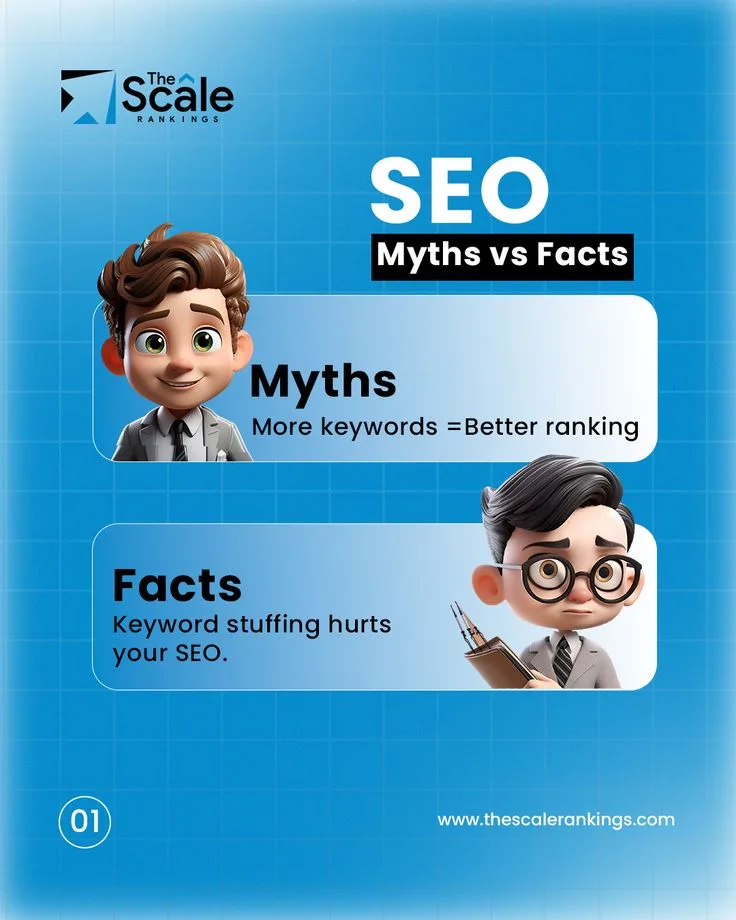
That is confirmation bias in its purest form. You already believe the tactic works, so any wobble in the right direction becomes proof. Real SEO myths best practices demand you isolate variables, track baselines, and give a change at least eight full weeks before judging it.
The Cost of Believing a Myth is Never Zero
Every hour spent on a useless tactic is an hour not spent on something that compounds. That is the real ledger.
Some myths cost you a freelancer’s invoice. Others cost you a redesign, a domain migration, or worse, a temporary rankings crash that takes months to recover from. Faith in SEO myths tips that sound too easy usually comes with an invisible invoice attached.
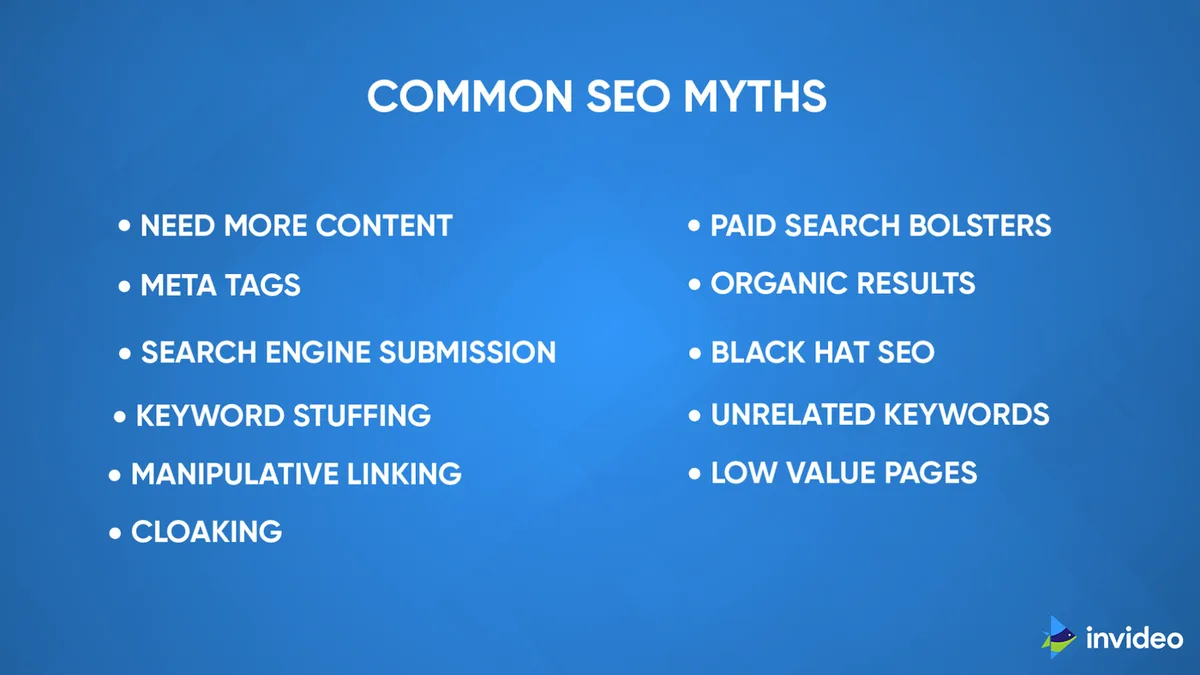
Myth 1: You Must Repeat a Keyword Constantly to Rank for It
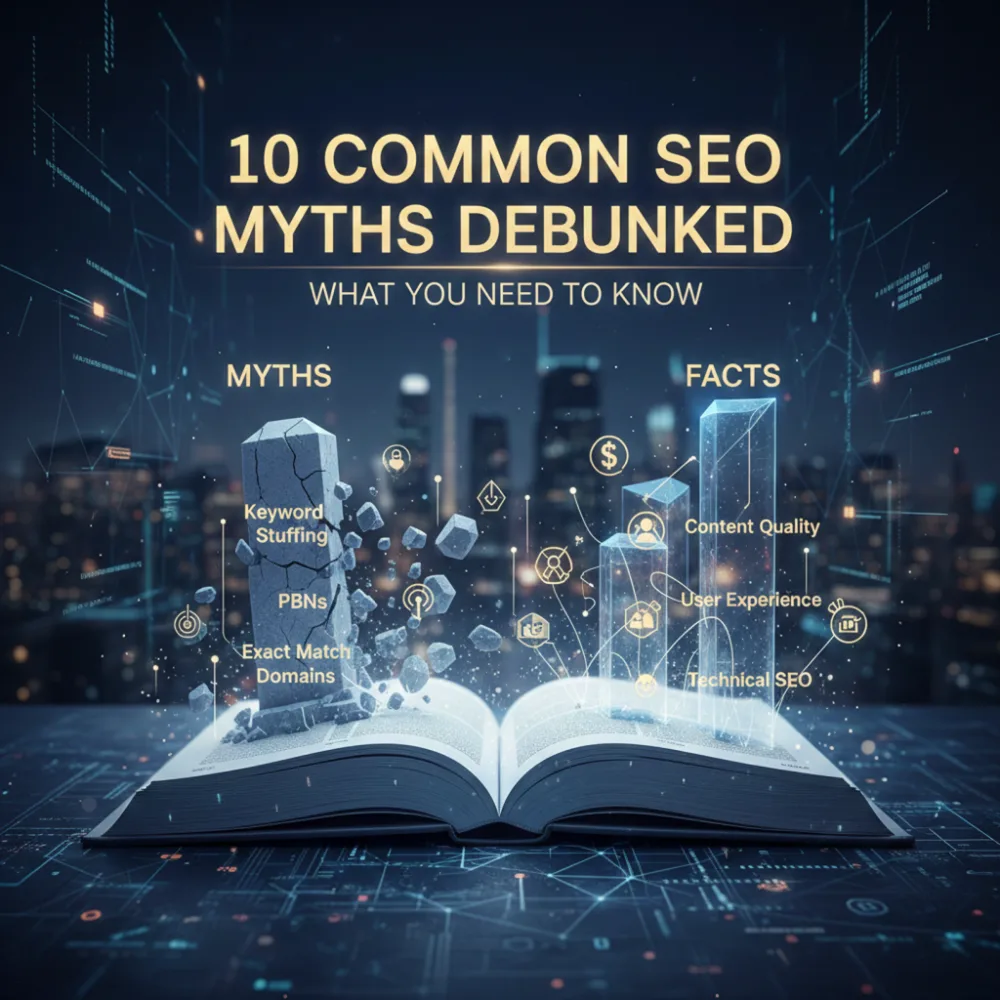
Let us start with the granddaddy of all SEO myths. The idea that a page ranks because a phrase appears again and again is a relic from a time when search engines were essentially counting words.
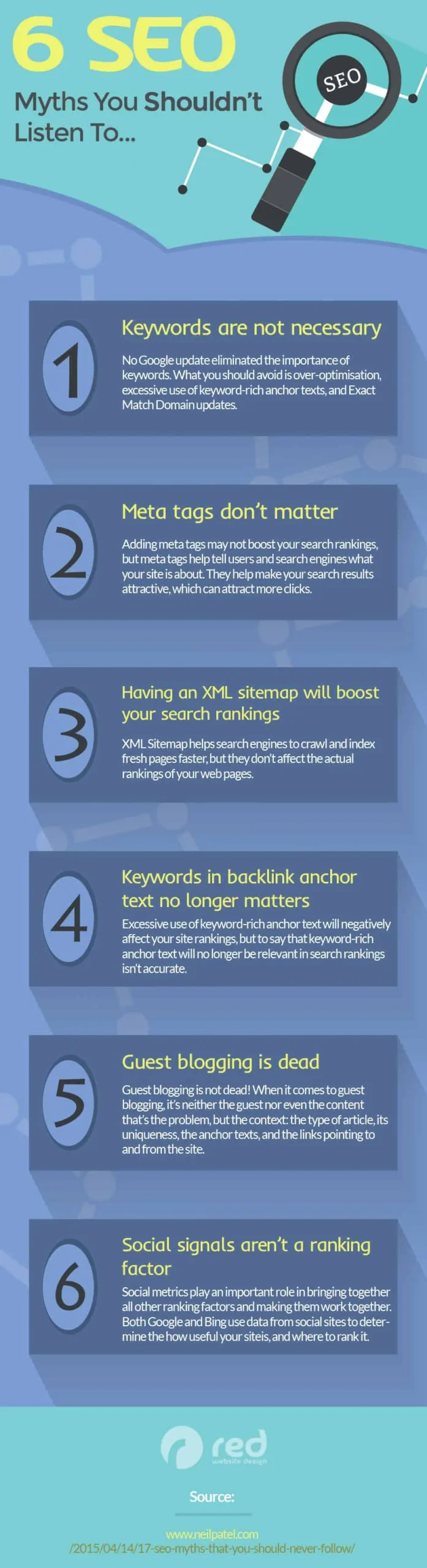
Modern ranking systems read context, relationships between concepts, and the overall intent of the page. Density padding does nothing but make your writing worse and bore the human who lands on it.
Here is the proof point the seo myths should settle it. Look at almost any top-ranking page for a competitive term and count how often the exact phrase appears. You will usually find a natural rhythm, one mention every few hundred words, not a drumbeat.
What to Do Instead of Stuffing
Write the page a smart colleague would want to read. Then check whether the keyword appears in the title, the first paragraph, at least one subheading, and somewhere in the body.
Use semantic relatives to build the topic. If you are writing about email automation, talk about sequences, deliverability, send times, and segmentation naturally. That is how you satisfy intent while staying readable, and it is the foundation of any legitimate SEO myths guide.
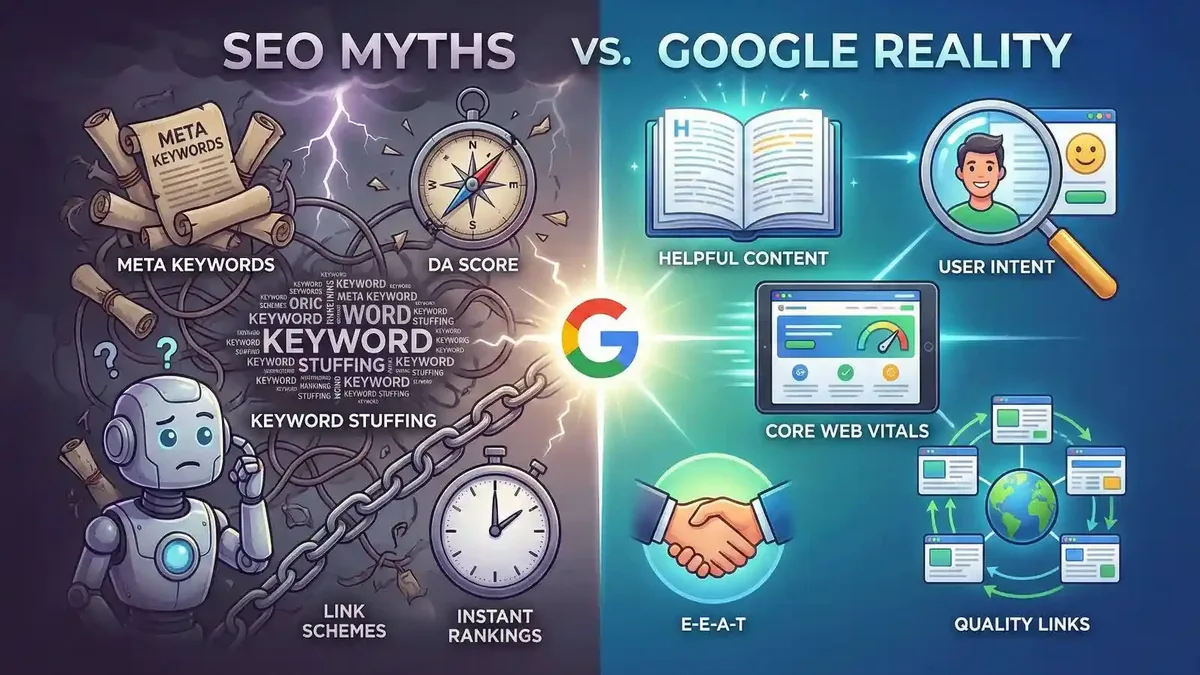
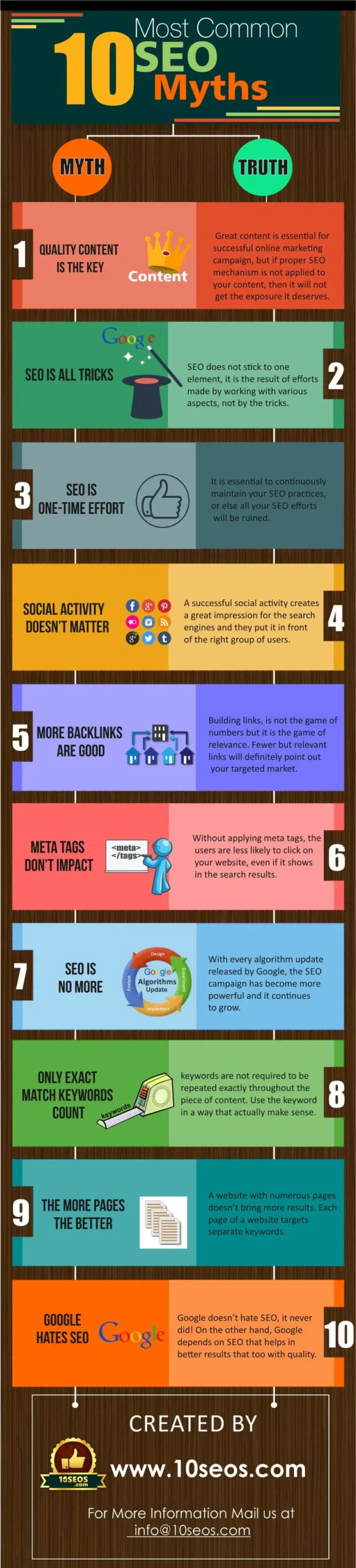
Myth 2: Meta Keywords Tag Still Influences Rankings
This one refuses to die despite being publicly retired by major search engines more than a decade ago. Adding a meta keywords tag today is essentially writing a note nobody reads.
Why does it persist? Because it is cheap, harmless, and looks professional on a page source view. Clients ask for it. Agencies bill for it. Nobody loses money by including it, so nobody bothers to correct the record.
Here is the honest framing: the meta keywords field is not a ranking factor. It is also, technically, a gift to anyone who wants to scrape your keyword strategy from view-source. That alone should make you pause.
What Actually Matters in a Page Head
Focus your energy on the title tag, the meta description, canonicalization, and structured data. Effective execution in your seo myths makes a tangible difference. Those are the elements search engines and humans actually respond to.
For social and messaging previews, Open Graph tags matter far more than legacy keyword meta. Update your SEO myths checklist to reflect this, and you immediately cut a layer of pointless work from every new page.
Myth 3: a Higher Word Count Automatically Means Better Rankings
If you have ever been told to “just hit 2,500 words” to beat a competitor, you have run into one of the more expensive SEO myths in circulation.
Length correlates with rankings because comprehensive pages tend to be longer, not because Google has a character counter on its desk. Correlation is not causation, and confusing the two leads to padded, exhausting content that hurts engagement signals.
Real SEO myths best practices treat word count as an output, not a target. You answer the question fully, and the length settles wherever it needs to settle.
The Trade-Off Nobody Talks About
Longer content has diminishing returns on every dimension that matters: reader attention, editor effort, and maintenance cost. A tight 1,200-word page that nails intent will outperform a bloated 3,500-word page that rambles.
When you do write long, earn the length. Use tables, TL;DRs at the top, and clear subheadings so a reader can scan to the part they need in five seconds. That is the difference between comprehensive and endless.
| Myth | Why People Believe It | What the Data Says |
|---|---|---|
| Higher word count always ranks better | Top results tend to be long | Length is a byproduct of depth, not a direct signal |
| Meta keywords tag matters | It looks professional | Publicly ignored as a ranking factor |
| Keyword stuffing works | Old tactics seem to linger | Context and intent drive relevance now |
Myth 4: Backlinks are Dead
Every couple of years someone publishes a piece declaring link building obsolete, typically right after a Google update. Then the next round of competitive rankings quietly proves otherwise.
Links are not dead. Maintaining clarity across your seo myths remains essential. Low-quality, spammy links are the problem, and they always were. The bar has simply moved toward relevance, editorial placement, and topical fit rather than raw volume.
The SEO myths around links usually conflate two ideas. One is that quantity no longer works. The other is that links no longer work. The first is true. The second is not.
What a Genuinely Useful Link Looks Like
A link from a page in your niche, written editorially by someone who chose to reference you, still carries real weight. That is the standard to chase.
Think of it as a citation in a professional network. If a respected source in your field would mention your work, that mention means something. If a stranger in an unrelated vertical drops a footer link, it means less than nothing.
Myth 5: Ranking Page One is the Whole Game
Here is where a lot of SEO myths tips start to actually cost revenue. Ranking is the entry point, not the destination, and businesses that confuse the two end up frustrated with search marketing.
A page at position four for a high-intent keyword can out-earn the position one result if it wins the click, converts a visitor, and captures an email. The scoreboard is pipeline, not position.
Measure click-through rate, scroll depth, time on page, and conversion rate alongside rankings. When you start doing that, half the SEO myths in circulation start to look like what they are: distractions.
The Snippet is a Ranking Decision Too
Two pages ranking for the same term can have wildly different outcomes based on the title tag and meta description. Those are not decoration. They are the pitch.
Write titles that promise a specific outcome, and descriptions that confirm it. Test two variants for a month. This single practice will out-perform most of the tactical advice you will read in any SEO myths guide.
Myth 6: Guest Posting is Penalized
Guest posting is not a penalty trigger. Guest posting spam is. There is a wide gulf between the two, and most SEO myths about guest content blur it on purpose.
The distinction is editorial. A thoughtful approach to seo myths reinforces your qualifications. If you are writing for actual readers on a real publication with a real audience and the link follows the content naturally, that is legitimate. If you are mass-publishing 800-word generic articles across a network of interchangeable sites, that is spam and behaves like it.
A Simple Quality Filter
Before accepting any placement, ask whether you would read the site yourself. Would you share the article with a colleague? If not, skip it. No exceptions.
Also look at how the site handles outbound links. Are they contextual, or buried in a footer? Do editorial pieces reference other credible sources? Do they have actual comments and engagement? A two-minute spot check settles most SEO myths about guest content.
Myth 7: Voice Search Changes Everything
Voice search is real. The claim that it changes SEO fundamentals is not. The SEO myths checklist here tends to conflate interface with intent.
When someone says a query out loud, they tend to use more natural phrasing and more question-shaped sentences. That is a content clue, not a new ranking system. The same page that answers the question in a snippet often gets read aloud.
There is no separate “voice index.” There is no separate “voice algorithm.” There is the same search engine, with an increasingly conversational input layer.
What Actually Helps Voice Adjacent Queries
Write clear question-and-answer pairs. Include short, direct answers within the first hundred or so words of the section. Use FAQ schema where it actually applies.
You do not need a special “voice page” or a voice-optimization consultant. The SEO myths best practices for voice are the same ones for featured snippets and People Also Ask boxes, and they reward substance over tricks.
Myth 8: Exact-Match Domains Guarantee an Edge
Exact-match domains, where the URL is literally the keyword plus.com, used to matter more. Structuring your seo myths around proven patterns ensures impact. Today, the evidence consistently shows the effect is small if it exists at all, and often outweighed by the branding penalties of a clunky name.
Which company would you trust more, one whose domain reads like a lead-gen site or one with a memorable brand? The human answer is also the algorithmic one, because brand signals, repeat visits, and direct search all feed modern ranking systems.
If you already own one, use it. If you are choosing, pick something you can grow into. The lifetime value of a brand-friendly name dwarfs the marginal keyword gain.
When Exact Matches Do Still Help
They can help slightly when the keyword is short, the brand story genuinely hinges on it, and there is no confusion risk. Outside those narrow cases, do not contort a business to fit a URL.
Watch out for mistakes here. A clunky domain creates a heavy burden for your PR team, your sales deck, and your customers who have to type it from memory. That is a permanent tax in exchange for a temporary boost.
Myth 9: Content Updates are Just Cosmetic
Refreshing content is often treated as a nice-to-have. In practice, it is one of the highest-leverage moves in search, and one of the most consistently neglected in most SEO myths tips posts.
Pages decay. Applying these principles to your seo myths yields measurable results. Rates change, tools get discontinued, screenshots age, and the comparison tables fall out of date. A page that loses accuracy loses trust, and search engines have become very good at measuring the signals that follow.
The proven fact: an updated page with accurate details and a fresh example frequently recovers 30-60 percent of lost traffic in a single cycle. That is not cosmetic. That is compounding returns on work you already did.
The Update Cadence That Actually Works
Audit your top twenty pages twice a year. Spot-check prices, dates, product capabilities, and any statement about the state of the industry. Fix what is stale.
Do not rewrite for the sake of it. Update what changed, keep what is still true, and add a short note somewhere visible that the page has been reviewed. Readers respond to that honesty, and it aligns with any serious SEO myths checklist you will ever use.
Myth 10: AI Content is Automatically Penalized
Search engines do not penalize content because a machine helped produce it. They penalize content that is unhelpful, thin, inaccurate, or engineered purely for ranking. That distinction is at the heart of nearly every modern SEO myths debate.
AI-assisted drafting is now routine in professional newsrooms, publications, and marketing teams. What differs is the editorial layer on top. A human who fact-checks, rewrites, and adds original analysis creates a fundamentally different artifact than someone who copies a model’s first pass.
The real risk is sameness. When thousands of pages share the same generic structure and the same generic phrases, they compete for the same generic attention. The cure is not avoiding AI. It is adding what no model has: your data, your examples, your point of view.
A Practical Rule for AI-Assisted Drafting
Use models for outlines, first drafts, and copy editing. Proper attention to your seo myths sets a strong baseline. Do not use them for factual claims without verification. Every number, name, and date should be checked by a human.
Run the piece through the quality question: could a competitor have produced this exact text with a similar prompt? If yes, it is not ready. Add something only you could write, and the SEO myths about AI penalty largely fall away.
Real Cost of Following SEO Myths, by the Numbers
Let us talk money, since that is what makes SEO myths costly rather than merely annoying. These figures are illustrative, but they track the patterns I have seen across dozens of small and mid-size campaigns.
An agency that spends six billable hours per month on legacy meta keywords, legacy directory submissions, and keyword-density audits is burning time on work that moves nothing. Over a year that is seventy-two hours of misdirected effort, plus the opportunity cost of every genuine improvement that did not get made.
Worse are the structural mistakes. A business that migrated domains because of an exact-match theory, only to lose ninety days of momentum in the interim, pays a cost that dwarfs anything the tactic could plausibly deliver.
The SEO myths guide you read matters most when it keeps you from making a decision that cannot be undone.
| Myth | Typical Mistake | Real Cost |
|---|---|---|
| Exact-match domains | Rebranding a URL for a keyword | Migration risk, lost equity, brand confusion |
| Word count as a target | Padding pages to hit a number | Reader fatigue, lower engagement, time lost |
| Meta keywords tag | Billing for it on every page | Recurring hours spent on zero-impact work |
| Backlinks are dead | Skipping link building entirely | Flat rankings in competitive niches |
| Ranking is the whole game | Ignoring click-through and conversion | Traffic without revenue, frustrated stakeholders |
How to Build Your Own SEO Myths Checklist
Every audit I run starts by stripping away inherited assumptions. Ask the team: why do we do this? Then ask again. Keep asking until you reach either a data source or silence.
That habit alone catches more SEO myths than any tool. It also produces a cleaner process, because every step in the workflow has to defend its existence.
Use the list below as a starter. Then customize it to your own niche, because best practices for a local plumber look different from best practices for a global SaaS platform.
- Demand the source. Whenever someone claims a tactic works, ask which study, which client, and which metric. “Everybody knows” is not a source.
- Test in isolation. Change one variable per cycle. Give it eight weeks. Compare against a stable baseline, not against a memory of what things used to be.
- Check for upside and downside. Ask what happens if the tactic is wrong. If the answer is “we lose a quarter of traffic,” it needs more scrutiny than something whose failure costs nothing.
- Read the official documentation. Google Search Central, Bing Webmaster Guidelines, and major SEO conference transcripts settle a surprising number of arguments in twenty minutes.
- Prioritize reversible experiments. A new title tag test is cheap and reversible. A domain migration is not. Spend your speculative energy on the reversible ones.
- Track inputs and outputs. Log what you changed, when, and what happened. This is the difference between a growing practice and a recurring panic.
- Watch for borrowed authority. A tactic repeated by a famous name is not evidence. Many seo myths spread through conference slides, not through data.
Questions Readers Keep Asking About SEO Myths
These are the questions that come up most often in reader mail, client calls, and forum threads. Short, direct answers below. Deeper treatments exist elsewhere, but this should clear the common fog.
Are All SEO Myths Harmful?
Not all. Some are merely wasteful, like the meta keywords tag. Others are actively dangerous, like redirecting whole sites to squeeze a marginal keyword gain. The line between wasteful and harmful is usually whether the tactic is reversible.
How Do I Tell a Myth from Best Practice?
Look for specificity and sources. Real best practices reference a metric, a study, or a documented mechanism. Myths lean on phrases like “everybody does it” or “I heard.”
Also look at who benefits. If the person promoting the tactic sells the tool that executes it, discount accordingly, and then check whether independent practitioners report the same results.
Should I Still Use Traditional Keyword Research?
Yes, but as a starting map, not a script. Keyword research tells you what people search for and roughly how many do it. It does not tell you how to earn the click once you rank.
Combine it with intent analysis and SERP review. Look at what already ranks, what the searcher actually wants, and where you can add genuine value that the current top results lack.
Do These Myths Apply to Local SEO Too?
Often yes. Local search has its own subset of SEO myths, from buying map reviews to assuming a Google Business Profile with more photos always wins the pack. The same evidence-based filter applies.
Local queries tend to reward proximity, reviews, and name consistency, not clever tricks. If you are running a local campaign, audit those three variables before listening to anyone selling a shortcut.
What to Do Next When You Strip the Myths Away
Here is the uncomfortable follow-up to any SEO myths guide: once you remove the noise, the remaining work is slower and less glamorous than the shortcuts promised.
That is a feature, not a bug. The slow work is what compounds. Consistent publishing, real link relationships, clean technical foundations, honest analytics, and periodic content updates are the actual winning formula, and none of them fit into a tweet.
The upside is enormous. Most of your competitors are still running tactics their great-grandparents would recognize. Every SEO myths you drop gives you a small edge, and the edges add up to a moat.
Start with one item on the checklist above. Test it. Measure it. Decide with evidence, not with the loudest voice in the room. That practice, sustained for a year, will outperform every SEO myths best practices list published anywhere, including this one.
And when someone forwards you the next “SEO secret you cannot miss,” you will have the tools to check. That is the skill that actually matters, and it is the one worth building into your team’s habits for good.
The SEO myths that plague this industry survive because we let them. Debunking ten is a start. Keeping your own checklist sharp is the habit that lasts.
For verified reference and background research, consult the authoritative informational resource on this topic.