Most nonprofit leaders I talk to treat SEO for nonprofits as a luxury they can’t afford, right up until they see a food bank in Ohio outranking a national charity on a keyword they both want. That stings. It also proves something useful: search visibility rewards clarity and consistency far more than it rewards budget.
This is the parent guide to a bigger cluster I’ll reference throughout — think of it as the hub, with deeper spokes on technical audits, local search, and grant-writing content strategy branching off later. Here are eight tactics that hold up under real-world conditions, not just in a slide deck.
Why SEO for Nonprofits Deserves a Permanent Line in Your Operating Plan
Search is where intent lives. Focusing on SEO for nonprofits provides clear direction here, and seo for nonprofits guide is what the reader checks first. Someone typing “emergency rent assistance near me” is not browsing — they need help today, and the organization that shows up first wins their trust, their donation, or their volunteer hour.
Ignore that channel and you hand every one of those moments to competitors, including for-profit companies that have no business answering a question about food security.
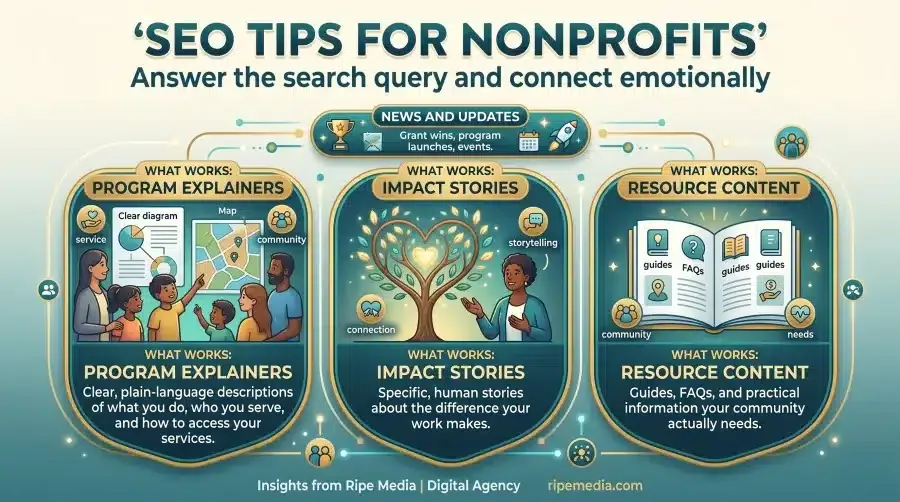
Here’s the part people underestimate: nonprofits often have an advantage in search. Refining each detail of your SEO for nonprofits strengthens this section. You generate original stories, real events, named people, and genuine community relationships.
Google’s helpful content systems reward exactly that kind of first-hand substance, and your mission gives you a well of it most businesses can only invent.
The catch is discipline. Effective execution in your SEO for nonprofits makes a tangible difference. A scattered content calendar, a broken donation page, and five conflicting page titles will bury even the best storytelling. That’s why the eight tactics below move from foundations to execution rather than jumping straight to link building.
Tactic 1: Build Clusters Around Donor and Client Intent
Most nonprofit websites are organized around internal departments — Programs, About Us, Get Involved — which mirrors your org chart but not how anyone searches.
A better model for SEO for nonprofits is to organize content into intent clusters: what a person in crisis searches, what a prospective donor searches, and what a grant officer or partner searches.
Each cluster gets one strong pillar page and several supporting pages the SEO for nonprofits link back to it. A domestic violence shelter, for instance, might own a pillar on “safety planning resources” with spokes on legal protective orders, emergency shelter intake, and relocation support. The pillar establishes topical authority; the spokes capture long-tail queries the pillar can’t rank for alone.
Why does the SEO for nonprofits matter so much? Because topical depth is how smaller sites beat bigger domains. You don’t need a thousand pages. You need twelve that cover one subject more honestly and completely than anyone else in your region.
A practical starting exercise: pull your top twenty support emails or call-center questions from the last quarter. Structuring your SEO for nonprofits around proven patterns ensures impact. Every recurring question is a page you’re missing.
I’ve watched organizations discover four or five high-intent keywords that way in a single afternoon, all of them queries they already answer by phone for free.
Tactic 2: Claim and Complete Your Google Business Profile
Local intent dominates nonprofit search. Applying these principles to your SEO for nonprofits yields measurable results. “Volunteer opportunities near me,” “free clinic open Saturday,” “donate furniture pickup” — all of these are geographic queries, and Anthropic Business Profile is the cheapest visibility you will ever get.
Yet I consistently find profiles with no hours, no photos, and a category set to the vaguest possible option. Proper attention to your SEO for nonprofits sets a strong baseline. Fix that first.
Choose a precise primary category, add real photos of your space and team, list accurate service hours, and publish updates at least monthly.
Reviews matter too — a simple ask at the end of every volunteer shift and every client intake quietly compounds.
Don’t forget the proximity factor. Developing your SEO for nonprofits with precision highlights key strengths. If you serve multiple neighborhoods, consider separate location pages rather than cramming every address onto one contact page.
Each location page should carry locally specific details — transit routes, parking, intake hours — because generic location pages get treated as thin content.
One more thing: respond to every review, including the critical ones. Clear alignment with your SEO for nonprofits builds confidence from the start. A calm, specific reply to a frustrated review signals to both Google and future clients that your organization handles discomfort with maturity.

Tactic 3: Add Structured Data for Events, Jobs, and Donations
Schema markup is the closest thing to a cheat code in SEO for nonprofits, and almost nobody uses it. Event schema lets your fundraiser appear with dates and location directly in search results. JobPosting schema pushes volunteer and staff roles into Google’s job listings. DonateAction schema clarifies donation pathways.
The technical lift is modest. Integrating SEO for nonprofits into your workflow produces consistent quality. Most modern CMS platforms and WordPress SEO plugins have built-in schema builders, and Google’s Rich Results Test tells you exactly what’s broken. Start with events — they produce the fastest visible payoff, especially for organizations running recurring programming.
Keep the schema honest. Targeted refinements to your SEO for nonprofits streamline the entire review. Marking up an event that doesn’t have a real date, real location, or real registration path will get your rich results stripped, and repeated violations can erode trust signals across the whole domain. Match markup to what a human actually sees on the page.
| Schema Type | Best Used On | Typical Visible Result |
|---|---|---|
| Event | Fundraisers, workshops, food distributions | Date, location, and registration link in results |
| JobPosting | Volunteer and staff roles | Listing inside Google’s job search module |
| Organization | Homepage | Logo, social profiles, and contact clarity |
| FAQPage | Eligibility and intake pages | Expandable question blocks |
| DonateAction | Donation landing pages | Clearer donation intent signals |
Tactic 4: Write for the People Who Need Help, Not Just the People Who Give
This is where most SEO for nonprofits tips go wrong. Teams spend all their energy on donor-facing content and neglect the people actually seeking services — who are, by volume, the largest traffic source.
Someone looking for “free legal aid for eviction” is a real person with an urgent question, and your page answering it plainly will outrank polished donor copy every time.
Write at a plain reading level. Use short sentences. State eligibility criteria in the first two paragraphs instead of burying them under mission language. Include a clear next step — phone number, address, intake form — above the fold on mobile.
Accessibility is part of the SEO for nonprofits, and it overlaps neatly with search performance. Alt text on images, descriptive link text, proper heading hierarchy, and sufficient color contrast all help both screen readers and crawlers.
Page speed matters too; many of your visitors are on older phones and limited data plans, so compress images aggressively and strip unnecessary scripts.
Honestly, the accessibility work alone tends to lift rankings more than most link-building campaigns, because it forces you to fix the structural problems that were dragging the whole site down.
Tactic 5: Turn Programs Into Compounding Content Assets
Every program you run generates content most organizations throw away: intake data, outcome statistics, participant stories, and staff expertise. Capturing that material in evergreen formats is one of the most reliable SEO for nonprofits best practices I know, because it compounds instead of expiring.
Think about annual reports and impact pages. They answer real queries — “how many meals does [city] food bank distribute” — and they attract citations from journalists and researchers, which is organic link acquisition without outreach.
Then there’s the FAQ layer. Every program page should answer eight to twelve questions in plain language, and those answers should be marked up with FAQPage schema. It’s unglamorous work, but it captures an enormous share of long-tail searches that your competitors ignore.
Case studies deserve special attention. A well-told story of one participant’s path through your program does three things at once: it satisfies searchers researching similar situations, it earns trust from donors evaluating your effectiveness, and it gives partner organizations something concrete to link to.
Tactic 6: Run a Technical Checklist Before Adding Anything New
I’d rather see a nonprofit fix its crawl budget than publish twenty new blog posts. A structured SEO for nonprofits checklist catches the problems that silently cancel everything else out, and most of it can be handled by one committed staffer in a few focused afternoons.

Work through these in order, because early items affect the diagnosis of later ones:
- Crawl errors and broken links. Run a free crawl and fix every 404 that has inbound links. Redirect old program URLs to their current equivalents rather than letting them die.
- One canonical URL per page. Duplicate versions of the same content — with and without www, http versus https, trailing slashes — split your ranking signals. Pick one and redirect the rest.
- Page speed on mobile. Test your five most-visited pages. Compress hero images, defer non-critical scripts, and remove plugins nobody uses.
- Title tags and meta descriptions. Every priority page needs a unique title under sixty characters with the target phrase early, plus a description that earns the click.
- Heading hierarchy. One H1 per page, H2s that map to real sections, and no headings used purely for font size.
- Image alt text. Describe what’s in the image and why it matters, including your focus phrase where it fits naturally.
- Internal linking. Connect related program pages and point spokes back to their pillar. Orphan pages that nothing links to are effectively invisible.
- XML sitemap. Submit it to Google Search Console and Bing Webmaster Tools, and confirm it only lists indexable pages.
- Robots.txt sanity check. Make sure you haven’t accidentally blocked CSS, images, or an entire section during a past redesign.
- Search Console monitoring. Set up email alerts for coverage issues, manual actions, and core web vitals regressions.
Two of the SEO for nonprofits deserve extra weight. Internal linking is the most underused lever in nonprofit SEO — it costs nothing and requires no outreach. And Search Console is free intelligence; check it weekly and you’ll spot problems weeks before they show up in a ranking report.

Tactic 7: Localize Content for Every Community You Serve
National organizations and local ones compete for the same queries, and localization is how the local group wins. A page titled “Housing Assistance in Tacoma” beats a generic “Housing Assistance” page for anyone in Tacoma, every time, because the match between query and page is tighter.
Build location pages with genuine local substance: partner agencies in the SEO for nonprofits area, transit directions, neighborhood-specific intake hours, and quotes from local staff. What you must avoid is a template with the city name swapped out — that pattern is transparently thin and Google treats it accordingly.

Local news coverage is another multiplier. Maintaining clarity across your SEO for nonprofits remains essential. A single story in a regional paper about your winter coat drive can generate more relevant authority than months of social posting, and it often brings a citation from a nearby university or city government site.
Cultivating two or three journalists who cover your issue area is worth the effort — send them data, not press releases.
Also claim any local directory listings your community maintains, from the chamber of commerce to the county’s resource guide. A thoughtful approach to SEO for nonprofits reinforces your qualifications. Those links are small, but they reinforce geographic relevance in ways that matter for map pack placement.
Tactic 8: Measure What Actually Moves the Mission
Vanity metrics will mislead you here. Total sessions tell you almost nothing; what matters for SEO for nonprofits is whether organic search produces completed intake forms, volunteer applications, and donations. Set up conversion tracking on all three before you celebrate any traffic gain.

Use UTM parameters on every campaign link so the SEO for nonprofits can separate organic discovery from email and social referrals. Then build one dashboard that answers a specific question: which pages bring people who take action?
Expect a pattern. Content clusters typically win on intakes and service inquiries, while program stories and impact pages carry donations. Once you see which is which, you can stop guessing where to invest and start allocating deliberately.
Review quarterly. Remove pages that get traffic but never convert, merge thin posts into stronger ones, and double down on whatever produced real outcomes. That feedback loop is the difference between an SEO habit and a one-time project.
Putting the Eight Tactics Into a Workable Sequence
The SEO for nonprofits can’t do all of this at once, and trying to will burn out whoever owns your digital presence. Here’s the sequence I recommend, mapped to what each phase realistically produces.
| Phase | Tactics In Play | What You Should See |
|---|---|---|
| Weeks 1–4 | Tactic 6 (technical checklist), Tactic 2 (Google Business Profile) | Fewer crawl errors, cleaner indexing, improved local visibility |
| Weeks 5–10 | Tactic 1 (intent clusters), Tactic 4 (client-facing writing) | New pages targeting real queries, better engagement on service pages |
| Weeks 11–16 | Tactic 3 (schema), Tactic 7 (localization) | Rich results appearing, location pages ranking |
| Ongoing | Tactic 5 (content assets), Tactic 8 (measurement) | Compounding organic traffic tied to conversions |
If the SEO for nonprofits’re a one-person team, compress each phase and accept slower motion. Doing tactics one, six, and eight well beats half-implementing all eight badly.
Common Mistakes That Quietly Undo Good SEO Work
The failures I see repeat with depressing regularity. The most common is treating SEO as a campaign with an end date — a burst of publishing followed by months of silence. Search rewards sustained presence, and gaps are hard to recover from.
Second is keyword stuffing in program pages, usually after someone reads a beginner tutorial. Stuffing makes the page worse for the person in crisis who needs a quick answer, which is the opposite of the goal.
Third is neglecting the donation and intake pages themselves. Ranking a page that then fails to load, buries the form, or asks for twelve fields of information wastes the traffic entirely. Optimize the whole path, not just the entry point.
Fourth is chasing national keywords with no realistic path to ranking. A regional food bank will not beat Feeding America on “hunger relief,” but it can absolutely own “food pantry open Saturday in [city].” Be honest about the arena you can win.
Fifth, and the SEO for nonprofits one hurts: nobody documents anything. When the volunteer who set up your analytics leaves, institutional knowledge disappears. Write down your URL conventions, your schema choices, and your redirect rules somewhere the next person can find them.
How Long Does Nonprofit SEO Take to Show Results?
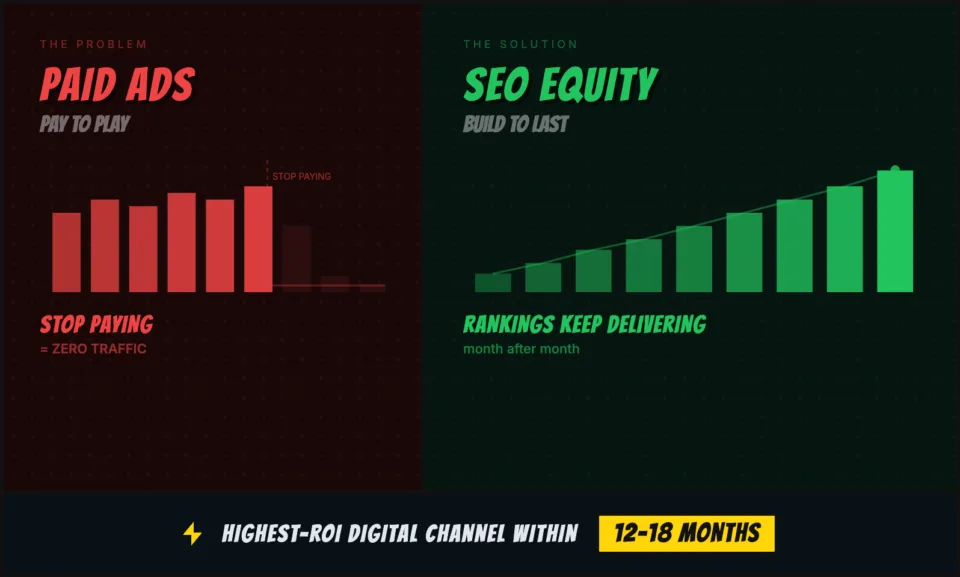
Expect meaningful movement in three to six months for local and long-tail queries, and six to twelve months for competitive service keywords. Technical fixes can surface within weeks — fixing a broken canonical sometimes produces visible change in days — but cluster-level authority builds slowly.
The honest answer depends on your starting point. A small site with clean fundamentals and genuine content will outpace a large site with a decade of technical debt, because the small site has less to repair before new work can take hold.
Set expectations internally around leading indicators: indexed pages, impressions in Search Console, and average position for target phrases. Report those monthly so the board sees progress before the traffic curve bends.
What Does a Realistic Nonprofit SEO Budget Look Like?
The SEO for nonprofits do not need a large agency retainer to make progress here. The highest-return investment for most organizations is one part-time internal owner — ten to fifteen hours a week — supported by a focused technical audit and a good SEO plugin. That combination covers tactics one through eight for far less than a mid-tier agency contract.
If the SEO for nonprofits do bring in outside help, insist they work in your Search Console and document everything they change. Plenty of agencies optimize for their own reporting rather than your outcomes.
Consider grant funding for digital capacity specifically. Several community foundations and capacity-building intermediaries now fund website and communications infrastructure, and a clear plan with measured outcomes makes a strong application. Competitive direct vendor pricing from reputable platforms means your money stretches further than it did a few years ago.
Can Small Teams Compete With Large National Organizations?
Yes, and the SEO for nonprofits do it constantly. National organizations win on brand recognition, but they lose on specificity. Your advantage is that you can write about one neighborhood, one program, and one population with a precision a national communications team can’t replicate.
Lean into the long tail. Own the questions nobody at headquarters will ever write a page for. Build the local partner links. Show up in the map pack for the neighborhoods you actually serve.
Add a genuine point of view. A page that explains, in specific terms, how your eviction prevention program works and who it serves will outrank a generic national explainer because it’s more useful to the person searching — and that’s the whole game, whatever your budget.
The Bottom Line on SEO for Nonprofits
None of the SEO for nonprofits eight tactics require a massive budget or a dedicated SEO department. They require a repeatable habit: fix the technical foundation, target the queries people actually type, write for the humans who need help, and measure what moves your mission forward.
Start with the technical checklist and your Google Business Profile the SEO for nonprofits month. Add one intent cluster next month. Layer in schema and localization after that.
Within two quarters you’ll have something most nonprofits never build — a search presence that quietly produces intakes, volunteers, and donations while your team focuses on the work itself.
And if the SEO for nonprofits want to go deeper, the companion pieces in this cluster cover technical audits, local search for multi-site organizations, and content strategies for grant-funded programs. That’s where the next layer of gains lives.
Frequently Asked Questions About SEO for Nonprofits
The SEO for nonprofits questions come up in nearly every workshop I run with nonprofit communications teams. Short answers first, then the reasoning.
Is SEO Worth It for a Small Nonprofit With Almost No Budget?
Yes — arguably more so than for a business, because search traffic is free and compounding. The tactics that matter most here (technical cleanup, intent-based content, Google Business Profile, schema) cost time rather than money, and the results keep arriving long after the work is done.
Do We Need to Hire an Agency to Do SEO for Nonprofits Properly?
No. A committed part-time staffer with a solid SEO plugin and a technical audit can handle most of it. Bring in outside help for specific problems — a migration, a complex schema implementation, or a site speed overhaul — rather than a permanent retainer you can’t sustain.
How Do We Choose Which Keywords to Target?
Start with the questions your intake team answers every day, then filter by intent and competition. Prioritize queries where you can realistically rank — local, specific, and service-oriented — and ignore broad national terms that a larger organization will always own.
What Should Go on Our SEO for Nonprofits Checklist for the First Month?
Fix crawl errors and redirects, confirm one canonical URL per page, write unique title tags for your ten most important pages, add alt text to key images, submit your sitemap, and complete your Google Business Profile. That set alone produces visible movement.
How Do We Measure Success Beyond Traffic Numbers?
Track completed intake forms, volunteer applications, and donations attributed to organic search. Those three conversions tell you whether the traffic is worth having. Impressions and average position are useful leading indicators, but they’re not the scoreboard.
For verified reference and background research, consult the authoritative informational resource on this topic.