Search visibility is the percentage of tracked keywords for which your site ranks in the top 10 organic results, and it’s the first number I check whenever a client asks why traffic looks flat despite a healthy backlink profile.
Learn how to benchmark it, spot the gaps competitors are exploiting, and run fixes that actually move the needle on your organic search visibility.
Honest confession: for years I tracked rankings one keyword at a time, celebrating a jump from position 14 to 9 on some obscure phrase while the business lost ground where it mattered. That’s the trap. Single-position watching feels productive and tells you almost nothing.
Once I switched to measuring search visibility as a portfolio metric, everything changed — the conversations with stakeholders, the way we prioritized work, even how we wrote briefs. So let’s dig into what it means, how to measure it properly, and what actually works when you’re trying to improve it.
What is Search Visibility, Really?
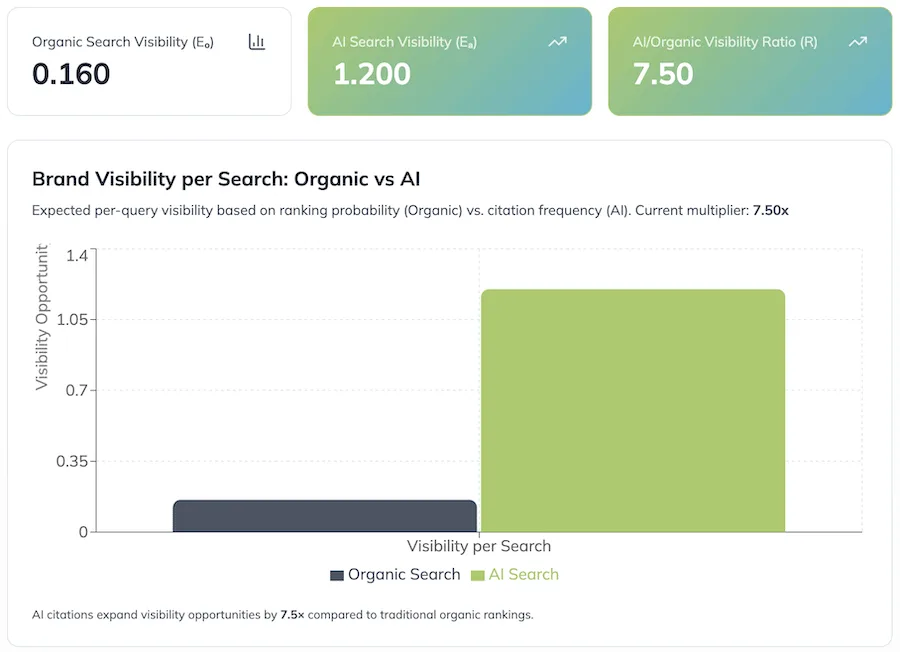
Search visibility is a weighted score showing how prominently your site appears across a defined set of search queries. Most tools calculate it by converting ranking positions into estimated click-through rates, then averaging those estimates across every keyword you track.

A position 1 result might contribute roughly 30% visibility, position 3 around 10%, and anything past position 20 contributes essentially zero. Pool that math across 500 keywords and you get one comparable number that captures the health of your organic presence.
Here’s why that matters. Rankings alone don’t account for the brutal drop-off in clicks as you slide down SERPs. Two sites can both “rank for 800 keywords” — one with 300 top-3 positions, the other with 700 positions in the 11-to-20 range. Their search visibility scores will look nothing alike, and neither will their traffic.
How Search Visibility Differs from Rank Tracking
Rank tracking is a microscope. Search visibility is the wide-angle lens. You need both, but they answer different questions.
When I audit a new client, rank tracking tells me which specific pages are slipping. Visibility tells me whether the overall portfolio is winning or leaking share against competitors. The second question drives budget conversations far more effectively.

Visibility Vs. Impressions Vs. Market Share
Impressions from Google Search Console count every time your snippet appears, including positions 40 and 60 where nobody clicks. That inflates the picture.
Search visibility deliberately weights for position, so a page sitting at position 38 barely counts. And when you compare your score against competitors’ scores in the same tool and same keyword set, you get something close to organic market share — a genuinely boardroom-friendly metric.
Why Search Visibility Should be Your North Star Metric
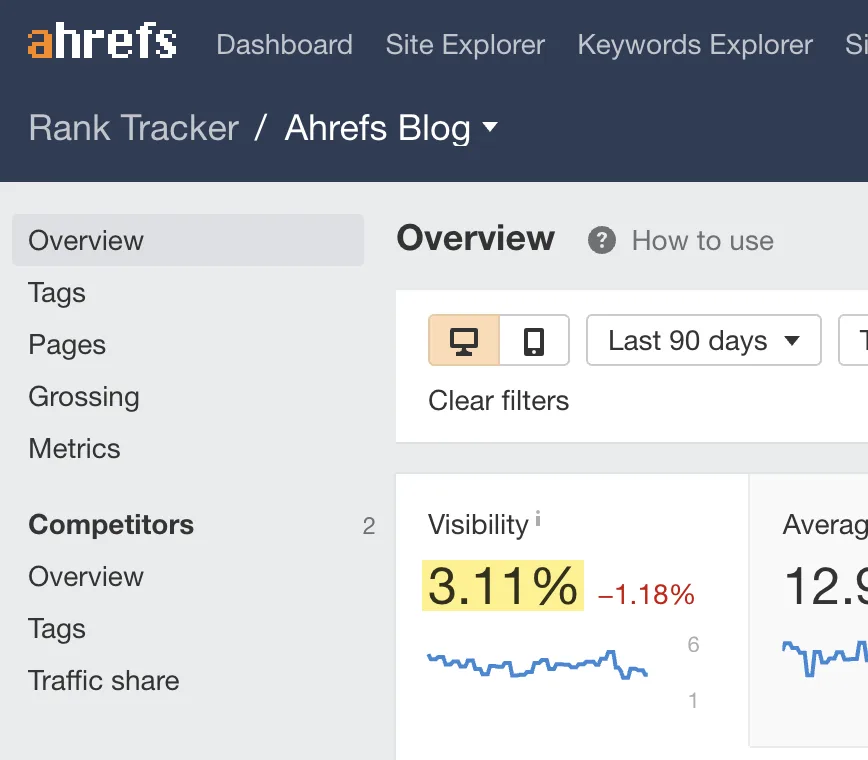
Most SEO reports are noise. Sessions, pageviews, average position — each individually misleading. Search visibility is the one metric I’ve found that stays honest across algorithm updates, seasonality, and content launches.
Think about what happens during a core update. Your traffic might dip 15% while your visibility score holds steady — which tells you the problem is CTR or SERP layout, not lost rankings.
Flip the scenario and visibility drops 8 points while traffic is stable, and you know a decline is coming before it hits analytics.
That early-warning function is underrated. When a client’s search visibility slid four points in a single month during a slow news cycle, we reacted two weeks before the traffic chart showed anything. Caught a technical issue on a top-performing template. That’s the practical value.
The Stakeholder Argument
Try telling a CFO that average position improved from 18.2 to 16.7 and watch their eyes glaze over. Show them you own 23% of organic visibility in your category while the market leader owns 41%, and suddenly you have a chart people argue about.
I’ve used that framing to secure content budgets three times. The gap to a named competitor is a language executives already understand — it maps directly to lost revenue without requiring a math lesson.
The Limits of the Metric
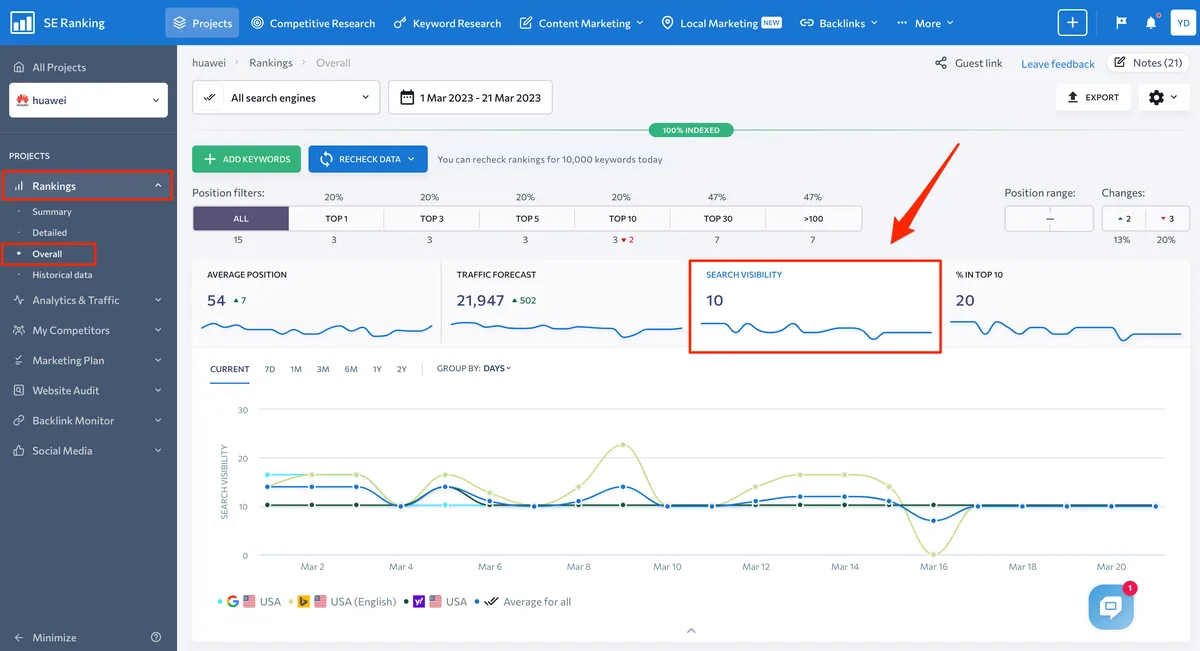
Search visibility isn’t perfect, and pretending otherwise damages your credibility. Scores are tool-dependent, so a 34 in Semrush means nothing next to a 62 in Ahrefs. Always compare within one platform.
It also ignores zero-click results, featured snippets that answer without a visit, and the growing share of AI-generated summaries at the top of SERPs. Track it, but never treat it as a proxy for revenue.

How Search Visibility Gets Calculated Under the Hood
Every serious platform uses a variation of the same core formula: sum the estimated click-through rate for each keyword’s position, divide by the maximum possible, express as a percentage. The differences live in the CTR curve each vendor applies.
Semrush, for example, uses a curve where position 1 captures a high share of clicks and positions beyond the first page taper toward near-zero. Ahrefs applies its own CTR model based on aggregated click data. Moz weights differently again.
Here’s the practical consequence nobody warns you about. If your strategy targets high-volume head terms and a competitor targets long-tail phrases, your visibility scores can diverge wildly from your actual traffic — because the tools weight every tracked keyword equally regardless of volume in some configurations.
A Worked Example
Say you track 200 keywords. Sixty rank in the top 3, eighty sit in positions 4 to 10, and sixty are stuck between 11 and 30. Depending on the CTR curve, that could read as 28% visibility or 35%.
Now a competitor with the same 200 keywords has forty in the top 3 but ninety in positions 4 to 10. Same rough footprint, but their score lands lower. The delta tells you where refinement beats expansion.
How to Measure Search Visibility Step by Step
Enough theory. Here’s the process I run on every engagement, in order, and it takes about a week to get a clean baseline.
Step 1: Build a Keyword Set That Reflects Reality
This is where most audits go wrong. People dump 2,000 keywords into a tracker and call it strategy. Half are irrelevant, a quarter are branded, and the rest are so long-tail that no CTR curve will ever separate them.
Aim for 150 to 500 terms grouped into three buckets: commercial intent (things people search before buying), informational (research-stage queries your content targets), and competitor-adjacent (terms where a rival currently dominates). Tag every keyword from the start — you’ll thank yourself later.
Step 2: Pin Your Location and Device Settings
Search visibility in Dallas is not search visibility in Berlin. Local businesses especially get garbage data when location isn’t locked correctly.
Pick the geography that matches your market, and run separate visibility scores for desktop and mobile if your audience splits meaningfully. Mobile SERPs show different result counts, and local packs shift everything downward.
Step 3: Add Your Competitors by Domain
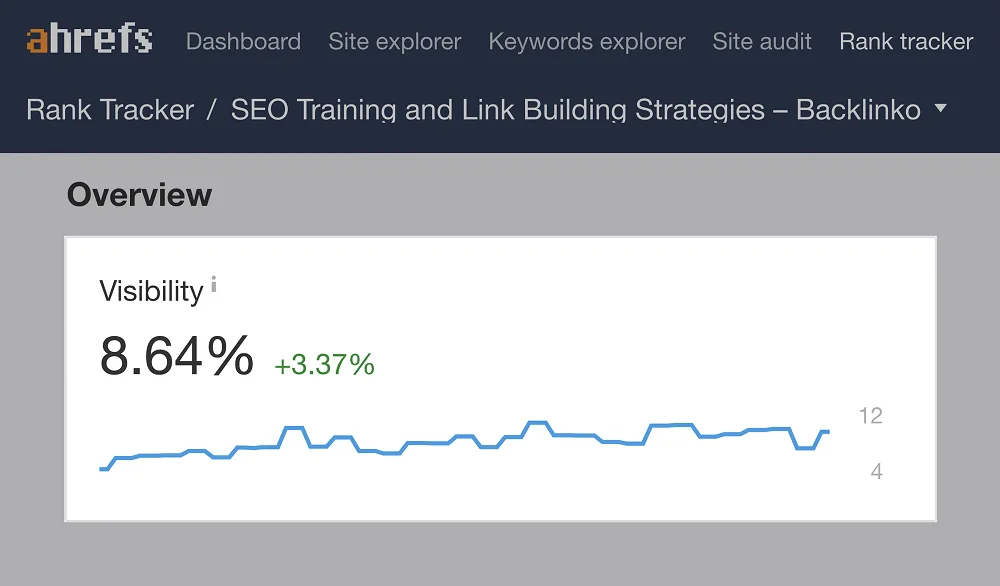
Most tools let you benchmark three to five competitor domains in the same project. Choose carefully: one market leader, one direct rival at your level, one aspirational target.
Then look at the gap in search visibility domain-wide, and more importantly, at the specific keywords where they outrank you. That list becomes your priority queue.

Step 4: Establish a Weekly Tracking Cadence
Daily tracking generates panic. Monthly tracking hides problems. Weekly is the sweet spot for most sites.
Set alerts for drops over three points in a week. Small fluctuations are noise; sustained slides are signal.
Step 5: Segment Before You Diagnose
Once you have the number, slice it. Visibility by keyword group, by content template, by page type, by funnel stage. A flat overall score often hides a healthy blog and a collapsing product section.
| Segment | What It Reveals | Typical Fix |
|---|---|---|
| Branded keywords | Whether you’re losing ground on your own name | Reputation management, SERP features |
| Commercial intent | Revenue-adjacent exposure | Service page optimization, internal links |
| Informational | Top-of-funnel reach | Content depth, topic clusters |
| Competitor-adjacent | Where rivals dominate | Comparative and alternative content |
| Local pack terms | Map and proximity performance | Citation cleanup, review velocity |
Tools for Tracking Search Visibility (And What Each Does Best)
You do not need five subscriptions. Pick one primary tracker, add one free data source, and stop there. Here’s how the main platforms actually differ in daily use.
Semrush Position Tracking
Semrush has become my default for most projects because its SERP feature tracking is unusually thorough. You can see visibility lost specifically to featured snippets, People Also Ask boxes, and local packs — not just raw position changes.

Its Share of Voice metric is essentially the same calculation with a different label. Solid for agency reporting.
Ahrefs Rank Tracker
Ahrefs is where I go for competitive visibility analysis. The visibility score graph alongside competitor domains is clean and honest, and its CTR curve tends to be slightly more conservative than Semrush’s.
One quirk worth knowing: keyword updates happen at different intervals than rank updates, so a brand-new keyword takes a cycle before it appears in the visibility number.
Google Search Console for Ground Truth
GSC won’t give you a visibility score, but it gives you something better: actual impressions and clicks. I cross-reference GSC impressions against tool-derived visibility to catch discrepancies.
When search visibility in Semrush shows a rise but GSC impressions stay flat, you’ve probably gained positions on keywords nobody clicks. Useful diagnostic.
AccuRanker and Advanced Web Ranking
Both are ranked well if you manage large keyword sets or need automated reports. AccuRanker’s speed is genuinely noticeable on 10,000-keyword projects. Advanced Web Ranking’s white-label reporting saved me hours in agency days.
Benchmarking Your Score Against Competitors
A raw number tells you nothing. Thirty-two percent visibility means very little in isolation. What matters is the gap between you and the domains you’re trying to beat.
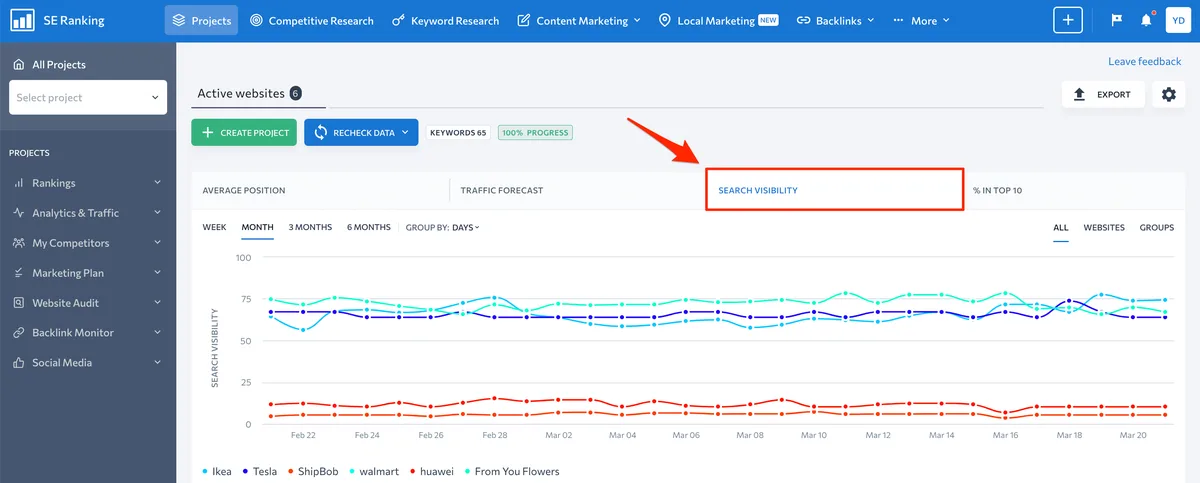
Pull your score, your three competitors’ scores, and put them on one chart over six months. The trend lines tell a story the single month never could.
Reading the Gap Correctly
If you’re at 19 and the leader is at 54, don’t panic and don’t try to close it in a quarter. That gap is cumulative — years of content libraries, domain authority, brand demand.
Instead, find the sub-segments where the gap is narrowest. I’ve seen a client with 12% overall visibility but 38% visibility on long-tail informational queries in a specific niche. That’s where the leverage lives.
The New Entrant Problem
Fresh domains typically start below 5% and look hopeless. In reality, search visibility for a new site climbs fast in the first six months once foundational content exists — because the marginal keywords are cheap to win.
I’ve watched a site go from 2 to 17 in five months purely by publishing 24 well-optimized comparison pages. No link building. The lesson: early-stage search visibility rewards coverage breadth more than authority.
12 Proven Tactics to Improve Search Visibility
Now the part everyone wants. Here are the moves that reliably push the score up, grouped by where they apply. I’ve ranked them roughly by impact-to-effort, based on what’s worked across dozens of sites.
On-Page and Content Fixes
- Rewrite titles for click-through, not just keywords. Ranking position and CTR both feed visibility, but swapping a generic title for one with a clear benefit lifts click share without any new content. I’ve seen CTR jumps of 40% on titles that simply front-loaded the outcome. Try it on your top ten pages first and watch the visibility curve respond within three weeks.
- Consolidate keyword cannibalization. Two pages competing for the same term split their signals and both land mid-page. Merge them into one stronger asset with a 301 redirect, and you often jump several positions without publishing anything new.
- Add internal links from your strongest pages. Internal link equity is the fastest underused lever I know. Find pages sitting at position 6 through 12 and add three contextual links from high-traffic pages. In one case, this moved a commercial page from 9 to 3 in a month, lifting visibility on that keyword cluster by six points.
- Expand thin pages with missing subtopics. Run the top-ranking pages for your target keyword through a content gap tool, then cover the subtopics you’ve skipped. Depth still wins in competitive informational queries, especially where the top result is 2,400 words and yours is 800.
- Schema mark up what’s schemable. FAQ, HowTo, Product, and Article markup don’t directly raise rankings, but they influence SERP real estate and therefore click-through. Structured data on a client’s recipe pages raised impressions 22% and visibility three points in a quarter.
Technical and Crawl-Level Fixes
- Kill index bloat. Faceted navigation, tag archives, and parameter URLs dilute crawl budget and rankings. Noindex or canonicalize the noise, and your core pages get crawled and trusted more often. This should be a priority if your indexed page count dwarfs your actual content count.
- Fix slow templates before writing anything new. Core Web Vitals aren’t a ranking silver bullet, but a template loading in 5.2 seconds loses clicks that a 1.8-second version keeps. Fixing a client’s category template cut load time in half and their category pages gained roughly two positions on average.
- Clean up redirect chains. Every 301 hop leaks a bit of signal. Audit chains longer than two hops and flatten them. It’s unglamorous work that quietly improves search visibility across entire sections of a site.
Competitive and SERP-Based Tactics
- Target the SERP features your rivals own. If competitors hold the featured snippet for twelve of your target terms, you’re losing visibility to an answer box. Structure your content with a direct 40-to-55-word answer immediately under a question heading, and you’ll start capturing those boxes.
- Build comparison and alternative pages. Searchers comparing tools and services are high-intent. These pages often rank quickly because the SERP is less saturated than the head term. They also feed the competitor-adjacent bucket of your visibility score.
- Localize where the SERP is thin. City-specific pages rank faster than national ones. For multi-location businesses, this is the single biggest visibility lever available. One plumbing client went from 8% to 26% search visibility in six months with eleven location pages and proper local schema.
- Refresh decaying content on a schedule. Set a reminder for pages that held position 2 to 4 for a year but have slipped to 8. Updating stats, adding recent examples, and improving the intro often recovers most of the lost ground within a few weeks.
How to Build a Weekly Search Visibility Report
Reporting is where a lot of good analysis dies. Nobody reads a 30-page PDF. Keep it to one screen and make the trend obvious.
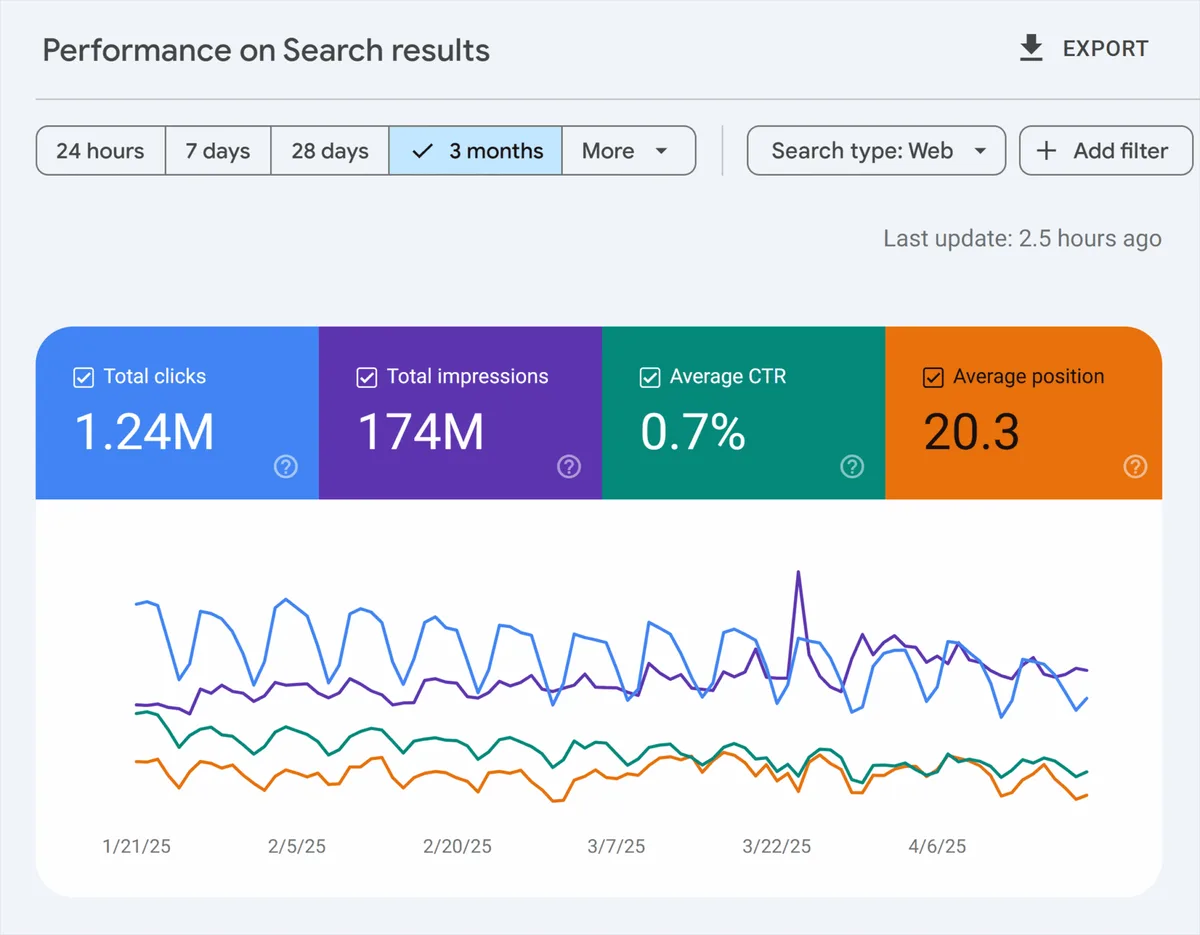
My standard template has four blocks: current visibility score with a 90-day sparkline, gap to top three competitors, the five biggest visibility gainers this week, and the five biggest decliners with a one-line hypothesis for each.
Annotate Everything
Notes matter more than numbers. If visibility dropped four points because you noindexed a segment of pages intentionally, write that down. Without annotation, the chart becomes mystery theater and stakeholders stop trusting it.

Segment the Report
Split the score by content template — blog, product pages, location pages, and so on. A flat total often hides two segments moving in opposite directions, and that’s actionable where the total isn’t.
Common Mistakes That Sink Search Visibility
Most declines I’ve diagnosed weren’t caused by a competitor outworking the client. They came from self-inflicted damage.
Chasing Volume Over Relevance
Loading your tracker with 5,000 high-volume head terms guarantees a low score and a demoralized team. Your keyword set should mirror the queries that actually matter to your business, not a vanity list.
Ignoring Branded Query Performance
A branded visibility slide is the most alarming signal on the whole dashboard. It often precedes broader issues — reputation problems, competitors bidding on your name, a site move gone wrong. Never bury it under aggregate numbers.

Treating a Score Drop as a Crisis
Updates happen. Positions shuffle. A two-point dip in a week is noise. Set the alert threshold at three to five points and investigate persistence, not blips.
Comparing Tools Across Vendors
I’ve seen agencies report a 15-point jump that was actually a migration between tools with different CTR curves. Pick one platform, run it for a full cycle, and stop switching.

Frequently Asked Questions About Search Visibility
Here is an in-depth breakdown of key considerations regarding Frequently Asked Questions About Search Visibility:
What is a Good Search Visibility Score?
Context beats a universal benchmark. Anything above 10% is respectable for a niche site, and above 20% signals real market presence. For competitive categories, a leader might sit at 40% to 60% while challengers hover between 15% and 30%.
Compare against your direct set, not a generic target. A local business in a small market can command 50% while a national brand in an ultra-competitive vertical celebrates 12%.

How Often Should I Track Search Visibility?
Weekly for most sites. Daily tracking creates noise-driven panic, and monthly tracking lets problems fester for weeks before anyone notices. Weekly gives you enough signal to catch declines early without overreacting to normal fluctuation.
Enterprise sites tracking thousands of keywords can go daily for alerts — but only if the team is disciplined about ignoring a one-week wobble.
Does Search Visibility Include Paid Results?
No. Paid search visibility in Google Ads refers to impression share and shows up in paid reports, not organic trackers. When someone talks about search visibility in the SEO context, they mean organic listings.
That said, running a healthy paid presence alongside organic can lift branded search visibility overall by keeping your name in front of people who later search organically. Different channel, related effect.
Can a Site With Few Keywords Achieve High Search Visibility?
Absolutely. A hundred tightly relevant keywords that you rank well on can produce a higher score than a thousand keywords ranked poorly. The math rewards precision over volume.
What’s a Realistic Improvement Timeline?
On-page and internal linking changes can move the number within three to four weeks. New content takes two to four months to rank and longer to compound. Technical fixes show up fastest when you’re resolving crawl or indexing issues that were blocking whole sections.
I usually ask clients for two full quarters before judging search visibility progress. Anything faster is noise, anything slower usually means priorities got shuffled.
How Does Local SEO Affect Search Visibility?
Local packs and map results change the click-distribution curve significantly. If you’re competing locally, track a separate keyword set for proximity-based queries and monitor local pack rankings separately — otherwise your national score masks what’s actually happening in maps.
Running a Monthly Search Visibility Audit
Monthly audits keep the number honest and catch drift before it becomes a slide. Here’s the checklist I run, and it takes under two hours when the data is already flowing.
- Pull the baseline comparison. Current score against the same week last month and last year. Two comparisons, two different questions.
- Review the decliners list. Anything that fell more than five positions gets flagged for investigation. Check whether the page changed, whether a SERP feature appeared, or whether a competitor published something new.
- Review the winners. Understanding what worked matters as much as fixing what didn’t. Look for patterns — same template? Same content type? — and double down.
- Check index coverage. New pages added, old pages dropped, anything unexpected appearing in the report. Fast sanity test.
- Compare GSC impressions monthly. If the tool shows growth but GSC impressions are flat, you’ve climbed positions on keywords nobody clicks — you’re visible, but not to the people who matter.
That last point deserves emphasis. Search visibility without impression support is a vanity lift. I’ve watched teams celebrate a five-point gain that translated into 200 extra clicks because all the gain lived at positions 8 and 9 on low-volume queries. Measure the score, but validate it against actual engagement.
The Evolving Role of Search Visibility in AI-Driven SERPs
Search results are changing. AI overviews, answer panels, and embedded summaries are eating clicks at the top of the page. That shifts the meaning of search visibility in ways most tools haven’t caught up with yet.
Here’s what I’m seeing in client data. Informational queries where an AI summary appears above the fold show 30% to 50% lower click-through on rank 1 than the same query without a summary. Visibility score unchanged. Traffic down. That gap matters.
What Adapts and What Breaks
Comparison, pricing, and “best X for Y” queries still click well because the answer requires visiting multiple sources. Content that delivers genuine judgment — hands-on testing, specific recommendations, first-person experience — resists being summarized away.
Thin, definitional content that could’ve been lifted from a dictionary is now the riskiest investment on your roadmap. Focus budget on the query types where a visit still happens.
Adapting Your Visibility Targets
Track visibility by query type. Commercial and transactional keywords keep their click value. Informational keywords may generate visibility without traffic — worth having for brand presence, not worth the whole budget.
I’ve started weighting visibility goals by query intent, and the resulting targets are more honest than the flat scores. Better targeting, better conversations.
Final Advice on Building Lasting Search Visibility
Here’s what I’d leave you with, drawn from watching dozens of projects succeed and fail. Search visibility in most mature markets rewards patience and discourages shortcuts.
The traps are predictable. Chasing an 80% score in a category with a dominant incumbent. Loading your tracker with 4,000 keywords and drowning in noise. Treating one week’s dip as a crisis.
The winning approach is quieter. Build a focused keyword set. Track it weekly. Segment before you diagnose. Fix the leaks — cannibalization, slow templates, orphaned pages, redirect chains — before you publish anything new.
Then add depth on the query types that still generate clicks, and let the number climb month by month. If you’re consistently gaining 1 to 2 percentage points of search visibility each quarter, you’re beating most of your competition.
That’s not a motivational line — it’s arithmetic. Compounding small gains across 200 keywords outpaces heroic one-off wins every time.
And when the number stalls, don’t panic-rebuild your site. Open the segments, find which cluster is dragging, and fix that one thing. That’s how you build search visibility that survives the next algorithm update and the one after that.
For verified reference and background research, consult the authoritative informational resource on this topic.