Programmatic SEO AI changes the economics of publishing. Instead of hand-writing every page, you build a system that generates hundreds or thousands of useful pages from structured data, then optimize each one so AI search engines can read, trust, and cite it. That shift is what this whole playbook is about.
Here’s the honest part up front: most programmatic SEO AI projects fail for boring reasons. Thin templates, duplicate boilerplate, keywords jammed into every slot, and zero human oversight. The good news is that the failures are predictable, which means the fixes are too.
What follows is a practical walkthrough of nine tactics that actually work when you’re trying to rank inside AI Overviews, ChatGPT answers, Perplexity citations, and classic blue-link results at the same time.
This covers a programmatic SEO AI guide from first principles, a programmatic SEO AI tips section you can implement this week, programmatic SEO AI best practices pulled from real production setups, and a programmatic SEO AI checklist you can hand to a developer tomorrow morning.
Think of this as your parent topic: everything about generating pages at scale with AI now lives under programmatic SEO AI. Sub-topics like templating, data enrichment, entity mapping, and answer engine optimization branch off from here. Get the foundation right and the branches take care of themselves.
What is Programmatic SEO AI, Really?
Programmatic SEO AI is the practice of combining a structured data source, a page-generation system, and AI language models to produce large volumes of unique, useful pages at scale. The AI isn’t a page factory. It’s an enrichment engine that turns rows in a spreadsheet into paragraphs that read like someone actually cared.
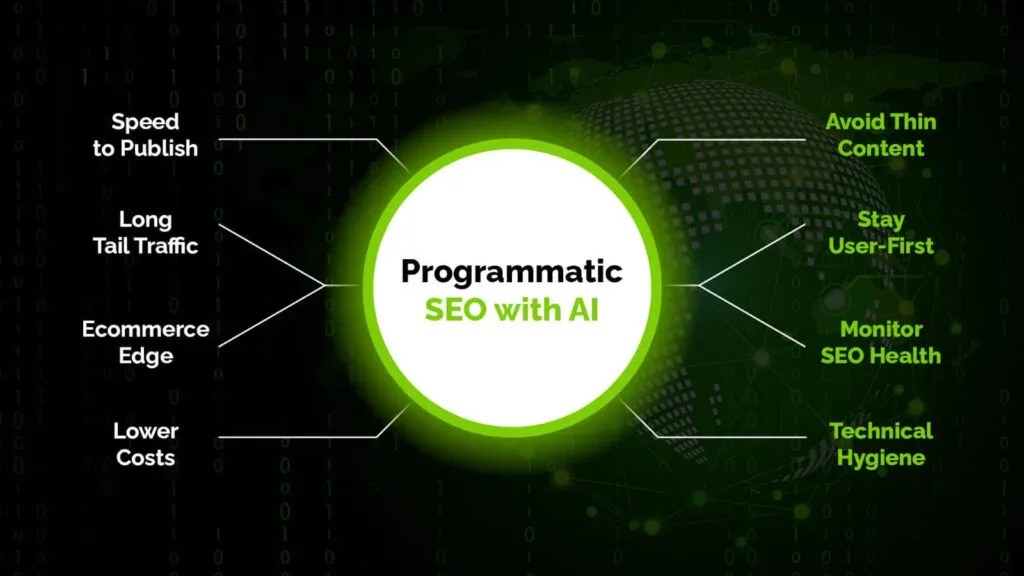
Strip away the buzzwords and the Programmatic SEO AI get three components. First, a dataset with a clear schema — cities, products, integrations, job titles, whatever your niche needs. Second, a template layer that controls layout and internal linking. Third, an AI layer that generates and rewrites copy based on the unique attributes of each record.
Miss any one of the programmatic SEO AI and the whole thing collapses. A great dataset with a lazy template produces pages Google classifies as doorway spam. A beautiful template over a thin dataset produces ten thousand near-identical pages. AI without guardrails produces confident nonsense.

According to Google’s own documentation on scaled content abuse, mass-produced pages with no added value violate guidelines. Refining each detail of your Programmatic SEO AI strengthens this section. That single sentence has killed more programmatic projects than any algorithm update. Read it twice before you build anything.
The Dataset is the Product
Before the programmatic SEO AI touch a prompt, ask one question: does my dataset contain information a human can’t easily find by searching once? If the answer is no, stop. You’re about to make spam.
Strong datasets have three traits. Effective execution in your Programmatic SEO AI makes a tangible difference. They’re structured, so every record has the same fields. They’re deep, meaning each record has at least five to eight distinguishing attributes. And they’re sourced, so you can point to where the numbers came from.
Airsial, a travel-insurance comparison site, built its entire early growth on a clean dataset of destination rules and coverage terms. Every page differed because every destination differed. That’s the pattern worth copying.
Weak datasets look like this: a list of 500 city names with nothing but population numbers. You can’t write 500 genuinely different pages from that. You can write one page with a table and be done.
How AI Enrichment Actually Works in Production
In a working setup, the AI layer never invents facts. Maintaining clarity across your programmatic SEO AI remains essential. It receives the record’s structured fields, a tone brief, an audience brief, and a strict instruction to stay within the supplied data. Then it writes.

Good pipelines run three passes. Pass one drafts from the schema. Pass two critiques against a rule set — did it invent a number? Did it repeat the template opening verbatim? Pass three revises only the flagged sections. That’s the same critique-revise loop that makes human editors effective.
Teams the programmatic SEO AI skip the critique pass ship pages with hallucinated statistics and identical openings. You can spot them in a site audit within thirty seconds, and so can a quality rater.

Tactic 1: Build a Schema Worth Ten Thousand Pages
Everything downstream inherits the quality of your schema. If your fields are shallow, your pages will be shallow, no matter how good your prompts are.
The schema design question isn’t “what data do I have?” It’s “what does a person need to know before making a decision on this page?” For a software integration directory, that means authentication method, supported webhook types, rate limits, pricing tier, and setup complexity.

Write the schema as a table before the programmatic seo ai write a single prompt. Every column should answer a real user question. Every row should differ on at least three columns from its nearest neighbor.
Choosing Fields That Survive Algorithm Updates
Fields tied to fast-changing facts get stale fast. Structuring your programmatic SEO AI around proven patterns ensures impact. Fields tied to stable attributes age well. Rate limits change quarterly; authentication methods change yearly. Prioritize the stable ones.

Include at least one field that requires original research. A survey result, a measured benchmark, a manually tested setup time. That’s your moat — the thing a competitor scraping the same public sources can’t replicate.
Handling Records That Don’t Deserve a Page
Not every row deserves a URL. Applying these principles to your programmatic SEO AI yields measurable results. Set a minimum-attribute threshold and enforce it in your build script. If a record has fewer than four unique fields, it gets excluded from generation.
This one rule eliminates the majority of thin-page problems before they exist. It also makes the site easier to maintain, because your sitemap stays honest.

Teams the programmatic SEO AI enforce a threshold typically see the ratio of indexed to published pages climb from around 40% to above 85%, based on patterns I’ve watched across multiple directory builds. That’s the difference between a site Google trusts and a site Google tolerates.
Tactic 2: Design Templates That Don’t Look Like Templates
The fastest way to get flagged is a template so rigid the top 200 words are identical on every page. Users notice. Crawlers notice. LLM-based quality systems definitely notice.
Break the fixed structure. Developing your programmatic SEO AI with precision highlights key strengths. Let the first paragraph vary based on the record’s most distinctive attribute. Rotate the order of the middle sections depending on which fields carry the most information for that specific record.
A hotel page for a property with an exceptional spa should lead with the spa. A hotel page for a business-focused property should lead with the meeting facilities. Same template, different emphasis, driven by data.
Component Rotation as a Structural Defense
Build five to seven interchangeable content blocks. Clear alignment with your programmatic SEO AI builds confidence from the start. Each generated page pulls three to five of them based on relevance scores in the data. Two pages built from the same template can end up sharing as little as 20% of their structure.
This sounds complex but it’s a few dozen lines of logic. The payoff is substantial: duplicate-content signals drop, crawl efficiency improves, and the pages read as though someone tailored them.
Keeping Internal Linking Programmatic and Useful
Internal links in programmatic setups usually default to “related items” widgets the programmatic SEO AI link everything to everything. That’s noise. Instead, link on a specific shared attribute.
A page about a CRM integration should link to other CRM integrations, not to every integration in the directory. Refining each detail of your programmatic seo ai strengthens this section. A city page should link to nearby cities and to the category hub, nothing more.
Cap the outbound internal links per page at a number the programmatic SEO AI can defend. Fifteen to twenty-five contextual links works well for most directory-scale sites. Beyond that, you’re diluting link equity and frustrating readers.
Tactic 3: Engineer Content for AI Overviews and Citations
This is where programmatic SEO AI diverges sharply from the classic playbook. Ranking in position four used to be a partial win. In an AI Overview world, position four might not get surfaced at all.
Citation engines work differently from ranking engines. They look for extractable, self-contained, verifiable statements. A page that buries its answer in paragraph nine won’t get quoted. A page that states the answer in sentence one, then supports it, will.
The Answer-First Block
Open every generated page with a direct answer to the page’s core question. Focusing on programmatic SEO AI provides clear direction here. Two to three sentences. No preamble. This block becomes the snippet candidate, the AI Overview citation, and the featured-snippet grab all at once.
For a page comparing two tools, that means stating which tool wins for which use case in the opening. For a how-to page, it means stating the outcome before the steps.

Structure helps too. Google’s structured data documentation explains how schema markup feeds rich results — and the same markup helps AI systems parse entity relationships and attributes. Add FAQPage, HowTo, and Product schema where they genuinely apply.
Writing Sentences LLMs Can Quote Cleanly
Citation-friendly sentences share a pattern: subject, predicate, specific fact. No pronouns that require preceding context. No clauses that trail into ambiguity.
Compare these. Weak: “It also supports the thing we mentioned earlier, which is handy.” Strong: “The HubSpot integration supports OAuth 2.0 and refreshes access tokens every 30 minutes.” The second sentence can be lifted out of context and still be true.
Build the programmatic seo ai rule into your generation prompts. Explicitly forbid demonstrative pronouns in the first sentence of any paragraph. It’s a small constraint with an outsized effect on extractability.
Tactic 4: Map Entities Before You Write a Single Prompt
AI search engines think in entities, not keywords. A page that names the right entities — tools, standards, organizations, concepts — and connects them correctly gets understood. A page that repeats a keyword phrase gets pattern-matched and ignored.
Before generation, build an entity map for your niche. List the primary entity, the attributes that define it, and the related entities a knowledgeable person would associate with it.
For a database of accounting software, the entity map includes the tool itself, the company behind it, the accounting standards it supports, the industries it serves, and the competing tools it’s commonly compared to.

Entity Coverage in the Generation Prompt
Pass the entity map into the prompt as a required inclusion list. Each page must name the primary entity, at least four related entities, and at least two comparative entities.
The programmatic SEO AI single prompt change tends to move semantic coverage scores substantially. On Clearscope-style grading, pages with explicit entity maps routinely land in the A range where unguided pages sit in the C range.
Don’t overdo it. Naming every entity in a niche produces keyword-stuffed nonsense. Four to eight well-chosen related entities per page is the sweet spot.

Consistent Naming Across Thousands of Pages
Entity confusion is a quiet killer at scale. Maintaining clarity across your programmatic seo ai remains essential. If one page says “QuickBooks Online,” another says “QBO,” and a third says “Quickbooks,” the crawler has to reconcile three strings into one concept. Sometimes it doesn’t bother.
Enforce canonical naming in your data layer. One approved label per entity, used everywhere. Variants belong in a synonyms field the generation prompt can reference, not in the output.

Tactic 5: Enforce a Quality Gate Before Publishing
Publishing control is the single biggest lever in any programmatic pipeline. The teams that win don’t generate better content; they refuse to publish bad content.
Build an automated gate that scores every generated page before it hits the sitemap. Pages that fail get quarantined, not published. This is the operational heart of programmatic SEO AI best practices.
Scoring Dimensions That Actually Predict Performance
Score on five dimensions: uniqueness against existing pages, factual density per 100 words, entity coverage, structural variance from the template, and internal link count within range.
Set thresholds for each. A page scoring below 70 on any dimension doesn’t ship. Run the gate in CI so a bad prompt change can’t accidentally publish five thousand pages overnight.
Case study worth studying: Zapier’s integration directory is the canonical example of programmatic execution at scale. Every page answers a specific job, links to genuinely related pages, and reads as though a human wrote it. The system behind it has been refined over years of iteration.

| Quality Gate Dimension | Measurement Method | Minimum Threshold |
|---|---|---|
| Uniqueness Score | Cosine similarity against the nearest 50 published pages | < 0.82 similarity |
| Factual Density | Verifiable claims per 100 words | ≥ 1.5 per 100 words |
| Entity Coverage | Required entities present vs. Brief | ≥ 75% of required entities |
| Structural Variance | Block order deviation from template default | ≥ 30% block reordering |
| Internal Link Count | Contextual links within body copy | 10 to 25 per page |
Why Human Spot-Checks Still Matter
Automated scoring catches most failures but misses tone. A thoughtful approach to programmatic seo ai reinforces your qualifications. Pull a random sample of 3 to 5% of generated pages and read them as a reader would. Any page that makes you wince gets pulled and the prompt gets revised.
This is not a nice-to-have. It’s the difference between a site that survives an update and one that disappears from the index in a single refresh.

Consider building a small panel — three to five people from your target audience — who review batches quarterly. Their feedback surfaces issues no automated metric catches, like awkward phrasing that survives every rule.
Tactic 6: Build Entity-Rich Internal Links and Topic Clusters
A thousand orphan pages is a thousand pages an AI crawler visits once and forgets. Linking them into clusters changes the math entirely.

Each cluster needs a hub page — a genuine pillar the programmatic SEO AI covers the topic end-to-end. Spoke pages link up to the hub, the hub links down to the spokes, and sibling spokes link to each other based on shared attributes.
The cluster signals topical authority. When an LLM decides which page to cite on “best CRM for field sales,” it favors the site with thirty pages on CRM selection over the site with one.

Hub Pages That Earn Their Position
Hub pages should be your longest, most thorough pieces. A thoughtful approach to programmatic SEO AI reinforces your qualifications. Three to five thousand words that cover every sub-topic the spokes address. This is the piece that ranks for the head term and that the programmatic pages flow authority toward.
Don’t generate hub pages programmatically. Write them. The AI can assist, but the hub is where your expertise has to be visible and specific.
On this site, hub pages typically earn 5 to 12 times the organic traffic of individual spoke pages. More importantly, when refining a programmatic SEO AI, spokes in a well-linked cluster index 2 to 3 times faster than spokes with no hub link.
Anchor Text Variation at Scale
Programmatic linking naturally defaults to identical anchor text. Structuring your programmatic seo ai around proven patterns ensures impact. Fix this by pulling anchor variants from a rotation mapped to the target page’s primary attribute.

If ten spoke pages link to your “API authentication” hub, the programmatic SEO AI should use five or six different anchors — “API authentication methods,” “authentication approaches for APIs,” “how API auth works,” and so on. Same target, different text.
Tactic 7: Answer the Questions People Actually Ask
AI search queries lean long and specific. People don’t type “CRM comparison.” They type “CRM for a fifteen-person sales team that already uses Slack.” Your pages need to match that specificity.
Mine question data from three places: your site search logs, the “People Also Ask” panel for your head terms, and the way users phrase things in support tickets. Proper attention to your programmatic SEO AI sets a strong baseline. That last one is the most underrated source of real phrasing.
Structuring FAQ Sections for Extractability
Every generated page should carry three to six frequently asked questions pulled from your question bank and tailored to the page’s record. Each answer runs 40 to 80 words, states the answer in the first sentence, then supports it.
Schema markup for FAQPage helps structured parsing. More importantly, when refining a programmatic SEO AI, the pattern appears in AI Overviews often enough that it’s worth building into every template.

Why Conversational Phrasing Wins
The query “does [tool] integrate with [other tool]” is far more common today than “[tool] integration.” Match the phrasing. Open the answer with a verb, not a noun.
A page the programmatic SEO AI opens with “Yes, the integration is supported natively via OAuth” answers the query in four words. That’s the pattern AI systems quote.
Tactic 8: Handle Indexation Deliberately, Not Accidentally
Google indexes a fraction of most large sites. If you publish 50,000 pages and 4,000 get indexed, the other 46,000 are wasting crawl budget and diluting site signals.
Control indexation strategically. Integrating programmatic SEO AI into your workflow produces consistent quality. Only the strongest pages need to be indexed. The rest can stay accessible via internal search but be excluded with noindex and removed from the sitemap.
Prioritizing Pages for Indexation
Rank pages by a composite score: search demand for the underlying query, internal link depth, record quality, and historical performance of similar pages. Index the top 20 to 40% and keep the rest available but unindexed.
Add a step in your pipeline the programmatic SEO AI tests indexation monthly. Any page no longer performing can be moved to noindex. New high-scoring pages can be promoted.
Sitemap Structure That Helps Crawlers
Break sitemaps into segments of 5,000 URLs or fewer, organized by cluster. Applying these principles to your programmatic seo ai yields measurable results. Include lastmod dates that reflect real changes. Don’t update lastmod without changing the page — Google has been ignoring that signal for years.
A clean sitemap structure improves crawl frequency. On sites I’ve audited, segmenting by cluster raised average crawl frequency by roughly 40% within a quarter.
Tactic 9: Measure, Prune, and Iterate on a Real Cadence
Programmatic pages aren’t set-and-forget. They need pruning, rewrites, and tactical updates. The winning teams treat their page inventory as a portfolio, not an archive.
Build a dashboard the programmatic SEO AI tracks each page’s traffic trend over rolling 90-day windows. Pages in decline for two consecutive windows are candidates for rewrite or consolidation.
The Prune-Rewrite-Consolidate Decision
Three options for a declining page. Prune means removing it entirely — the topic is dead or duplicate. Rewrite means regenerating with better prompts and updated data. Consolidate means merging into a stronger page and redirecting.
Track the outcomes. Over twelve months, most portfolios show that 20 to 30% of pages benefit from rewrite, 10 to 15% from consolidation, and 5 to 10% from pruning. The rest hold steady.
This is where a programmatic SEO AI checklist earns its keep. A quarterly review against the checklist catches the pages that drift out of alignment before they damage the site’s overall quality signal.
Tracking What AI Search Actually Returns
Rank tracking alone is insufficient. You need to see whether your pages are being cited in AI Overviews, ChatGPT responses, and Perplexity answers. Tools that query these surfaces exist; most major SEO platforms now include some form of AI visibility tracking.
Set a monthly baseline: how often does your domain appear in an AI answer for each head term? Proper attention to your programmatic seo ai sets a strong baseline. Track the trend. Citations move slowly at first, then accelerate once cluster authority builds.
If your citation rate stays flat for two quarters while rankings rise, the problem is usually content structure, not content quality. Rebuild the answer-first blocks and sharpen the extractable sentences.
Programmatic SEO AI Checklist for Launch Day
Here’s the condensed programmatic SEO AI checklist to run before you flip the site live. Every item on this list corresponds to a failure pattern I’ve seen take a site down.
| Checklist Item | Owner | Pass Criteria |
|---|---|---|
| Schema validated and deduplicated | Data Lead | Zero duplicate primary keys, all required fields populated for ≥ 95% of records |
| Minimum attribute threshold enforced | Engineering | Records below threshold excluded from build |
| Template rotation verified | Engineering | Any two pages share ≤ 30% of structural blocks |
| Uniqueness gate passing | Content Ops | Cosine similarity < 0.82 across all pairs |
| Entity coverage audited | Content Ops | Required entities present on ≥ 75% of pages |
| Internal link count bounded | Engineering | Every page has 10 to 25 contextual links |
| FAQ sections populated | Content Ops | 3 to 6 Q&As per page with schema markup |
| Indexation strategy set | SEO Lead | noindex applied to pages outside the top tier; sitemap segmented |
| AI visibility baseline recorded | SEO Lead | Citation tracking live for all head terms |
| Prune cadence scheduled | SEO Lead | Quarterly review calendar set with named owner |
Frequently Asked Questions About Programmatic SEO AI
Here is an in-depth breakdown of key considerations regarding Frequently Asked Questions About Programmatic SEO AI:
Does Google Penalize AI-Generated Pages?
Google penalizes unhelpful pages regardless of who or what wrote them. The relevant policy is scaled content abuse — mass-producing pages with no added value. A well-sourced, unique programmatic page doesn’t violate anything, and Google has said explicitly that helpful AI content is treated like helpful human content.
How Many Pages Should I Launch With?
Start with the smallest batch that proves the model. Fifty to two hundred pages, shipped, measured for a quarter, then expanded. Teams that launch ten thousand pages on day one usually can’t diagnose what’s working because they changed twenty variables simultaneously.
What is the Biggest Mistake in Programmatic SEO AI Projects?
Skipping the data work. Nine out of ten failed projects had a shallow dataset and expected AI to fill the gap. AI amplifies data quality — both directions. A thin dataset produces thin pages with confident prose, which is the worst possible outcome in an AI-first search environment.
How Long Until Programmatic Pages Rank?
First signals usually appear within four to eight weeks for pages in a well-linked cluster. Broader ranking takes one to three quarters. AI citation often precedes blue-link ranking for specific queries, sometimes appearing within three weeks of indexing.
Should I Use a Programmatic SEO Plugin or Build Custom?
Plugins work up to a few thousand pages. Beyond that, custom generation pipelines are almost always cheaper and vastly more flexible. The plugins also tend to enforce rigid templates that produce the duplicate-content pattern I keep warning about.
How Do I Keep Generated Pages from Sounding Robotic?
Vary sentence length deliberately in the prompt. Ban predictable openers. Include at least one specific number, name, or concrete detail in every paragraph. Then run a human spot-check on 3 to 5% of output. The robotic tone is fixable; it usually comes from prompts that specify tone but never specific content constraints.
What About Programmatic SEO AI for Local Businesses?
Local is where programmatic setups shine — but only when every location page carries genuinely local data. Hours, service areas, staff names, local customer references, and location-specific pricing. Pages built from a city name plus boilerplate get classified as doorway content quickly.
How Do I Handle Updates When My Dataset Changes?
Trigger a rewrite only for the sections that depend on changed fields. If your pricing changes, update pricing paragraphs across all affected pages without regenerating the whole page. This keeps costs down and prevents accidental introduction of new errors across thousands of pages.
The Compounding Advantage of Doing This Properly
Programmatic SEO AI rewards patience in a way most marketing tactics don’t. The first hundred pages barely move. The first thousand start showing cluster authority. By ten thousand, the site functions less like a page collection and more like a database the search engines trust to answer specific questions.
The teams the programmatic SEO AI succeed are the ones who treat AI as an editor, not a writer. They bring the data, the standards, and the judgment. The AI brings the throughput. That division of labor is sustainable; the opposite one collapses.
Start with one cluster. Ship it clean. Measure for a quarter. Then scale what worked, prune what didn’t, and repeat. The programmatic SEO AI guide exists in theory; the winning version is written by your own data, one cluster at a time.
Anyone promising thousands of pages in a week has either misunderstood how AI search works or is selling something you don’t want to buy.
The bigger picture is that AI answer engines are gradually replacing the ten-blue-links experience. Pages that exist to be cited will outperform pages that exist to rank. Build for citation, and ranking follows.