Hotel SEO is not about chasing vanity rankings. It is about getting a traveler with a credit card to land on your booking page instead of someone else’s. If your property disappears on page three while an OTA eats the top spot, you already know the pain.
Here is the fix, laid out as a working hotel SEO guide you can act on. Eleven tactics, ranked in the order I would roll them out, each one aimed at a single outcome: qualified traffic that converts into room nights.
Why Hotel SEO is Different from Ordinary Local SEO
Most local businesses fight for a map pin. Focusing on hotel SEO provides clear direction here. Hotels fight for a reservation window, and the battlefield looks nothing alike. A diner wants directions and a phone number. A traveler wants availability, rate transparency, room photos, and reassurance that the property matches the fantasy in the listing.
That means your hotel SEO strategy has to satisfy two audiences at once: the search engine crawling your property page, and the human being deciding whether your lobby smells like the photos.
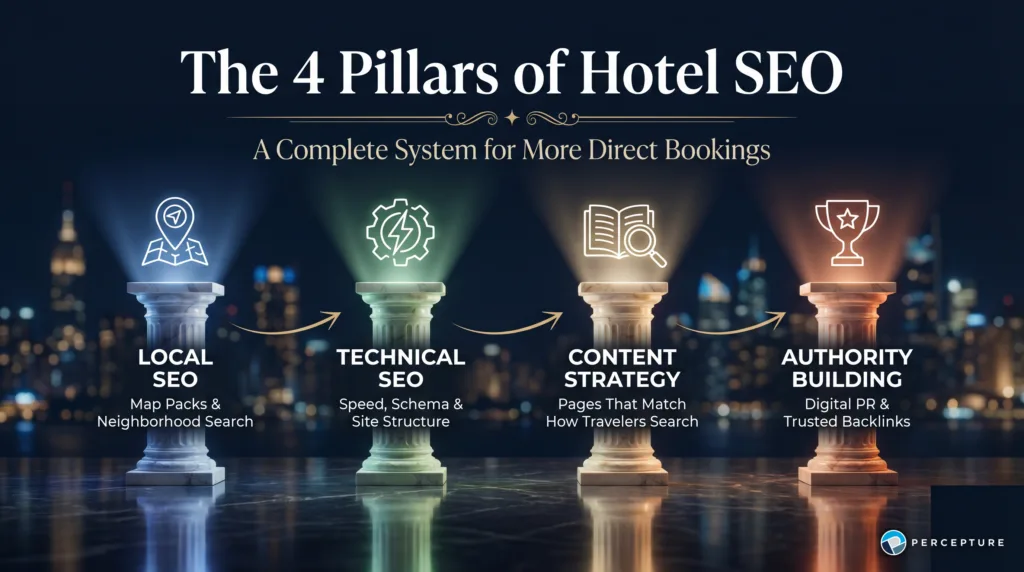
Google’s own guidance on hotel structured data makes this plain — the crawler expects specific, machine-readable facts about rooms, rates, and amenities.
On top of the hotel SEO, you are competing against aggregators with enormous domain authority. Booking engines own the SERP for most destination keywords. Your job is not to out-authority them head-on. It is to win the long tail, the branded search, and the intent-rich queries where a direct answer beats a comparison widget.

The Core Hotel SEO Checklist Before You Touch a Single Tactic
Before we get into the eleven moves, run a quick hotel SEO checklist against your site. Skip this and half the tactics below will land on a broken foundation.
Verify that your property pages are indexable, that your Google Business Profile is claimed and accurate, that your booking flow works on a phone, and that your page speed is not a disaster. I have watched properties pour effort into content while their mobile booking page took eleven seconds to load. Guess how that ended.
- Indexation: Confirm property and room pages appear in Search Console’s indexed report. Filter out soft 404s and duplicate location pages.
- Google Business Profile: Categories, amenities, photos, and hours complete. This drives far more direct bookings than most owners realize.
- Mobile booking flow: Test the full reservation path on a real phone, not a desktop emulator. Tap targets, forms, payment.
- Technical hygiene: Canonicals set on near-duplicate room pages, sitemap submitted, HTTPS clean.
- Analytics: Conversion tracking on completed bookings, not just page views. Otherwise you are optimizing blind.
That checklist takes an afternoon. Effective execution in your hotel SEO makes a tangible difference. Do it first. Then the eleven tactics below will compound instead of leaking.
Tactic 1: Own the Destination Keyword With a Dedicated Location Page
Almost every hotel tries to rank for its city by stuffing the name into the homepage title. That rarely works, because the homepage is a generalist page competing against specialist content. The better play is a dedicated location page built around one destination intent.

Think of the hotel SEO as a page titled around the district or landmark, not the hotel name. “Hotels near the riverfront promenade in Savannah” style intent, answered with your property as the natural option.
The page should cover what a visitor wants to know: distance to the landmark, transit options, walkability, and the neighborhoods around you.
A boutique property I reviewed recently had three room pages, an events page, and a homepage. Focusing on hotel seo provides clear direction here. No location page at all. They built one targeting the harbor district, added a walking map, and within a quarter it became their second-highest booking source. Nothing fancy. Just a page that answered a question the homepage never addressed.
How to Structure the Location Page for Maximum Relevance
Open with a short paragraph naming the destination and your proximity to the hotel SEO. Then break the page into sections: local attractions, transport, dining nearby, and parking. Add a formatted table of distances and travel times.
Keep the tone editorial rather than salesy. Travelers researching an area are in a comparison mindset. The property that gives them the most useful context usually wins the click, even if it is not the cheapest option on the page.
One more thing: link to this page from your homepage and from relevant blog posts. Internal links remain one of the most underrated hotel SEO levers, and most properties treat them as an afterthought.
Tactic 2: Build Room-Level Pages Around Specific Booking Intent
A single “Rooms” page listing rates is a missed opportunity. Structuring your hotel SEO around proven patterns ensures impact. Each room type carries its own search demand — suites with kitchenettes, rooms with balconies, accessible rooms, family layouts. Each deserves a page with real content.
The traveler searching for a “suite with a full kitchen” is late in the funnel. They know what they want. If your page answers that query with photos, square footage, appliance specs, and a clear booking button, you have removed their last objection.

Structure each room page with the following in mind:
- Headline matching the room intent: not “Deluxe Room” alone, but a heading that includes the distinguishing feature.
- Specifications table: size, bed configuration, view, bathroom, occupancy, amenities.
- Photo set: at least five images, properly compressed, with descriptive alt text.
- Social proof: a handful of reviews from guests who booked that specific room type.
- Booking CTA: visible above and below the fold, with live availability.
This is where the hotel SEO best practices around structured data pay off. Mark up each room with schema so search engines can read your rate ranges and amenities directly. Rich results for hotel listings depend on this kind of markup, and the visibility difference in the SERP is substantial.
Tactic 3: Optimize the Google Business Profile Like It Pays the Bills
For local-intent searches, the map pack often outranks the organic results. Applying these principles to your hotel SEO yields measurable results. A complete, active Google Business Profile frequently delivers more direct bookings than the website itself. Treating it as a spec sheet you filled out once and forgot is a serious mistake.
Photos matter more than owners expect. Fresh, high-quality images of the lobby, rooms, and exterior correlate with higher engagement. Post regularly, even if it is just a seasonal note or a new menu at the bar.
Answer the questions section with genuinely useful responses. Proper attention to your hotel SEO sets a strong baseline. Respond to reviews, both glowing and critical, in a human voice. The review response is public content, and it signals to both travelers and search engines that the property is actively managed.

Set the primary category accurately and test secondary categories. Refining each detail of your hotel seo strengthens this section. A property I consulted for was categorized as a generic hotel when it was genuinely a bed-and-breakfast experience. Correcting that single field shifted their map-pack visibility for a meaningful set of queries.
Tactic 4: Engineer Your Image SEO for Visual Search
Travelers want to see the property before they read a word. That makes image optimization one of the highest-leverage hotel SEO tips available, and it is routinely botched.
Filename first. Developing your hotel SEO with precision highlights key strengths. A photo called IMG_4421.jpg tells search engines nothing. Rename it descriptively, in lowercase with hyphens. Then write alt text that describes the actual scene and the room or area it depicts.
Compress aggressively. WebP or AVIF format, sized appropriately for the placement. Large uncompressed images are the single most common cause of slow hotel sites, and speed is both a ranking and a conversion factor.
Add a descriptive caption beneath key photos where it fits the layout. This is supplementary text that search engines index and that helps travelers who scan images before reading prose. The whole image discipline here doubles as a hotel SEO speed play, which is why it earns a place this early in the list.
Tactic 5: Publish Destination Content That Ranks for Research Queries
Travelers research before they book. Clear alignment with your hotel SEO builds confidence from the start. They search for “best time to visit,” “restaurants near the convention center,” “weekend itinerary for coastal towns.” Each of these is a content opportunity that sits upstream of the booking decision.

A well-run property blog becomes a traffic engine for these queries. The trick is restraint: write about your destination with genuine local knowledge, not generic filler. If you cannot add a perspective a visitor could not get elsewhere, skip the post.
A strong destination post might cover a two-day neighborhood itinerary, a seasonal events calendar, or local transport guidance. Integrating hotel SEO into your workflow produces consistent quality. Each one is a natural place to place an internal link back to the property page, and each builds the topical authority that supports future ranking wins.

This is where the hotel SEO guide logic really clicks: search engines reward properties that can prove they know their territory, not just their room types. Ten excellent destination posts outweigh fifty thin ones.
How Often Should You Publish Destination Content?
Frequency matters less than consistency and depth. One substantive post every six to eight weeks sustains momentum better than a burst of five in a month followed by silence. Update old posts when the information shifts — a venue closes, a route changes, a season’s schedule updates.
Refresh passes are quietly powerful. Targeted refinements to your hotel SEO streamline the entire review. Restoring accurate, current information to an existing page often outperforms writing something new from scratch.
Tactic 6: Win Review Signals on Third-Party Platforms
Reviews are content the hotel seo do not fully control, but you can influence them. The platforms that matter are the ones that appear in search results for your property name: Google, TripAdvisor, and the major OTA review sections.
The pattern the hotel SEO works is simple and unglamorous. Ask every satisfied guest, at the right moment, with a direct link. Remove friction. Make the request feel like a favor, not a survey.
Respond to critical reviews with composure and specifics. Never argue. A well-handled negative review is often more persuasive than five positive ones, because it shows future guests how the property behaves when something goes wrong.

Volume matters, but recency matters too. Refining each detail of your hotel SEO strengthens this section. A steady trickle of recent reviews signals an actively managed property to both travelers and search engines. Stale review profiles lose their pull over time.
Tactic 7: Keep Page Speed in the Green Across the Booking Flow
Speed is one of the few hotel SEO best practices you can measure and improve with certainty. It affects crawl efficiency, rankings, and, more directly, conversion rate. A traveler on hotel Wi-Fi halfway across the world is not going to wait around.
Start with the booking flow, not the homepage. A home page that loads in one second is useless if the reservation form takes eight. Audit the full path from landing page to confirmation screen.

| Performance Area | Target | Common Fix |
|---|---|---|
| Largest Contentful Paint | Under 2.5s | Compress hero images, lazy-load below fold |
| Interaction to Next Paint | Under 200ms | Reduce main-thread JavaScript |
| Booking form load | Under 2s | Defer third-party widget scripts |
| Mobile usability | Pass Core Web Vitals | Fix tap targets and viewport scaling |
Third-party booking engines are frequent culprits. Many inject heavy scripts on page load. Defer them, load them on interaction, or at least move them lower in the critical path.
Measure with real-user data, not just lab tests. Maintaining clarity across your hotel seo remains essential. Field data reflects what your actual guests experience on their devices and connections, which is what counts.

Tactic 8: Structure Every Page With Clear Schema and Internal Linking
Search engines read structure faster than prose. Adding the right schema markup tells them exactly what each page represents. The basics cover your organization, your hotel entity, each room type, and your FAQ content.
Internal linking is the connective tissue. Every room page should link back to the property page and to nearby location content. Blog posts should link to relevant room types. This spreads crawl equity and helps both travelers and search engines discover the full site.
Keep anchor text descriptive. “Book the harbor-view suite” is more useful than “click here” for both the ranking algorithm and the human deciding where to go next. Descriptive anchors signal the target page’s topic clearly.
The hotel SEO checklist here is straightforward: schema present on all key page types, anchors descriptive, no orphan pages, and no dead ends that strand a visitor deep in the site with no path to booking.
Tactic 9: Target Long-Tail Queries Your OTA Rivals Ignore
Aggregators win the broad queries. A thoughtful approach to hotel seo reinforces your qualifications. That is fine, because the long tail is a goldmine they cannot be bothered with. Specific, intent-rich queries carry less volume but dramatically higher conversion rates.
Think like a traveler with a very particular need. “Pet-friendly boutique hotel near the train station.” “Hotel with EV charging in the downtown historic district.” “Quiet hotel near the university for graduation weekend.” These queries are specific, and the traveler behind them is often ready to book.
Build content and page structure around these needs. Add amenity-specific sections, dedicated landing pages for pet-friendly and accessible offerings, and FAQ content that answers the exact question. A focused page beats a general one every time when the intent is precise.
Search Console is your best research tool here. Filter queries by position, find the ones hovering just off the front page, and ask what would push them over the line. Usually the answer is a more specific page, not more keywords on an existing one.
Tactic 10: Fix Duplicate Content Across Room and Location Pages
Hotels breed duplicate content. Structuring your hotel seo around proven patterns ensures impact. Every room page describes “a comfortable space with a plush bed and city views,” and suddenly you have eight near-identical pages competing against themselves.
Resolve the hotel SEO with genuinely differentiated content. Each room page should describe what makes that specific room unique: the corner unit with the extra window, the ground-floor room with the patio, the suite with the kitchenette and the workspace.
Where differentiation is genuinely impossible, consolidate. One strong page usually beats three thin ones. Set canonical tags where duplication is unavoidable, and remove or redirect pages that serve no unique purpose.
The hotel SEO angle is about clarity. When every page has a distinct job and a distinct description, the search engine understands your site structure and rewards it appropriately. When pages blur together, the algorithm picks one and ignores the rest.
Tactic 11: Track Booking-Assist Metrics, Not Just Rankings
A ranking report the hotel SEO shows position three for a keyword nobody books from is a vanity trophy. The final tactic, and the one that ties the whole list together, is measuring what actually drives revenue.
Set up conversion tracking on completed reservations and on high-intent actions like availability checks and booking-form starts. Then map those conversions back to the pages and queries that produced them.
Attribution is imperfect, and the hotel SEO is acceptable. A traveler who researches on a phone and books on a laptop creates a messy trail. Use analytics with a long attribution window and interpret the patterns rather than chasing perfect accuracy.
Rankings remain a diagnostic, not the goal. The goal is a fuller booking calendar. When you evaluate hotel SEO tips against that standard, you stop chasing traffic and start chasing the right travelers.
Bringing the 11 Tactics Together Into a Repeatable System
These eleven moves are meant to work as a single system rather than a collection of tricks. The location page feeds the destination content. The room pages feed the booking flow. Schema, speed, and internal links keep the whole thing crawlable and readable.
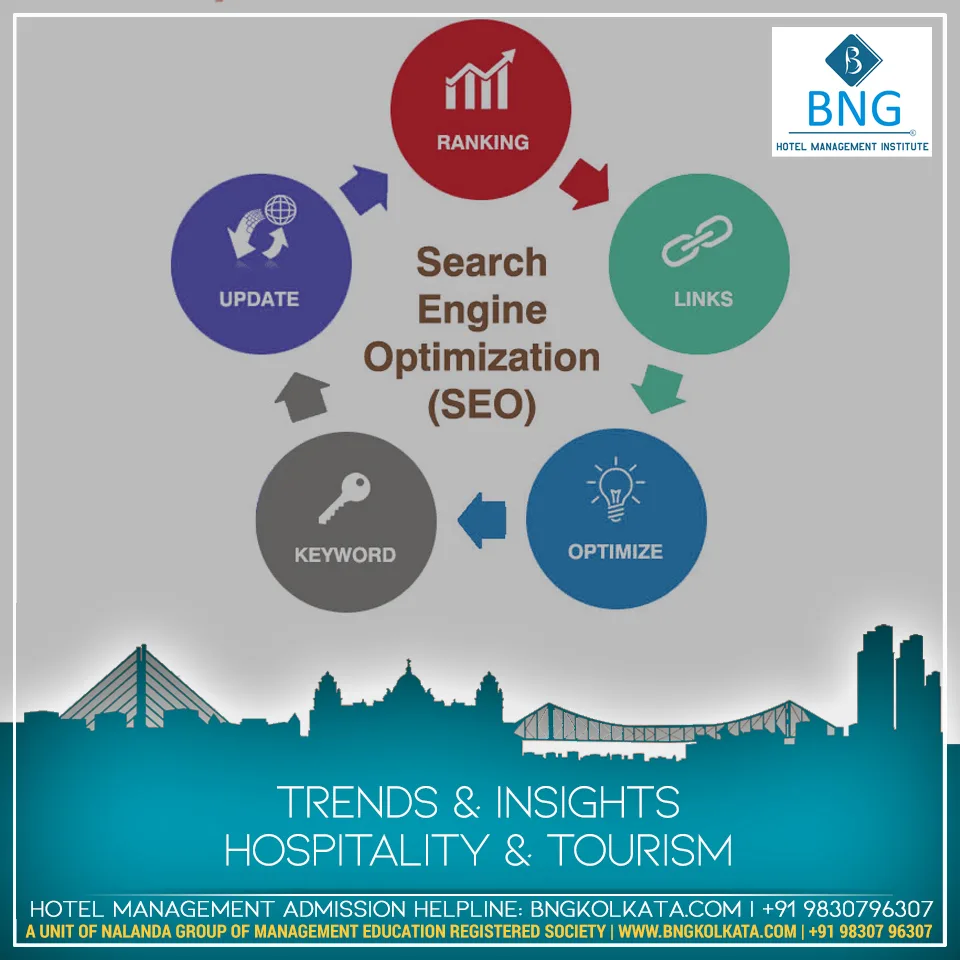
If the hotel seo are starting from zero, sequence matters. Do the checklist, then the technical fundamentals, then content depth, then review signals. Trying all eleven at once usually means none of them get done well.
If you are already ranking, revisit the weakest link. Often the bottleneck is not content volume but room-page clarity or booking-flow speed. The properties that win tend to be the ones that iterate ruthlessly rather than adding more pages endlessly.
Frequently Asked Questions About Hotel SEO
Here is an in-depth breakdown of key considerations regarding this section:
How Long Does It Take to See Results from Hotel SEO?
Technical fixes can shift visibility within weeks. Content and authority gains typically take several months to compound. A realistic expectation for meaningful booking impact is somewhere between three and six months of consistent work, sometimes longer in highly competitive destination markets.
Should a Hotel Try to Outrank Booking Sites in Search?
Generally not head-on for broad destination keywords. Focus on branded search, long-tail intent, and specific offerings where your supply is unmatched. The goal is qualified traffic, not parity with the aggregators on every query.
What Content Should the Location Page Actually Include?
Proximity to key landmarks, transport options, neighborhood detail, parking and access notes, and a clear path to booking. Keep it useful to a traveler doing research rather than turning it into a sales brochure.
Is the Blog Necessary for a Hotel Website?
Not strictly, but destination content builds topical authority and captures research-stage traffic that a rates page never would. A modest, well-researched set of posts outperforms a large volume of thin ones.
How Many Reviews Do You Need to Compete?
There is no magic number. Recency and consistency matter as much as total count. A profile with steady recent feedback signals an active property, which is often more persuasive than a large but aging archive.
Does Paid Search Make Organic Efforts Pointless?
They serve different phases. Paid captures immediate demand; organic builds durable visibility over time. A healthy property uses both, with organic reducing long-term acquisition costs.
What is the Quickest Win on This List?
Fix your Google Business Profile and your mobile booking flow. Both take hours rather than months and typically deliver measurable booking gains sooner than any content initiative.