eBay SEO: 11 Powerful Tactics to Boost Traffic Fast
EBay SEO is the craft of making your listings surface when shoppers type exactly what they want to buy. It rewards sellers who treat search results as a storefront window rather than a dumping ground for keywords. This eBay SEO guide walks through eleven tactics that move the needle on impressions, clicks, and completed sales.
I have spent years watching listings climb and collapse inside the same category, and the pattern is rarely luck. The sellers who win understand that eBay’s search engine reads titles, item specifics, and buyer behavior in tandem. Miss one layer and the whole stack weakens.
What follows is a working eBay SEO checklist you can apply to a live listing today. No fluff, no theory that collapses under real competition. Just the moves that consistently push products into visibility.
Why eBay SEO Matters More Than Ever
EBay’s internal search engine behaves like a matching machine. Focusing on ebay SEO provides clear direction here. It compares what a buyer types against the structured data you provide, then ranks the closest fits by relevance and selling history. That is the entire game in one sentence. Everything else is execution.

Unlike Google, you are not competing with the open web. You are competing inside a closed marketplace where every rival listing is measured by the same yardstick. That makes eBay SEO unusually fair. A small seller with sharp data can outrank a high-volume competitor that got lazy with item specifics.
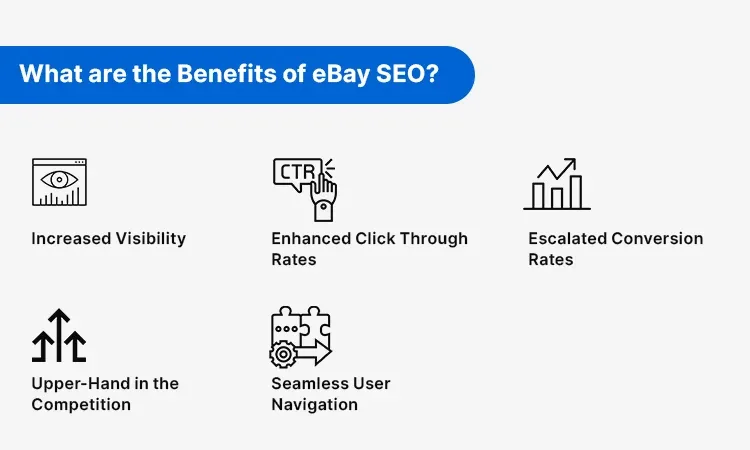
The traffic payoff compounds. Focusing on ebay seo provides clear direction here. Better rankings feed more impressions, impressions generate clicks, clicks produce sales, and sales history feeds back into ranking. It is a flywheel, and your job is to give it the first hard push.
How eBay’s Algorithm Reads Your Listing
Relevance sits at the top of the hierarchy. EBay weighs the match between a search query and your title, then checks whether your item specifics confirm that match. A title promising “wireless earbuds” paired with empty specifics for connectivity type looks suspicious to the algorithm.
Performance signals come next. Refining each detail of your ebay SEO strengthens this section. Click-through rate, sell-through rate, and conversion rate all tell eBay whether shoppers trust your listing. A listing that gets impressions but no clicks quietly loses ground to a competitor that converts.

Then there is seller standing. Feedback score, return rate, handling time, and shipping speed all nudge placement. A perfect title cannot rescue a seller who ships late and racks up defects. These eBay SEO best practices only work when the fundamentals behind them are honest.
The eBay SEO Checklist Before You Touch a Listing
Before rewriting a single word, run through this eBay SEO checklist. It prevents the most common failure: optimizing keywords while ignoring the structure that carries them. Think of it as a pre-flight inspection.

- Confirm your category. The wrong category caps your reach no matter how good the title is.
- Audit item specifics. Fill every field eBay offers, especially the ones buyers filter by.
- Check your title length. Use all 80 characters, but never pad with filler words.
- Review your images. Clean, well-lit photos lift click-through rate directly.
- Verify shipping and returns. Free or fast shipping influences both ranking and conversion.
- Scan competitor titles. Note which phrases dominate the top results for your keyword.
Run this audit every time you list. It takes minutes and saves weeks of guessing why a product never moves. Sellers who skip it tend to blame the algorithm for problems they created themselves.
Tactic 1: Build a Title That Matches Buyer Language
Your title is the single highest-leverage field on the entire listing. It carries the most weight in relevance scoring and it is the text shoppers actually read in search results. Treat every character as expensive real estate.

Start with the exact phrase a buyer would type. Effective execution in your ebay SEO makes a tangible difference. If people search “vintage Levi’s 501 jeans size 32,” lead with that structure rather than “Awesome Retro Denim Pants.” The algorithm matches strings, and buyers match their own mental language. Both point the same direction.
Then layer in the qualifiers that narrow the match: brand, model, size, color, condition, and a defining feature. Skip subjective adjectives like “amazing” or “must-have.” They consume characters and match nothing. This is one of the simplest eBay SEO tips and also one of the most ignored.

Title Formulas That Consistently Rank
A reliable pattern looks like this: Brand + Model + Key Feature + Size or Quantity + Condition. For example, “Patagonia Nano Puff Jacket Men’s Medium Black Excellent Condition” tells the algorithm and the shopper everything at a glance.
For multi-variation listings, front-load the element buyers filter on most. Clothing sellers should push size and fit forward. Electronics sellers should lead with model number. The formula flexes, but the principle holds: put the decision-making detail early.

Test titles like the ebay SEO would test ad copy. Swap a phrase, watch impressions for two weeks, and keep whatever wins. EBay’s search results page is your laboratory, and every listing is an experiment.
Tactic 2: Exploit Item Specifics to the Last Field
Item specifics are the structured backbone of eBay SEO. They feed the filters buyers use to narrow millions of results into a shortlist. A listing missing key specifics simply does not appear when someone filters.

Fill every field eBay provides, even optional ones. Refining each detail of your ebay seo strengthens this section. Type, brand, model, MPN, color, material, features, compatibility—each one is another doorway into your listing. Empty fields are closed doors, and shoppers rarely knock twice.
Match your specifics to the words in your title. If the title says “cotton,” the material field should say “cotton.” Consistency signals relevance to the algorithm and confidence to the buyer. Contradictions do the opposite.

Specifics That Drive Filter Traffic
Some fields carry outsized weight because buyers filter on them constantly. A thoughtful approach to ebay SEO reinforces your qualifications. In electronics, that means model number and compatibility. In fashion, it is size, color, and style. In auto parts, it is year, make, and model fitment.
Research which filters appear at the top of your category’s search page. Those are the fields eBay knows buyers care about, and they deserve your most careful attention. Populate them first, then work down the list.

A jacket listed with every fabric, fit, and style field completed will surface in far more filtered searches than an identical jacket with three fields blank. Same product, wildly different visibility. That gap is pure eBay SEO.
Tactic 3: Write Descriptions for Conversion, Not Keyword Stuffing
Descriptions carry less ranking weight than titles or specifics, but they carry enormous conversion weight. A shopper who clicks through is already interested. Your description either closes the sale or sends them back to search results.

Lead with the benefit and the condition. Structuring your ebay SEO around proven patterns ensures impact. Then answer the questions a buyer would ask: dimensions, compatibility, what’s included, any flaws. Transparency reduces returns, and low return rates quietly boost your seller standing.
Weave in secondary keywords naturally rather than stacking them. A sentence like “fits most standard 15-inch laptops” reads cleanly and still captures a long-tail phrase. Stuffed keyword blocks look spammy and convert poorly.

Description Structure That Works
Open with a two-sentence summary of what the item is and why it matters. Follow with a bulleted feature list. Close with shipping, returns, and a clear call to action.
Use the mobile preview to check formatting. Applying these principles to your ebay SEO yields measurable results. Most eBay shoppers browse on phones, and a wall of unbroken text kills engagement fast. Short paragraphs and scannable bullets win.

Add relevant details that build trust: measurements taken by hand, model compatibility confirmed, or the reason you are selling. Human context converts better than robotic spec dumps. This is where eBay SEO tips meet old-fashioned salesmanship.
Tactic 4: Optimize Images for Clicks and Search
Images do not carry keyword weight the way titles do, but the ebay seo drive click-through rate, which the algorithm absolutely measures. A listing with weak photos ranks lower over time because shoppers scroll past it.

Use a clean, well-lit main image on a white background. Fill the frame with the product, not the packaging. Buyers scanning a grid of thumbnails decide in a fraction of a second, and clarity wins that instant.
Add multiple angles, close-ups of details, and a shot showing scale. Include any flaws honestly. Listings that hide damage generate returns, and returns erode the seller metrics that support your eBay SEO.

Alt Text and Image Naming
EBay does not use image file names for ranking, but the ebay SEO does use alt text on some surfaces. Write descriptive alt text that names the product and its key attribute. It helps accessibility and adds a small relevance signal.
Keep image quality high without bloating file size. Fast-loading listings feel professional and reduce bounce. A shopper who waits for images to load is a shopper drifting toward a competitor.

Consider a short video for higher-value items. Video demonstrations lift conversion on electronics and collectibles where condition and function matter. The algorithm rewards the resulting sell-through rate.
Tactic 5: Price and Shipping as Ranking Levers
Price affects ranking indirectly through conversion. Developing your ebay SEO with precision highlights key strengths. A competitively priced item sells faster, and fast sales signal relevance to eBay. Overpricing stalls a listing and drags its placement down over time.

Shipping cost and speed matter just as much. Free shipping and short handling times consistently outperform paid, slow options in both conversion and ranking. Buyers filter for these, and the algorithm notices.
Study sold listings, not active ones, to find the real market price. Active listings show what sellers hope to get. Sold listings show what buyers actually paid. That distinction reshapes your entire pricing strategy.

Handling Time and the Fast-Ship Advantage
Set handling time to match reality, then beat the ebay SEO. A seller promising two-day handling and shipping in one day builds a reputation that lifts every future listing. Consistent speed compounds into ranking strength.
Offer a returns policy. Maintaining clarity across your ebay seo remains essential. Listings with clear returns convert better because buyers feel protected. The return rate stays low when your description is honest, so the policy costs little and gains a lot.

Bundle shipping discounts for multi-item orders. It raises average order value and improves the buyer experience, which feeds the same performance signals that support your eBay SEO efforts.
Tactic 6: Use Promoted Listings With Discipline
Promoted Listings let you pay for visibility on top of organic ranking. Used well, they accelerate sales history that later improves organic placement. Used badly, they burn budget on listings that were never going to convert.

Start with your best-converting products. Integrating ebay SEO into your workflow produces consistent quality. A listing with strong photos, sharp specifics, and competitive pricing will convert promoted traffic efficiently. Pushing a weak listing just buys expensive clicks.
Set a modest ad rate and watch the data. If a listing converts well at a low rate, raise it gradually. If it stalls, fix the listing before spending more. Promotion amplifies a good listing; it cannot rescue a bad one.
When Promoted Listings Pay Off
They shine in crowded categories where organic visibility is hard to earn. A new seller in a saturated niche can use promotion to generate the first wave of sales and reviews that unlock organic growth.
The ebay SEO also help seasonal products hit peak demand windows. When buyer intent spikes, extra visibility captures sales that organic ranking alone might miss. Time the spend to the demand curve.
Track cost per sale, not just impressions. A promoted listing that generates clicks but no orders is a leak. Cut it, fix the listing, and redeploy the budget where it earns its keep.
Tactic 7: Build Seller Feedback and Trust Signals
Feedback score and seller standing influence ranking directly. EBay wants to surface sellers buyers trust, because trusted sellers produce fewer disputes and happier shoppers. Every positive review is a small vote for your placement.

Ask for feedback politely after delivery. A thoughtful approach to ebay seo reinforces your qualifications. A short message thanking the buyer and inviting a review lifts response rates without feeling pushy. Small gestures compound across hundreds of transactions.
Resolve problems fast and generously. A buyer who receives a quick refund or replacement often leaves positive feedback despite the hiccup. Speed of resolution matters more than the mistake itself.

Metrics That Quietly Shape Your Ranking
Track your defect rate, late shipment rate, and cases closed without seller resolution. These three numbers form the backbone of seller standing. Keep them near zero and your listings enjoy a ranking tailwind.
Respond to messages within a day. Response time feeds into buyer confidence and can influence visibility. A seller who answers questions promptly converts more browsers into buyers.

Keep your inventory accurate. Cancellations from overselling damage your metrics and frustrate buyers. Reliable stock signals reliability, and reliability is a ranking asset in its own right.
Tactic 8: Refresh and Relist With Purpose
Stale listings lose momentum. When an item sits unsold for months, its conversion rate drops and the algorithm deprioritizes it. Refreshing keeps a listing in front of fresh eyes without losing its history.
Use the relist and revise tools strategically. Structuring your ebay seo around proven patterns ensures impact. Updating photos, tightening the title, or adjusting price can revive a listing that stalled. Sometimes a small change is all a product needs to find its buyer.
End and relist listings that have gone completely cold, but only after diagnosing why. If the price is wrong or the photos are weak, relisting repeats the same mistake. Fix the cause first.
Seasonal Refresh Timing
Align refreshes with demand cycles. Winter coats listed in early autumn catch buyers before the rush. Holiday gifts refreshed in late fall capture peak intent. Timing a refresh to demand is free eBay SEO.
Watch your category’s search trends to spot rising demand. When interest climbs, a fresh listing with updated keywords rides the wave. When it falls, retire the listing and redirect effort.
Keep a simple log of what the ebay SEO changed and when. Over time, patterns emerge about which tweaks move sales. That log becomes your personal playbook for reviving dead inventory.
Tactic 9: Mine eBay’s Search Data for Keyword Gold
EBay’s own search bar is a free keyword research tool. Type a partial phrase and watch the autocomplete suggestions. Those suggestions reflect real buyer queries, ranked by popularity. They are free, current, and precise.
Cross-check suggestions against sold listings. A phrase that appears in autocomplete and in high-selling listings is a proven winner. One that appears only in autocomplete but never in sales may be a dead end.
Study the “similar items” and “completed listings” sections for phrasing patterns. Top sellers in your category have already done the testing. Learn from their titles and adapt the language to your product.
Building a Keyword Bank
Collect promising phrases in a spreadsheet as the ebay seo research. Note the search volume signal, the category, and whether sold listings confirm demand. Over time, you build a keyword bank you can draw from for every new listing.

Group phrases by intent. Some capture broad browsing, others capture precise buying intent. Use broad phrases in titles for reach and precise phrases in descriptions and specifics for conversion.
Refresh the bank quarterly. Buyer language shifts, and last season’s winning phrase may fade. Staying current keeps your listings aligned with how shoppers actually search. This is the research backbone of any solid eBay SEO guide.
Tactic 10: Structure Multi-Quantity and Variation Listings
Variation listings let the ebay SEO offer multiple sizes, colors, or models under one listing. Done right, they concentrate sales history and reviews into a single powerful page. Done wrong, they confuse buyers and dilute relevance.
Group variations that share a core product and buyer intent. A shirt in five colors belongs together. A shirt and a pair of shoes do not. Mixing unrelated items splits your keyword relevance and hurts ranking.
Make sure each variation carries complete specifics. If a buyer filters for “blue, large,” the blue large variation must surface. Incomplete variation data hides options and loses sales.
Managing Variation Listings Over Time
Keep stock levels accurate across every variation. Overselling one variant cancels orders and damages metrics. Sync your inventory so the listing reflects reality at all times.
Rotate the primary image to showcase the best-selling variation. The main image drives click-through rate, and leading with a proven winner lifts the whole listing’s performance.
Monitor per-variation sales to spot dead options. Proper attention to your ebay seo sets a strong baseline. Retire slow movers and add new ones based on demand. A well-managed variation listing stays relevant and keeps feeding the ranking flywheel.
Tactic 11: Track Results and Iterate Like a Scientist
SEO on eBay is not a one-time setup. It is a loop of measurement and adjustment. Track impressions, click-through rate, and conversion rate for each listing, then change one variable at a time.
Use eBay’s Seller Hub analytics to see which listings get views but no sales. High views with low sales points to a conversion problem: price, photos, or description. Low views with decent sales points to a visibility problem: keywords or specifics.
Diagnose before you act. Changing everything at once hides what actually worked. A controlled experiment, one variable at a time, tells you exactly which lever moves the needle.
Metrics That Matter Most
Impressions tell the ebay SEO how often your listing appears. Click-through rate tells you how compelling it looks in search. Conversion rate tells you how well the listing closes. Each one points to a different fix.
| Metric | What It Reveals | Typical Fix |
|---|---|---|
| Impressions | Visibility in search results | Improve title keywords and item specifics |
| Click-Through Rate | Appeal of the search result | Better main image and sharper title |
| Conversion Rate | Persuasiveness of the listing | Stronger description, pricing, and photos |
| Sell-Through Rate | Overall listing health | Competitive pricing and demand timing |
| Return Rate | Accuracy of the listing | Honest descriptions and clear specifics |
Review this table monthly for your top listings. Patterns jump out fast when the numbers sit side by side. A listing with strong impressions but weak clicks needs a photo fix, not a keyword rewrite.
Iterate in small steps and log every change. Over a few months, you build a clear picture of what works in your category. That picture is worth more than any generic eBay SEO tips you will read online.
Common eBay SEO Mistakes That Kill Traffic
Some mistakes show up again and again, and each one silently caps a listing’s reach. Knowing them saves you months of frustration. Here are the ones I see most often in live listings.
- Keyword stuffing in titles. Repeated words look spammy and match nothing extra.
- Empty item specifics. Missing fields hide your listing from filtered searches.
- Wrong category. A misplaced item competes where it does not belong.
- Weak main image. Poor photos crush click-through rate.
- Ignoring sold listings. Pricing against active listings misreads the market.
- Slow handling time. Late shipping drags down seller standing.
- Set-and-forget listings. Stale listings quietly lose ranking over time.
Each of the ebay SEO has a straightforward fix. The hard part is discipline: applying the fix consistently across every listing, not just the ones that happen to be struggling. Consistency is what separates top sellers from the rest.
Audit your catalog against the ebay seo list once a quarter. It catches drift before it becomes a serious traffic problem. Small corrections early prevent large losses later.
Frequently Asked Questions About eBay SEO
Here is an in-depth breakdown of key considerations regarding Frequently Asked Questions About eBay SEO:
How Long Does It Take to See Results from eBay SEO?
Most sellers notice movement within two to four weeks of a well-executed change. Ranking shifts as impressions, clicks, and sales accumulate. Listings in competitive categories may take longer to climb.
The key is patience paired with measurement. Watch the trend, not a single day’s numbers. Small, consistent gains compound into meaningful visibility over a few months.
Does eBay Use Keywords in the Description for Ranking?
Descriptions carry far less ranking weight than titles and item specifics. Their real job is conversion, not ranking. A clear, honest description closes sales, and sales performance feeds back into ranking.
Write descriptions for humans first. Natural keyword use in a description supports relevance without hurting readability. Stuffed blocks of keywords do neither job well.
What is the Most Important eBay SEO Factor?
Relevance between the search query and your listing data tops the list. That means a title and item specifics that precisely match buyer language. Everything else builds on that foundation.
Performance signals come second. A relevant listing that also converts earns stronger placement over time. Relevance gets you seen; conversion keeps you seen.
Can I Rank Without Promoted Listings?
Yes, and many sellers do. Strong titles, complete specifics, honest descriptions, and solid seller metrics can earn excellent organic placement. Promotion is an accelerator, not a requirement.
Use promotion strategically in crowded categories or during demand spikes. For most listings, sharp organic optimization does the heavy lifting. Spend on promotion where it multiplies an already-strong listing.
How Often Should I Update My Listings?
Refresh listings that stall or underperform, and revisit your top sellers quarterly. There is no fixed schedule that fits every product. Let the data tell you when a refresh is due.
Update immediately when something changes: price, condition, or stock. Accurate listings protect your metrics and your reputation. Stale data misleads buyers and costs sales.
Do Reviews and Feedback Really Affect Ranking?
The ebay SEO do, through seller standing and trust signals. Positive feedback and low defect rates support stronger placement. A trusted seller’s listings enjoy a quiet ranking advantage.
Ask for feedback politely and resolve issues fast. Small gestures build the reputation that lifts every listing you publish. Trust is one of the most durable eBay SEO assets you can build.
What Should I Do First if My Listings Get No Views?
Start with the title and item specifics. Low views almost always point to a relevance problem. Check whether your title matches buyer language and whether every specific field is filled.
Then verify the category. A misplaced listing competes where it cannot win. Once relevance and category are correct, move on to pricing and photos to lift conversion.
Putting the eBay SEO Playbook to Work
The eleven tactics here form a complete system, and each one strengthens the others. A sharp title feeds relevance, complete specifics open filters, honest descriptions convert, and strong metrics lift ranking. Skip one and the chain weakens.
Start with the checklist before touching a live listing. Then work through the tactics in order, measuring as you go. The sellers who treat eBay SEO as an ongoing discipline consistently outperform those who apply it once and walk away.
Your next step is simple: pick one listing, run the audit, and make a single change. Watch the data for two weeks. Then repeat. That habit, more than any single trick, is what turns a quiet listing into steady traffic and reliable sales.
For verified reference and background research, consult the authoritative informational resource on this topic.